KnownSec Leak: Mapping India’s Digital Exposure
Executive Summary
This report focuses exclusively on findings related to the Republic of India, derived from the leaked KnownSec document and associated sources. The document contains internal files and statistical tables from the KnownSec data leak incident.
The document references India in two distinct contexts:
- As part of a data leak listing labeled “_data_india, shoppingmessage,” and
- Within the Critical Infrastructure Target Database statistical summaries that enumerate Indian organizations, IP addresses, and domains across key sectors.
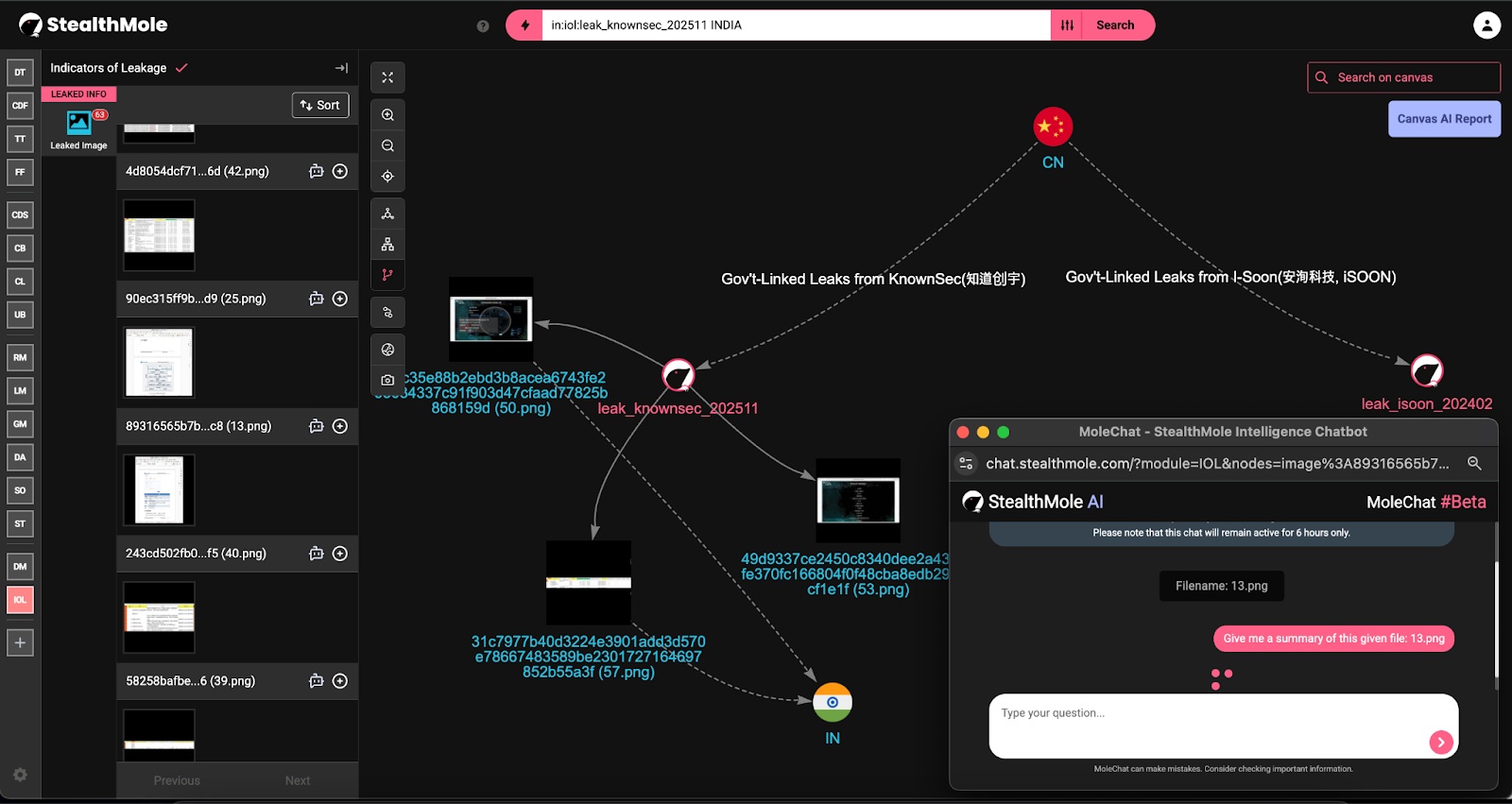
India is explicitly identified as one of the 26 covered regions in KnownSec’s internal “Critical Infrastructure Target Database Description Document.”
As of September 12, 2023, the dataset lists 55 organizations, 62,723 IP addresses, and 24,703 domains attributed to India. Sectoral breakdowns indicate coverage across government, finance, energy, telecommunications, military, education, and healthcare networks.
The presence of dataset identifiers such as “_data_india” underscores that India was a monitored focus within KnownSec’s cyber intelligence scope.
Methodology
The analysis was conducted via manual review of the leaked data, which contains text-based statistical tables and data inventory lists extracted from KnownSec’s internal databases.
The following sources within the file were examined:
- Data Leak Listing Table (showing _data_india reference)
- Critical Infrastructure Target Database Statistics
- User Industry Breakdown for India
- Associated dataset listings
All content referencing India, whether textual, numerical, or metadata, was compiled and cross-tabulated for this report.
No extrapolation beyond the provided document was made.
Domain indicators (.in, .gov.in, .nic.in, .ac.in) are referenced where applicable for IOC enrichment.
Detailed Findings: Republic of India
1) Presence in the Data Leak Listing
The Data Leak Listing section of the leaked file contains one explicit entry for India:
| Name | Record Count | Area | Fields |
| _data_india, shoppingmessage | 5,649 | 印度 (India) | IN (incomplete / unspecified fields) |
This entry confirms that KnownSec maintained a data object explicitly named _data_india, associated with India and containing 5,649 records.
Although the field definitions are incomplete, this suggests that the dataset was intended for structured ingestion or enrichment with Indian network or transactional data.
2) Critical Infrastructure Target Database: Overall Statistics for India
The document “Critical Infrastructure Target Database Description Document” identifies India (印度) among 26 tracked regions.
Overall Statistics for India (as of 2023.09.12)
| Area | Organizations | IP Addresses | Domains |
| India | 55 | 62,723 | 24,703 |
These values represent aggregated reconnaissance mapping over Indian infrastructure, including both public and private-sector entities. Such enumeration would provide situational awareness of India’s cyber landscape for intelligence or operational planning purposes.
3) Statistics by User Industry in India
The same source provides granular enumeration by sector. All sectors correspond to India’s recognized Critical Information Infrastructure (CII) categories.
| User Industry | Organizations | IP Addresses | Domains |
| Government | 142 | 5,979 | 10,554 |
| Finance | 67 | 20,250 | 2,274 |
| Energy | 63 | 24,062 | 1,713 |
| Health & Medical | 56 | 384 | 1,178 |
| Media | 54 | 3,674 | 2,323 |
| Political Party | 53 | 113 | 587 |
| Education | 52 | 728 | 1,857 |
| Transportation | 48 | 3,507 | 842 |
| Telecommunications | 31 | 3,026 | 3,594 |
| Military | 22 | 46 | 67 |
| Military Industry | 15 | 1,448 | 189 |
| Water Conservancy | 12 | 27 | 48 |
| Broadcast Television | 1 | 2 | 4 |
These figures highlight the breadth of KnownSec’s visibility into Indian CII sectors. Notably, Energy and Finance sectors exhibit the largest IP counts, while Government maintains the highest domain count, suggesting broad external enumeration activity.
4) Project and Dataset Context
In addition to statistical tables, the Data Leak Listing includes a dataset explicitly labeled: _data_india.
This entry indicates that KnownSec maintained a structured data object specific to India, containing 5,649 records.
No explicit internal project names related to India were observed in the provided document.
5) Contextual Corroboration
Previous analyses of the KnownSec breach indicate coverage of several Asian states, including India, Singapore, and South Korea. The India-specific dataset and enumerated IP/domain totals directly align with those external assessments.
The compiled evidence collectively indicates that India’s governmental, financial, and infrastructure networks were subject to structured reconnaissance and data collection by KnownSec’s internal systems prior to the breach.
Risk Assessment: India
The inclusion of India in both the Data Leak Listing and the Critical Infrastructure Database implies potential exposure of sensitive institutional and network-layer metadata.
Key Risk Factors
- Exposure of Government Infrastructure Enumerated .gov.in and .nic.in ranges increase the likelihood of vulnerability scanning or mapping of government networks.
- Energy and Finance Sector Reconnaissance High IP density in these sectors indicates possible pre-exploitation reconnaissance relevant to national power grids and banking systems.
- Telecommunications Exposure Over 3,000 domains under the telecom sector may represent enumerated ISP and backbone infrastructure, increasing interception risk.
- Weaponization of Reconnaissance Data Paired with leaked KnownSec toolkits (RAT, KRACK, Karma), these network maps could support follow-on targeting by other actors.
- PII and Institutional Data Leakage The _data_india object’s record count (5,649) suggests the presence of structured datasets potentially containing institutional or transactional metadata.
Recommended Actions for Indian Entities
- IOC Extraction and Network Blocking
- Extract all .in, .gov.in, .nic.in, .ac.in domains from the leak.
- Deploy blocklists and detection rules across SIEM, IDS/IPS, and DNS filtering systems.
- Prioritize ranges tied to critical sectors.
- Credential Hygiene and MFA Enforcement
- Reset passwords for any email addresses or usernames found in the leaked datasets.
- Enforce multi-factor authentication across administrative accounts.
- Comprehensive Vulnerability Scanning
- Conduct external perimeter scans on IPs associated with critical infrastructure.
- Validate exposure of services (HTTP, SSH, RDP, VPN) within enumerated IP ranges.
- Incident Detection and Response
- Search historical logs for inbound connections from KnownSec-related infrastructure.
- Cross-match enumerated IPs/domains against telemetry and threat feeds.
- National-Level Coordination
- Engage CERT-IN and NCIIPC for joint review.
- Correlate dataset identifiers with national vulnerability databases.
- Sectoral Awareness and Training
- Disseminate advisories within government, finance, and telecom sectors.
- Conduct phishing and network-security drills based on the exposed reconnaissance profiles.
Summary Statement
The KnownSec leak provides quantifiable evidence that India was a defined intelligence target within KnownSec’s internal reconnaissance databases, with structured datasets and enumerated infrastructure statistics spanning multiple sectors.
This data exposure carries strategic, operational, and diplomatic implications, warranting immediate national-level review and coordinated mitigation.
Labels: Target Country
.svg)
.svg)
.svg)