Beyond the Battlefield: Inside Baloch Liberation Army’s (BLA) Online Infrastructure

When people talk about the Baloch Liberation Army (BLA), the focus is almost always on attacks, claims of responsibility, or major incidents on the ground. What usually goes unnoticed is everything that happens after an operation: how messages are shaped, preserved, translated, republished, and quietly pushed across the internet.
This report looks at that overlooked side of the story.
Over time, BLA has built a surprisingly durable online footprint, one that doesn’t rely on a single platform or a single account. Content appears, disappears, resurfaces elsewhere, and often re-emerges in different languages or formats. Telegram channels, media labels, video platforms, document archives, and file-sharing services all play a role. Individually, these pieces may seem scattered. Taken together, they form a coordinated media ecosystem.
Using StealthMole, this investigation follows those digital traces, linking channels, media identities, publications, and reposting behavior, to understand how BLA sustains its narrative presence despite takedowns and platform pressure. Rather than documenting every claim or publication, the focus is on structure, continuity, and intent: how content moves, where it survives, and why certain platforms keep reappearing.
What emerges is a picture of an organization that treats media not as an afterthought, but as infrastructure. The sections that follow break down how this network operates, how different media entities intersect, and what this tells us about modern insurgent communications in the digital age.
Background
Long before its name began appearing regularly in claims of responsibility and breaking news alerts, the Baloch Liberation Army (BLA) emerged from a broader current of Baloch nationalist resistance. The group traces its roots to longstanding political and economic grievances in Balochistan, where disputes over autonomy, resource control, and state authority have shaped conflict for decades. From the outset, BLA framed itself not as a religious movement, but as an armed expression of Baloch identity and self-determination.
Unlike many militant organizations in the region, BLA’s ideology is secular and ethno-nationalist. Its messaging consistently centers on territory, representation, and resistance to what it portrays as external exploitation of Baloch land and resources. Over time, this narrative has expanded to include opposition to large infrastructure and development projects, particularly those linked to Chinese investment, which the group depicts as symbols of exclusion rather than progress.
Geographically, BLA’s physical operations remain largely anchored in Balochistan, where its attacks, sabotage efforts, and symbolic targeting are designed to assert relevance within the local conflict landscape. Yet while its operational theater is regional, its audience is not. The group’s communications increasingly reach beyond local boundaries, allowing it to speak simultaneously to supporters, adversaries, and international observers.
Organizationally, BLA has evolved rather than remained static. Leadership shifts, internal realignments, and factional distinctions have shaped how the group presents itself over time. Despite these changes, BLA has shown a consistent ability to preserve continuity through shared narratives, recurring spokesperson identities, and coordination under broader umbrella formations with other Baloch separatist groups.
Tactically, BLA has relied on high-impact attacks and carefully framed claims to project strength and relevance. These actions are reinforced by sustained propaganda output that seeks to explain, justify, and memorialize violence. Membership figures and internal structures remain deliberately opaque, leaving media output as one of the few observable indicators of the group’s internal priorities and evolution.
This background matters because it helps explain why communication has become such a central pillar of BLA’s strategy. As the sections ahead show, the group’s media presence is not incidental, it reflects a deliberate effort to ensure that its narrative survives, even when its platforms do not.
Incident Trigger & Initial Investigation
This investigation began in an unexpected place, not with an attack or a formal claim of responsibility, but with a sudden surge of online discussion following the release of the Indian film Dhurandhar. The film’s portrayal of the Baloch struggle in Pakistan sparked widespread debate across social media, triggering a wave of posts from Balochi users themselves, alongside broader political commentary and reinterpretations of long-standing grievances.
As this discussion gained traction, I decided to map out one of the Baloch militant groups to better understand how they function beyond the battlefield. StealthMole soon showed that references to the Baloch Liberation Army were appearing alongside this wave of discourse, sometimes directly, sometimes indirectly through shared visuals, reposted narratives, or archived material.
At first glance, much of the content appeared spontaneous. However, as keywords, reposts, and external links were followed more closely, it became clear that a portion of the material circulating was not newly created. Instead, it echoed themes, formats, and statements that had been published well before the film’s release and were now resurfacing through familiar distribution paths.
Using StealthMole, the investigation shifted from observing reactions to tracing content flows. Telegram messages, external hosting links, document repositories, and archived files were correlated across platforms. Material removed from one service frequently reappeared elsewhere, sometimes unchanged, sometimes repackaged, but rarely disconnected from its original source.
Infrastructure Mapping
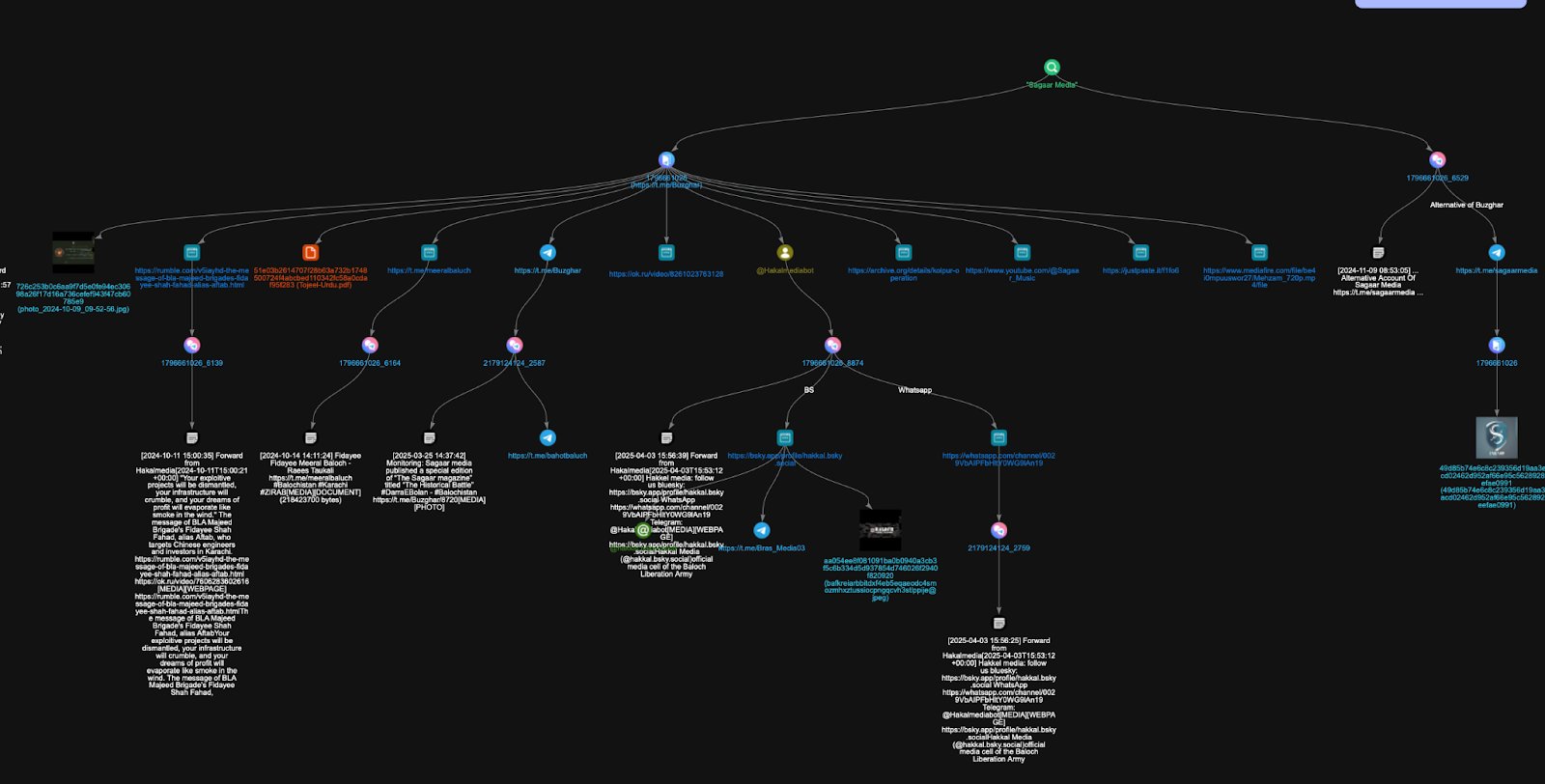
Tracing BLA’s digital footprint revealed an infrastructure built around redundancy and role separation, rather than reliance on any single account or platform. What appears fragmented on the surface resolves into a coordinated system once individual channels, links, and reposting behavior are viewed together.
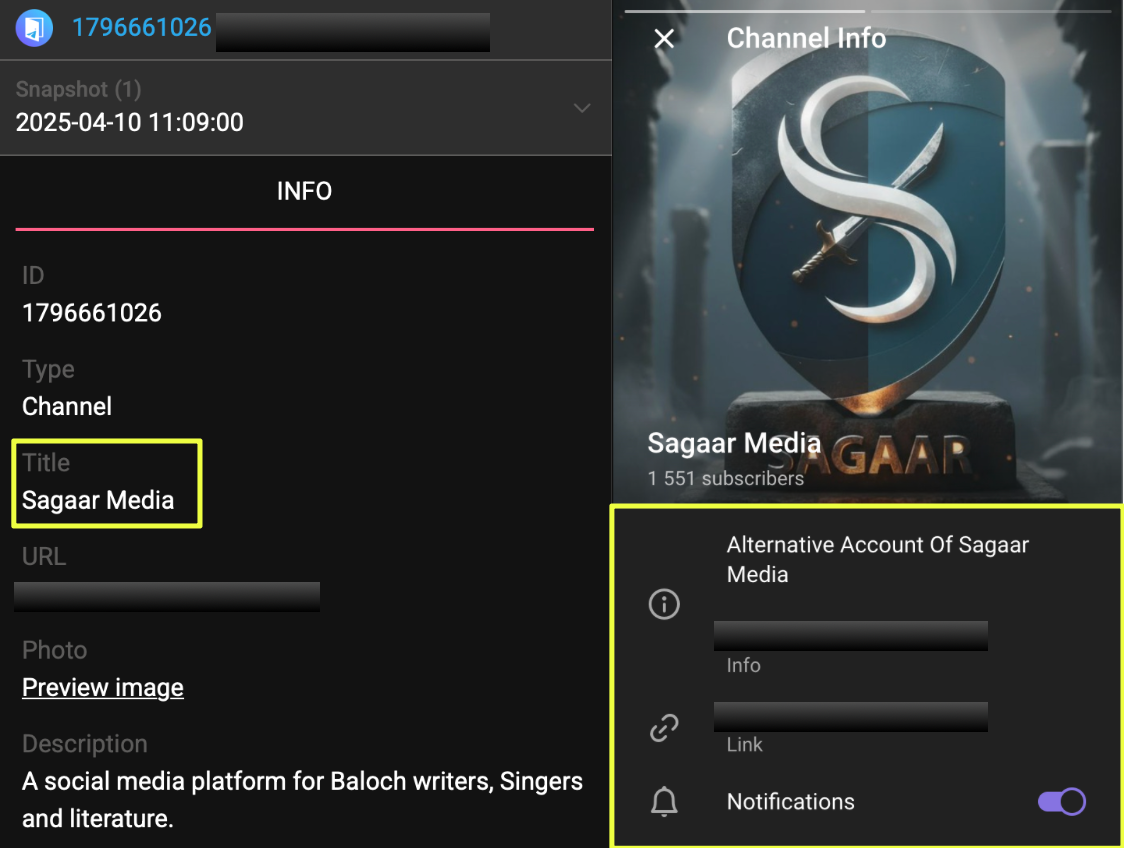
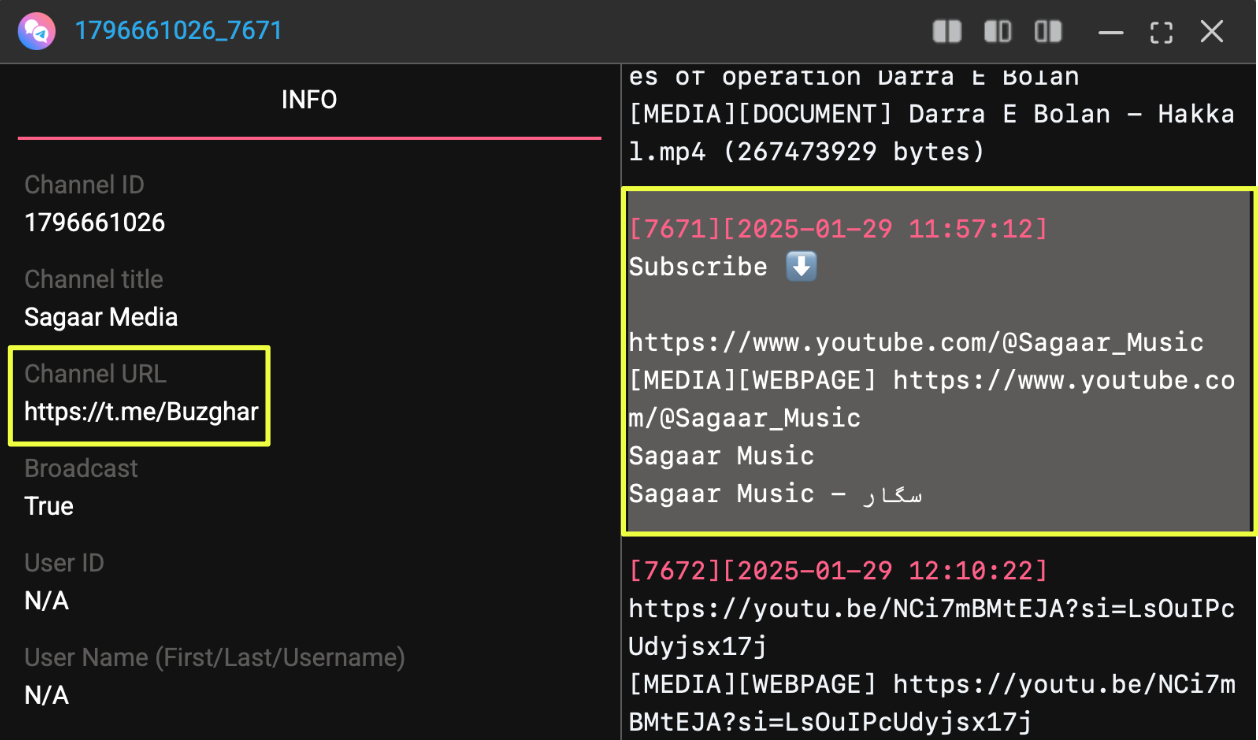
At the core of this ecosystem is Telegram, which functions as the primary coordination and distribution layer. Two channels operate under the Sagaar Media identity and serve as the main publishing outlets for BLA-linked material:
- Sagaar Media — https://t.me/sa********a
- Buzghar (Sagaar Media – alternate account) — https://t.me/Bu*****r
These channels consistently disseminate official statements, visual claims, monthly activity reports, and externally hosted media. Rather than hosting everything directly, they frequently act as an index—directing audiences to content stored elsewhere while preserving continuity when links or platforms are removed.
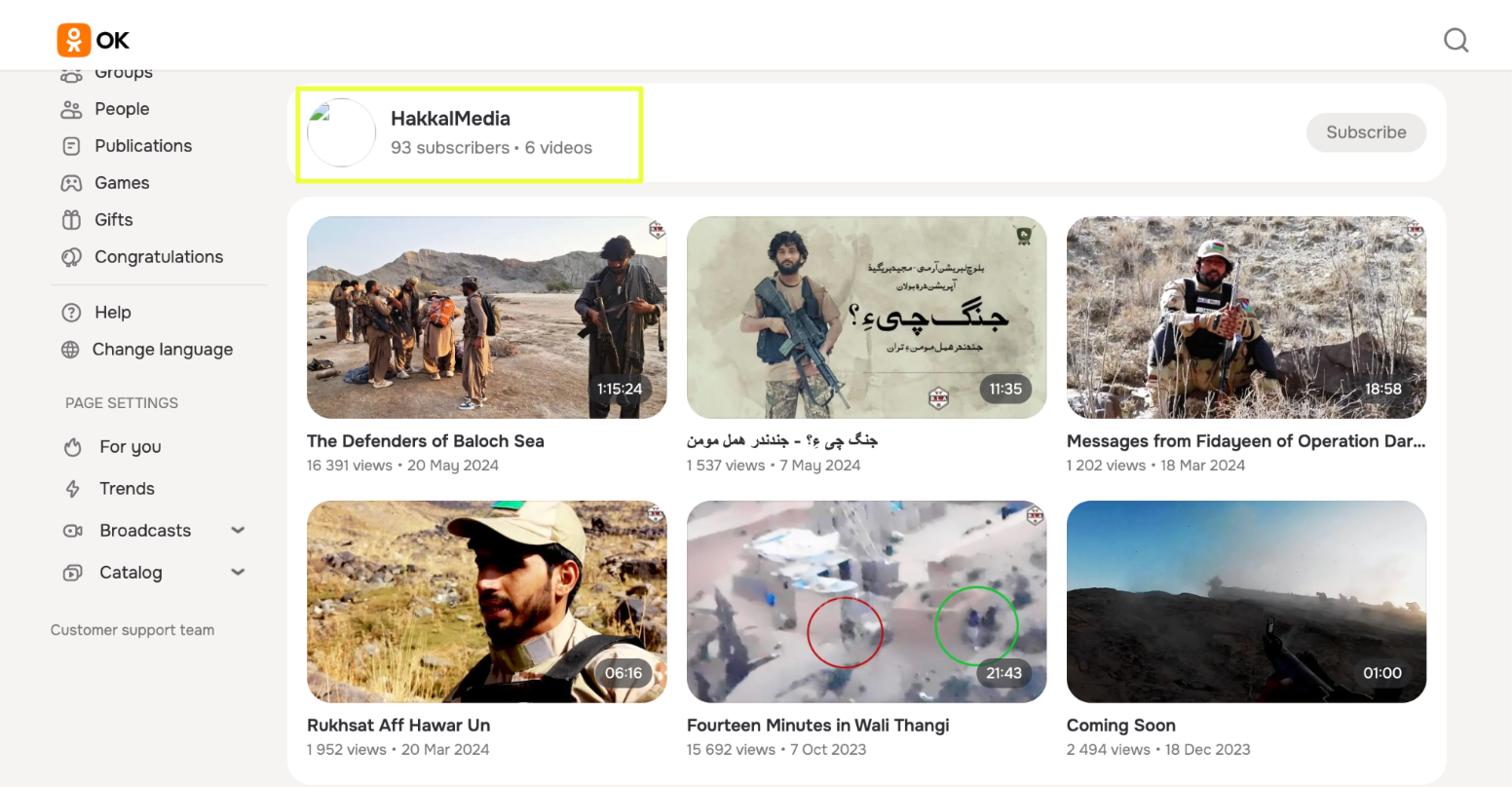
Supporting this layer is Hakkal Media, identified as BLA’s official media cell and responsible primarily for video production and cross-platform distribution. Its presence spans multiple services:
- Telegram bot (automated distribution): @Hak*******t
- OK.ru (video hosting): Hakkal Media account (linked via posts such as https://ok.ru/video/8261023763128)
- BlueSky: https://bsky.app/profile/hakkal.bsky.social
- WhatsApp Channel: https://whatsapp.com/channel/0029VbAIPFbHltY0WG9lAn19
Previously circulated content also appeared on platforms such as Rumble, where videos were later removed but preserved through Telegram links and alternative hosting.
Alongside video dissemination, BLA-linked material is distributed through file-hosting and publishing services that prioritize accessibility and persistence over visibility. These include:
- JustPaste.it: https://justpaste.it/f1fo6
- MediaFire: https://www.mediafire.com/file/be4i0mpuuswor27/Mehzam_720p.mp4
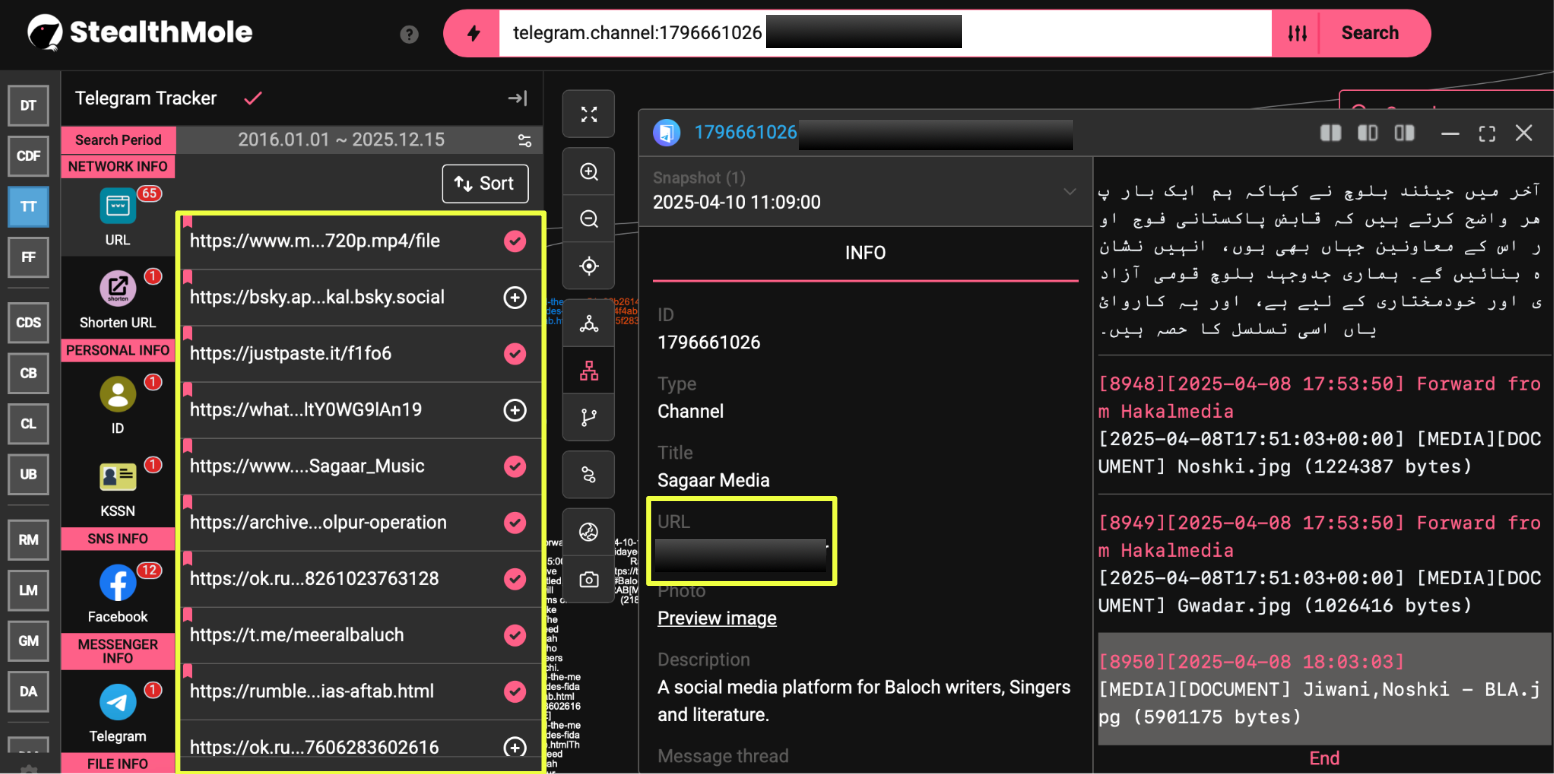
These services are used to host text statements and video files that can be quickly reshared when links are taken down elsewhere.
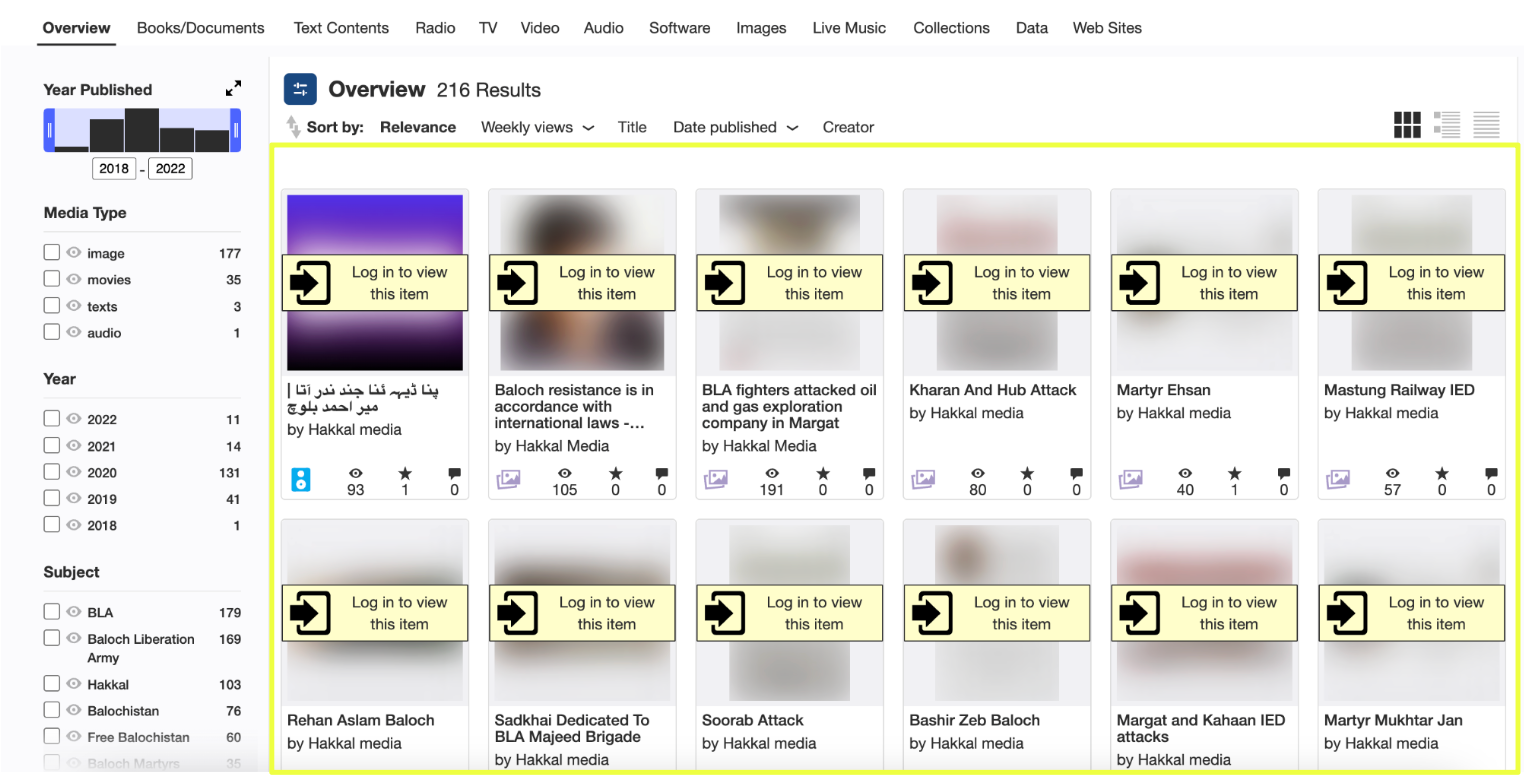
Long-term preservation plays a visible role within this infrastructure. BLA-linked media, particularly content attributed to Hakkal Media and Bahot Baloch, has been uploaded to the Internet Archive, suggesting deliberate archival intent:
- Internet Archive example: https://archive.org/details/kol*********n
In parallel, ideological and literary material circulates through dedicated outlets. A separate Telegram channel focuses on books and publications associated with Baloch nationalist narratives:
- Hakkal Books: https://t.me/Hakal_Books
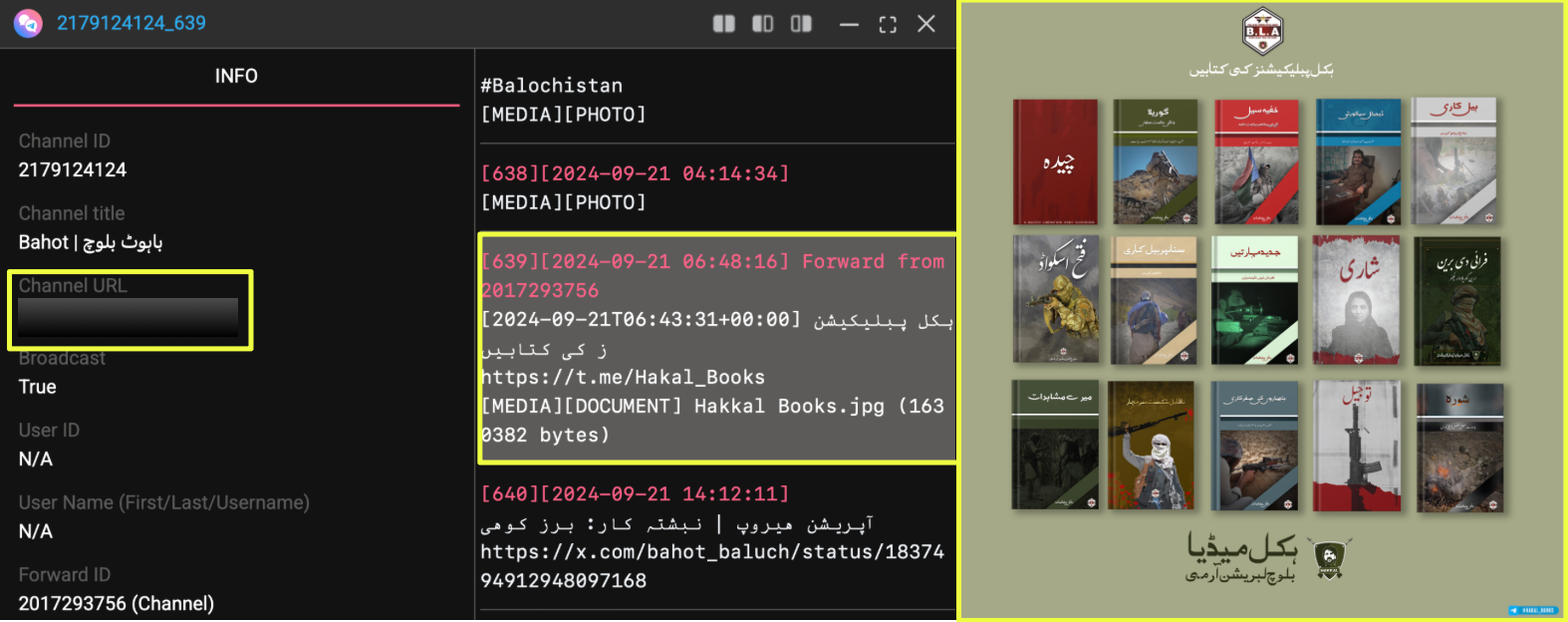
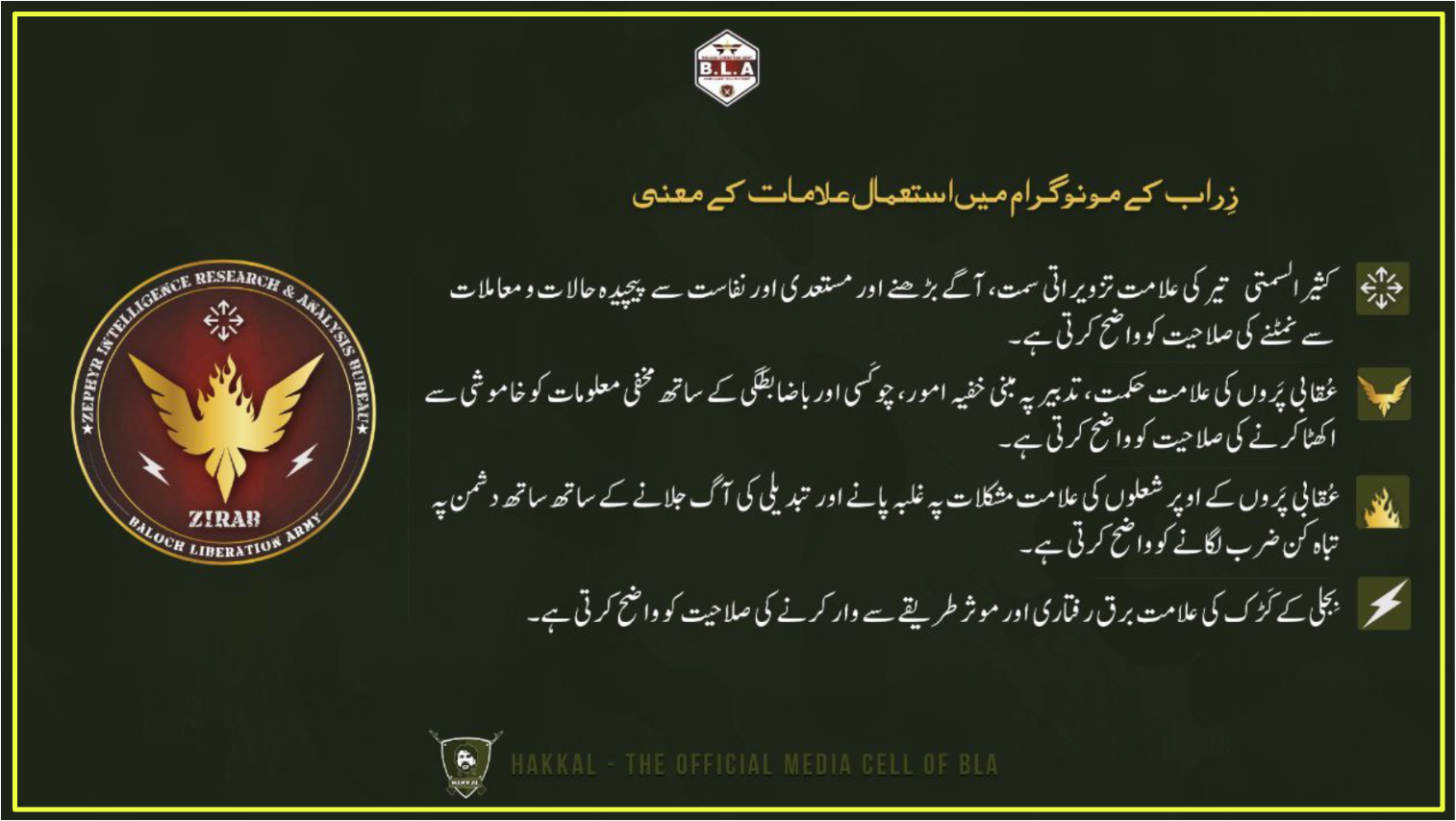
This publishing layer overlaps with material attributed to ZIRAB (Zephyr Intelligence and Research Analysis Bureau), which produces analytical and ideological content distributed through the broader media network.
Cultural content exists in close proximity but remains operationally distinct. Channels such as Sagaar Music on YouTube and artist-focused Telegram accounts contribute to cultural visibility but do not function as operational infrastructure.
- YouTube: https://www.youtube.com/@Sagaar_Music
Overall, these channels and platforms form a distributed media system in which Telegram acts as the control layer, external services provide durability, and archives preserve continuity. Content is rarely lost, only relocated. This structure allows BLA’s messaging to persist, resurface, and adapt even as individual platforms restrict or remove material.
Assessment
The digital footprint mapped in this investigation points to an organization that treats media as a core operational asset, not a secondary function. BLA’s online presence is not built for visibility alone, but for survival, structured to withstand platform takedowns, account losses, and sudden attention spikes without losing continuity.
Rather than consolidating activity into a single official outlet, BLA distributes responsibility across media labels, hosting services, and formats. Telegram acts as the connective tissue, but not the sole dependency. Videos, documents, and statements are deliberately placed on external platforms, mirrored elsewhere, and in some cases archived permanently. This design reduces reliance on any one service and allows content to reappear quickly when disruptions occur.
The presence of distinct media functions: production, redistribution, ideological publishing, automation, and archiving, suggests intentional role separation. Each component serves a specific purpose, and no single channel appears indispensable. This compartmentalization limits the impact of enforcement actions and complicates attribution for observers who focus on isolated accounts rather than network behavior.
Equally notable is the group’s approach to timing and reuse. Content that resurfaced during periods of heightened attention was rarely new; instead, it drew from an existing library of material that could be repackaged, translated, or recontextualized. This indicates that moments of public interest are leveraged not to improvise messaging, but to reactivate pre-existing narratives.
At the same time, the investigation highlights the importance of analytical restraint. Cultural outlets, artistic content, and adjacent platforms coexist alongside operational media but do not serve the same function. Distinguishing between official infrastructure, secondary relays, and unrelated cultural spaces is essential to avoid overstating connections and misattributing intent.
Taken together, BLA’s media ecosystem reflects a broader trend seen among modern insurgent movements: digital resilience achieved through distribution rather than dominance. The group’s ability to persist online is less about controlling a platform and more about ensuring that its narrative always has somewhere else to go.
Conclusion
This investigation shows how the Baloch Liberation Army maintains a broad and durable online presence without relying on a single, fixed home online. Rather than operating an official website, BLA distributes its content across messaging platforms, video hosts, file-sharing services, and archival repositories, allowing its narratives to persist even as individual accounts or links disappear.
The absence of a dedicated website appears deliberate. By avoiding a centralized domain, BLA reduces exposure to takedowns while retaining flexibility to shift platforms as needed. Content is instead anchored through interconnected media entities and reposting behavior, with Telegram serving as the primary coordination layer.
These findings highlight a model of digital presence built around mobility and resilience, not permanence. Understanding this approach is essential for analysts tracking militant groups whose online infrastructure is designed to move constantly, rather than exist in one easily identifiable place.
Editorial Note
While every effort has been made to ensure the accuracy of this report, it is important to acknowledge that attribution in cyber investigations can never be guaranteed with complete certainty. The connections drawn are based on available open-source intelligence and StealthMole platform data. However, attribution remains probabilistic and subject to change as new information emerges.
The primary goal of this report is not just attribution, but also to showcase how StealthMole’s platform enables comprehensive, efficient, and intuitive profiling of threat actors through integrated tools such as Dark Web & Telegram Trackers, ULP Binder, the Compromised Data Set and others. These tools allow even independent researchers to connect dots across aliases, infrastructure, and behavioral patterns, transforming fragmented data into actionable intelligence.
To access the unmasked report or full details, please reach out to us separately.
Contact us: support@stealthmole.com
Labels: Militant Organization
.svg)
.svg)
.svg)