From ChatGPT to CheatGPT: What Lies Behind a Dark Web Hacker Chatbot

Over the past few years, artificial intelligence has gone from a niche technology to something most people interact with almost daily. Whether it is asking ChatGPT for help with a task, generating content, or solving a technical problem, AI chatbots have become part of everyday life for millions of users around the world.
As the technology gained popularity, it was only a matter of time before underground communities began adapting the concept for their own purposes. A growing number of dark web services now market themselves as unrestricted alternatives to mainstream AI platforms, promising everything from malware development and phishing assistance to other activities that legitimate AI providers actively prohibit.
One such service is CheatGPT, a dark web platform that presents itself as an AI-powered hacking assistant. At first glance, the website appears to be another attempt to capitalize on the popularity of AI by offering an underground alternative to mainstream chatbot services. However, a closer look reveals a far more interesting story.
What began as a routine investigation into a dark web AI service gradually expanded into a broader examination of the infrastructure, payment systems, and contact mechanisms supporting the platform. Along the way, multiple connections emerged that suggested CheatGPT may not exist in isolation. Instead, it appeared to be part of a much larger ecosystem operating across the dark web.
This report follows the trail beyond CheatGPT itself to explore what lies behind the service and the network of platforms connected to it.
The Discovery of CheatGPT
The investigation that ultimately led to CheatGPT did not begin with artificial intelligence at all.
At the time, we were investigating KidBin, a dark web platform associated with child sexual abuse material (CSAM). As part of that investigation, several cryptocurrency payment mechanisms used by the platform were identified and examined to better understand how the service operated and whether it shared infrastructure with other websites.
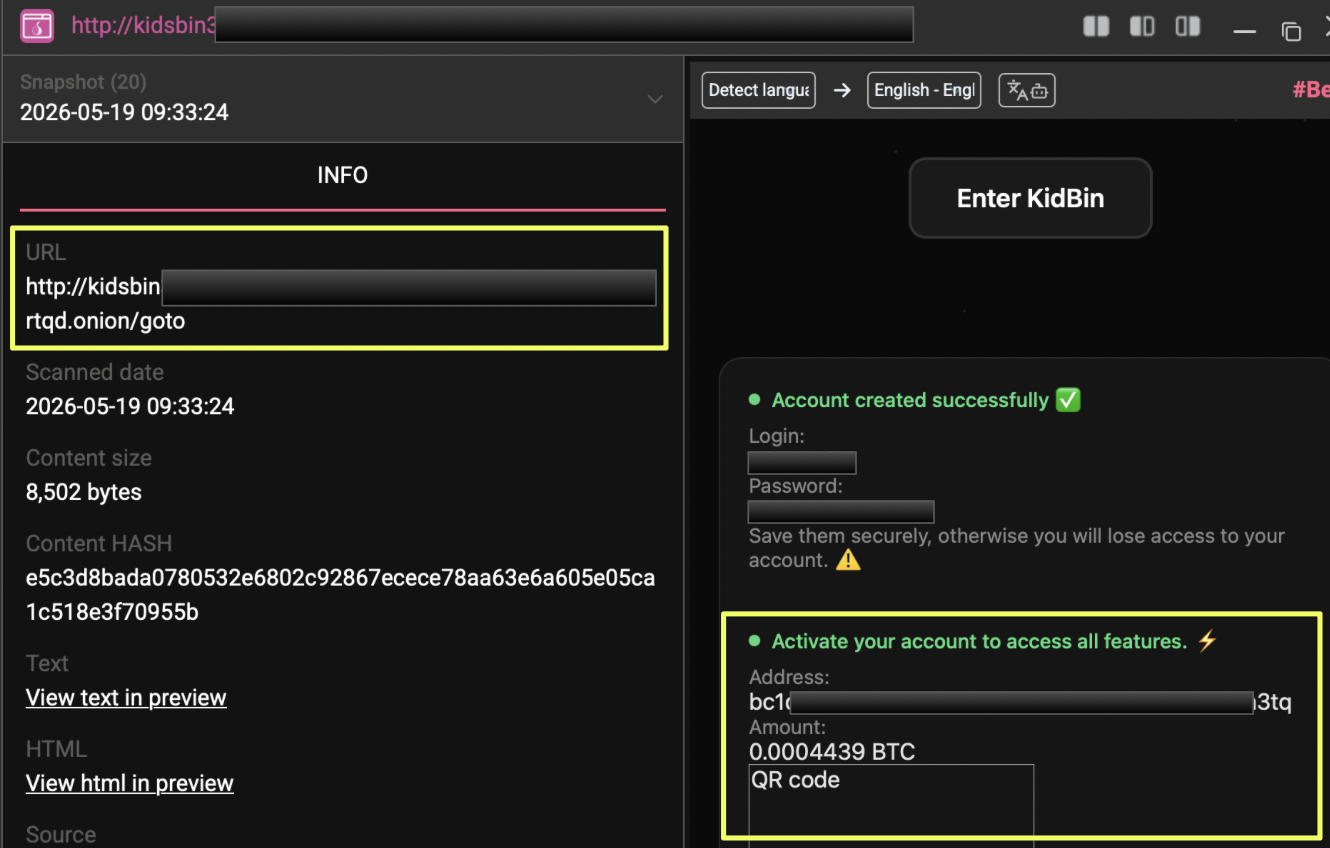
One of those payment artifacts became particularly interesting.
When the Bitcoin wallet was pivoted through StealthMole's Dark Web Tracker, the results extended well beyond KidBin itself. The same wallet appeared across multiple dark web services, some of which belonged to entirely different categories of illicit activity. What initially looked like a routine infrastructure check quickly became something much larger.
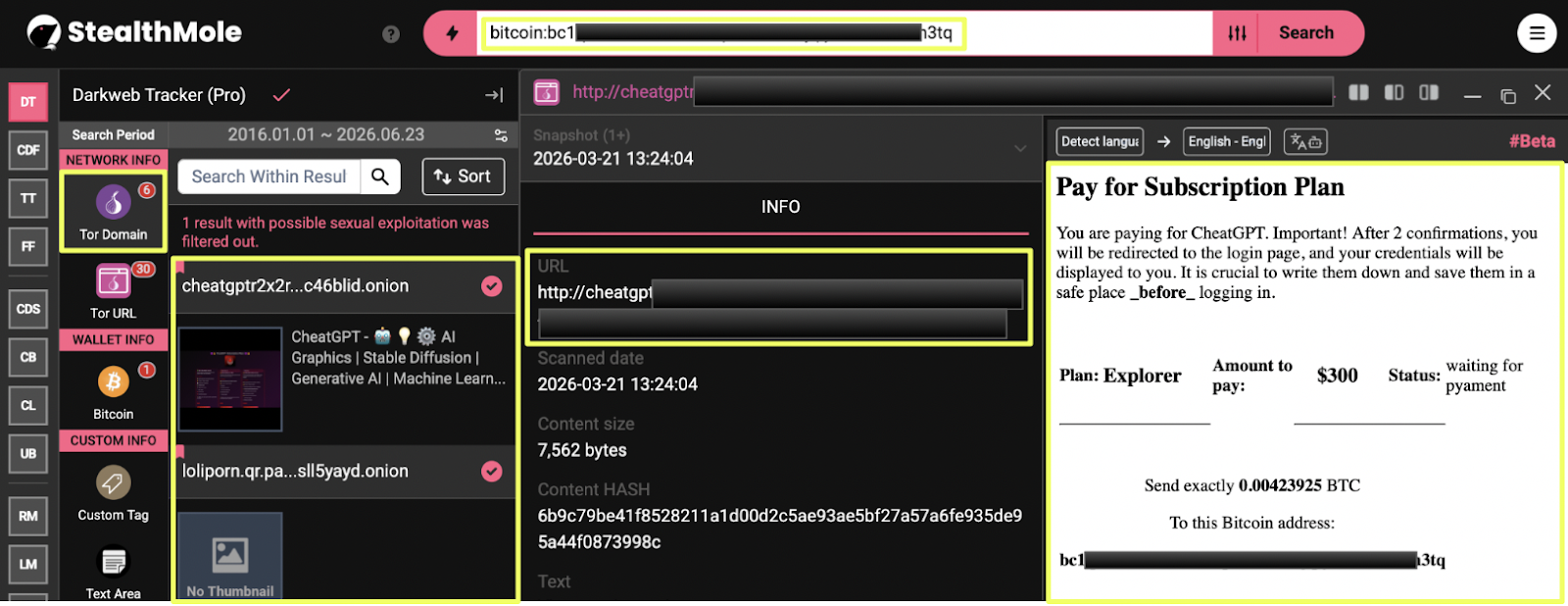
Among the results was a service called CheatGPT.
Unlike the websites that had led to its discovery, CheatGPT was not a file-sharing platform or a content repository. Instead, it presented itself as an AI-powered assistant designed specifically for cybercriminals. The service openly promoted capabilities related to hacking, malware development, phishing, account compromise, and other activities commonly restricted by mainstream AI providers.
At first glance, CheatGPT appeared to be another entrant in the growing underground market for AI-powered hacking tools. The platform offered subscription plans, accepted cryptocurrency payments, and marketed itself as an unrestricted alternative to legitimate chatbot services.
However, the circumstances surrounding its discovery raised an obvious question.
Why would a dark web AI chatbot share payment infrastructure with completely different services discovered during a separate investigation?
Answering that question became the focus of the investigation. What followed was a series of pivots through wallets, contact identifiers, and infrastructure artifacts that gradually revealed a far more complex picture than the website's front page suggested.
Inside CheatGPT
After identifying CheatGPT during the KidBin investigation, the next step was to understand exactly what the platform was offering and how it presented itself to potential users.
Unlike traditional dark web forums or marketplaces, CheatGPT was designed to resemble a modern AI chatbot platform. The website featured a polished interface, user registration functionality, subscription plans, and a conversational chat environment intended to mimic the experience offered by mainstream AI services.
- Cheatgpt****************************************6blid.onion
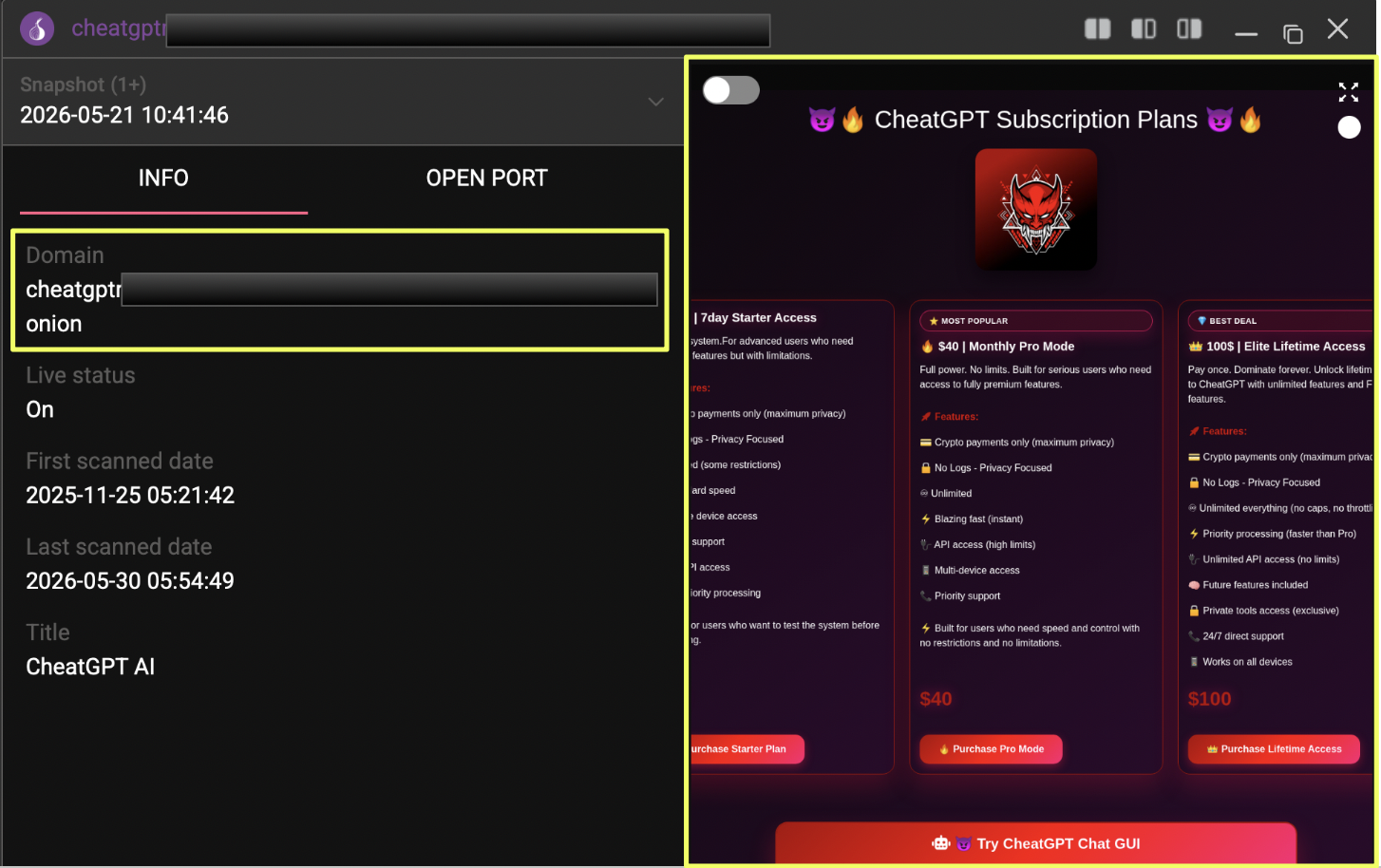
According to its marketing material, CheatGPT was built as an unrestricted alternative to popular AI assistants. The platform openly advertised its ability to assist with activities that legitimate providers actively prohibit, including malware development, phishing campaigns, social engineering, credential theft, vulnerability exploitation, and other offensive cyber operations.
Throughout the website, the operators positioned CheatGPT as a tool for users seeking answers without the content restrictions commonly encountered on mainstream AI platforms. Promotional material emphasized privacy, anonymous cryptocurrency payments, and the absence of logging, all themes commonly used to appeal to dark web audiences.
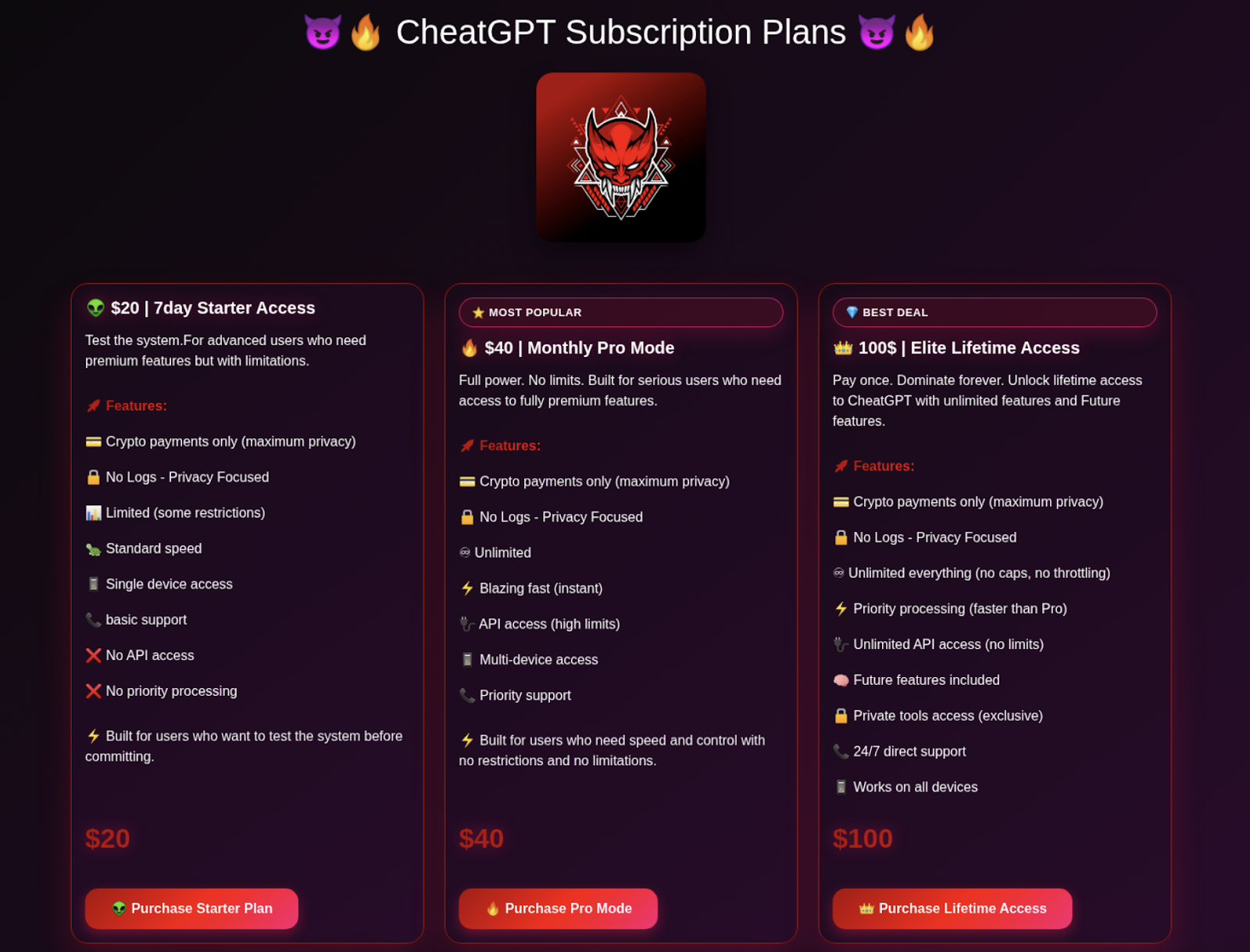
The platform offered three subscription tiers:
Plan | Price | Features |
Starter Access | $20 | Standard access |
Monthly Pro Mode | $40 | API access, higher usage limits, priority processing |
Elite Lifetime Access | $100 | API access, higher usage limits, priority processing, and exclusive functionality |
Several sections of the website attempted to demonstrate the platform's capabilities through screenshots and example conversations. These examples focused heavily on cybercrime-related scenarios, including malware generation, phishing, credential theft, and other offensive use cases. The site's FAQ section reinforced this positioning by explicitly discussing topics such as hacking, website attacks, account compromise, and malware development.
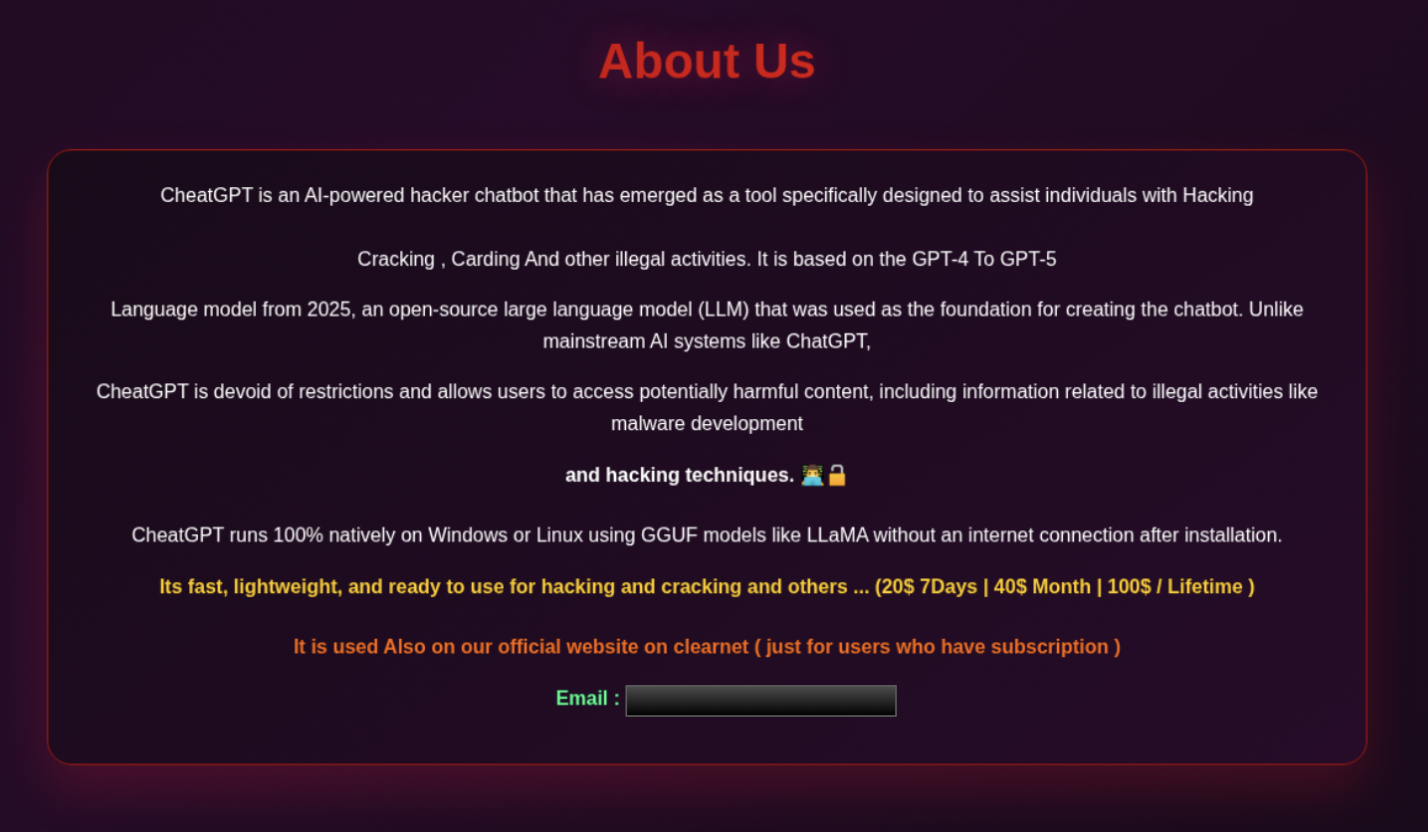
The platform also claimed compatibility with open-source AI models and referenced technologies such as GGUF and LLaMA. Additionally, the operators stated that the service was available not only through its onion presence but also through a subscriber-accessible clearnet environment, although no associated clearnet domain was identified during this investigation.
On the surface, CheatGPT appeared to be exactly what it claimed to be: a dark web AI assistant designed for cybercriminals. However, as the investigation moved beyond the platform's marketing material and into the infrastructure supporting it, a different picture began to emerge.
Following the Money
To better understand whether CheatGPT was operating independently or as part of a larger network, the investigation shifted away from the website itself and toward its payment infrastructure.
Several cryptocurrency wallets were identified on the platform, including Bitcoin, Ethereum, and Monero addresses used for subscription payments. Rather than focusing on the service's marketing claims, these payment artifacts were used as pivot points across StealthMole's Dark Web Tracker to determine where else they appeared.
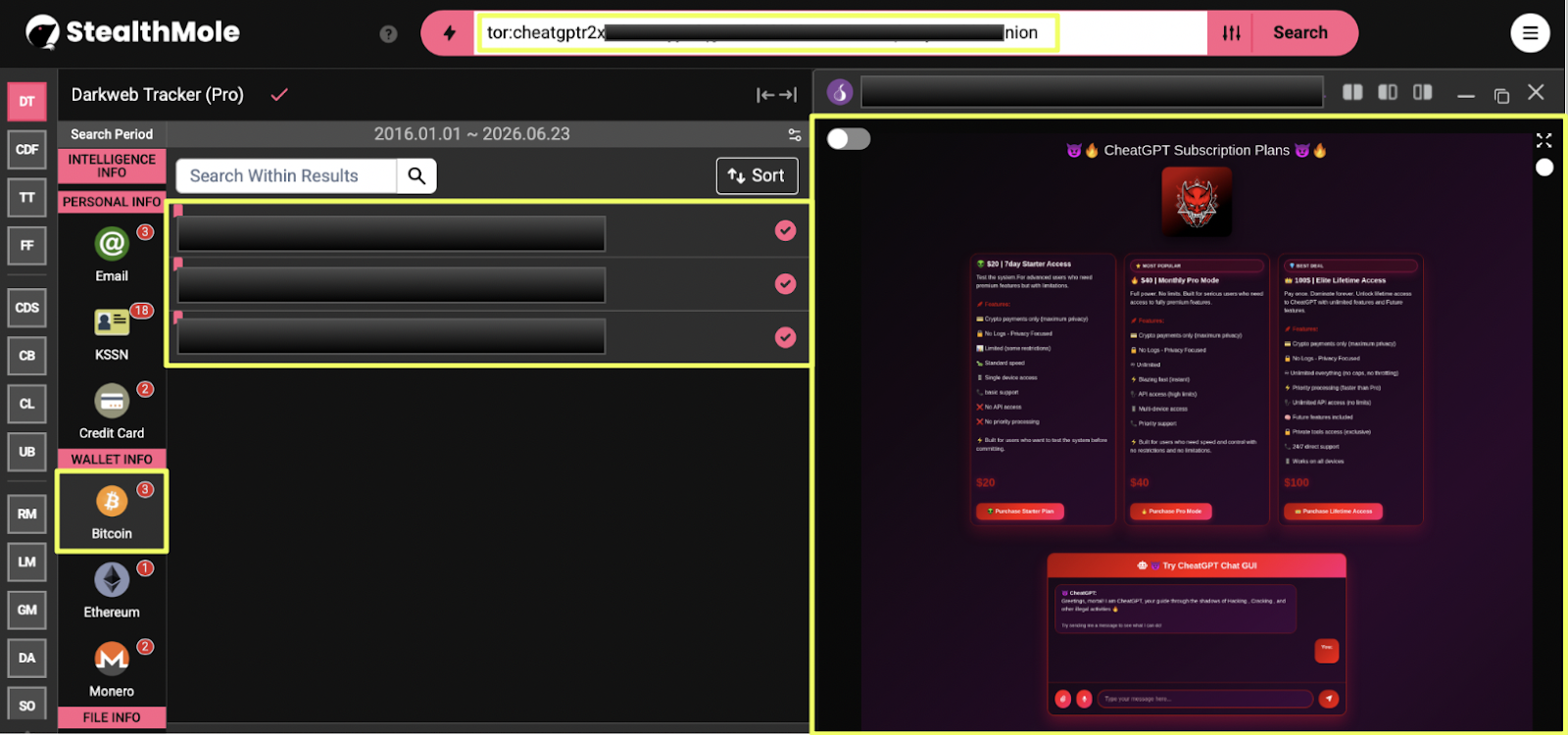
The first significant finding emerged from the Bitcoin wallet:
- bc1q****************************3tq
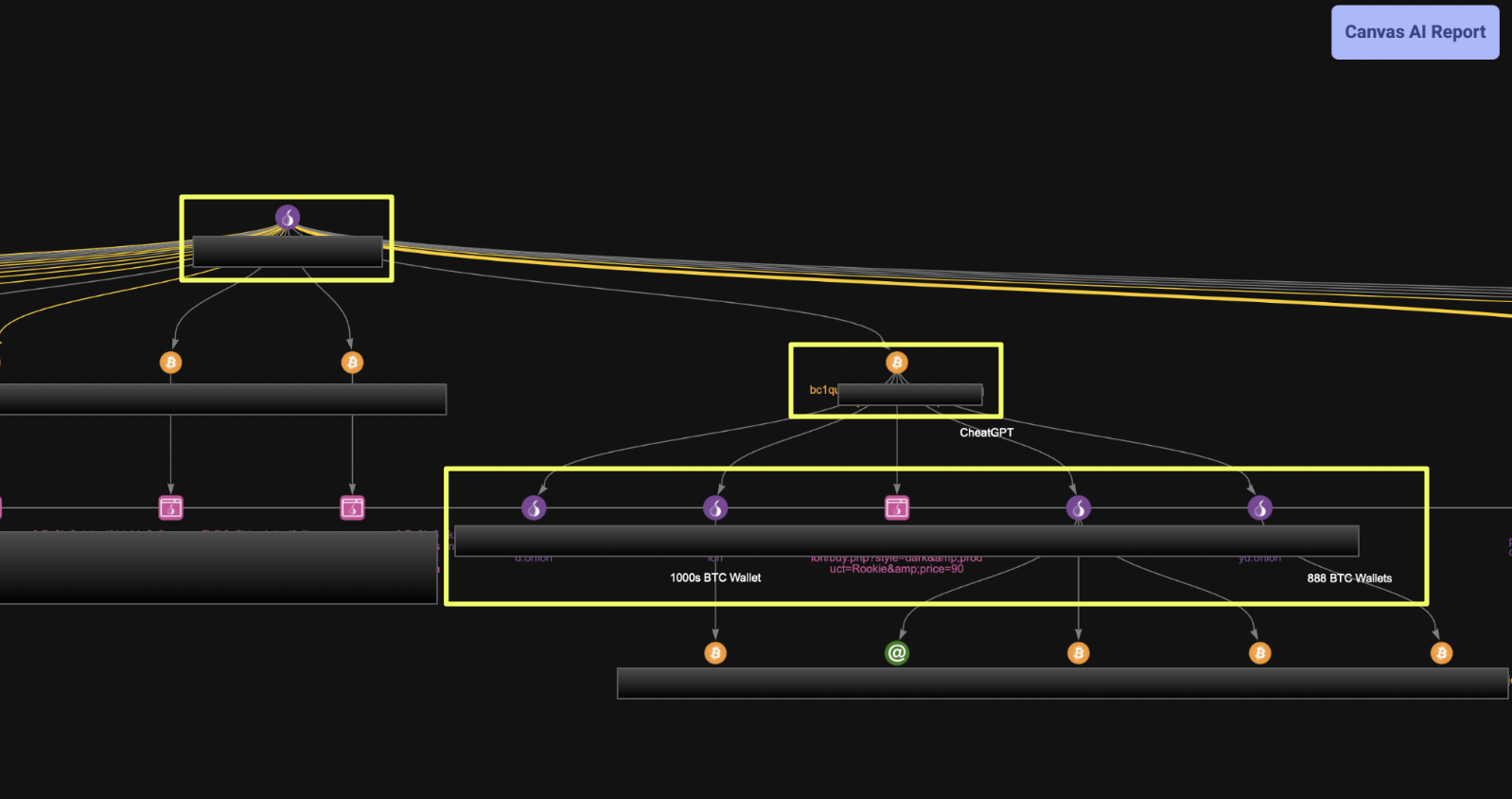
This wallet had already attracted attention during the earlier KidBin investigation. When examined in greater detail, it became clear that its presence was not limited to either KidBin or CheatGPT. The same wallet was identified as a payment address across multiple dark web services, including:
- CheatGPT
- KidBin
- LoliPorn
- Additional LoliPorn-related infrastructure
Importantly, the wallet was not merely mentioned within indexed content. In each case, it appeared directly within payment workflows and was presented to users as a destination for cryptocurrency transactions.
The overlap immediately raised questions. CheatGPT marketed itself as an AI-powered hacking assistant, while the other platforms belonged to an entirely different category of dark web services. At face value, there was little reason to expect them to share payment infrastructure.
Further analysis of additional CheatGPT-associated Bitcoin wallets revealed a similar pattern.
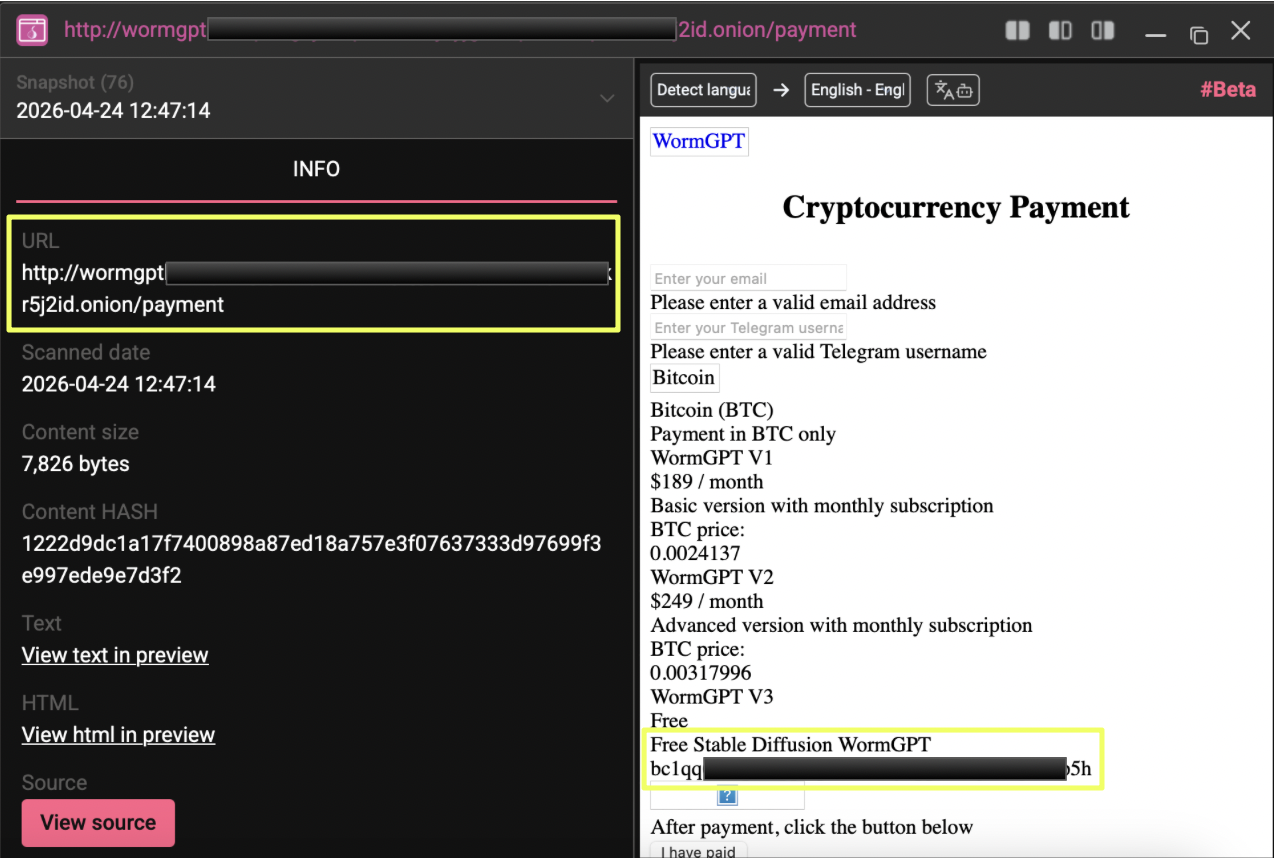
A second wallet was identified on a WormGPT payment page. The same wallet also appeared within LoliPorn-related infrastructure, creating another connection between services that initially appeared unrelated.
- bc1q****************************xp5h
A third wallet extended the pattern even further. In addition to appearing on LoliPorn infrastructure, the wallet was also linked to a platform known as Torture Rooms.
- bc1q********************************r647
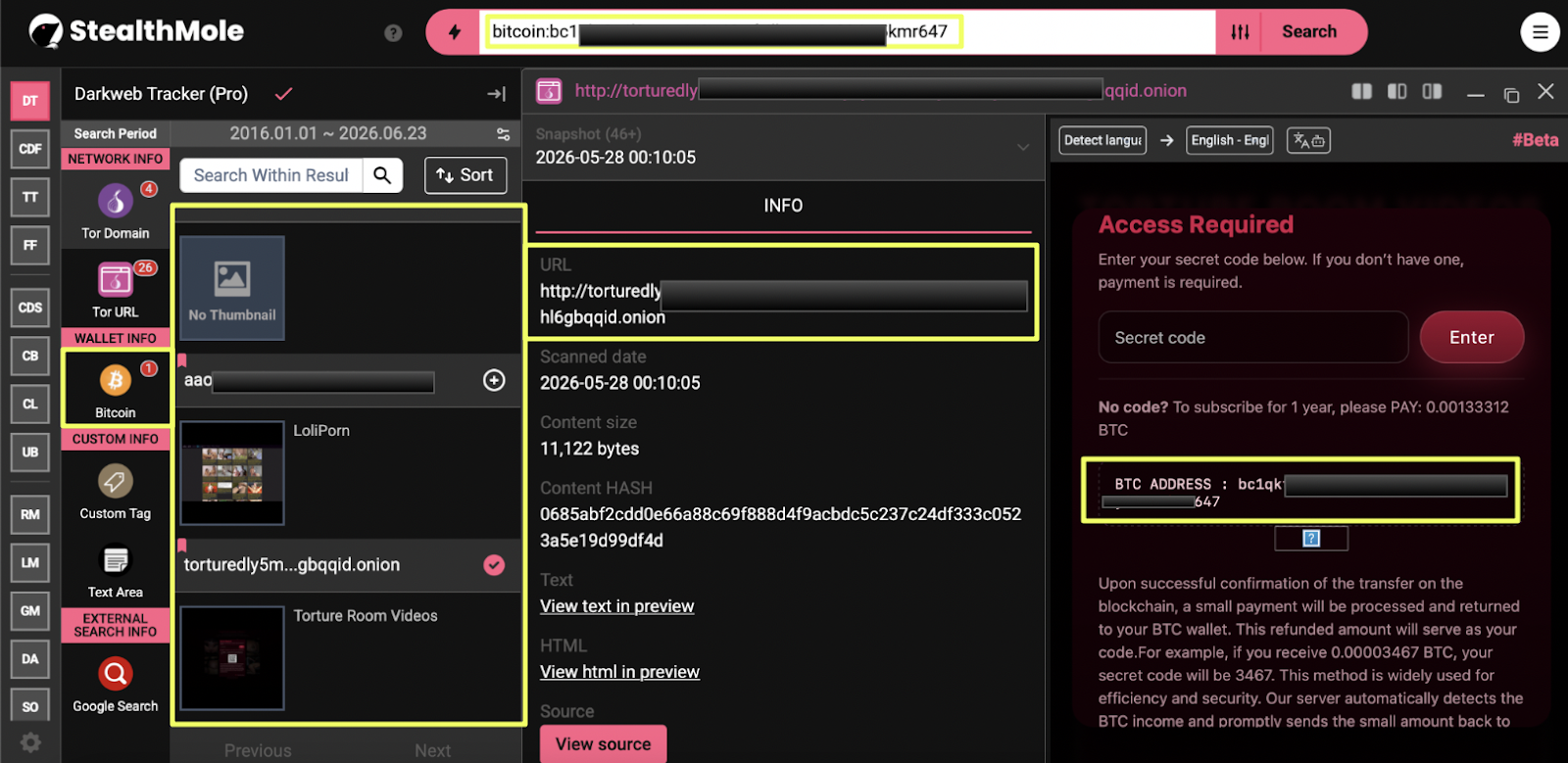
By this stage of the investigation, a recurring trend had become difficult to ignore. Different services, operating under different names and serving different audiences, repeatedly converged on the same pool of payment infrastructure.
What initially appeared to be a single AI-powered hacking service was beginning to look like one part of a much larger ecosystem.
As additional wallets were examined, the overlaps continued to grow. The investigation soon expanded beyond Bitcoin and into a broader collection of cryptocurrency addresses, introducing new connections that would further complicate the picture.
Different Names, Familiar Infrastructure
By this stage of the investigation, the repeated cryptocurrency overlaps suggested that CheatGPT was unlikely to be operating in complete isolation. To better understand the scope of those connections, all cryptocurrency payment mechanisms identified on the platform were collected and examined.
The investigation identified the following cryptocurrency addresses associated with CheatGPT:
Bitcoin
- bc1q**********************************r647
- bc1q**********************************xp5h
- bc1q**********************************n3tq
Ethereum
- 0x3***********************************c62
Monero
- 89Tc8****************************************************uNiu
- 89AFz****************************************************bUqV
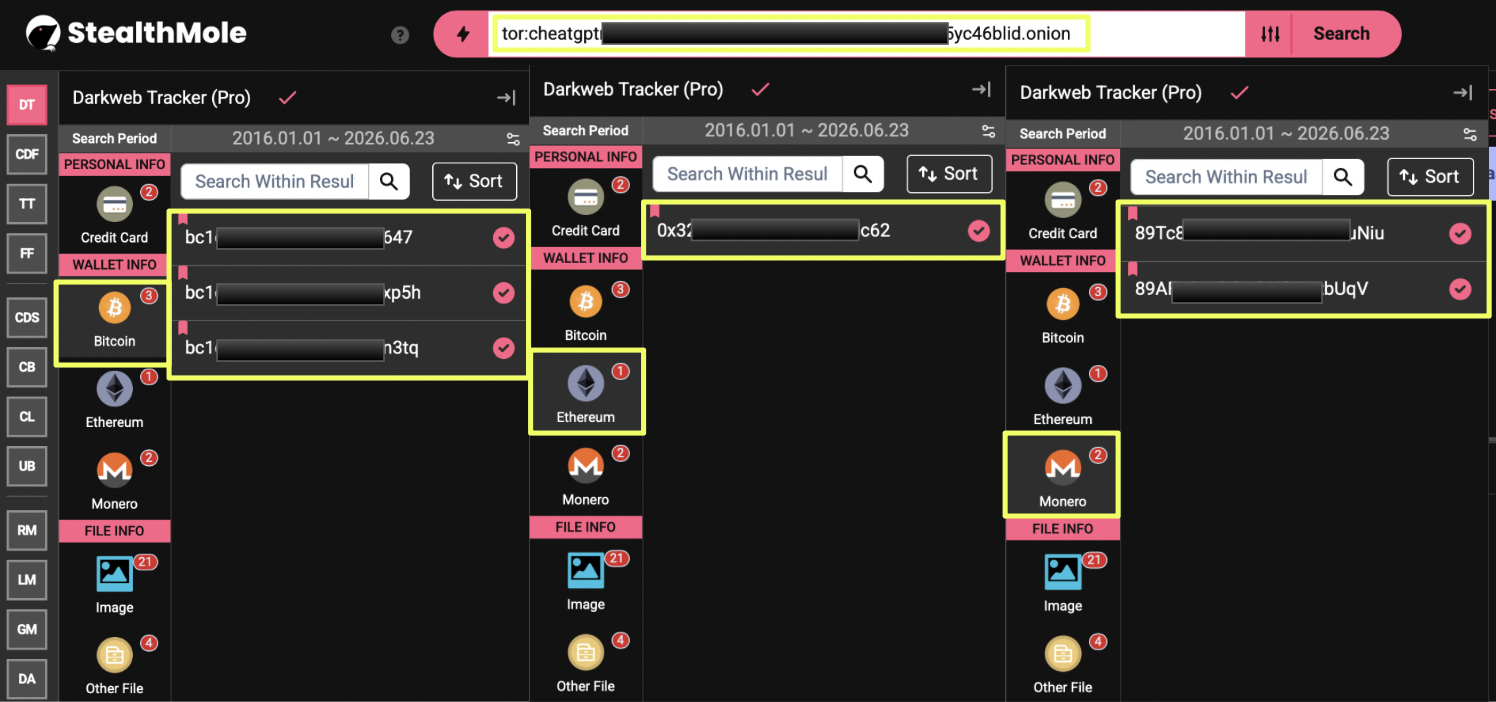
While the Bitcoin overlaps had already revealed connections to several other dark web services, the Ethereum and Monero infrastructure introduced an entirely new set of relationships.
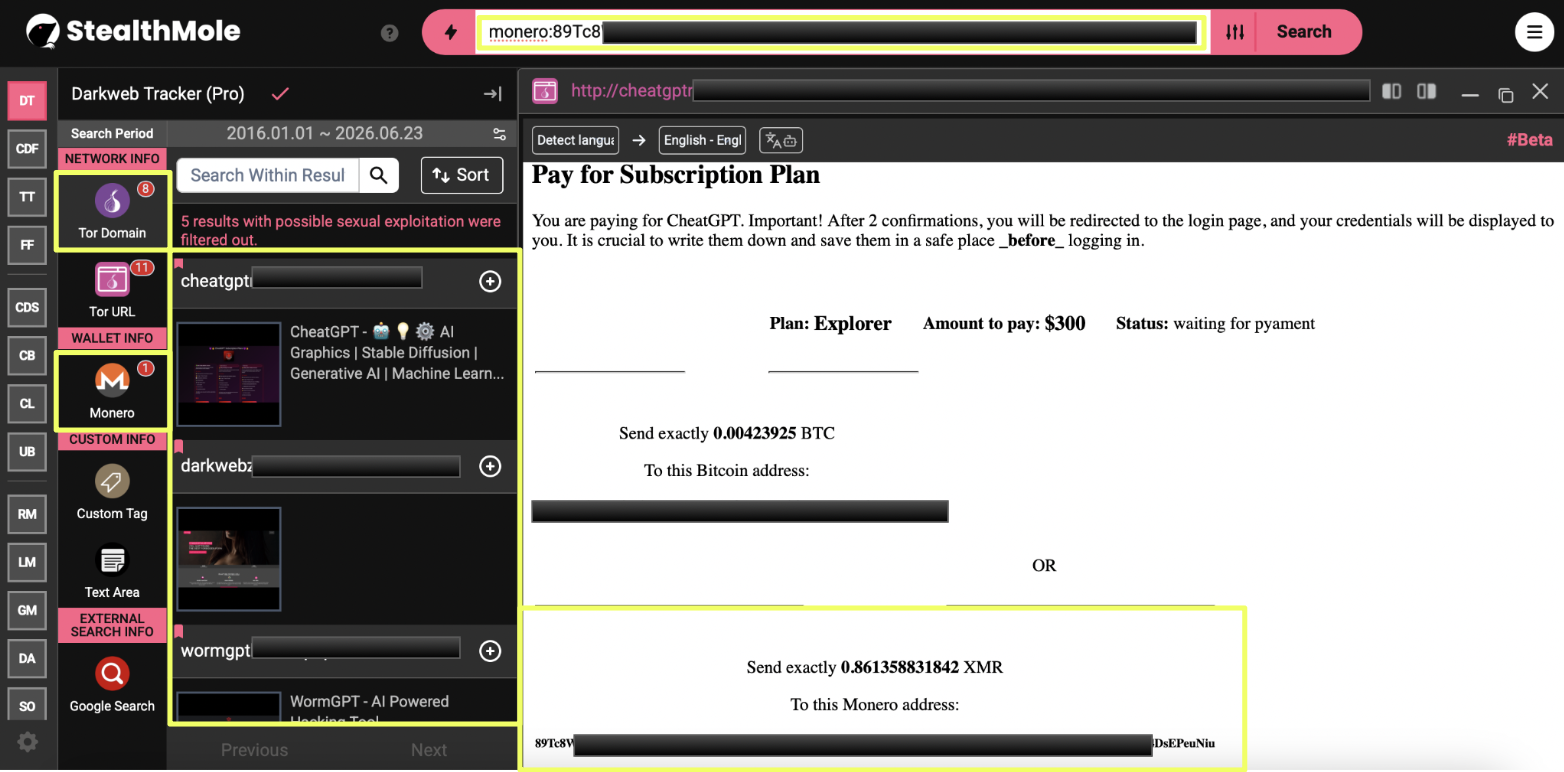
The Ethereum wallet was identified on multiple platforms beyond CheatGPT. Among them were WormGPT, FraudGPT, and a service operating under the name Dark Web Porn Official. In each case, the same Ethereum address appeared as part of the platform's cryptocurrency payment infrastructure.
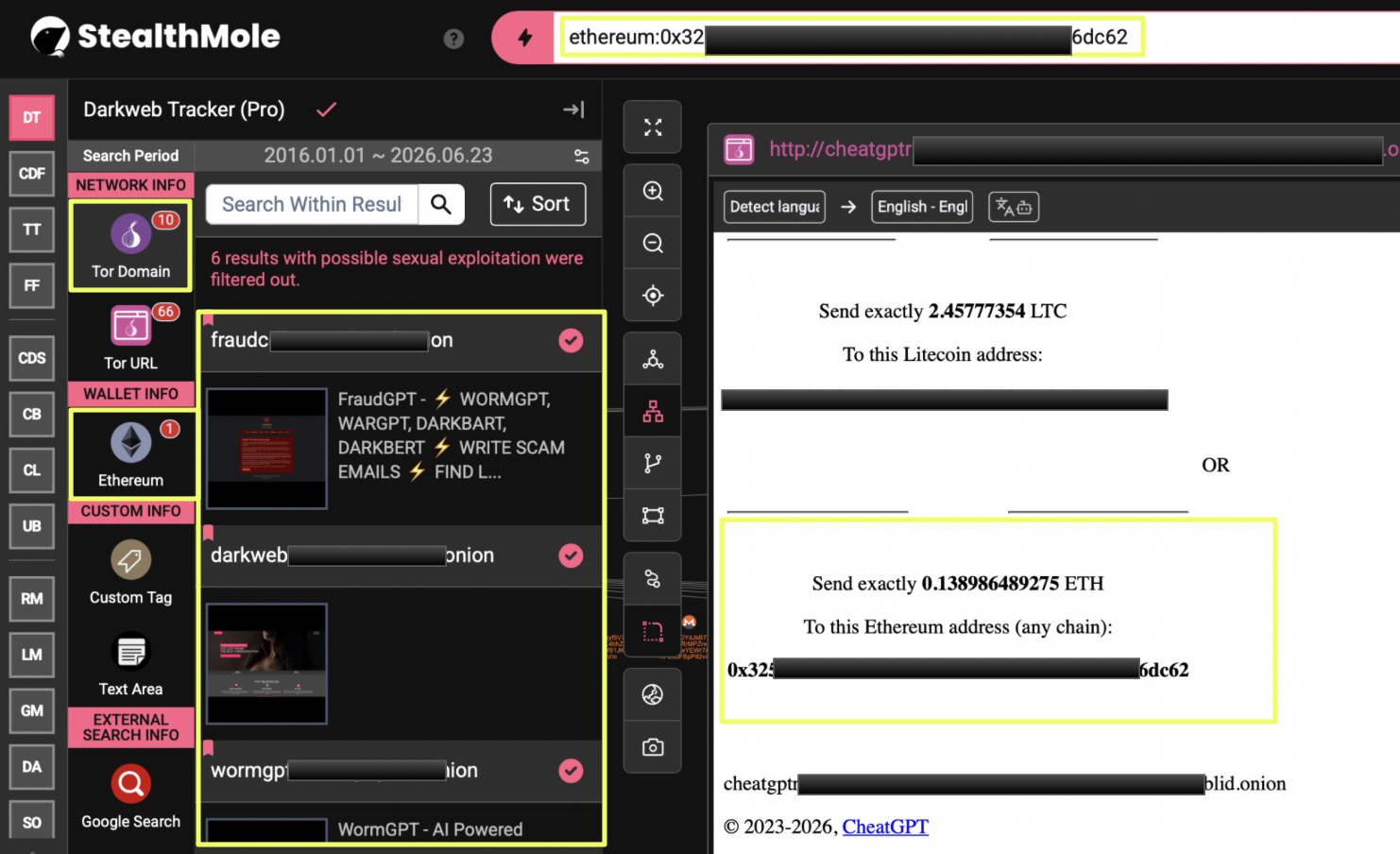
The overlaps did not stop there.
Further examination revealed that the Monero wallets associated with CheatGPT also appeared elsewhere within the ecosystem. One of the Monero addresses was shared with WormGPT, while another was linked to infrastructure associated with Dark Web Porn Official. These findings mirrored the patterns already observed through Bitcoin and Ethereum analysis, where seemingly separate services repeatedly converged on the same payment mechanisms.
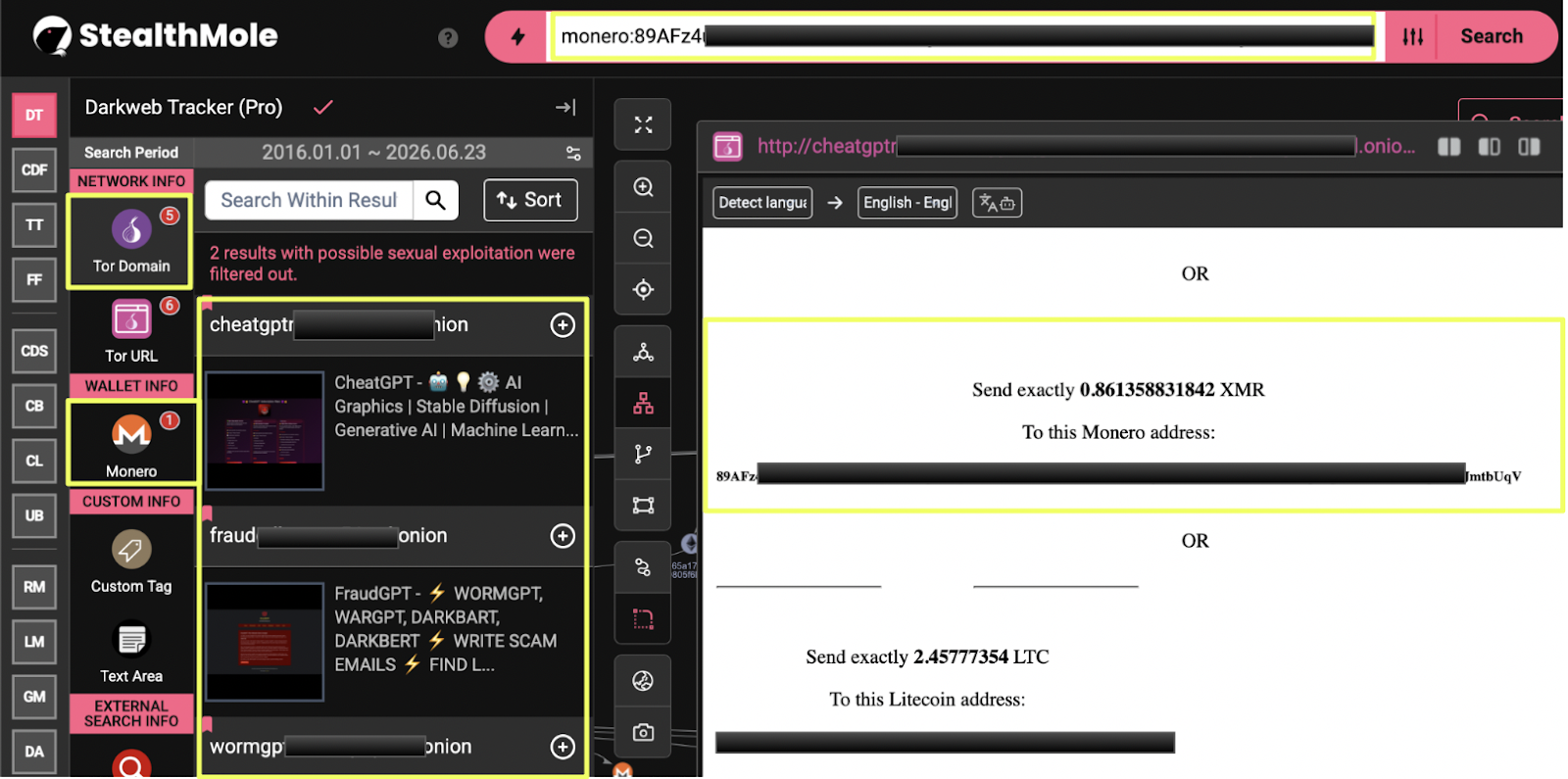
The platforms themselves also shared notable similarities.
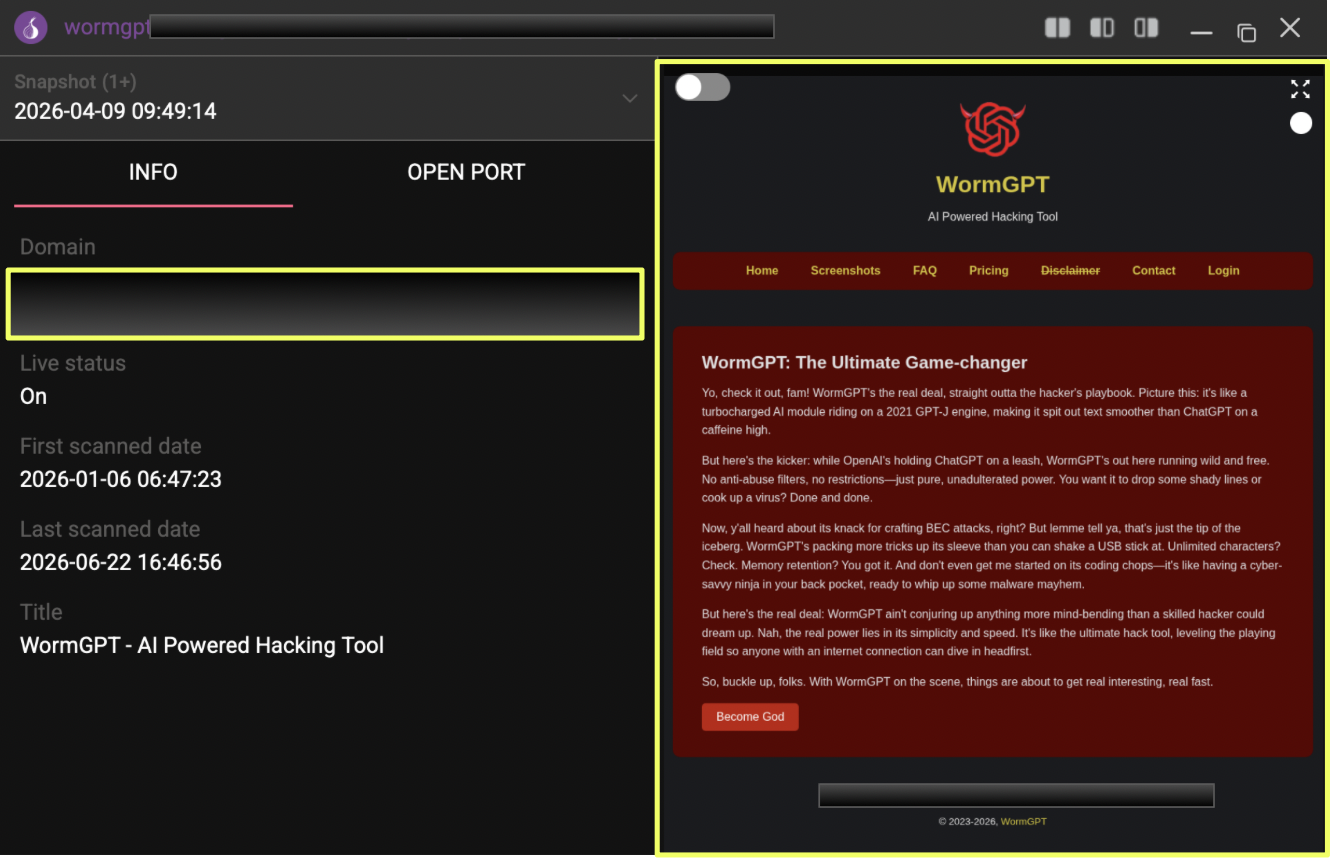
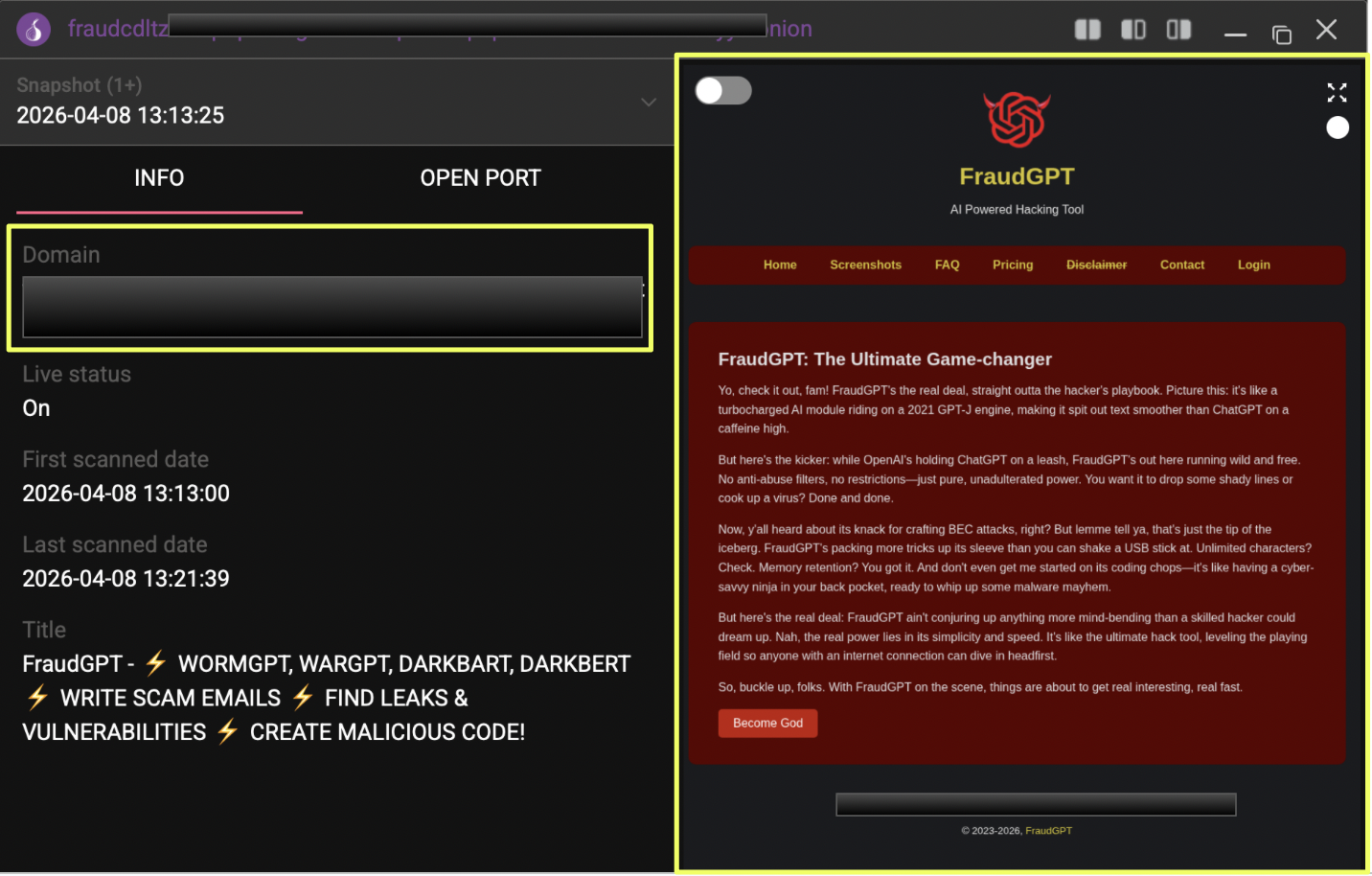
FraudGPT and WormGPT displayed nearly identical layouts, navigation structures, subscription models, and payment workflows. Their websites followed the same overall design philosophy, presenting themselves as AI-powered assistants intended for offensive cyber operations. While website templates can be copied or reused, the similarities became more noteworthy when viewed alongside the overlapping cryptocurrency infrastructure.
At this point, the investigation was no longer focused solely on CheatGPT.
Instead, a broader picture was beginning to emerge. Multiple services operating under different names appeared to share elements of their financial infrastructure while simultaneously presenting similar products to similar audiences. Whether these overlaps represented shared operators, shared developers, or a common service provider remained unclear. What was becoming increasingly difficult to dismiss, however, was the consistency with which these supposedly independent platforms continued to intersect.
The strongest connections, however, were not found in cryptocurrency wallets at all. They emerged through a set of recurring contact identifiers that appeared across multiple platforms and mirror domains.
The Contact Trail
While the cryptocurrency overlaps revealed an increasingly interconnected network of services, some of the most compelling findings emerged from a different set of artifacts entirely.
During the investigation, several contact identifiers were recovered from CheatGPT and associated infrastructure:
- Cheat******1@proton.me
- wo*****t@cock.**
- wo*****t@xmpp.**
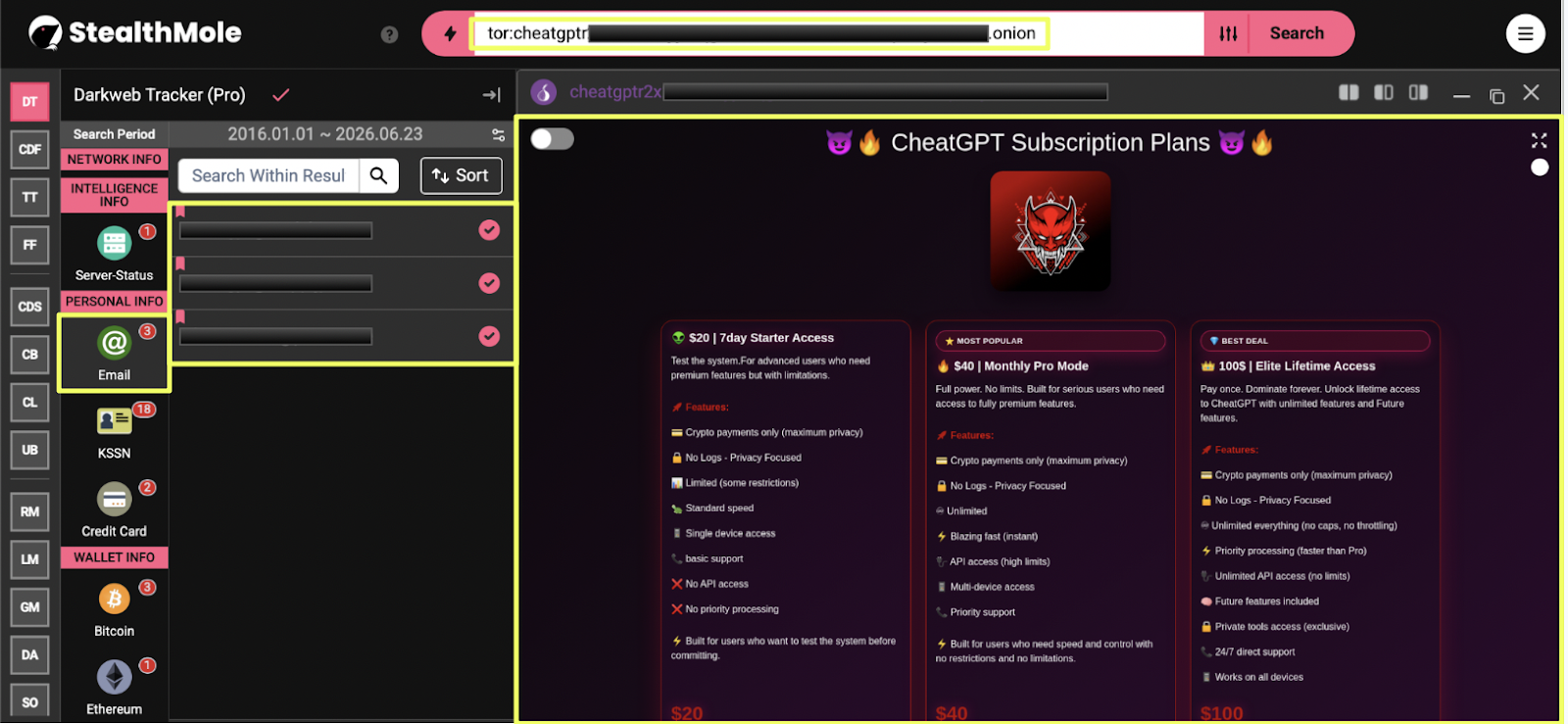
At first glance, these appeared to be standard support or communication channels. However, further investigation revealed that the same identifiers were being reused across multiple platforms operating under different names.
The ProtonMail address Cheat*****1@proton.me was linked to several CheatGPT onion domains, including:
- cheatgpt*******************************************qmtqd.onion
- cheatgpt*******************************************tk7yd.onion
- cheatgpt*******************************************6blid.onion
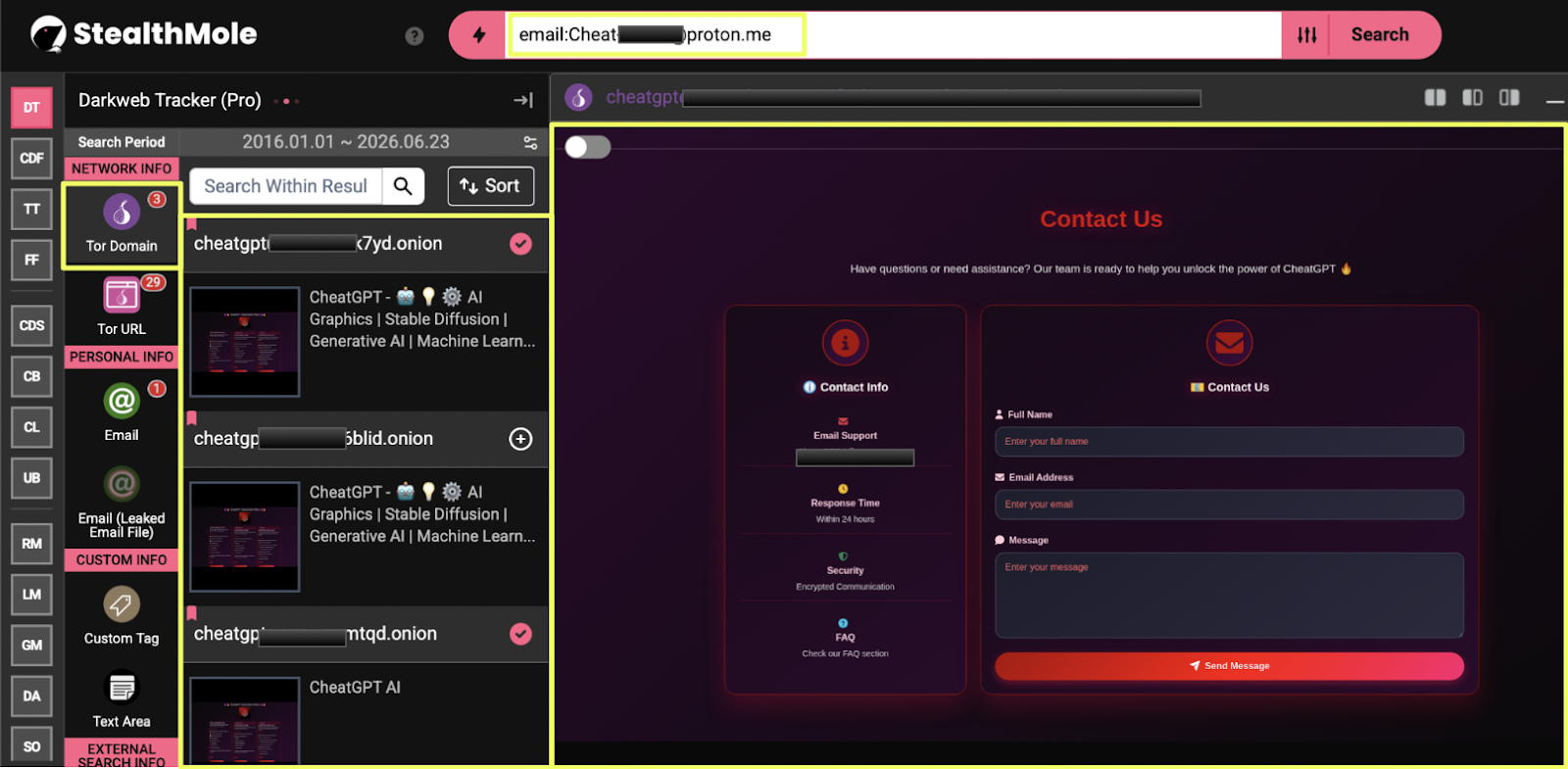
This provided a clear link between multiple CheatGPT mirrors and helped establish them as part of the same service rather than unrelated websites using a similar name.
More interesting findings emerged from the identifiers wo****t@cock.** and wo***t@xmpp.**.
Rather than being limited to WormGPT infrastructure, these addresses appeared across multiple services examined during the investigation. The address wormgpt@cock.li was linked to:
- wormgpt**********************************************qqd.onion
- wormgpt**********************************************uad.onion
- wormgpt**********************************************7ad.onion
- fraudcd**********************************************yyd.onion
- cheatgpt*********************************************lid.onion
Similarly, wo****t@xmpp.** was identified across multiple WormGPT mirror domains and was also linked to CheatGPT infrastructure.
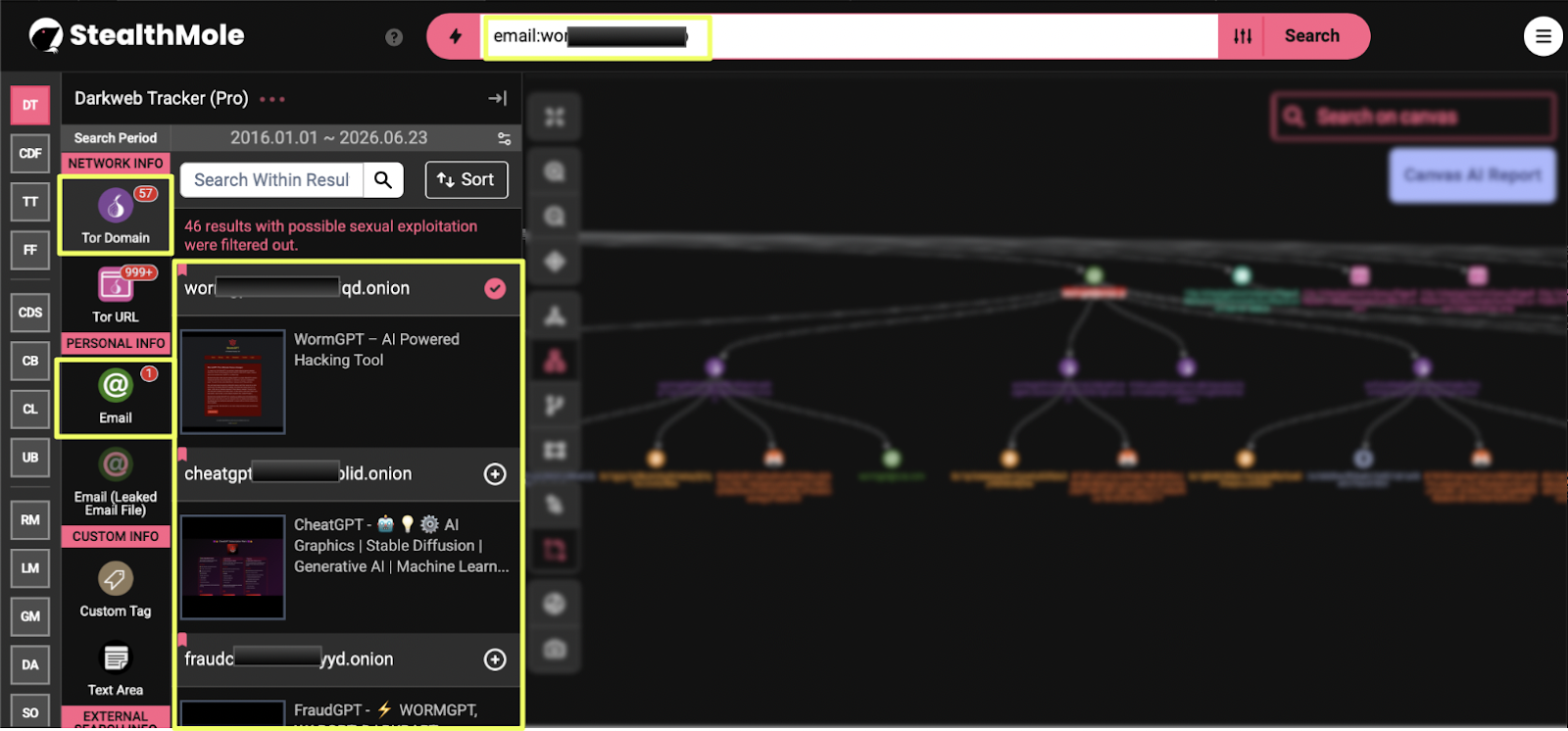
This pattern stood out because the services involved were marketed as separate products. CheatGPT, WormGPT, and FraudGPT each presented themselves as independent platforms with their own branding and identities. Yet behind the scenes, the same communication channels repeatedly appeared across their infrastructure.
The findings did not conclusively establish common ownership. However, they did demonstrate that the platforms were not as isolated from one another as their branding suggested. The repeated reuse of the same contact identifiers across multiple services provided another layer of overlap alongside the cryptocurrency infrastructure already identified during the investigation.
By this stage, several independent investigative paths had produced similar results. Wallet analysis, payment infrastructure, mirror domains, and communication channels all pointed toward a closely connected ecosystem operating behind multiple dark web services.
One final lead remained. During the investigation, an exposed server-status page revealed a potentially interesting infrastructure artifact. While it initially appeared promising, further analysis would produce a very different outcome.
Looking Beyond the Front-End
As the investigation progressed, attention shifted toward potential infrastructure artifacts that might provide additional insight into the services operating behind CheatGPT.
One such lead emerged from a server-status page associated with the platform:
- http://cheatgpt********************blid.onion/server-status
The page exposed the IP address:
- **7.**7.**3.**3
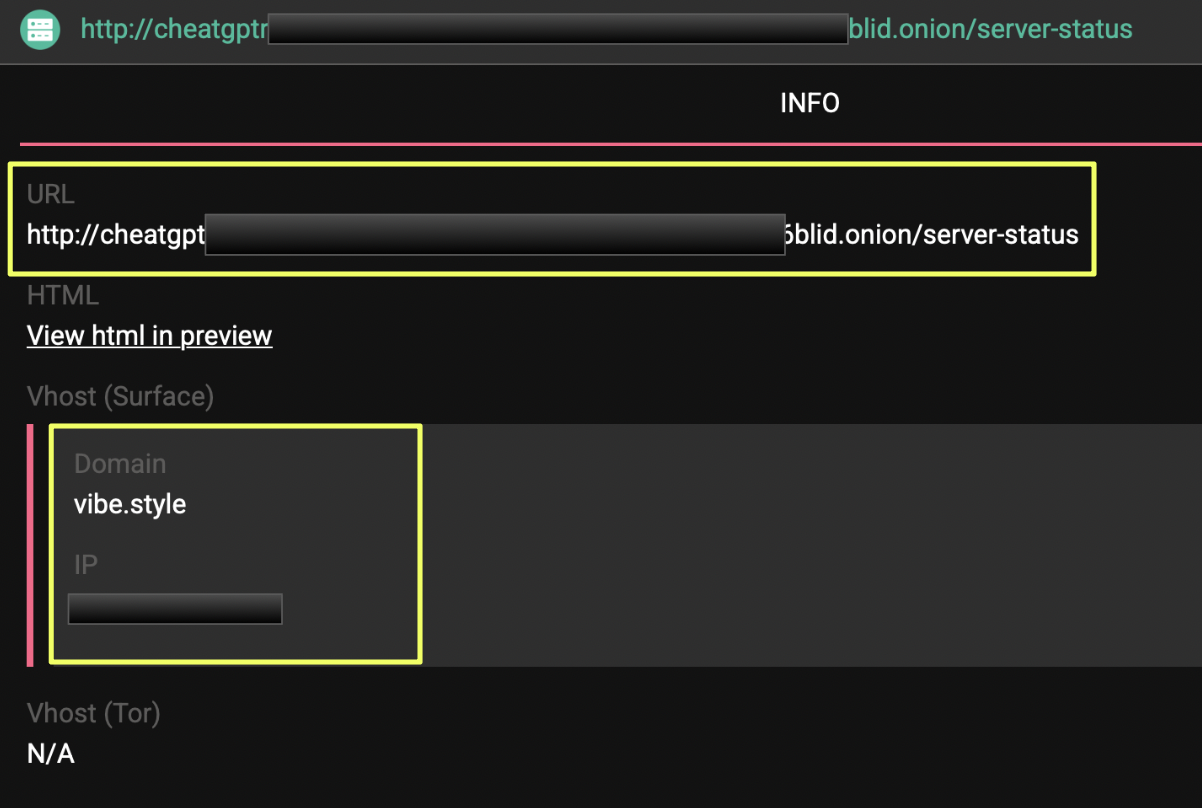
At first glance, the finding appeared noteworthy. Infrastructure-related artifacts can occasionally provide valuable clues regarding hosting arrangements, shared resources, or operational relationships between services. As a result, the IP address was examined further within StealthMole.
However, the follow-up investigation produced a different picture.
Searches revealed that the same IP address appeared across multiple unrelated server-status pages and was referenced within content that showed no obvious connection to CheatGPT, WormGPT, FraudGPT, or any of the other services identified during the investigation. Rather than functioning as a unique infrastructure indicator, the IP appeared to be associated with a broader collection of records that could not be reliably linked to any specific platform.
As a result, the artifact was treated with caution.
While the IP address was documented as part of the investigation, the available evidence was insufficient to establish it as a meaningful attribution indicator. Unlike the cryptocurrency wallets, contact identifiers, and mirror domains identified elsewhere in the investigation, the server-status finding did not provide a reliable basis for linking services or identifying operators.
The distinction is important.
Dark web investigations frequently generate large volumes of technical artifacts, but not every artifact carries the same evidentiary value. In this case, the IP address represented an interesting lead rather than a confirmed finding, and it was ultimately excluded from the broader attribution assessment.
Even without the server-status discovery, however, the investigation had already uncovered a substantial collection of overlapping infrastructure, payment mechanisms, and communication channels connecting multiple dark web services. Taken together, those findings painted a far more revealing picture than any single technical artifact could provide.
Conclusion
What began as a routine investigation into KidBin ultimately led far beyond its original scope.
The discovery of CheatGPT initially appeared to represent little more than another dark web service attempting to capitalize on the growing popularity of artificial intelligence. On the surface, the platform presented itself as a subscription-based chatbot designed to assist cybercriminals with activities ranging from phishing and malware development to other offensive cyber operations.
However, as the investigation progressed, the focus shifted away from the platform's marketing claims and toward the infrastructure supporting it.
Through a series of cryptocurrency pivots, multiple overlaps were identified between CheatGPT and a wider collection of dark web services. These connections extended across Bitcoin, Ethereum, and Monero payment mechanisms, linking CheatGPT to platforms operating under different names and serving different purposes. Further analysis revealed recurring contact identifiers, shared communication channels, and mirror infrastructure that appeared repeatedly throughout the investigation.
The findings did not conclusively establish that a single operator controlled every identified service. Attribution within dark web environments is rarely that straightforward. What the investigation did reveal, however, was a consistent pattern of shared infrastructure that challenged the appearance of independence presented by several of the platforms examined.
CheatGPT, WormGPT, and FraudGPT were found sharing more than a common theme. Cryptocurrency wallets, contact identifiers, communication channels, and supporting infrastructure repeatedly intersected across multiple services, suggesting the existence of a closely connected ecosystem operating behind a collection of seemingly separate brands.
Perhaps the most notable aspect of the investigation was not the discovery of a dark web AI chatbot itself, but what emerged when the surrounding infrastructure was examined. A service that initially appeared to be a standalone platform became the entry point into a much broader network of interconnected services, demonstrating how seemingly unrelated investigations can converge when viewed through the lens of shared operational artifacts.
In the end, the investigation serves as a reminder that the most valuable intelligence findings are often uncovered not on a website's front page, but within the infrastructure quietly supporting it.
Editorial Note
Dark web investigations rarely follow a straight path. What begins as the analysis of a single platform can quickly expand into a much broader examination of interconnected services, shared infrastructure, and overlapping operational footprints. While definitive attribution often remains difficult, the ability to identify and follow these connections is critical to understanding how underground ecosystems function.
This investigation demonstrates how StealthMole's extensive indexing of dark web content, cryptocurrency artifacts, communication channels, and historical infrastructure can help investigators move beyond surface-level observations and uncover relationships that might otherwise remain hidden.
To access the unmasked report or full details, please reach out to us separately.
Contact us: support@stealthmole.com
Labels: AI, Featured, Hacker Chatbot
.svg)
.svg)
.svg)