From Mass Defacements to Targeted Ransomware: Exploring Canada’s Threat Landscape Through Brain Cipher
 |
Canada’s digital exposure presents a layered picture, one that goes beyond isolated incidents and points toward a broader, evolving threat environment. Initial observations reveal a high volume of defacement activity targeting publicly accessible web assets, suggesting widespread automated exploitation and surface-level vulnerabilities. At the same time, parallel findings from leaked data and ransomware monitoring indicate a more structured and financially motivated threat landscape operating beneath this noise.
This contrast between scale and sophistication raises an important question: how do opportunistic attacks and organized ransomware operations coexist within the same ecosystem, and what does that reveal about the overall risk profile?
Starting from a broad sweep of Canada-related activity across multiple monitoring layers, this investigation gradually narrows its focus to a single ransomware actor, Brain Cipher. What begins as a wide-angle view of exposure ultimately leads to a deeper look at how one group operates within, and takes advantage of, this environment.
The sections that follow trace that shift, from surface-level disruptions to a more deliberate and coordinated operation, uncovering how different layers of threat activity intersect in practice.
Canada’s Cyber Threat Environment: From Surface Exploits to Structured Intrusions
The investigation did not begin with a single incident. It started with a broad sweep, looking at how often Canada appeared across different layers of StealthMole’s monitoring.
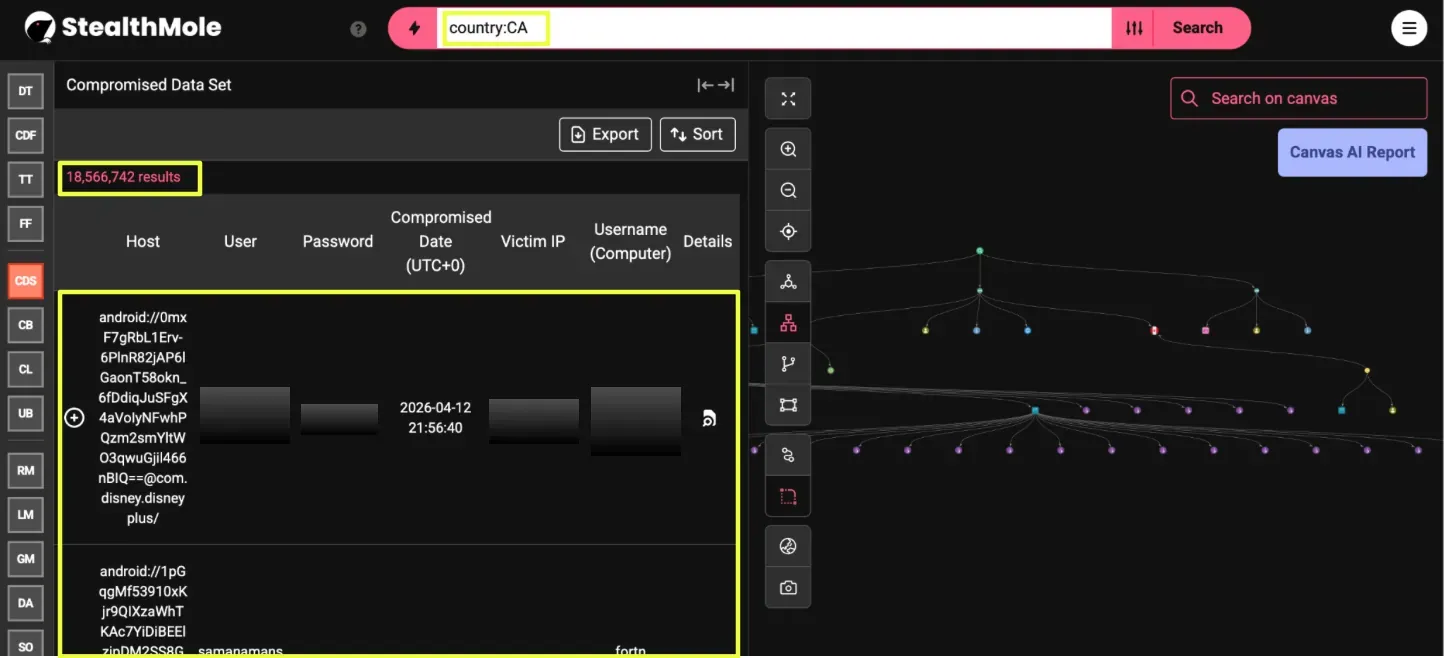
One of the first signals came from the Compromised Data Set tool. A search for Canada returned 18 Million results, representing exposed credentials linked to Canadian users and systems. The scale here was hard to ignore. These were not isolated leaks but part of a continuous stream of compromised data circulating across underground sources. It sets the tone early: exposure at this level is not occasional, it’s persistent.
 |
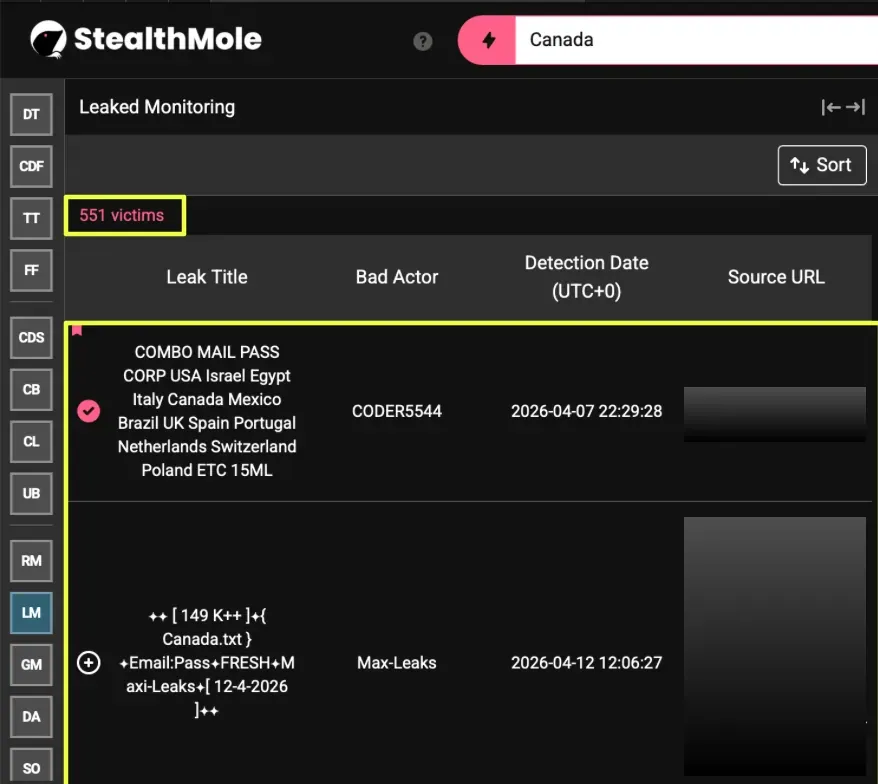
Building on that, leaked data monitoring showed over 500 exposed entries tied to Canada, including database leaks and credential dumps. While smaller in number compared to the dataset results, these entries provided clearer visibility into how such data was being packaged, shared, and redistributed.
 |
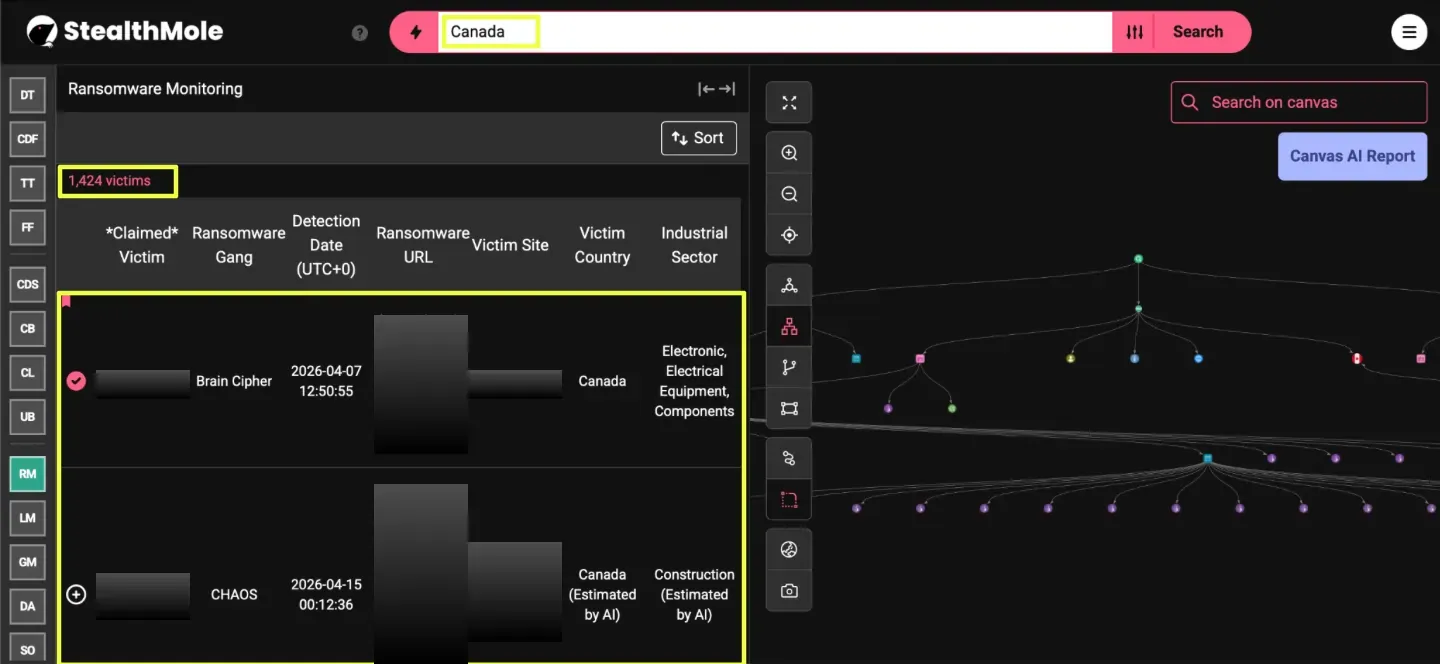
Ransomware monitoring added another layer entirely. Here, the volume increased significantly, with over 1,400 victim listings associated with Canadian entities. These were not just exposures: they represented confirmed incidents where organizations had been named, and in many cases, had data published on leak sites. The consistency of these listings suggested that Canada was a recurring target within ransomware operations.
 |
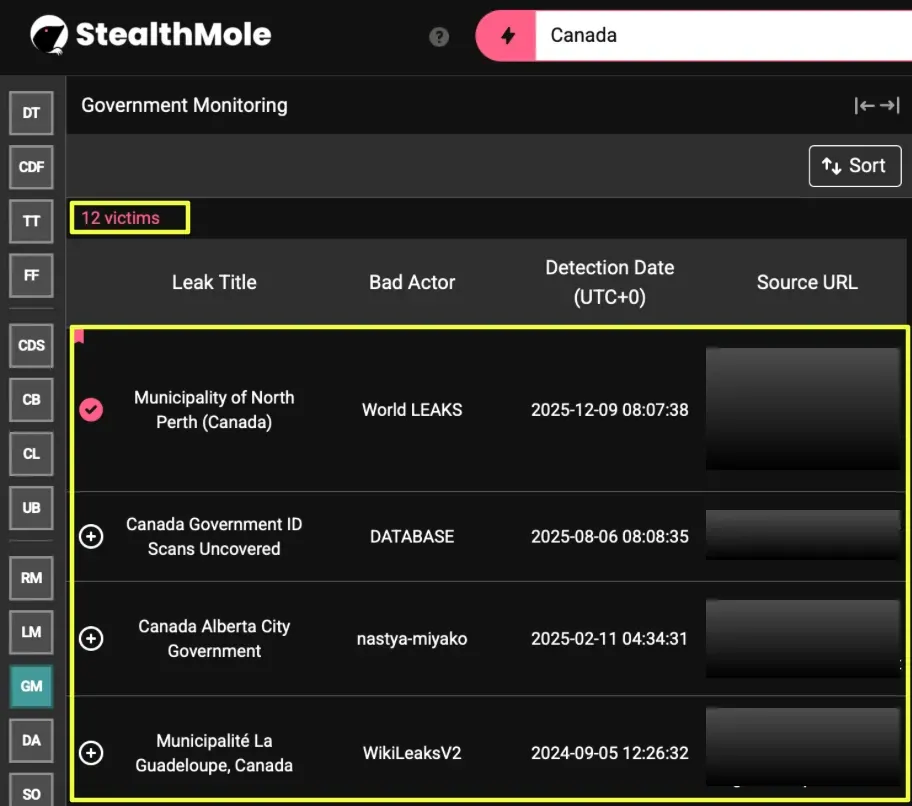
Government-focused monitoring revealed a more selective pattern. A total of 12 entries were identified involving government-related entities. While limited in number, the nature of these targets made them more sensitive, pointing toward deliberate interest rather than opportunistic activity.
 |
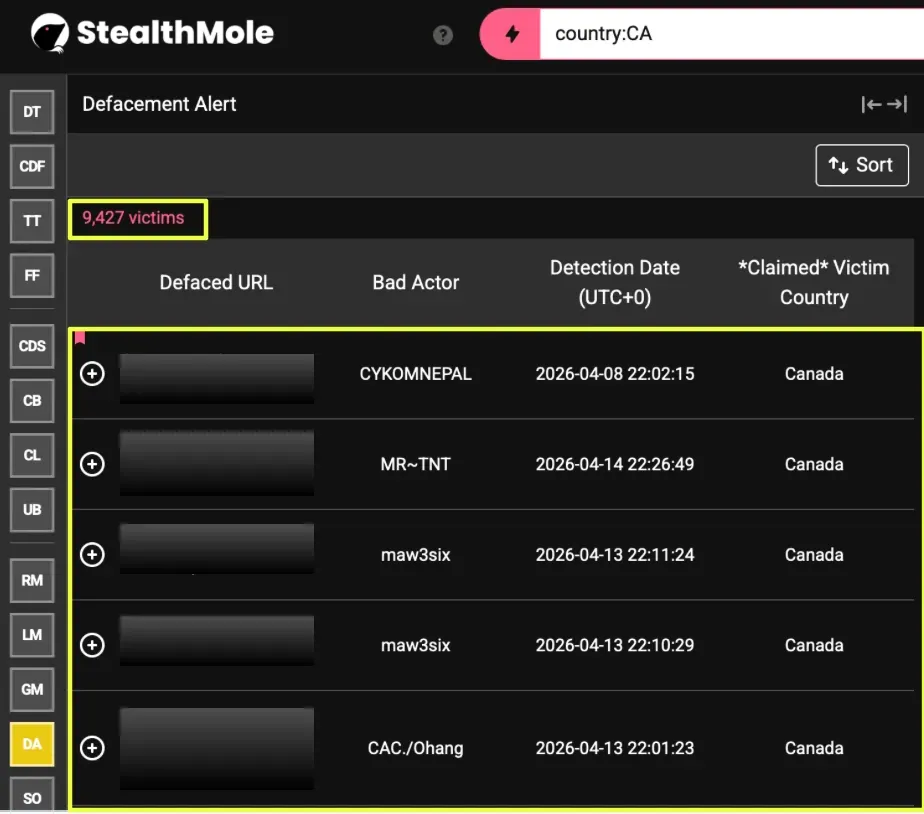
At the most visible layer, defacement monitoring highlighted ongoing exploitation of exposed systems. Within the observed dataset, over 9000 defacement cases were identified, affecting publicly accessible web assets. These incidents appeared low in complexity and were likely driven by automated scanning, but their frequency reinforced the same underlying issue: accessible systems with weak defenses.
 |
These layers painted a clearer picture. Canada’s cyber threat landscape is not defined by a single type of activity, but by the coexistence of scale and structure. On one end, millions of compromised credentials and frequent defacements point to widespread exposure. On the other, ransomware listings and targeted government-related activity reflect more deliberate, outcome-driven operations.
From Exposure to Exploitation: Identifying Brain Cipher Activity
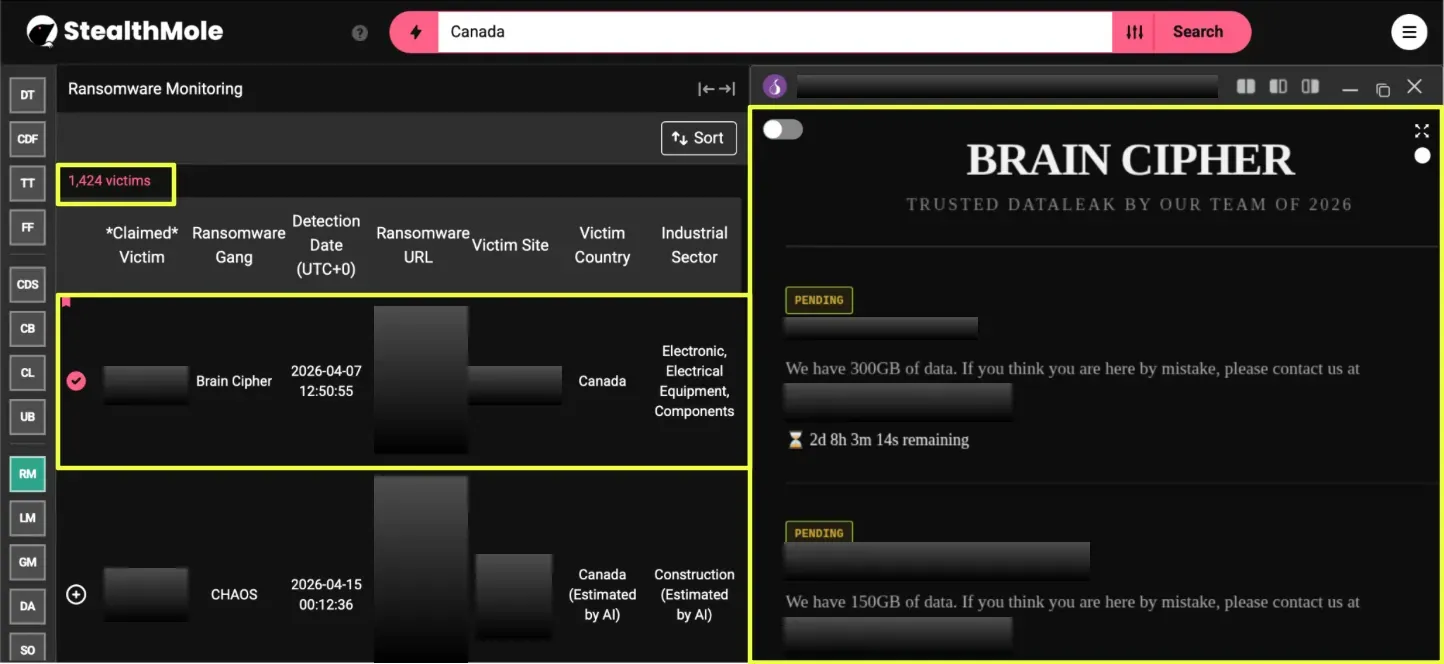
The shift from broad, opportunistic activity to something more structured became clear during ransomware-focused monitoring within StealthMole. Among the various signals, one entry stood out: a data leak associated with a Canadian entity. Unlike the earlier defacement cases, this was not about visibility. It pointed toward a deeper compromise.
The listing was traced back to a dedicated leak platform operated under the name Brain Cipher, marking the first direct link between the broader threat environment and a specific actor.
Accessing the victim-specific page revealed clear indicators of a ransomware operation. The page referenced exfiltrated data and provided structured instructions for engagement, suggesting that the intrusion had progressed beyond initial access into full-scale data compromise.
- http://vkvs**************************5hyd.onion/n/l*******ne
 |
What made this discovery particularly important was not just the victim itself, but how the information was presented. The layout, messaging, and supporting pages indicated that this was not an isolated operation but part of a maintained and organized infrastructure.
Further exploration of the same platform led to additional sections:
- http://vkvs*************************************5hyd.onion/faq
- http://vkvs***********************************5hyd.onion/rules
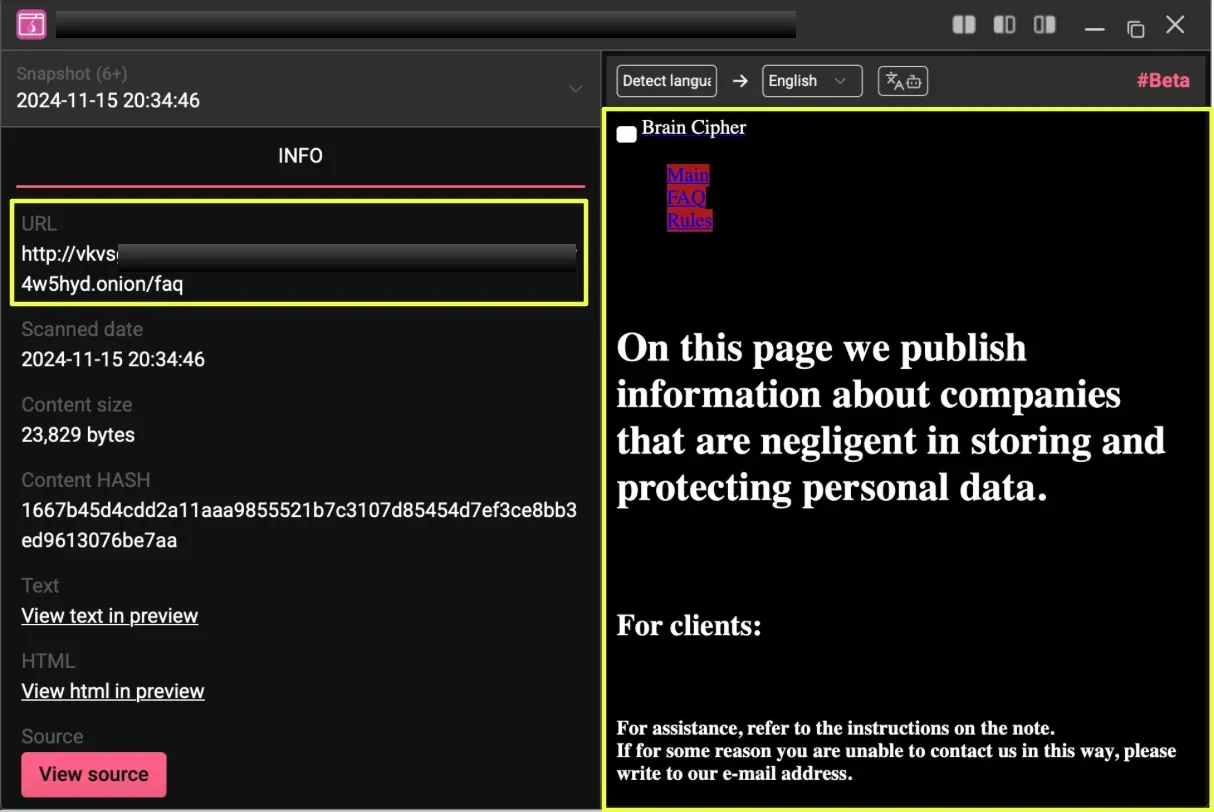 |
These pages outlined interaction guidelines, expectations, and communication processes, something rarely seen in opportunistic attacks. They reflected a level of operational consistency and intent that aligned more closely with established ransomware groups.
At this point, the investigation had clearly moved beyond general threat monitoring. What began as a high-level view of Canada’s exposure had now narrowed into a focused examination of a specific ransomware actor, one operating with defined processes, structured communication, and a visible presence within the ecosystem.
Secondary Access Points and Malware Linkage
While the primary Brain Cipher portal established the public-facing structure of the operation, further investigation revealed additional onion services directly linked to its activity, indicating that access to the ecosystem was not limited to a single entry point.
One such domain was identified during analysis of the Liteline leak page:
- http://zijgmuqjzb6dc7pofxhtaiz36qqyg35lhutybmzaz6whzgei2casjgid.onion
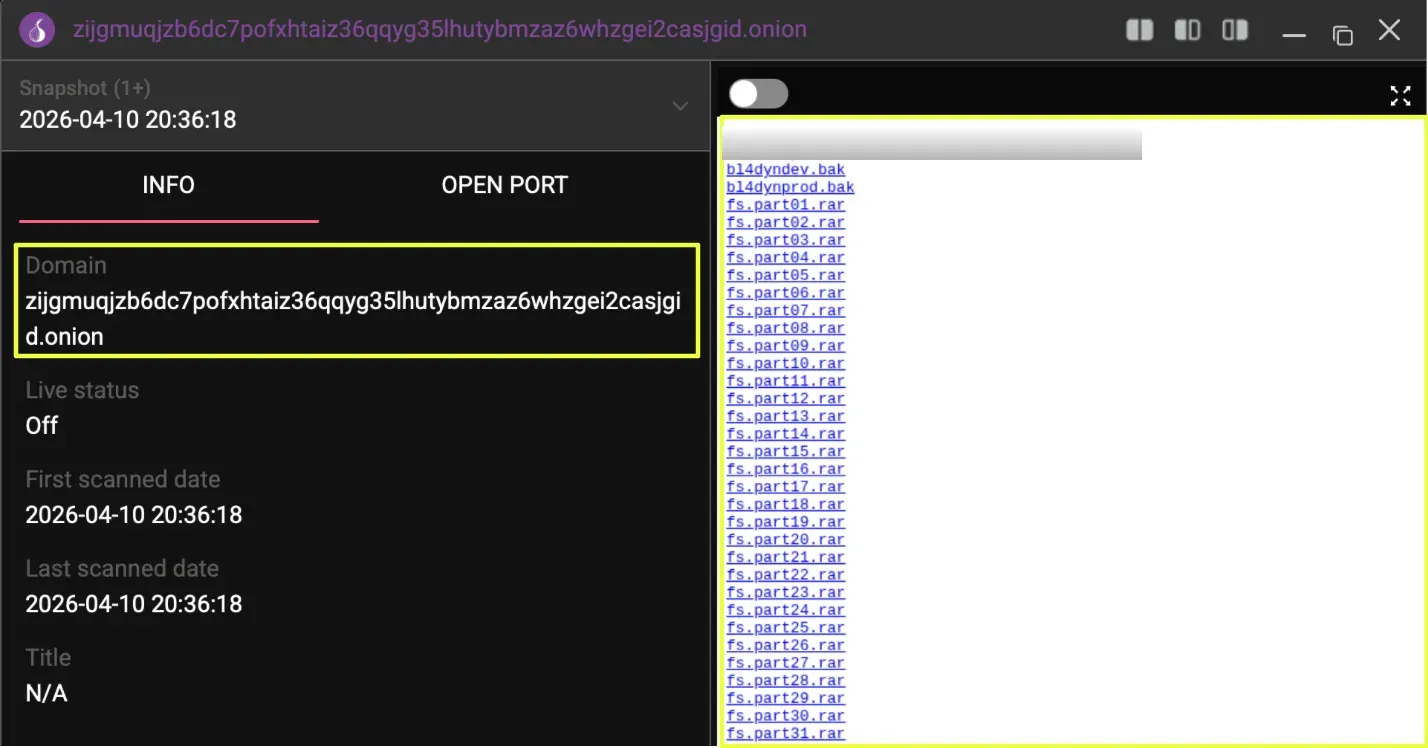 |
This domain appeared as a linked resource within the same environment, suggesting that it functioned as an auxiliary access point, likely used for data retrieval or distribution tied to specific victims. Its direct association with the victim page strengthens its relevance as part of the operational infrastructure rather than an unrelated node.
A second, more functionally distinct domain was identified through further pivoting:
- http://mybmtbgd7aprdnw2ekxht5qap5daam2wch25coqerrq2zdioanob34ad.onion
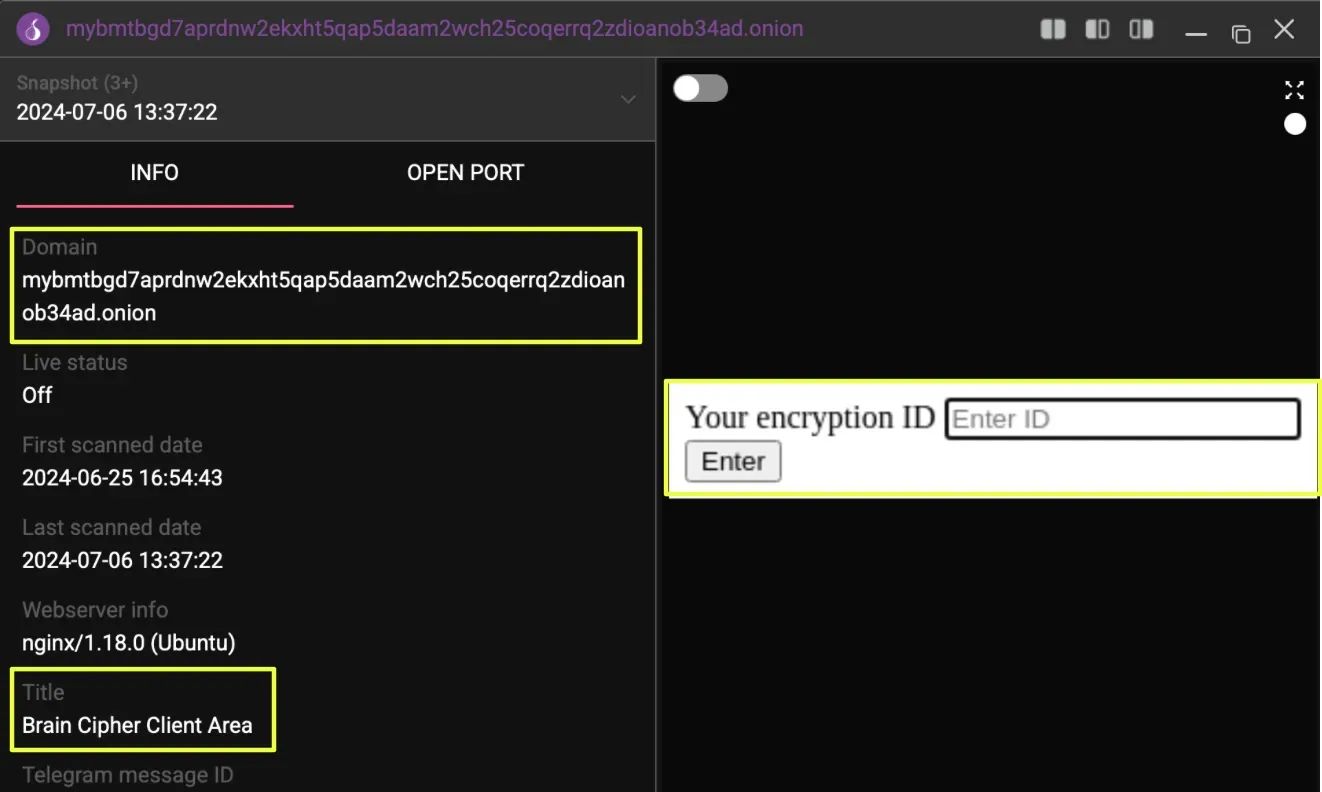 |
Unlike the leak site, this environment presented characteristics consistent with a support or interaction portal, indicating its role in facilitating communication or access during the post-compromise phase. This distinction highlights a separation between public exposure and operational engagement, reinforcing the structured nature of the group.
More importantly, this portal provided direct access to technical artifacts associated with the operation.
A total of 7 malware hashes were identified in connection with this domain:
- eb829*********************************************************12
- 6e07d*********************************************************17
- 4333**********************************************************34
- abc99*********************************************************7f
- c947f*********************************************************c9
- da2c6*********************************************************5f
- 27a3**********************************************************dd
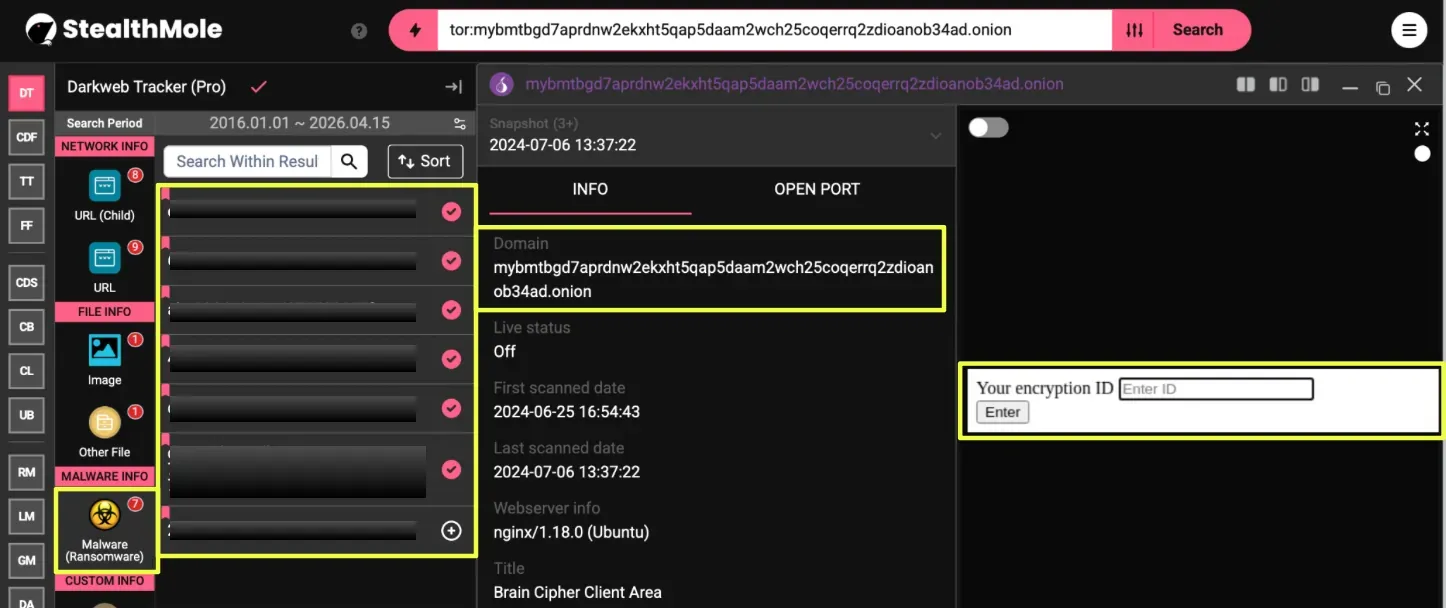 |
Notably, the final hash in this list was also observed in association with the primary Brain Cipher infrastructure, creating a direct linkage between the malware used in attacks and the group’s visible platforms.
This overlap is significant. It moves the investigation beyond surface-level observation and into operational correlation, where infrastructure and payload artifacts begin to align.
Extracting Operational Artifacts from the Brain Cipher Portal
With the structure of the Brain Cipher leak site already established, the next step was to focus on what the platform actually reveals beyond its surface presentation. Rather than expanding outward immediately, the investigation remained anchored to the primary portal to extract operational artifacts directly tied to the group.
This is where the platform became far more revealing.
Embedded within the leak environment were multiple communication and transaction indicators, each pointing toward how Brain Cipher manages victim interaction and payments. Among the most prominent was a Monero (XMR) wallet address:
- 42m1Si************************************************fFH
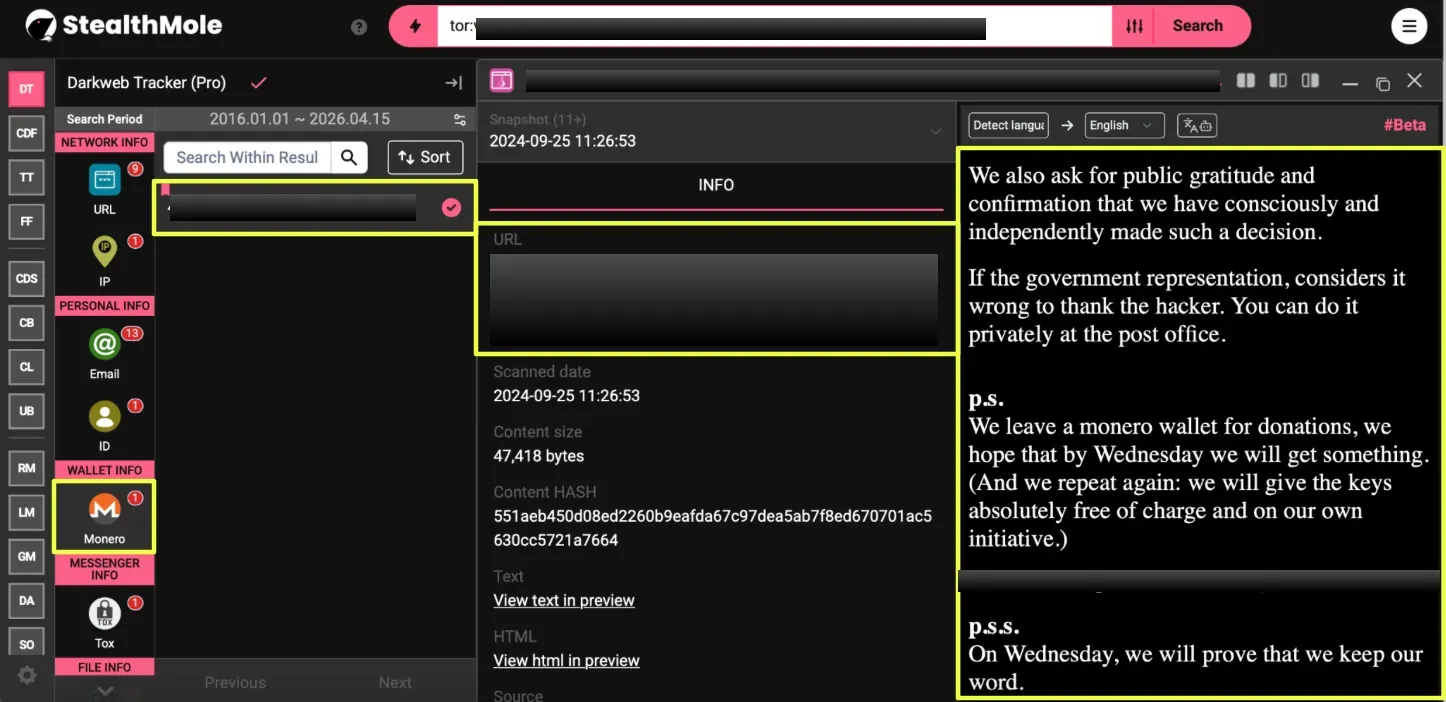 |
The use of Monero aligns with standard ransomware practices, emphasizing privacy and transaction obfuscation. Its presence within the portal confirms that financial handling is directly integrated into the group’s infrastructure rather than managed externally.
Alongside this, a TOX ID was identified:
- BEBA1*****************************************095
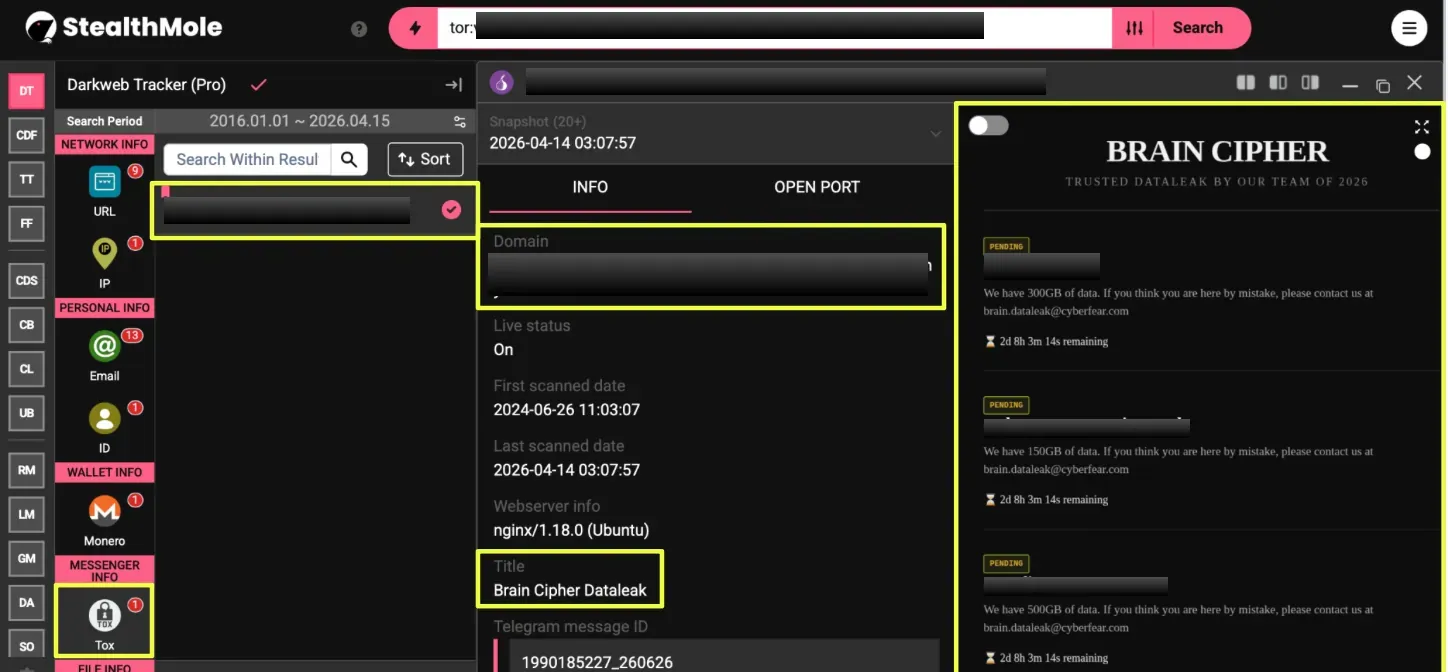 |
This provides an additional anonymous communication channel, reinforcing that Brain Cipher does not rely on a single method of contact but instead offers multiple pathways for victim engagement.
Email communication also appeared consistently across the portal, with addresses such as:
- brain*d****k@cybe*****r.com
Unlike externally sourced mentions, this instance was embedded directly within the platform itself, confirming it as an actor-controlled contact point rather than a secondary reference.
Beyond communication and payment indicators, the portal also exposed technical artifacts linked to the operation. A set of six malware hashes was identified in association with the infrastructure:
- 7d67c********************************************************952
- cc34b********************************************************3e3
- ec089********************************************************67f
- 27a3c********************************************************6dd
- 661608*******************************************************a73
- 2d04d*******************************************************68a7
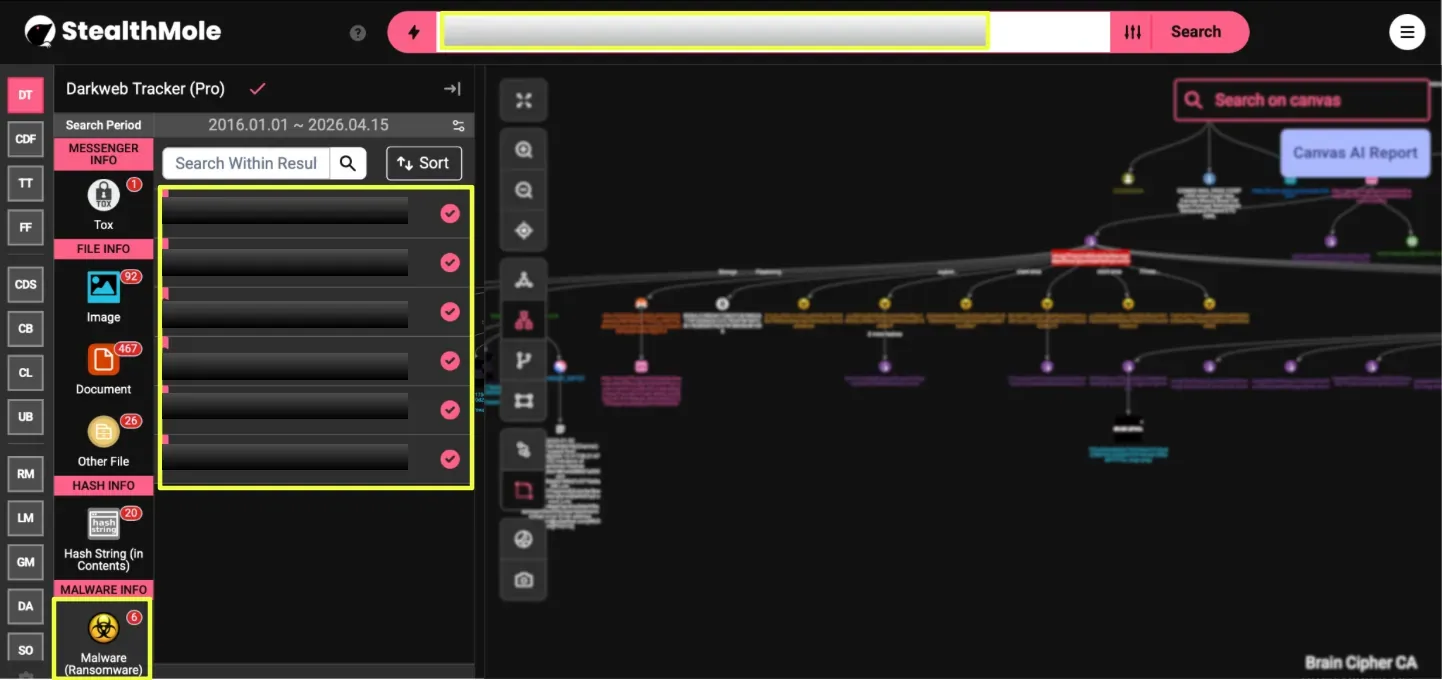 |
These hashes were not isolated findings. They were directly linked to onion-based infrastructure associated with the same portal, suggesting a connection between the malware used in attacks and the group’s hosting environment.
Further inspection revealed references to additional onion services categorized by function, including storage and file-sharing nodes:
- zke5xim35cfolmq2h5i5sfmcoxr4pbpkfjwtq5lf6o4zo7avfcvnb5qd.onion (storage)
- 4ldgw2wuidqu5ef3rzx4byonf3y7rdnh43jiw2z4sbtjiwic6gkov7yd.onion (file sharing)
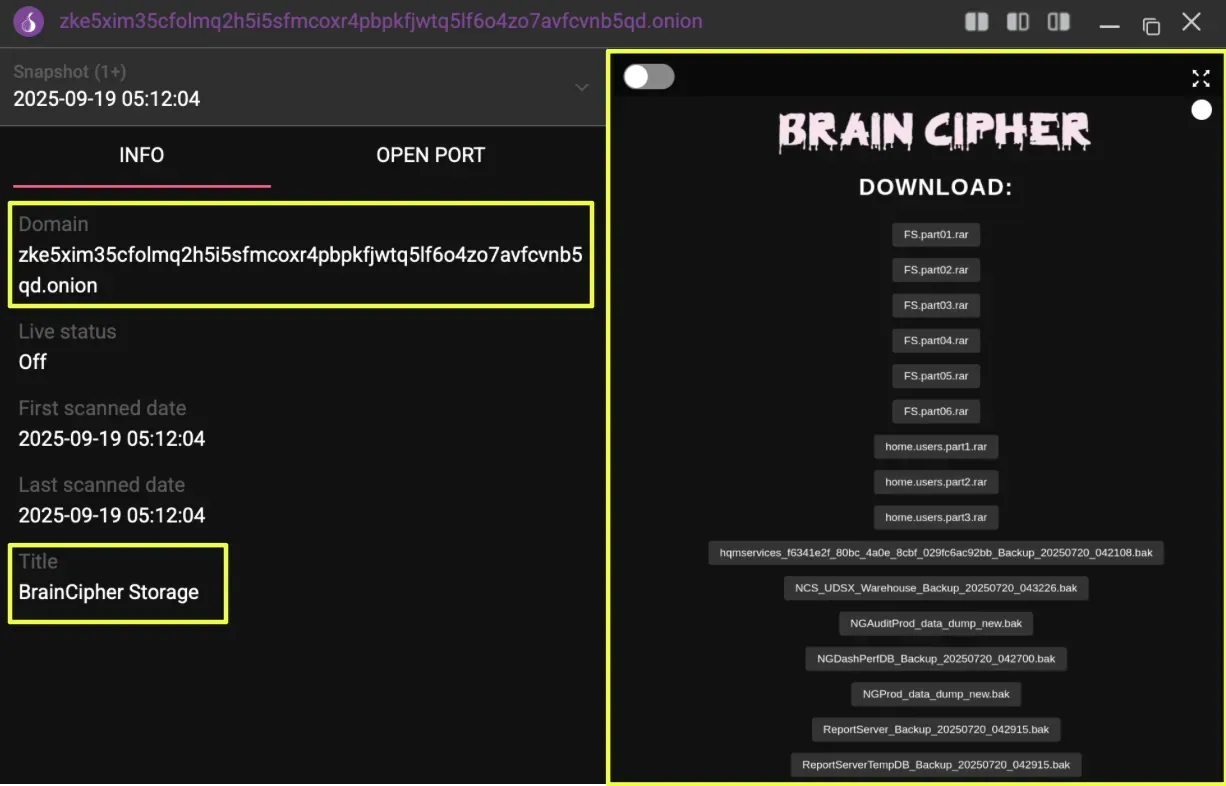 |
These links were embedded within the broader ecosystem connected to the primary portal, indicating that data hosting and distribution were handled through separate but related services.
The investigation had moved beyond simply identifying Brain Cipher as a ransomware actor. By focusing on artifacts extracted directly from the primary portal, it became possible to see how communication, payment, malware deployment, and data hosting were all interconnected within a single operational framework.
Expanding the Infrastructure: Storage Nodes and Data Distribution
With key artifacts extracted from the primary portal, the investigation moved to understand how Brain Cipher handles one of the most critical parts of ransomware operations, the storage and distribution of exfiltrated data.
The earlier discovery of storage and file-sharing references was not incidental. It pointed toward a broader infrastructure designed specifically for hosting victim data outside the main leak site.
Further analysis revealed a network of onion domains, each following a consistent structure and presentation. These included:
- 5v6t*************************************************7qd.onion
- ncyg**************************************************id.onion
- xangd**********************************************4j3ad.onion
- bgpeq***********************************************5iyd.onion
- pzghj***********************************************ysyd.onion
- oe7kc***********************************************elqd.onion
- tahr6***********************************************7tyd.onion
- as7fb************************************************tyd.onion
- zv27q************************************************sad.onion
- i6b4r8***********************************************kid.onion
- ixvar************************************************ryd.onion
- p6wmo***********************************************6pad.onion
- ubet*************************************************jid.onion
- zktn*************************************************qad.onion
- yt7be************************************************cad.onion
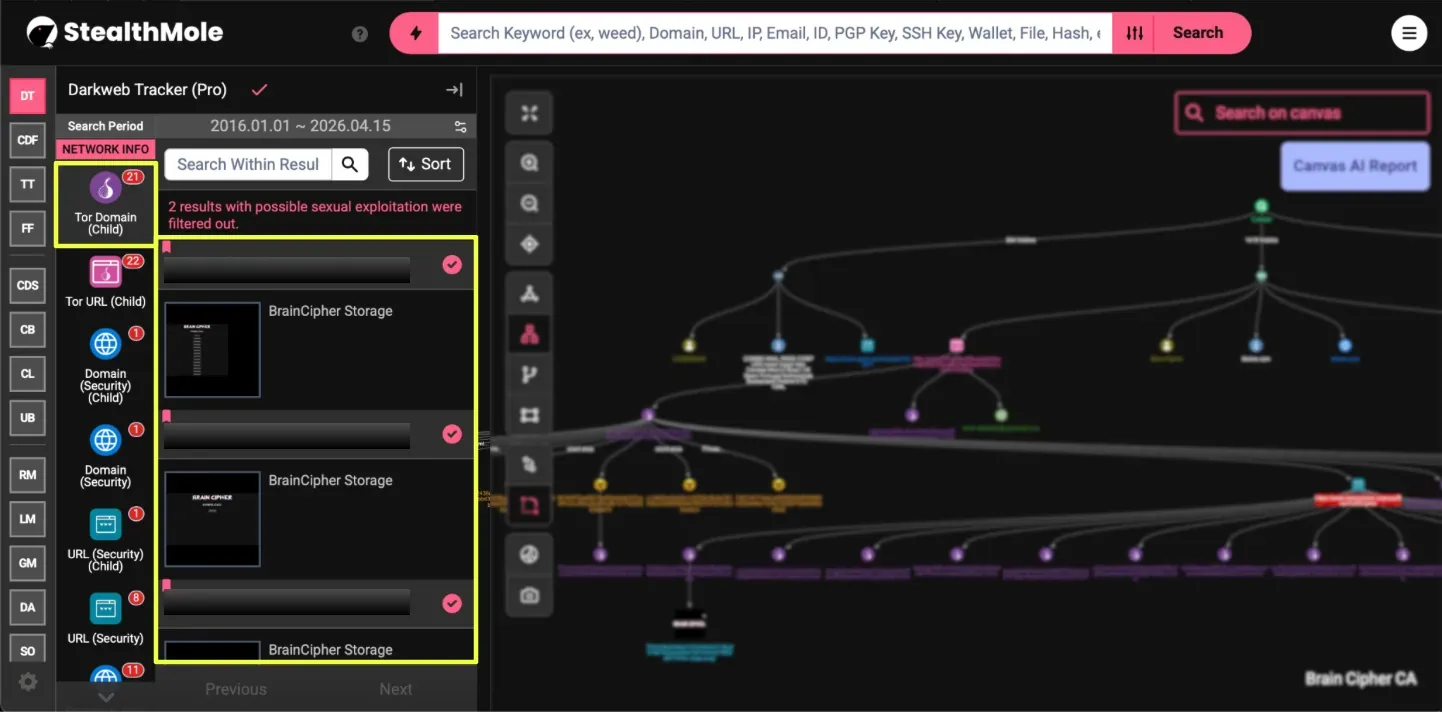 |
Across these nodes, a clear pattern emerged. The interfaces were consistent, often labeled as BrainCipher storage environments, and hosted compressed data archives segmented into multiple parts (e.g., .part01.rar, .part02.rar). This type of structuring suggests that large datasets were deliberately broken down for easier distribution and controlled access.
What’s important here is not just the number of domains, but the role they play.
Unlike the main leak site, which serves as a public-facing pressure mechanism, these storage nodes function as the data backbone of the operation. They are where exfiltrated information is actually hosted, staged, and made available for download, whether for victims under negotiation or for public release after deadlines are missed.
The presence of multiple such nodes indicates that Brain Cipher does not rely on a single hosting point. Instead, the operation appears to distribute data across several onion services, likely improving resilience and reducing the risk of disruption.
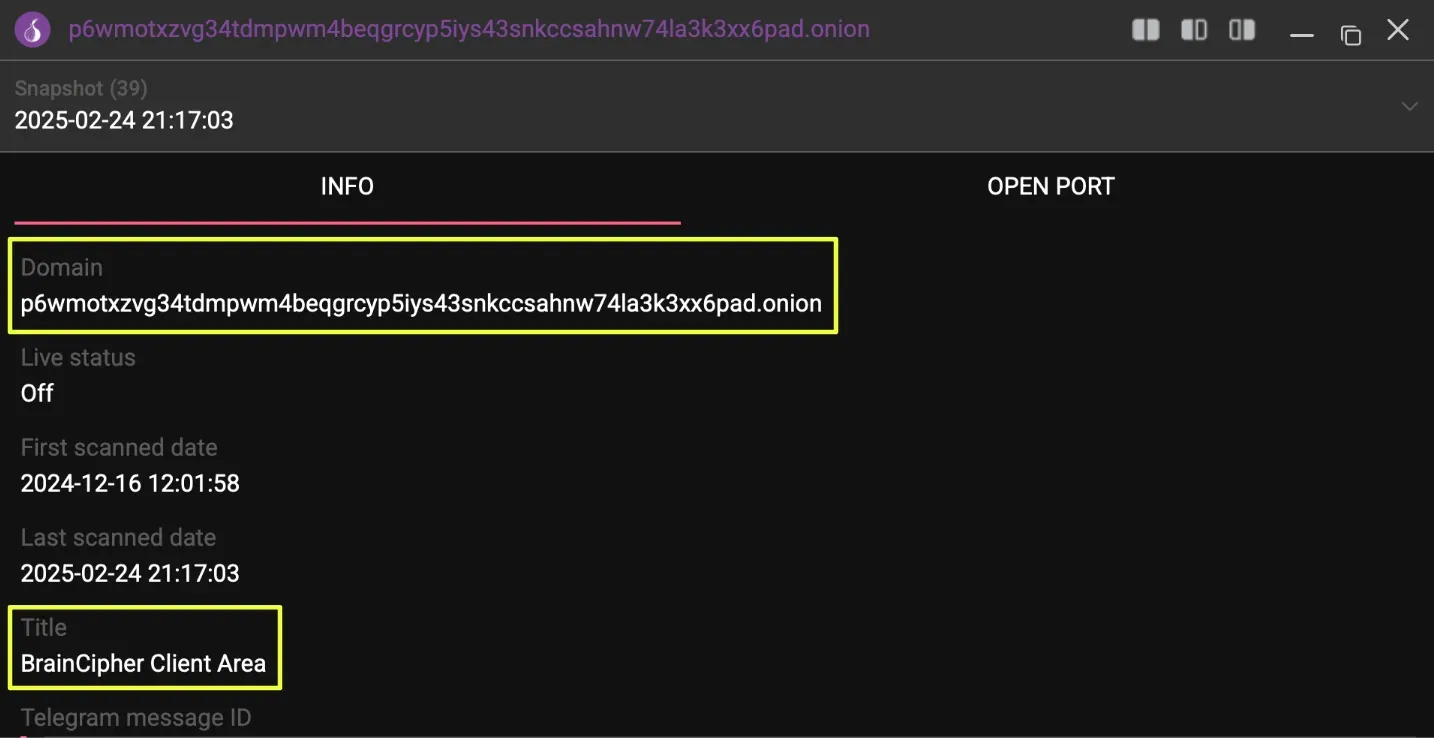
Additionally, one of the identified domains was observed functioning as a client-oriented interface, further reinforcing the idea that access to data is managed in a controlled manner rather than openly exposed.
- p6wmotxzvg34tdmpwm4beqgrcyp5iys43snkccsahnw74la3k3xx6pad.onion
 |
Communication Channels and External Visibility
With the infrastructure mapped, the next step was to understand how Brain Cipher communicates with victims and how its presence extends beyond its own controlled environment.
One of the clearest indicators came from the reuse of multiple email addresses across the operation. In addition to the previously identified contact, further analysis revealed:
- brain*s****t@cybe*****r.com
- brain*de***t@cybe*****r.com
- brain*d*****k@cybe***ar.com
The structure of these addresses is notable. Rather than relying on a single point of contact, Brain Cipher appears to segment communication based on function—support, decryption, and data-related interaction. This suggests a more organized workflow, where different stages of the ransomware process are handled separately.
Beyond direct communication, the investigation also identified external references to this infrastructure through StealthMole’s Telegram tracking.
Mentions of Brain Cipher were observed within a channel titled:
- https://t.me/RFrepoV1Chat (Raidforums | Discussion)
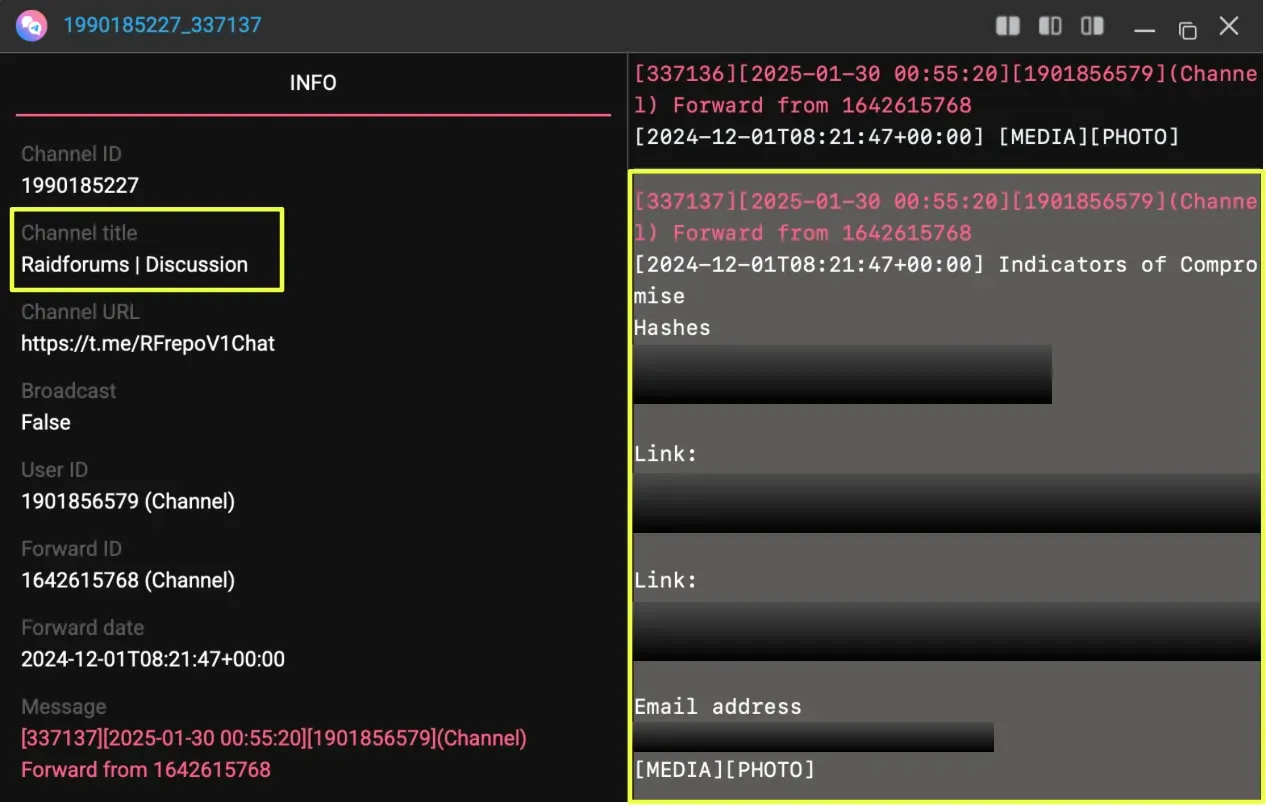 |
Within this channel, a forwarded message contained a cluster of indicators associated with the operation, including:
- The primary leak site
- A support portal link
- Associated email addresses
This finding is important for two reasons.
First, it shows that Brain Cipher’s infrastructure is not confined to its own onion services. The links and contact details are being shared in external discussion spaces, increasing visibility and accessibility.
Second, the format of the message suggests redistribution rather than original posting. This indicates that the information is circulating within underground communities, where it can be accessed, discussed, and potentially reused by others.
Together, these communication patterns highlight a dual-layer presence. On one side, Brain Cipher maintains controlled, direct channels for victim interaction. On the other, its infrastructure is passively propagated through external platforms, extending its reach beyond its own ecosystem.
This combination of structured communication and external visibility reinforces the idea that the operation is not only organized internally, but also embedded within a wider underground network.
Conclusion
What began as a broad examination of Canada’s cyber threat environment revealed more than just volume, it exposed a layered ecosystem where different types of activity coexist and, in some cases, reinforce one another.
At the surface level, the presence of millions of compromised credentials and frequent defacement incidents points to widespread exposure. These signals, while often low in complexity, highlight how accessible and continuously targeted publicly facing systems remain. On their own, they may appear fragmented, but collectively they create an environment where vulnerabilities are not just present, they are consistently discoverable.
Within this same landscape, ransomware activity represents a more deliberate layer. The identification of Brain Cipher through the Liteline case provided a clear example of how structured actors operate within this environment. Rather than relying on opportunistic disruption, the group demonstrates a coordinated approach, moving from intrusion to data exfiltration, followed by controlled disclosure and managed interaction.
The investigation showed that this operation is not built around a single platform, but a system. Each component, whether it is the leak site, communication channels, or distributed storage nodes, serves a specific purpose. Together, they form a workflow where exposure, negotiation, and data distribution are handled as separate but interconnected stages.
What makes this particularly relevant in the context of Canada is not just the presence of such actors, but the conditions that enable them. A landscape characterized by high exposure and continuous low-level exploitation provides both the opportunity and the entry points for more organized operations to take hold.
In this sense, Brain Cipher is not an isolated case. It is an example of how structured ransomware activity can emerge from, and operate within, a broader environment shaped by scale, accessibility, and persistence.
Editorial Note
Investigating ransomware activity and dark web infrastructure is rarely straightforward, as visibility is often fragmented and constantly shifting. While this case establishes clear connections between Brain Cipher’s leak platform, supporting infrastructure, and operational artifacts, it is important to recognize that such attribution is built through correlation rather than absolute certainty. This case shows how StealthMole helps cut through that uncertainty by connecting signals across multiple layers, enabling a clearer and more reliable understanding of threat activity.
To access the unmasked report or full details, please reach out to us separately.
Contact us: support@stealthmole.com
Labels: Featured, Malicious Group
.svg)
.svg)
.svg)