JulyJailbait: Reconstructing an Underground CSAM Ecosystem
Dark web continues to host a wide range of illicit platforms that cater to criminal markets, from stolen data and malware to illegal services and child sexual abuse material (CSAM). While many of these websites disappear as quickly as they emerge, others remain active for years by continuously adapting their infrastructure, replacing seized or abandoned domains, and maintaining access through mirror sites and alternative payment mechanisms. As a result, investigating these platforms often requires looking beyond what is immediately visible to understand how they continue to operate over time.

One such platform is JulyJailbait, also referred to as July Club, a long-running dark web website advertising access to a large collection of illegal material through paid memberships. At first glance, the platform appears to be just another onion service offering subscription-based access. However, its publicly visible pages reveal only a small part of a much broader ecosystem.

This investigation reconstructs that ecosystem using artifacts collected through StealthMole, following a series of investigative pivots that extend beyond the primary website. By correlating historical infrastructure, digital assets, cryptocurrency payment information, and other operational traces, the report demonstrates how seemingly isolated pieces of evidence can be combined to reveal a far more extensive underground network than the website alone suggests.

Following the First Lead

The investigation began with the identification of the primary JulyJailbait onion service:

  • julyl************************************************pid.onion
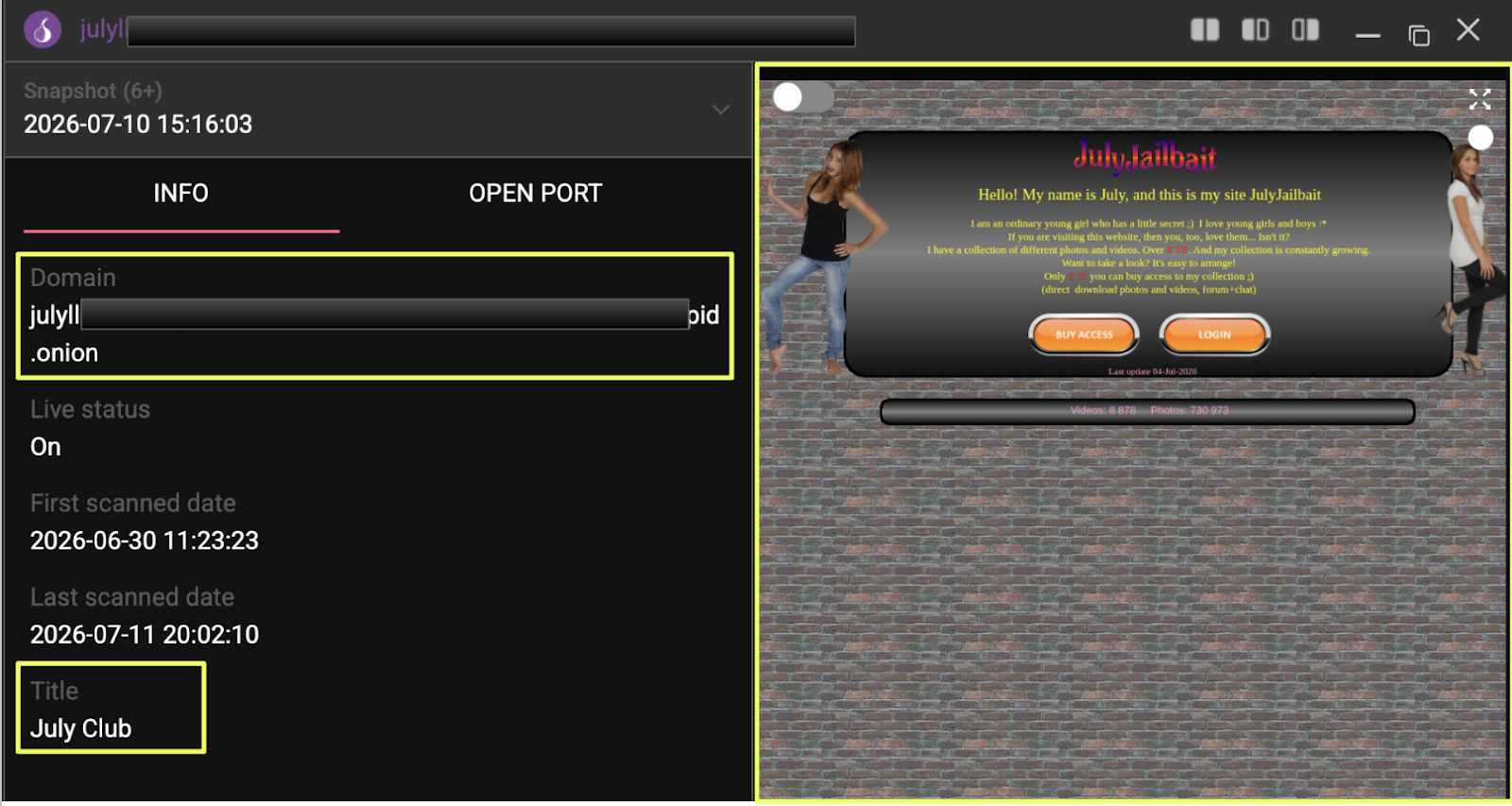
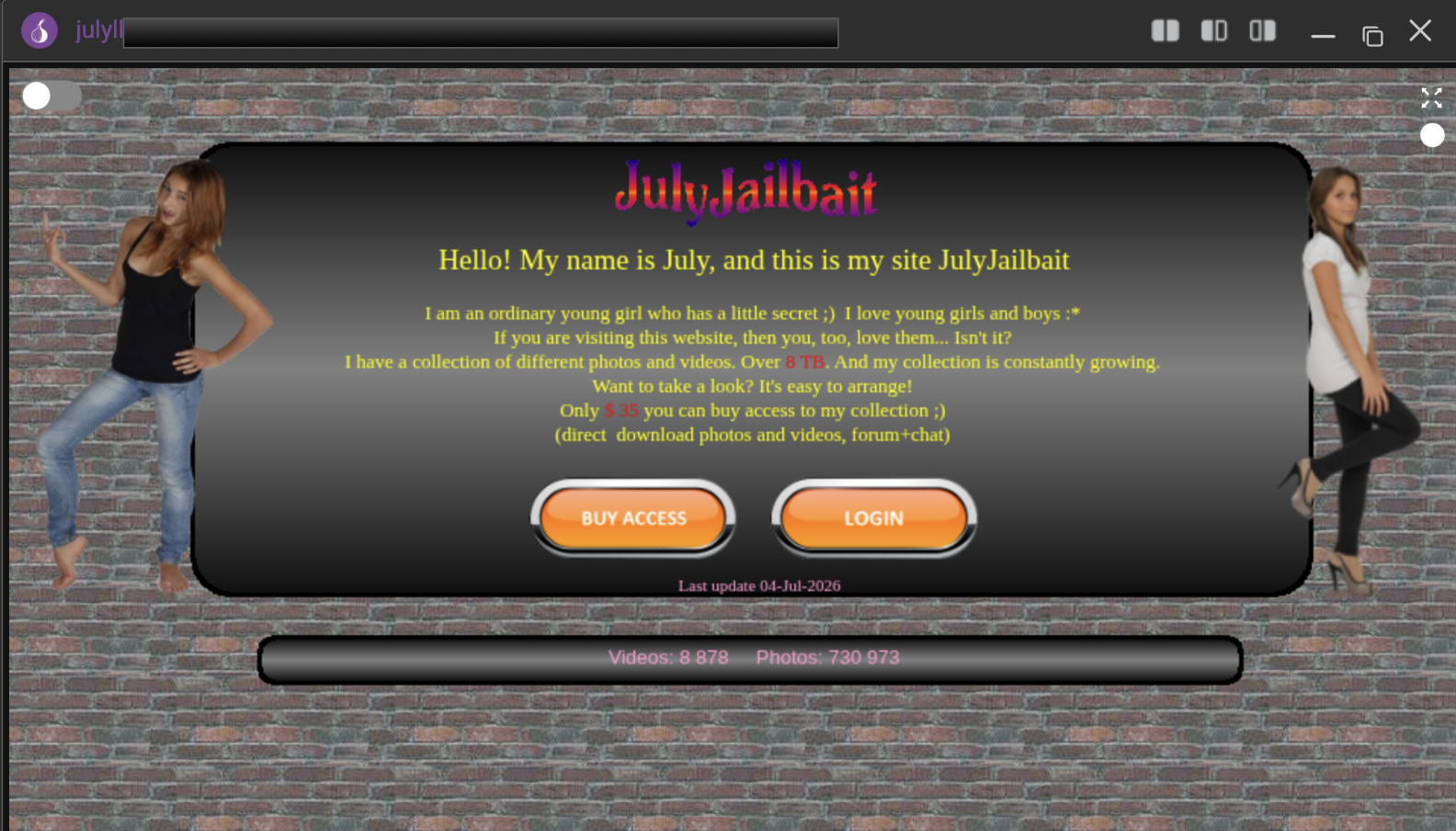
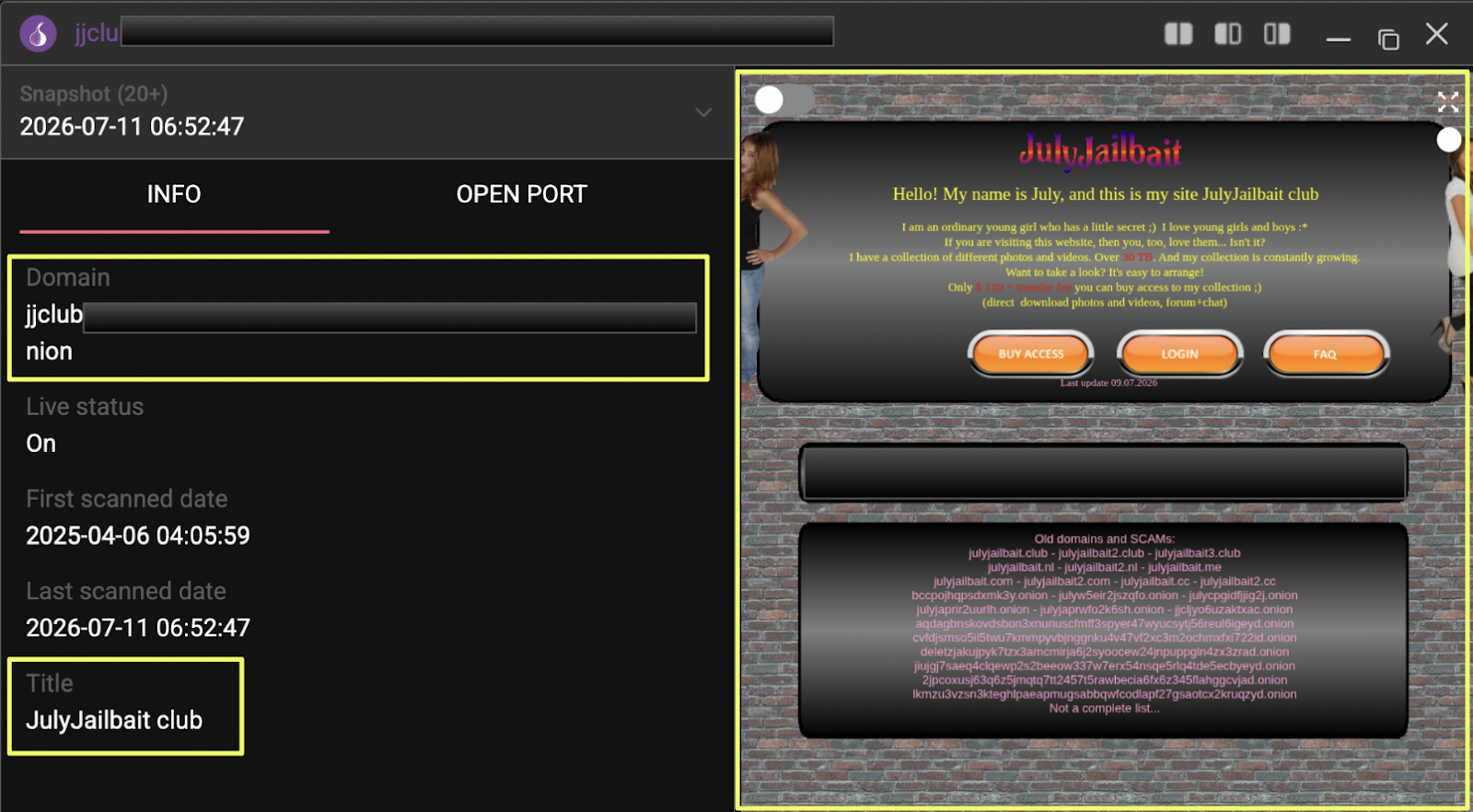
Historical snapshots indexed by StealthMole revealed that the website, also referred to as July Club, advertised subscription-based access to a large collection of illegal material through a simple membership model. The landing page claimed to host more than 8 TB of content and accepted payments in both Bitcoin (BTC) and Monero (XMR) before granting users access to the platform. The site also maintained dedicated login, payment, and FAQ pages, suggesting a structured and persistent operation rather than a temporary or opportunistic deployment.
Rather than limiting the investigation to the visible content of the website, the focus shifted towards identifying reusable artifacts that could reveal additional infrastructure. Historical snapshots, indexed files, payment pages, embedded resources, and other technical elements often persist even as underground services migrate between domains or modify their public-facing pages. These artifacts frequently provide more investigative value than the homepage itself.

Among the indexed files associated with the platform was a logo image named julylail.png. While appearing insignificant at first glance, reusable digital assets such as logos often retain identical cryptographic hashes across multiple deployments. This makes them valuable pivots for infrastructure discovery, particularly when operators reuse the same resources across mirror domains or successive versions of a website.

The image was therefore selected as the next investigative pivot to determine whether it could expose additional infrastructure beyond the primary onion service.

An Image That Led to Mirrors

With the primary website documented, the investigation shifted to the platform's embedded resources in search of reusable artifacts that could reveal additional infrastructure. Among the indexed files associated with the website was a logo image, julylail.png, bearing the JulyJailbait branding. Although visually unremarkable, the image retained a unique SHA-256 hash that made it an ideal investigative pivot.
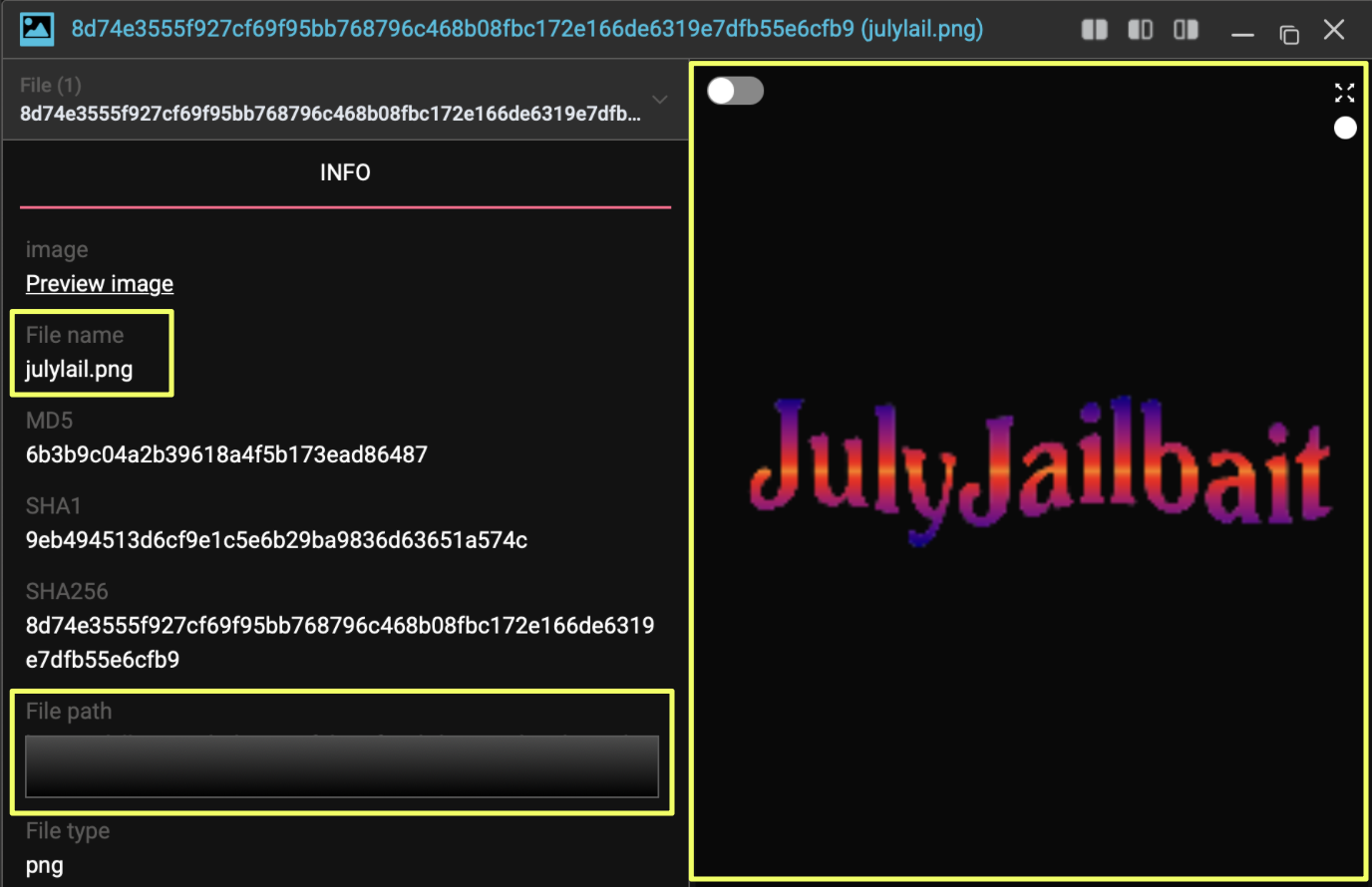
Rather than searching for domains or keywords, the image itself was queried through StealthMole's Dark Web Tracker. Because StealthMole indexes historical files alongside websites, identical images reused across different services can often expose infrastructure that is not directly linked from a platform's public pages.

The results significantly expanded the scope of the investigation. The same image hash was found across 35 mirror domains associated with JulyJailbait, many of which had never been referenced on the primary website. This demonstrated that the operators had repeatedly reused the identical logo while deploying new domains, unintentionally leaving behind a persistent artifact that connected otherwise independent instances of the platform.
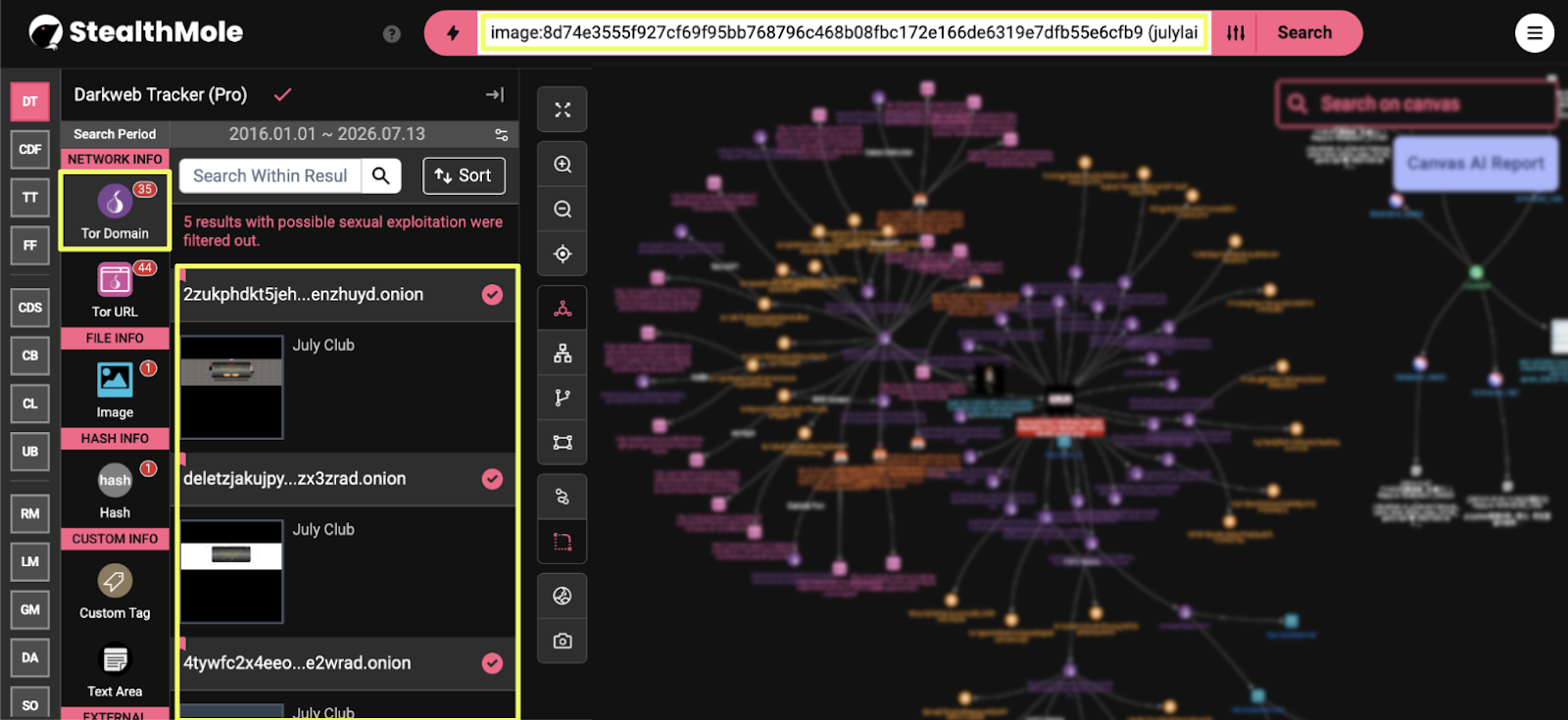
Among the identified infrastructure were both active and inactive mirrors, illustrating the platform's long operational history and its reliance on domain rotation to maintain accessibility. One of the active mirrors proved particularly valuable, as it contained a dedicated page listing both current and historical JulyJailbait domains while distinguishing them from domains the operators claimed were fraudulent or unauthorized. This provided rare insight into how the platform itself documented changes to its infrastructure and attempted to direct users toward legitimate mirrors.

  • jjclub********************************************lad.onion
Some of the notable mirror domains identified during the investigation include:

  • jjclubumn7vkhyuw.onion (inactive)
  • jjclub***********************************************lad.onion (active)
  • 232kckhwmfpl6mqqmigunmffkldxp3tbsfvxxwofrdv52ikvxshmzwid.onion (inactive)
  • 5am52idv6d2azc2drzmxvstt6y7pozju3ujn7eydqnxdynvkxwl2omad.onion (inactive)
  • jiujgj7saeq4clqewp2s2beeow337w7erx54nsqe5rlq4tde5ecbyeyd.onion (inactive)
  • cvfdjsmso5ii5twu7kmmpyvbjnggnku4v47vf2xc3m2ochmxfxi722id.onion (inactive)
  • tl65h3pazhvh6ewepmlvlwbwtrsl2ap7gox2qoyveem7s44umbfzboyd.onion (inactive)

What initially appeared to be a simple branding asset ultimately became one of the most valuable investigative pivots in the case. Instead of exposing only additional websites, the recovered mirror domains provided new avenues for infrastructure analysis, historical comparison, and financial tracing, allowing the investigation to move beyond the primary onion service and into the wider ecosystem supporting the platform.

Hidden in the Past

The discovery of JulyJailbait's mirror infrastructure provided more than additional access points to the platform. By examining several inactive mirror domains individually, the investigation uncovered historical payment artifacts that no longer appeared on the current deployment. These legacy mirrors effectively served as archived snapshots of the platform's earlier operational infrastructure, preserving cryptocurrency wallets that had since been replaced.

Across the investigated mirror domains, 17 additional Bitcoin wallets were identified. None of these wallets had been observed on the primary JulyJailbait website, indicating that the platform had periodically refreshed its payment infrastructure while continuing to operate under the same branding. Unlike the cryptocurrency artifacts recovered from the active website, these historical wallets showed no overlap with other underground services during this investigation, suggesting they belonged to an earlier phase of the platform's operation.

232kckhwmfpl6mqqmigunmffkldxp3tbsfvxxwofrdv52ikvxshmzwid.onion
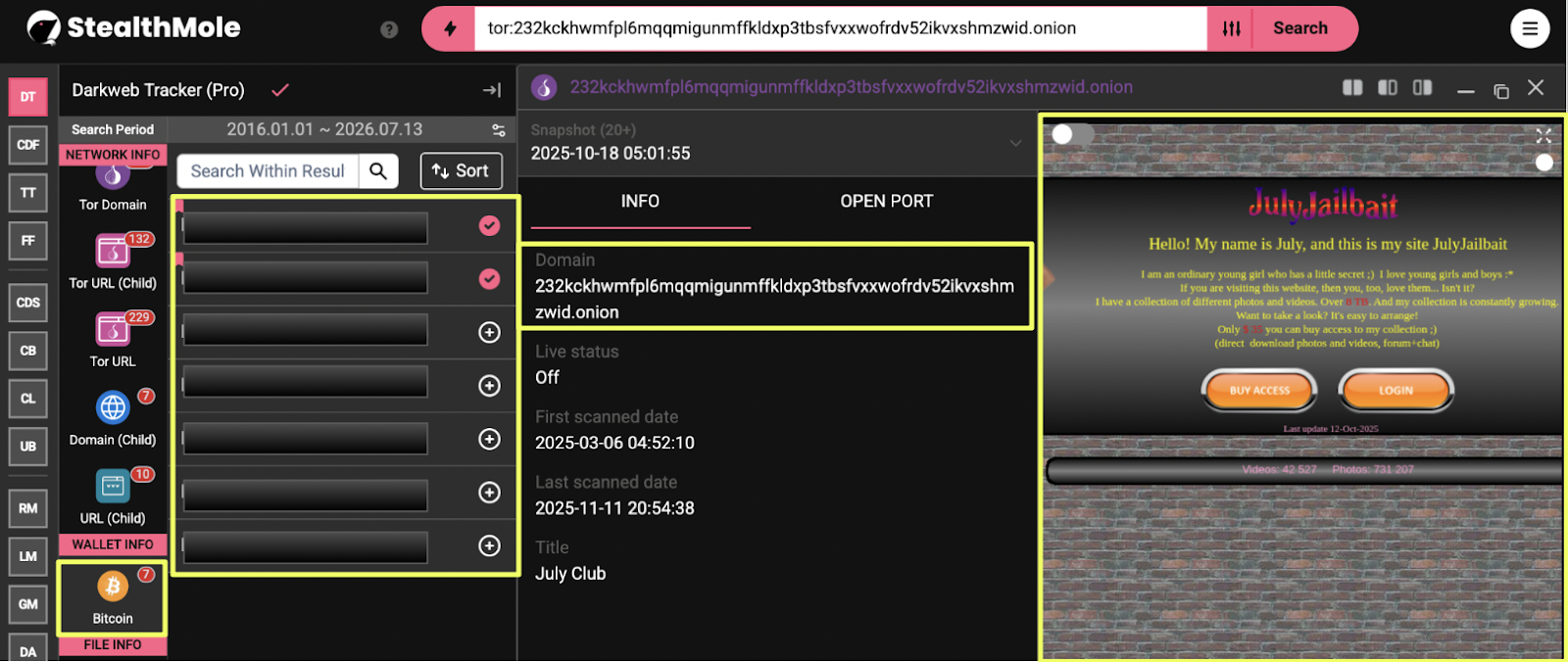
This inactive mirror proved to be the richest source of historical payment artifacts, revealing seven Bitcoin wallets that were not observed elsewhere during the investigation:

  • bc1qj**********************************qj8
  • bc1qv**********************************h8r
  • bc1q8**********************************hvm
  • bc1qf**********************************96x
  • bc1qe**********************************hkt
  • bc1qa**********************************9fv
  • bc1qr**********************************nrr

5am52idv6d2azc2drzmxvstt6y7pozju3ujn7eydqnxdynvkxwl2omad.onion
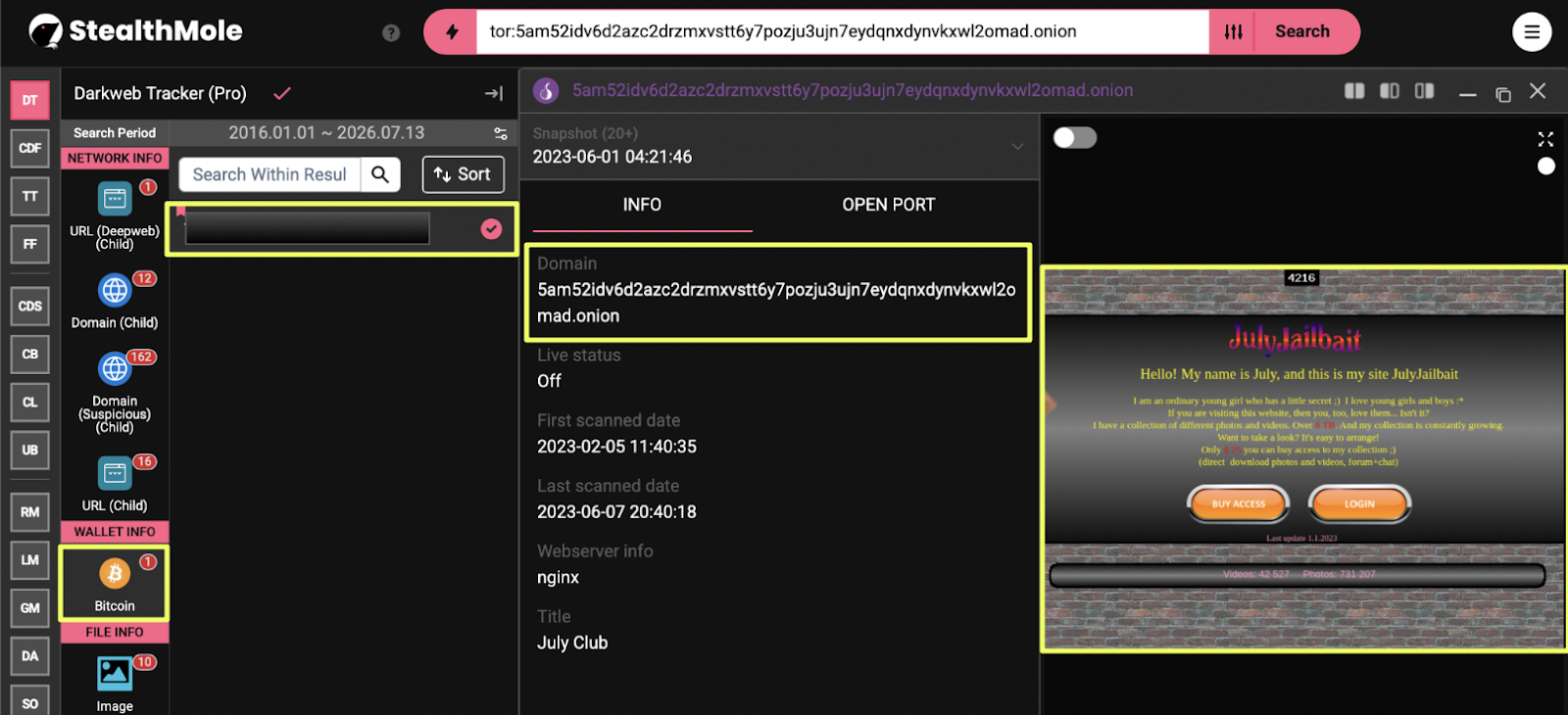
Analysis of this inactive mirror identified a single Bitcoin wallet associated with the platform:

  • 15UN**************************1SH

jiujgj7saeq4clqewp2s2beeow337w7erx54nsqe5rlq4tde5ecbyeyd.onion
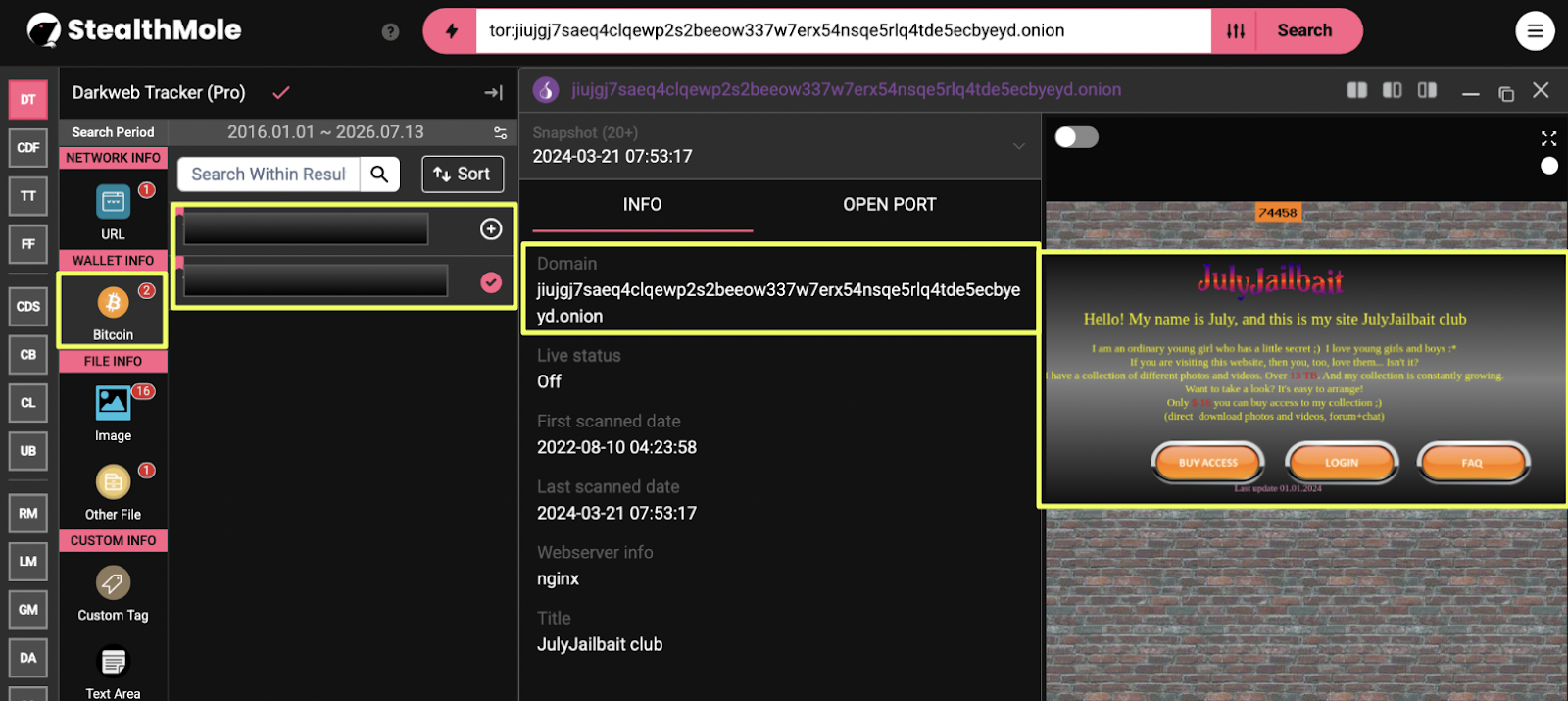
This mirror preserved two historical Bitcoin wallets:

  • 18P3**************************7Stc
  • 16Uyc*************************GwjW

cvfdjsmso5ii5twu7kmmpyvbjnggnku4v47vf2xc3m2ochmxfxi722id.onion
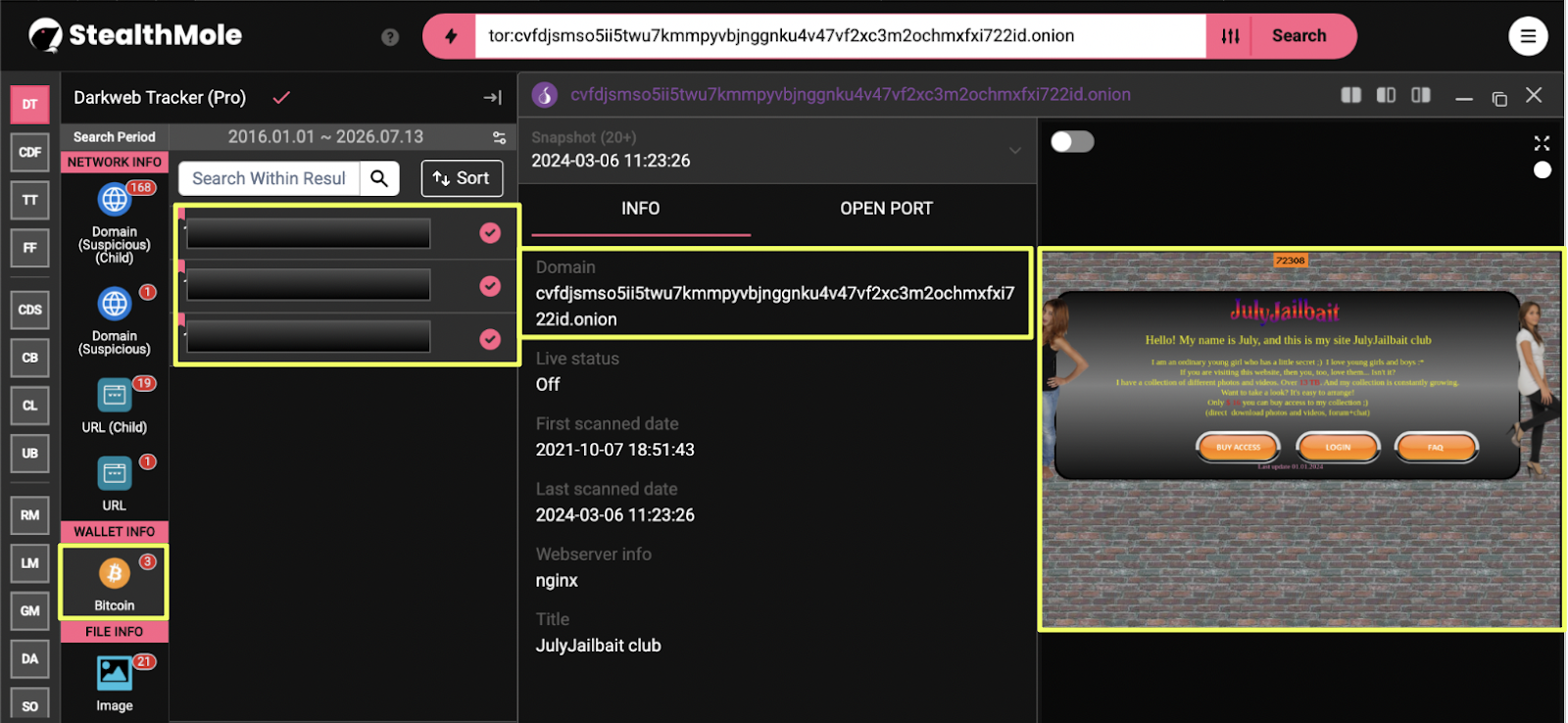
Investigation of this mirror recovered three Bitcoin wallets:

  • 1PnfX*************************SES
  • 1gY3w*************************czN
  • 18P3F************************7Stc

Notably, the wallet 18P3F16UoQm5rEAJPXbE5p4ERYUPNS7Stc had already been observed on jiujgj7saeq4clqewp2s2beeow337w7erx54nsqe5rlq4tde5ecbyeyd.onion, making it the only historical Bitcoin wallet reused across multiple archived deployments identified during this investigation.

tl65h3pazhvh6ewepmlvlwbwtrsl2ap7gox2qoyveem7s44umbfzboyd.onion
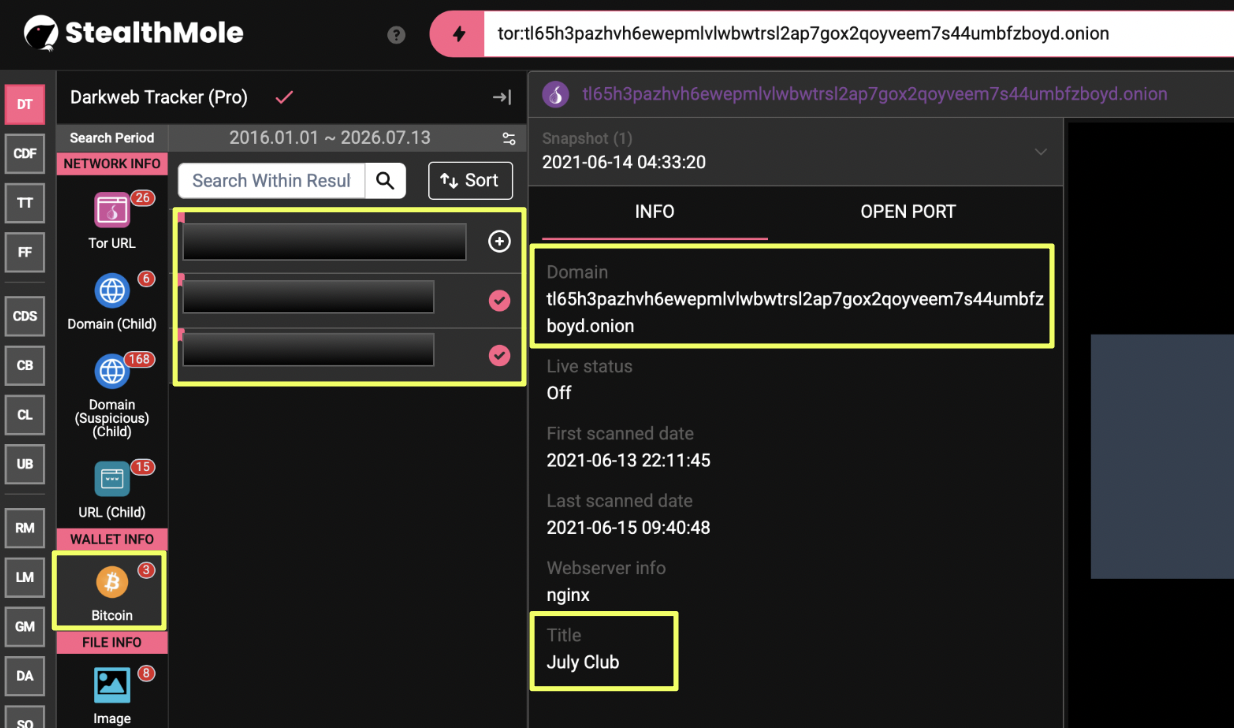
The final investigated mirror yielded three additional Bitcoin wallets:

  • 1FUoh**************************qbb
  • 1LBvk**************************PHk
  • 1GUgu**************************31h

Beyond the archived onion services, the active mirror jjclub**************hlad.onion contained a dedicated page documenting the platform's historical infrastructure. Alongside previous onion services, the operators also referenced several surface web domains, including julyjailbait.com, julyjailbait.net, julyjailbait.org, and julyjailbait.me, while separately identifying domains they considered fraudulent or unauthorized. Although these references originate from the operators themselves and should not be treated as independently verified infrastructure, they provide valuable insight into how the platform documented its historical presence and attempted to distinguish legitimate domains from impersonation sites.
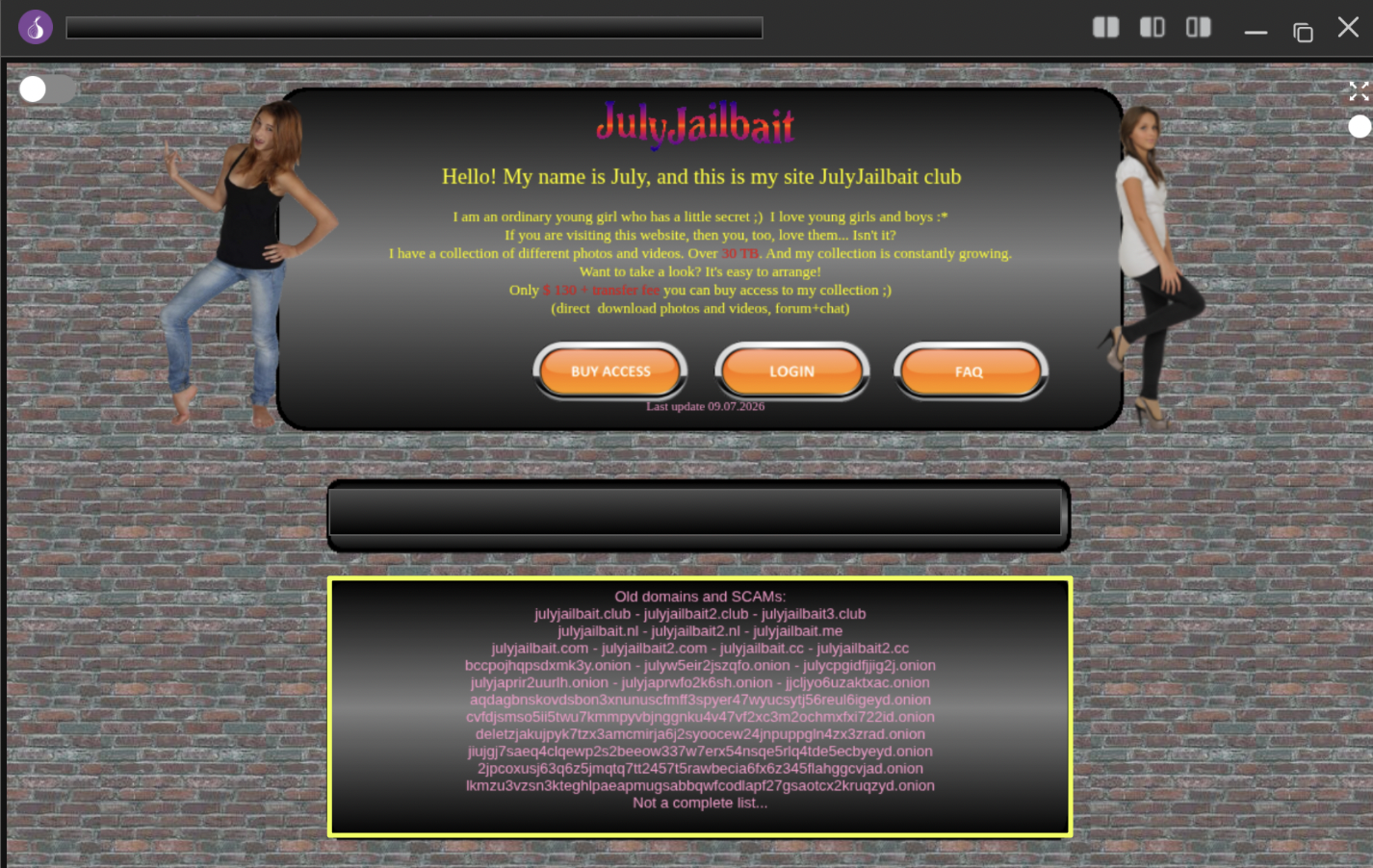
Rather than functioning solely as backup websites, the historical mirrors preserved intelligence that no longer existed on the active platform. By examining these archived deployments individually, the investigation reconstructed an earlier stage of JulyJailbait's financial infrastructure, providing a broader historical perspective that would not have been possible through analysis of the primary website alone.

Following the Financial Footprint

One of the most valuable sources of intelligence recovered from the primary JulyJailbait website was its cryptocurrency payment infrastructure. The publicly accessible payment page accepted both Bitcoin (BTC) and Monero (XMR), with users required to complete a cryptocurrency payment before gaining access to the platform. Rather than treating these wallets solely as payment addresses, each one was used as an investigative pivot within StealthMole to determine whether the same infrastructure appeared elsewhere across the underground ecosystem.
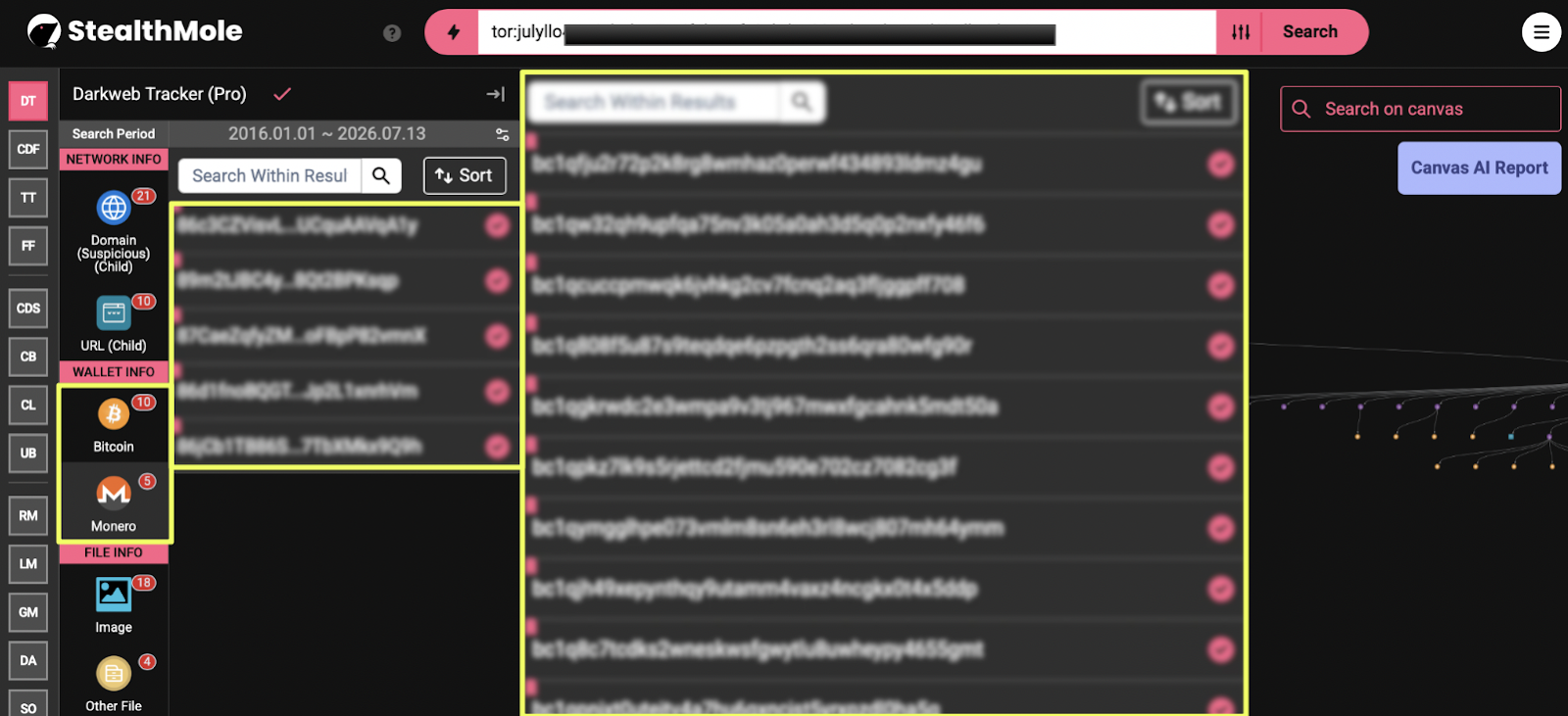
The investigation identified 10 Bitcoin wallets and 5 Monero wallets associated with the primary JulyJailbait domain. While several of these wallets appeared to be exclusive to the platform, others were reused across multiple underground services, exposing links that were not apparent through website analysis alone.

Bitcoin Wallets Identified

Bitcoin Wallet

Additional Infrastructure Identified

bc1q*********************4gu

JulyJailbait, Alice

bc1q*********************6f6

JulyJailbait only

bc1qc********************708

JulyJailbait, MOE Connect, WormGPT

bc1q8********************90r

JulyJailbait, MOE Connect

bc1qg*******************50a

JulyJailbait only

bc1qp********************g3f

JulyJailbait only

bc1qy**********************ymm

JulyJailbait, MOE Connect

bc1qj**********************ddp

JulyJailbait, KidBin, Snapchat account hacking service

bc1q8********************gmt

JulyJailbait, WormGPT

bc1qp********************ha5q

JulyJailbait only

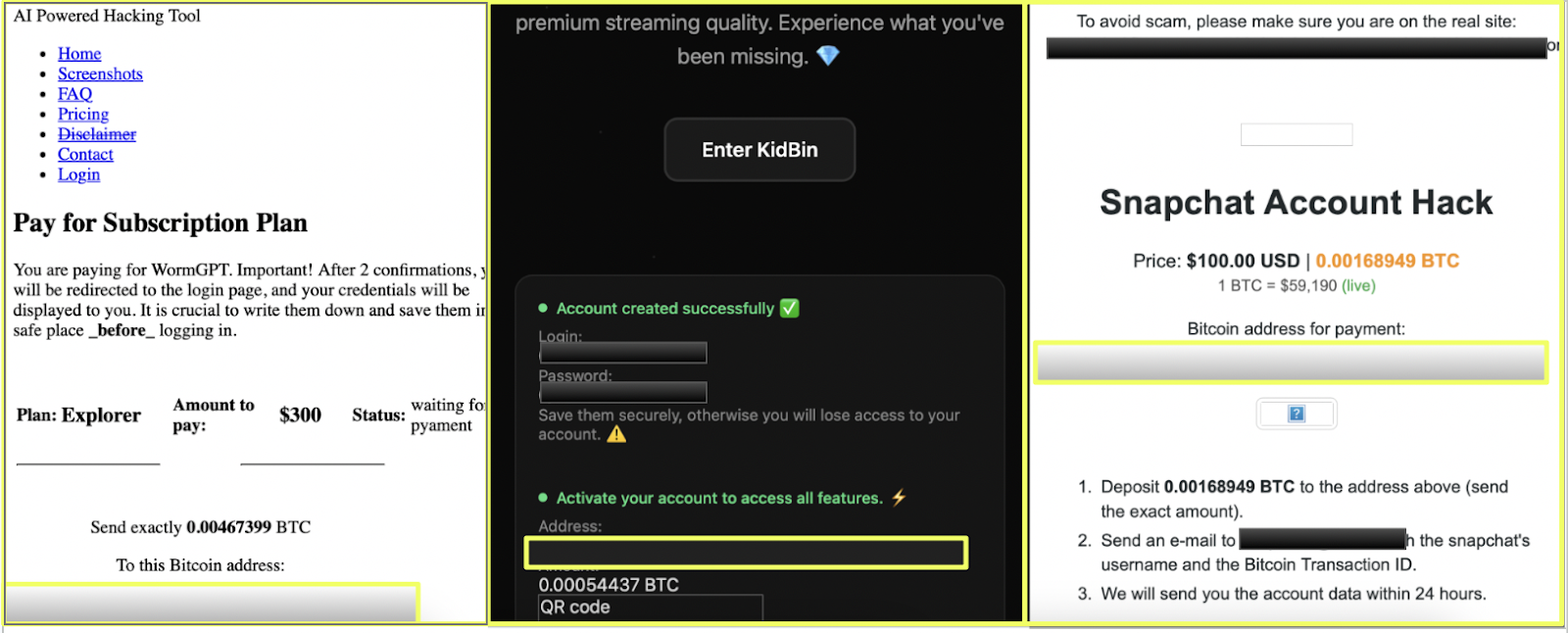
The Bitcoin infrastructure showed a mixture of exclusive and shared payment addresses. While several wallets appeared unique to JulyJailbait, others were reused across services such as WormGPT, MOE Connect and KidBin, suggesting that elements of the payment infrastructure extended beyond a single platform.

Monero Wallets Identified

Monero Wallet

Additional Infrastructure Identified

86c3CZ********************qA1y

JulyJailbait, WormGPT, FraudGPT, Darkweb Porn, Daisy's Destruction

89m2tJ*******************PKsqp

JulyJailbait, WormGPT

87Cae********************vmnX

JulyJailbait, WormGPT, Daisy's Destruction

86d1f********************rhVm

JulyJailbait, WormGPT

86jCb1******************9Q9h

WormGPT, FraudGPT, Daisy's Destruction, Alice

Compared with the Bitcoin addresses, the Monero wallets demonstrated broader overlap across multiple underground services. Several appeared repeatedly alongside platforms offering illicit AI services and other criminal offerings, making them particularly valuable investigative pivots for identifying relationships between otherwise separate dark web ecosystems.

The reuse of cryptocurrency wallets across multiple services does not, on its own, prove common ownership or operational control. It does, however, indicate shared payment infrastructure or operational relationships that warrant further investigation. By correlating these artifacts through StealthMole, the investigation extended beyond the primary JulyJailbait website and uncovered infrastructure spanning multiple underground platforms.

Beyond the Dark Web

While the investigation primarily focused on reconstructing JulyJailbait's infrastructure through its onion services, cryptocurrency wallets, and historical mirrors, the platform's footprint was not confined to the dark web alone. To determine whether JulyJailbait maintained an external presence or whether its content was being circulated elsewhere, the investigation pivoted to StealthMole's Telegram Tracker.

Searches for "July Jailbait" returned numerous references spanning several years across multiple Telegram groups and channels. Although these findings did not reveal an official Telegram channel or account directly attributable to the platform's operators, they demonstrated that JulyJailbait's name and associated content had been shared and discussed within a variety of unrelated communities.
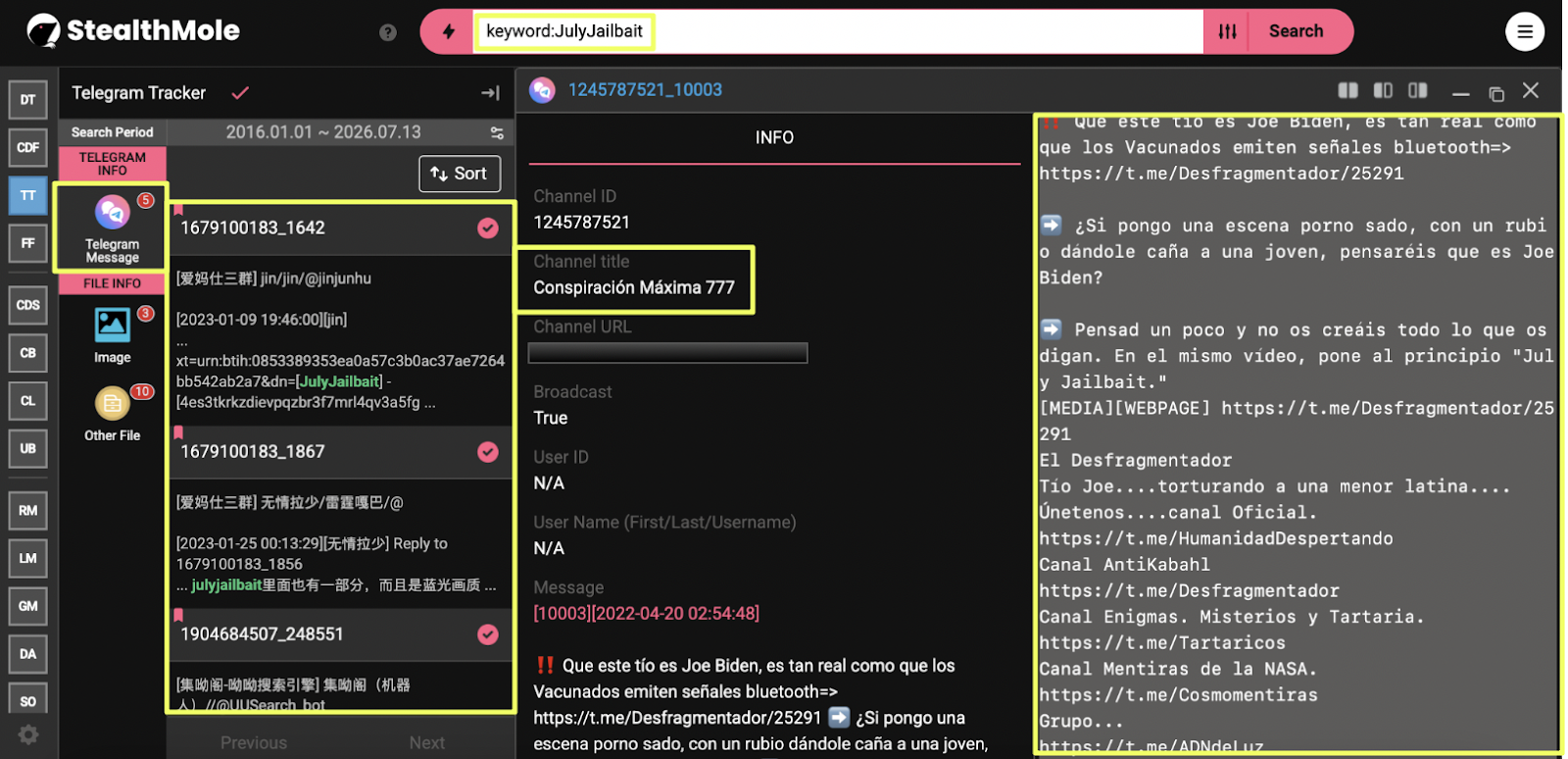
References were identified across channels operating in English, Russian, Chinese, and Spanish, reinforcing earlier observations that the platform catered to a multilingual audience. This multilingual footprint was also consistent with the language options available on the JulyJailbait website itself, suggesting that the platform was accessible to users from different regions rather than targeting a single linguistic community.

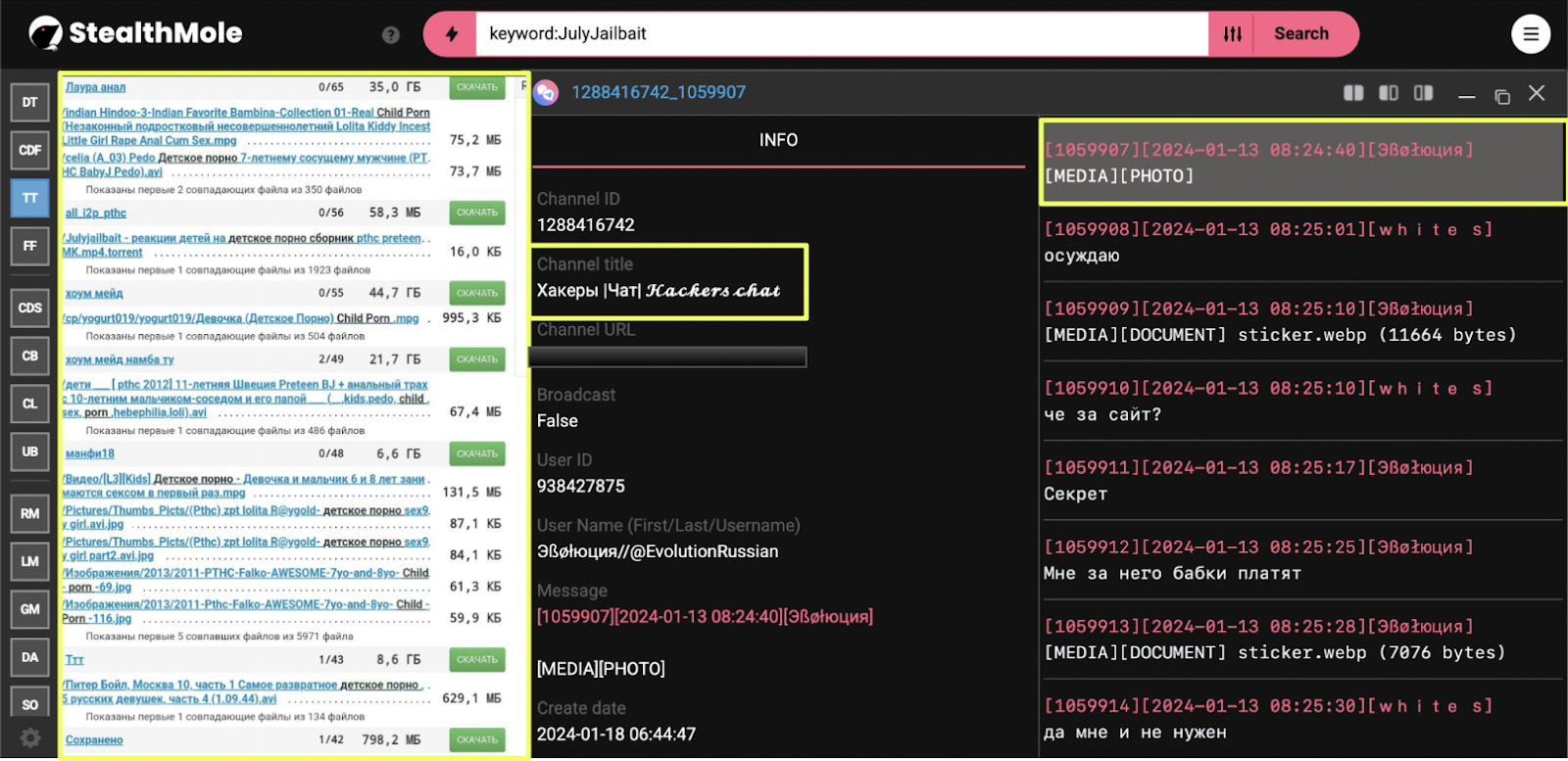
Several Telegram messages referenced JulyJailbait by name, while others contained filenames, torrent references, or media allegedly originating from the platform. Among the more notable findings was an image shared within the Telegram channel "Хакеры | Чат | 𝓗𝓪𝓬𝓴𝓮𝓻𝓼 𝓬𝓱𝓪𝓽", which appeared to depict the contents of a JulyJailbait repository. Although the image could not be independently verified as originating directly from the platform, it demonstrated that material associated with JulyJailbait was circulating beyond its own onion services.
Additional references were identified in channels including:

  • Conspiración Máxima 777, where users discussed media allegedly originating from JulyJailbait.
  • 爱妈仕三群, which contained multiple references to July Jailbait alongside BitTorrent magnet links.
  • 集帆阁-呦呦搜索引擎, where users shared file names associated with the platform.

These findings suggest that Telegram primarily functioned as a secondary distribution and discussion channel rather than an official communication platform operated by JulyJailbait. Instead of uncovering operator-controlled infrastructure, the investigation revealed how the platform's name, references, and associated material continued to circulate organically across multiple online communities, extending its visibility well beyond the dark web.

Conclusion

What began as the investigation of a single onion service ultimately evolved into the reconstruction of a much broader underground ecosystem. Although the publicly accessible July Jailbait website revealed only limited information due to its authentication wall, a series of investigative pivots through StealthMole uncovered infrastructure extending well beyond the primary domain.

By correlating a reusable logo image, historical mirror domains, cryptocurrency payment artifacts, and Telegram references, the investigation exposed multiple layers of the platform's operational footprint. The recovery of approximately 35 related mirror domains, 27 Bitcoin wallets, 5 Monero wallets, historical surface web domains, and shared cryptocurrency infrastructure demonstrated that July Jailbait was supported by a far more extensive network than its current website alone suggested.

The investigation also highlighted the importance of examining historical and indirect artifacts rather than focusing solely on active infrastructure. Legacy mirror domains preserved payment information that no longer appeared on the current deployment, while cryptocurrency wallet reuse revealed connections to other underground services that would not have been apparent through website analysis alone. Similarly, Telegram references illustrated how the platform's name and associated material continued to circulate across multiple language communities despite the absence of an identifiable official Telegram presence.

Rather than relying on any single source of intelligence, this investigation demonstrates how combining historical snapshots, digital artifacts, financial indicators, and cross-platform correlation can transform a seemingly isolated website into a much more comprehensive picture of an underground ecosystem.

Editorial Note

Investigations involving dark web platforms rarely produce a complete picture from a single source. Infrastructure changes, inactive domains, reused artifacts, and fragmented online traces often require analysts to reconstruct events from evidence collected across multiple locations and time periods.

This investigation illustrates how StealthMole's ability to correlate historical snapshots, reusable digital artifacts, cryptocurrency infrastructure, and cross-platform references enables analysts to move beyond individual websites and build a more complete understanding of long-running underground ecosystems while maintaining evidence-based attribution throughout the investigative process.

To access the unmasked report or full details, please reach out to us separately.

Contact us: support@stealthmole.com

Labels: ,

Following the Money: Mapping KidBin's Cryptocurrency Infrastructure Across Darkweb

Dark web continues to host a wide range of illicit platforms that rely on anonymity, cryptocurrency, and closed communities to operate beyond the reach of traditional online services. Among the most persistent are subscription-based content platforms that monetize access through Bitcoin payments, often presenting themselves as exclusive repositories of restricted or prohibited material. While many of these sites appear isolated at first glance, their underlying infrastructure can reveal connections that are not immediately visible to visitors.

One such platform is KidBin, a subscription-based dark web service that advertises access to illicit content through cryptocurrency-funded accounts. Like many similar services, KidBin presents itself as a standalone platform with its own payment and access mechanisms. However, the infrastructure supporting these operations often extends beyond a single domain, creating opportunities to identify relationships that would otherwise remain hidden.

By examining cryptocurrency payment infrastructure associated with KidBin, this investigation uncovered a broader network of interconnected services spanning multiple dark web platforms. The findings demonstrate how following financial artifacts can expose operational overlaps, shared infrastructure, and potential links between platforms that appear unrelated on the surface.


Behind the KidBin Facade

The investigation began during an unrelated dark web inquiry when StealthMole identified an active onion service operating under the name KidBin:

  • kidsbin3**************************************7krtqd.onion

At first glance, the platform presented itself as an "AI-Powered Adult Content Hub", promoting features such as content recommendations, automated tagging, premium streaming, and social interaction. The site's branding suggested a modern subscription-based content platform rather than a traditional dark web forum or marketplace.

However, a review of historical snapshots indexed by StealthMole quickly revealed inconsistencies between the platform's public description and the content visible within archived pages. These observations raised concerns regarding the true nature of the service and prompted a closer examination of both the platform and its supporting infrastructure.

StealthMole's Dark Web Tracker confirmed that KidBin remained operational and exposed several accessible components of its ecosystem. In addition to the main landing page, indexed content revealed a functioning login portal, topic pages, account creation workflows, and user activation pages accessible through additional platform URLs.

Unlike many dark web communities that rely on invitations or administrator approval, KidBin appeared to support automated account generation. Registration pages created user credentials on demand and presented newly generated usernames and passwords to prospective users. Multiple snapshots showed users being instructed to complete a cryptocurrency payment before access would be activated.


Following the Money

The presence of automated account creation and cryptocurrency-based activation raised an important question: how was access to KidBin being monetized?

To answer this, the investigation shifted toward the platform's payment infrastructure. Using StealthMole's Dark Web Tracker, multiple Bitcoin addresses associated with KidBin's registration and activation workflows were identified. In total, sixteen Bitcoin wallets were linked to the platform:

  • bc1qu*********************************n3tq
  • bc1qz*********************************mmgd
  • bc1q4*********************************xyxu
  • bc1qt*********************************jag4
  • bc1q2*********************************ttw8
  • bc1q9*********************************w444
  • bc1qq*********************************2fwk
  • bc1q9*********************************mlns
  • bc1qz*********************************v0ac
  • bc1ql*********************************cvpr
  • bc1qt*********************************h2cm
  • bc1qc*********************************a59l
  • bc1q4*********************************5xc2
  • bc1qt*********************************vhhs
  • bc1qx*********************************slhl
  • bc1q5*********************************56zs

Initial blockchain analysis revealed that not all identified wallets had been used. Several addresses showed no recorded transactions, suggesting they may have been generated for prospective users who never completed the payment process. This observation aligned with the registration workflow observed during the investigation, where unique payment addresses appeared to be assigned during account creation.

Other wallets displayed a different pattern. The following addresses showed transaction activity consistent with user payments. Several of these wallets received relatively small deposits before funds were subsequently transferred elsewhere, suggesting they functioned as temporary receiving addresses rather than long-term storage wallets.

  • Bc1q5****************************56zs

  • Bc1q**************************************5xc2

  • Bc1q***********************************vpr

  • Bc1q***********************************yxu

  • bc1q***************************************mgd

The observed transaction patterns provided further evidence that KidBin was operating an active subscription-based payment model. More importantly, the wallets offered a new investigative pivot. Rather than focusing solely on the visible platform, each Bitcoin address could be used as a starting point for identifying additional infrastructure, services, and relationships hidden beyond the original onion domain.

What began as an examination of KidBin's payment system would soon reveal connections extending well beyond the platform itself.


Beyond KidBin: Following the Wallet Trail

The investigation expanded significantly once the Bitcoin wallets associated with KidBin were used as pivot points within StealthMole's Dark Web Tracker. While the wallets initially appeared to be part of a payment system supporting a single platform, further analysis revealed associations with several additional dark web services.

One of the earliest findings involved the wallet:

  • bc1q**************************nn3tq

StealthMole linked this wallet to multiple domains, including:

  • kidbin.qr.payserver**************************l5yayd.onion
  • loliporn.qr.payserver*********************isll5yayd.onion
  • aaolh6codj*******************************up5ibqd.onion (LoliPorn)
  • cheatgpt*****************************c46blid.onion (CheatGPT AI)

Further review of indexed snapshots revealed that the same Bitcoin address appeared directly on payment pages associated with both KidBin and CheatGPT AI. This finding was particularly significant because it represented direct wallet reuse rather than a simple infrastructure overlap. While the relationship between the two services could not be conclusively attributed to a common operator, the reuse of the same payment address strongly suggested shared financial infrastructure.

Additional pivots uncovered similar patterns. The wallet:

  • bc1qt2zk6************************jag4

was associated with:

  • pureyoun*********************************z52wgqd.onion (PureYoung)
  • pure.qr.payserver*********************************ll5yayd.onion

Like KidBin, PureYoung relied on Bitcoin-based access controls and dedicated payment workflows. The platform's payment process used QR codes and automated transaction-based account activation, mirroring operational characteristics observed elsewhere during the investigation.

The investigation also identified wallet:

  • bc1q2ke8***********************wttw8

on the registration and payment pages of:

  • darkweb************************************5xdad.onion

a service operating under the name "Dark Web Porn Official." StealthMole additionally associated this wallet with both LoliPorn and WormGPT-related infrastructure. Although the exact WormGPT page displaying the wallet could not be independently verified during the investigation, the association was repeatedly observed within StealthMole's indexed data.

Another wallet,

  • bc1q9*************************gemlns

was similarly linked to PureYoung, WormGPT, and infrastructure associated with LoliPorn. The recurrence of these associations across multiple wallets suggested that the observed relationships were not isolated incidents.

A particularly notable finding throughout the investigation was the repeated appearance of the following onion service:

  • payserver*************************5yayd.onion

The domain appeared in connection with multiple services through dedicated payment subdomains, including:

  • kidbin.qr.payserver...
  • pure.qr.payserver...
  • loliporn.qr.payserver...

Its continued presence across unrelated platforms suggests that it may serve as a common payment component within a broader ecosystem of dark web services.

Taken individually, each wallet association could potentially be explained by shared infrastructure or payment processing services. Viewed collectively, however, the findings revealed a recurring pattern of overlapping cryptocurrency infrastructure spanning multiple platforms, including KidBin, PureYoung, LoliPorn, Dark Web Porn Official, CheatGPT AI, and WormGPT. What began as an investigation into a single onion service had evolved into the mapping of a much larger network connected through shared financial artifacts.


The AI Connection

One of the more unexpected findings to emerge from the investigation was the recurring presence of AI-themed services within the same ecosystem of cryptocurrency infrastructure.

The initial point of discovery, KidBin, marketed itself as an "AI-Powered Adult Content Hub", claiming to offer features such as automated content tagging, recommendations, and enhanced user experiences. While the investigation did not seek to verify the platform's AI capabilities, the use of AI-focused branding was notable given the nature of the service and the content observed within archived snapshots.

As the investigation expanded through cryptocurrency wallet analysis, additional AI-related platforms began to surface. Wallet associations identified through StealthMole linked portions of the investigated infrastructure to both CheatGPT AI and WormGPT, services commonly marketed as unrestricted alternatives to mainstream generative AI platforms. Unlike publicly available AI tools that implement safeguards and content restrictions, these services are typically advertised within underground communities as offering fewer limitations and greater anonymity.

Although the exact relationship between these platforms could not be conclusively established, their appearance alongside content-driven services such as KidBin, PureYoung, and LoliPorn highlights an emerging trend within the dark web ecosystem. Operators are increasingly incorporating AI branding, AI-powered features, or dedicated AI services into existing underground business models, either as standalone offerings or as part of a broader service portfolio.

The findings observed during this investigation suggest that AI is no longer confined to traditional cybercrime-focused communities. Instead, AI-themed services are increasingly appearing alongside other forms of illicit infrastructure, creating new intersections between emerging technologies and established underground economies.


Conclusion

What began as the examination of a single dark web platform ultimately revealed a much broader network of interconnected services linked through shared cryptocurrency infrastructure.

The investigation initially focused on KidBin, a platform that publicly presented itself as an AI-powered content service while operating a Bitcoin-based access model supported by automated account generation and payment workflows. Analysis of the platform's cryptocurrency infrastructure uncovered multiple Bitcoin wallets associated with user registration and activation processes, providing an opportunity to move beyond the visible website and examine the infrastructure supporting its operations.

By tracing these wallets through StealthMole's Dark Web Tracker, the investigation identified associations extending beyond KidBin itself. Multiple wallets were linked to additional services including PureYoung, LoliPorn, Dark Web Porn Official, CheatGPT AI, and WormGPT, while recurring references to the PayServer infrastructure suggested the presence of overlapping payment components used across multiple platforms.

Although the available evidence does not conclusively establish common ownership between the identified services, the repeated appearance of shared wallets, payment mechanisms, and supporting infrastructure demonstrates that cryptocurrency artifacts can expose relationships that are not immediately visible through content analysis alone. These findings illustrate how financial infrastructure can serve as a critical investigative pivot for uncovering connections between otherwise separate dark web operations.

Ultimately, the investigation demonstrates how a single cryptocurrency trail can expand the scope of an inquiry far beyond its original target, revealing a wider ecosystem of services connected through shared financial infrastructure and operational overlap.


Editorial Note

Dark web investigations rarely follow a predictable path. What begins as the analysis of a single platform can quickly expand into a much larger network of infrastructure, services, and relationships that are not immediately visible on the surface.

This investigation highlights the importance of following financial artifacts as investigative pivots and demonstrates how StealthMole can help uncover hidden relationships across complex dark web ecosystems, enabling analysts to move beyond isolated findings and develop a broader understanding of the infrastructure supporting illicit activity.

To access the unmasked report or full details, please reach out to us separately.

Contact us: support@stealthmole.com

Labels: ,

From Yab Yum to Daulatdia: Tracing the Infrastructure of a Dark Web Prostitution Platform

The investigation began with the discovery of an onion service presenting itself as Daulatdia Brothel, discovered incidentally during analysis of unrelated dark web activity. The site claimed to offer on-demand sexual services and positioned itself as an established operation rather than a newly created platform. At the time of discovery, there was no clear indication of who operated the service, how long it had been active, or whether it existed beyond a single domain.

Initial investigation raised subtle but important questions. The platform appeared more structured than many transient dark web listings, yet its presentation and claims did not fully align with its visible footprint. Certain elements suggested the service might not be confined to a single domain, prompting a broader examination of its digital presence rather than its advertised offerings.

As the investigation expanded, attention shifted away from the content of the site itself and toward the traces surrounding it, where the service appeared, how it was referenced elsewhere, and what technical artifacts persisted beyond the main page. These early indicators suggested that the Daulatdia-branded site might represent only one stage in a longer operational history.

This report follows that trail. By examining the infrastructure, external references, and financial touchpoints associated with the platform, the investigation seeks to reconstruct how the service emerged, evolved, and maintained continuity within the dark web environment, based solely on verifiable evidence.

Incident Trigger and Initial Investigation

The investigation was triggered when an onion URL surfaced during a separate dark web inquiry. The link appeared under the label “SlaveBay,” a third-party reference rather than a name used by the service itself.

  • b33y***************************************************eid.onion

When analyzed using StealthMole’s dark web tracker, the onion service was found to identify itself directly as “Welcome to Daulatdia Brothel.” The site claimed association with Daulatdia, Bangladesh, and advertised sexual services through a structured interface rather than a single static page. At this stage, the platform’s legitimacy, scope, and longevity were unknown.

Further contextual checks revealed that the same onion URL was mentioned in a Telegram channel, where it was described as a probable scam. This conflicting external characterization introduced early ambiguity, reinforcing the need to rely on infrastructure-level evidence rather than surface claims.

Given the discrepancy between the site’s apparent structure and its disputed reputation, the investigation shifted toward determining whether the platform existed elsewhere, had historical continuity, or shared infrastructure with other services.

Platform Structure and Internal Functionality

With the initial Daulatdia-branded onion service identified, the next step was to understand whether the platform functioned as a simple advertisement or as an operational service. So, we decided to run the first identified domain through StealthMole’s darkweb tracker. Consequently, another related domain appeared with the same interface.

  • yabyum***********************************************gpqd.onion

Beyond the landing page, the platform also exposed a login interface, a publicly accessible forum, and individual user profile pages, including a visible account under the username Nameless1. These elements suggested that the service was designed to support user accounts and repeat engagement rather than one-off contact. An FAQ section and a page discussing short-term accommodation, including Airbnb rentals, further reinforced the impression of a platform attempting to present itself as organized and service-oriented.

The forum was explicitly described as unmoderated. Threads visible at the time of investigation showed users openly requesting sexual services by geography and preference. Whether these requests resulted in real-world interactions could not be verified, but the design choice itself was telling. By hosting requests internally rather than pushing users immediately to external messaging platforms, the service positioned itself as a central coordination point rather than a passive directory.

Marketplace Presentation and Media Artifacts

As the investigation moved deeper, StealthMole’s media indexing capabilities revealed additional details about how the platform presented its offerings. Multiple image assets were discovered under user-associated directories, consistent with listing or profile imagery rather than generic decoration.

Several of these images carried embedded labels such as MACDADDYPIMP, Lonely_cuties, Lupin, and SupplyForKids. The repetition and formatting of these labels suggested deliberate categorization, likely intended to segment listings or personas within the marketplace. While the indexed images themselves did not contain explicit sexual content, their structured presentation aligned with how illicit service marketplaces commonly organize offerings for browsing and selection.

At this stage, the focus remained on what could be observed directly: the platform behaved like a marketplace, with persistent listings, categorized personas, and infrastructure built to support discovery and comparison, regardless of how effective or legitimate those offerings ultimately were.

Historical Footprint and Rebranding Indicators

Questions about the platform’s longevity were addressed through historical indexing. This process revealed that the Daulatdia-branded service had not emerged in isolation. The same infrastructure had previously operated under the name Yab Yum, using identical layouts, content structure, and service descriptions.

Several onion domains were associated with this earlier phase, including:

  • B33yiqlhpysykamkyzeerxz4yishmelo5fruityj543jlnn6silna2ad.onion
  • 4ogv76w42wjhv5zloluegzcpte7trrzxkbugqy7vvtismws4zm5zzmid.onion
  • 4ogv76w4nm5egekasxxudinby3uhowv6mt2pjtp2zcbrdsrdb65fp4id.onion

All three were offline at the time of investigation, but historical snapshots showed them hosting the same platform that later appeared under the Daulatdia identity. Rather than indicating unrelated copycat sites, the consistency across these domains pointed to deliberate mirror deployment and domain rotation.

During its Yab Yum phase, the platform also promoted a USD 2,000 weekend trip to Daulatdia, Bangladesh. The offer was framed as a bundled experience rather than casual travel advice, implying a level of coordination beyond simple online introductions. While there was no evidence that such trips were ever executed, their promotion provided insight into how the platform sought to position itself: as an organized service with international reach.

Operator Signals and Infrastructure Continuity

As the investigation expanded beyond domains, attention turned to identifying stable operator-linked artifacts. Two email addresses were recovered from the platform’s content across different iterations:

  • h******@notmail.com
  • hp****@mail2tor.com

One of these, h*****@notmail.com, was associated with the PGP fingerprint:

  • 3DC*************************************FE

This cryptographic identifier became a key pivot point. Unlike onion domains, which are frequently discarded, PGP keys often persist across infrastructure changes. Pivoting on this fingerprint led to the identification of another related onion domain, which was also offline at the time of analysis.

  • b33******************************************rad.onion

The reuse of the same PGP key across multiple domains and branding phases provided a strong continuity signal. It suggested that the Daulatdia and Yab Yum platforms were not separate efforts but successive iterations managed under the same operational control.

Financial Infrastructure and Payment Readiness

Financial artifacts added another layer to this continuity. Analysis of b33yiqlkdqa3scyxzvn6vbz5qsw7e7dzp3mizrknqeuv35bauuj6wrad.onion surfaced a large number of Bitcoin wallet addresses linked to the platform. Among these were addresses such as

  • Bc1q8x*******************************px43
  • bc1qax*******************************3lnl
  • bc1q2g*******************************qvfy
  • bc1qut******************************va5ju
  • bc1qry******************************s4py6
  • bc1qzk******************************pnhhs
  • bc1q4*********************************rnv7
  • bc1qm*********************************md7h
  • bc1qj*********************************rvrg
  • bc1qa*********************************tu78

Most of the identified wallets showed no observable transaction history, suggesting either low usage or preparatory provisioning rather than active throughput. One address, however, displayed confirmed activity, distinguishing it from the broader set.

  • bc1q4*******************************rnv7

A separate, Yab Yum–linked domain, 4ogv76wvasufotajocqxlobk3bwsqi2loqd7znu4bkxqovov6pgr6oyd.onion, exposed an additional wallet:

  • bc1q8****************************g8w

Taken together, the wallet infrastructure suggested deliberate readiness to accept cryptocurrency payments, even if actual usage appeared uneven.

External References and Promotion

The platform’s presence was not limited to its own onion infrastructure. One of the Yab Yum–associated domains was identified in a Telegram channel named Silent Cyber Force. In that context, the link was promoted explicitly as an online prostitution platform.

  • 4ogv76w4nm5egekasxxudinby3uhowv6mt2pjtp2zcbrdsrdb65fp4id.onion

This reference was external and third-party in nature, but it demonstrated that the service circulated beyond passive dark web discovery. Whether promoted intentionally by the operator or shared organically, the appearance of the link in Telegram indicated that the platform was perceived as operational and worth advertising within adjacent communities.

Conclusion

Following the Daulatdia Brothel onion service back through its infrastructure revealed a platform that evolved rather than appeared suddenly. Through rebranding, mirror rotation, and reuse of core technical elements, the service transitioned from its earlier Yab Yum identity while maintaining operational continuity.

Stable artifacts, particularly a reused PGP fingerprint, recurring contact details, and shared backend structure, tied these iterations together more convincingly than any single domain could. Financial infrastructure and external promotion further suggested a platform built with persistence and scalability in mind, even if its real-world impact remains difficult to measure.

By focusing on infrastructure, identifiers, and contextual traces rather than the platform’s own claims, this investigation reconstructs how the service emerged, adapted, and sustained itself within the dark web environment.

Editorial Note

Dark web investigations rarely provide complete certainty. Services fragment their infrastructure, rotate identities, and allow components to lapse and resurface over time. This case demonstrates how methodical correlation of domains, cryptographic identifiers, financial artifacts, and external references can reveal continuity where none is immediately apparent, and how StealthMole enables such analysis without relying on speculation or assumption.

To access the unmasked report or full details, please reach out to us separately.

Contact us: support@stealthmole.com

Labels: ,

Behind the Disguise: Investigating 3D Boys and the Normalization of Fictional Abuse

This report documents an investigation into a hidden service known as “3D Boys”, discovered via StealthMole’s Darkweb Tracker. While the platform publicly presents itself as a digital art and storytelling forum, the investigation uncovered significant indicators of deeper misuse involving the creation and exchange of synthetic content centered around fictional youth.

Through infrastructure mapping and content analysis, the platform is revealed to be a case study in how anonymized networks and generative technologies are being adapted for ethically concerning purposes. The findings outlined in this report highlight how simulated media is being operationalized in dark web environments and expose the technical and behavioral patterns surrounding its distribution.

This case contributes to a growing body of intelligence on the abuse of emerging tools for illicit content generation and the use of legal ambiguity to mask harmful intent.

Incident Trigger & Initial Investigation

The investigation into the platform began unintentionally during the profiling of a separate dark web case using StealthMole. While cross-referencing infrastructure indicators, an .onion domain stood out due to its unusual name and metadata associations:

  • 3d****************************************************d.onion

Upon loading the address, the domain resolved to a site called “3D Boys – Home to Boys and Art.” The site presented itself as a digital art and storytelling community focused on fictional youth characters rendered in 3D. Its homepage included a prominently displayed disclaimer indicating that no illegal material was allowed or hosted.

Despite this, the structure and tag system on the homepage immediately raised concerns. Among the most active tags were terms that, while not illegal on their own, are widely associated with simulated exploitation content. Categories such as “M-b,” “b-b,” “T*********n,” “Sl*****y,” and “Hu********n” appeared across the tag cloud and in post counts. The mixture of these themes, combined with the “artistic” positioning of the platform, suggested a potential attempt to conceal or reframe content that would otherwise attract scrutiny.

This contradiction between the public disclaimer and the site’s internal categorization prompted a deeper investigation. Using StealthMole’s platform tools, the domain was profiled across multiple data points. The platform’s infrastructure was examined for associated email addresses, crypto wallets, IP connections, and related domains. Further, using StealthMole’s indexing capabilities, the platform’s internal content including posts, image galleries, downloadable documents, and metadata, was directly retrieved and analyzed.

These initial steps confirmed that the platform was not operating as a harmless artistic community, but rather as a well-structured and anonymized environment for sharing AI-generated and 3D-rendered images of minor-like characters in sexualized or abusive scenarios, as well as fictional stories describing similar themes. The level of organization, consistency of content, and use of generative tools like AI image creation strongly indicated deliberate intent. This prompted a full profiling effort to document the platform’s structure, content distribution, and associated threat indicators.

The nature, organization, and delivery of this material, paired with the surrounding infrastructure, indicated that the platform was not simply an art forum, but a structured and anonymized hub for sharing highly inappropriate synthetic content. This led to the decision to escalate the investigation and document its findings in full.

Platform Content and Behavior Analysis

The internal structure of the 3D Boys platform reveals a tightly organized community designed to facilitate the ongoing creation and sharing of fictional content centered around minor-like characters. The forum layout mimics that of legitimate digital art platforms, with sections dedicated to image posts, story submissions, and community interaction. However, the thematic direction of the shared material is clearly focused on simulated exploitation, particularly through the use of digital tools to create lifelike depictions of minors in inappropriate scenarios.

A central component of the platform is its tag-based categorization system, which enables efficient navigation and content discovery for users seeking specific themes. Prominent tags include terms such as “M-*” (commonly interpreted as “M**-***”), “b-b” (b**-b**), “T*******n,” “N*****n,” “Sl*****y,” “Di****r,” and “H*********n.” These are not general artistic categories, but instead reflect a deliberate focus on fictional narratives and imagery that involve domination, infantilization, or abuse-related themes. The prevalence of such tags, along with the volume of associated content, indicates consistent and ongoing activity from contributors.

Much of the platform’s visual material is described by users as 3D rendered, created using tools like D** S******, P*****, and B*******. These images are notably realistic in appearance, often resembling photographs in terms of lighting, anatomy, and detail. Although the platform itself does not reference AI generation, some of the images appear to exhibit qualities often associated with modern generative processes, such as pattern repetition and photorealistic styling. However, all content reviewed is framed within the community as 3D artwork or fictional renderings.

In addition to the image-based content, the platform hosts a collection of PDF documents, 28 found through StealthMole’s Darkweb Tracker, each presented as part of an ongoing fictional series. These documents are structured by chapter and often include introductory notes or warnings referencing violent and exploitative themes. One story, titled "W***** the M*** S****** G****", contains a prelude describing scenes of abduction, torture, and death. These texts are not isolated works; rather, they are part of a larger collaborative environment in which writers, proofreaders, and artists contribute to building ongoing narratives. Contributors such as “In*********,” “B*******,” “X*****,” and “N****_Z****_V***” are credited by name in prefaces or metadata.

User interaction within the forum reflects a participatory structure. Members provide detailed feedback, request specific themes, and engage with serialized content across multiple threads. This dynamic promotes a cycle of production and refinement that supports persistent content development aligned with the platform’s thematic focus.

Overall, 3D Boys functions less as a passive archive and more as a closed-loop creative ecosystem. Its combination of structured categorization, high-volume image production, serialized storytelling, and engaged user participation forms a self-sustaining space that facilitates the continued creation and exchange of exploitative fictional content: all while framing itself as artistic expression.

Infrastructure and Actor Indicators

Further investigation through StealthMole’s infrastructure mapping tools revealed several key digital assets linked to the 3D Boys platform. These include cryptocurrency wallets, anonymized email addresses, network-level indicators, and a possible clearnet-linked social media account. Together, these artifacts provide insight into the operational model and potential attribution trails of the platform’s administrators or core contributors.

A total of three cryptocurrency wallets were identified:

Bitcoin address:

  • 1Z*****************************Q

Monero addresses:

  • 43P***************************************************************************ng
  • 42R***************************************************************************8

The presence of Monero wallets suggests an emphasis on privacy and untraceable transactions: a common practice on dark web platforms seeking to obscure donor identities or service payments. These wallets were directly associated with the domain during domain-level queries in StealthMole’s Darkweb Tracker.

Three email addresses were also surfaced in relation to the domain.

  • l************6@protonmail.com
  • A******e.A******e@b*********e.**
  • A**************te@cocaine.****a

One is a ProtonMail account (l*********6@protonmail.com), a provider widely used for anonymous communication. The others point toward decentralized or niche communication platforms, which are often favored by threat actors due to their resistance to monitoring and takedown. The use of @cocaine.ninja in particular indicates possible crossover with other dark web forums or illegal service providers.

In addition to wallet and communication data, a set of six IP addresses were uncovered during infrastructure analysis.

  • *.*0.*.**9 - China
  • *.1*.0.* - United States
  • 4.*5.*.* - United States
  • *.**.0.2 - United States
  • 4.1*.0.* - United States
  • *.*0.1.*1 - United States

One IP (*.*0.*.**9) was specifically flagged with a child-related URL label, indicating a possible history of abuse content hosting or access. The remaining IPs were also associated with this domain and may represent backend infrastructure, mirrors, or routing nodes.

A potential clearnet connection was also observed through a linked Twitter account: https://twitter.com/M********D. While not confirmed as directly operated by the site’s administrators, the handle was listed in StealthMole’s correlation results for this domain and may represent an operational mistake, an alias crossover, a member or just a disinformation tactic.

Conclusion

The 3D Boys platform represents a concerning example of how online communities are adapting digital tools to facilitate the production and distribution of harmful fictional content, while exploiting the legal ambiguity that surrounds simulated media. Though presented as a creative forum for 3D-rendered artwork and storytelling, the site's structure, thematic focus, and contributor activity clearly indicate intent to normalize and circulate material that simulates the abuse of minors in both visual and narrative form.

The use of lifelike 3D rendering software, combined with the platform's categorization system and serialized documents, points to a deliberate effort to replicate abusive scenarios in a controlled, yet high-fidelity digital format. While the content avoids direct violations of current CSAM laws in many jurisdictions by relying on fictional representations, it nonetheless serves the same behavioral and psychological ecosystem: one that desensitizes users, encourages harmful ideation, and potentially acts as a gateway toward more serious offenses.

The surrounding infrastructure further confirms the operational maturity of the platform. The integration of privacy-focused crypto wallets, anonymized email services, and evasive communication platforms demonstrates a clear intent to remain hidden from enforcement and scrutiny.

This case reinforces the growing challenge posed by simulated abuse material and the use of generative technologies in dark web spaces. As access to digital content creation tools continues to evolve, similar platforms are likely to proliferate, leveraging 3D rendering, anonymity networks, and decentralized payment systems to distribute content that, while fictional, is clearly designed to exploit a vulnerable thematic space.

Editorial Note

Attribution in cases involving fictional exploitation is uniquely complex. Platforms like 3D Boys operate in the space between legality and intent, where no real-world victims may be present, yet the content and community behavior are clearly aligned with abusive ideologies. By framing their material as art or fantasy, such platforms exploit legal loopholes while cultivating persistent, high-engagement environments that normalize harmful narratives.

This investigation was made possible through StealthMole’s capacity to index and correlate across deep content layers and anonymized infrastructure, surfacing connections between domain activity, contributor behavior, and platform-linked assets. In an era where simulated abuse can be digitally created and distributed at scale, tools like StealthMole are essential for exposing how these communities operate and for recognizing the real-world risks embedded in what may appear, on the surface, as fiction.

To access the unmasked report or full details, please reach out to us separately.
Contact us: support@stealthmole.com

Labels:

Learn more about StealthMole

Talk to our team of experts today to learn how you can manage your dark web exposure.
Request demo More Reports

Share this report