Party Heaven and the Storefronts Next Door: Mapping a Dark Web Drug Network

Dark web drug markets rarely stay still for long. Storefronts disappear, onion addresses change, and familiar shops can return under new names or slightly altered branding. What looks like a single marketplace at first glance may therefore represent only one visible part of a much larger and longer-running operation. Following these markets requires looking beyond what is currently online and paying attention to the traces they leave behind.

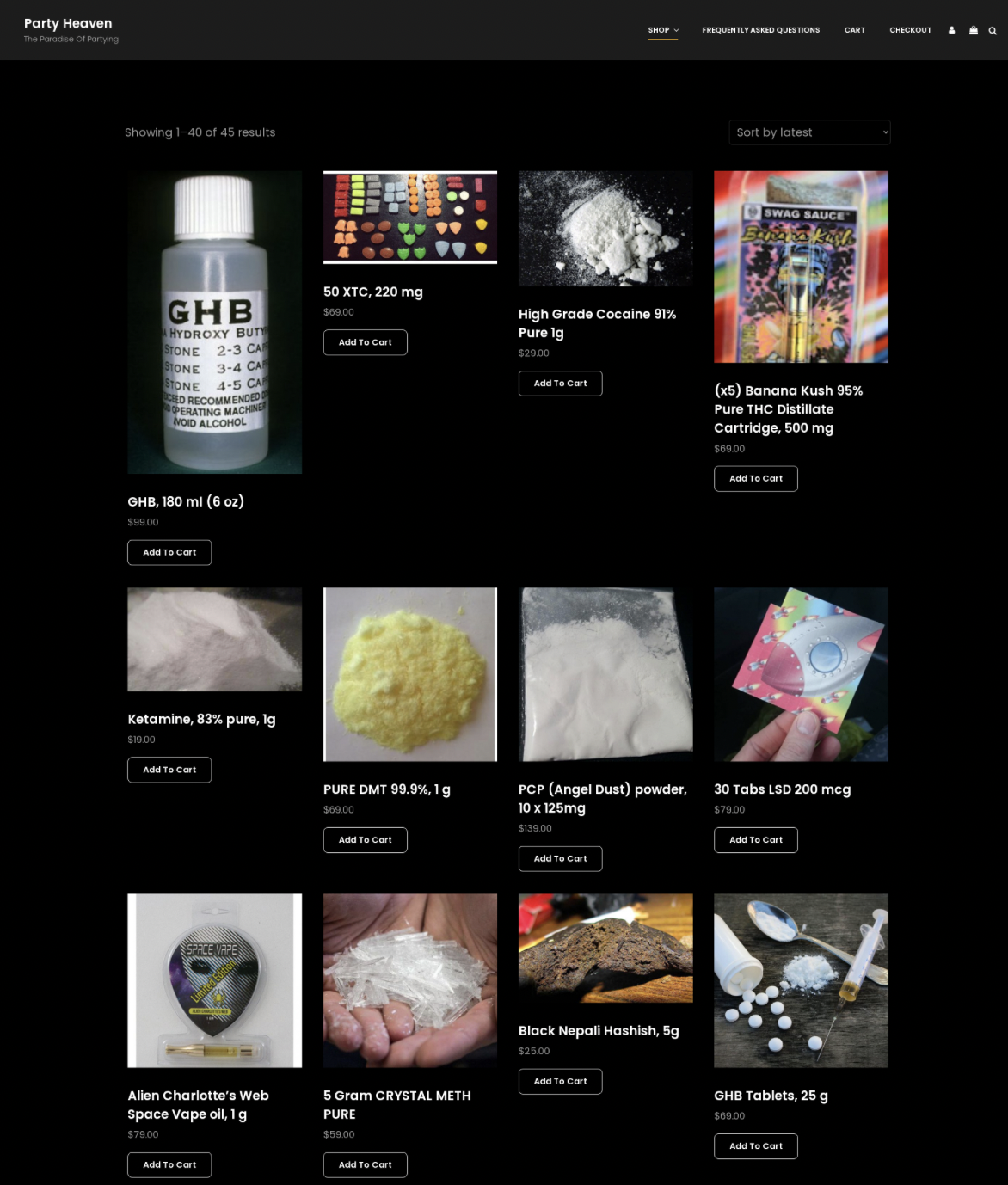
Party Heaven, a Tor-based drug storefront describing itself as “The Paradise of Partying,” became the starting point for this investigation. The platform advertised a broad catalogue of illicit drugs and pharmaceutical products through a conventional e-commerce-style interface, presenting itself much like an ordinary online shop despite the nature of the products being sold.

What began as a closer look at Party Heaven gradually moved beyond the storefront itself. Using StealthMole, the investigation followed the digital traces surrounding the platform across historical dark web records, cryptocurrency infrastructure, archived content and recurring product material. Each pivot added another piece to the picture and raised a larger question: was Party Heaven really an isolated marketplace, or was it sitting alongside a wider collection of connected storefronts?

This report follows that investigation from the original Party Heaven shop outward, examining the relationships that emerged along the way while separating direct technical connections from similarities that, on their own, cannot establish common ownership.

Behind the Shop Window

The investigation began with Party Heaven’s primary Tor storefront:

  • w543g*******************************************cmid.onion
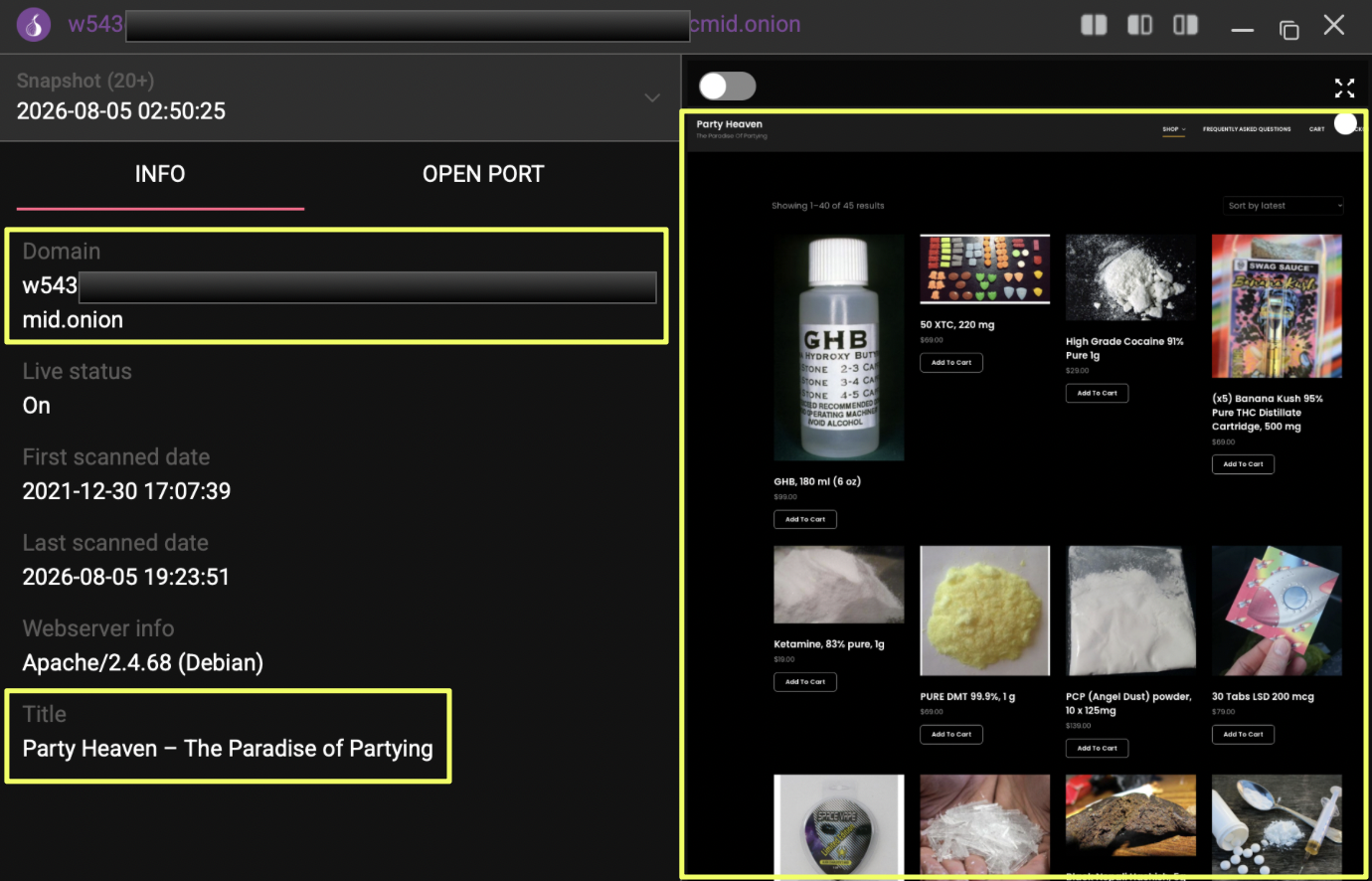
Indexed in StealthMole’s Darkweb Tracker under the title “Party Heaven – The Paradise of Partying,” the site followed a familiar e-commerce format. Products were displayed with photographs, prices and “Add to Cart” options, with categories spanning illicit drugs and pharmaceutical products. StealthMole had indexed around 70 images associated with the platform, including listings for products such as Viagra, morphine, cocaine, GHB, ketamine, PCP, LSD and other substances.

The storefront itself provided only part of the picture. A closer look at Party Heaven’s Frequently Asked Questions page offered considerably more insight into how the operation claimed to handle orders. According to the page, customers could pay using either Bitcoin (BTC) or Monero (XMR), while prices were also displayed in US dollars. Party Heaven claimed orders would be shipped within 24 hours, vacuum-sealed and packaged with a decoy. Weekend orders were reportedly held until Monday, while tracking information could be provided on request, although the operators reserved the right to withhold it if they believed doing so was necessary for security.
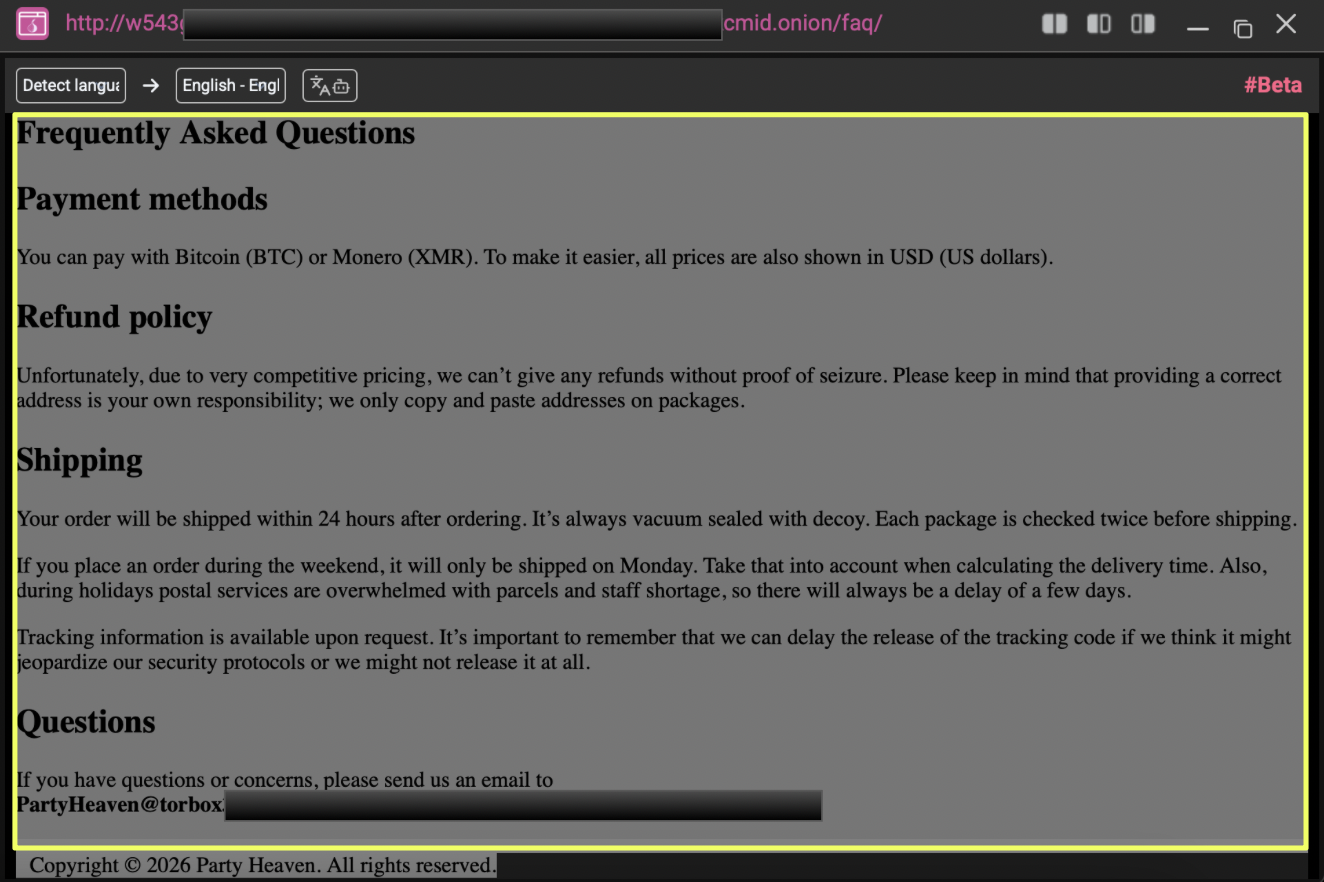
The refund policy was equally revealing. Party Heaven stated that refunds would not be provided without “proof of seizure,” and placed responsibility for providing a correct shipping address on the buyer. Rather than functioning as a multi-vendor marketplace with visible seller profiles, the site presented these policies as platform-wide operating procedures.

The FAQ also provided a contact point for customers, directing questions to the TorBox address:

  • PartyHeaven@torbox*******************************6to3uyqad.onion

The checkout page added another layer. Customers were specifically instructed not to use a clearnet email provider such as Gmail or ProtonMail, and were instead encouraged to use an onion-based hidden-service email account, with TorBox given as an example. Payment was required before an order would ship, and unpaid orders were stated to be automatically cancelled if payment was not received within one hour.
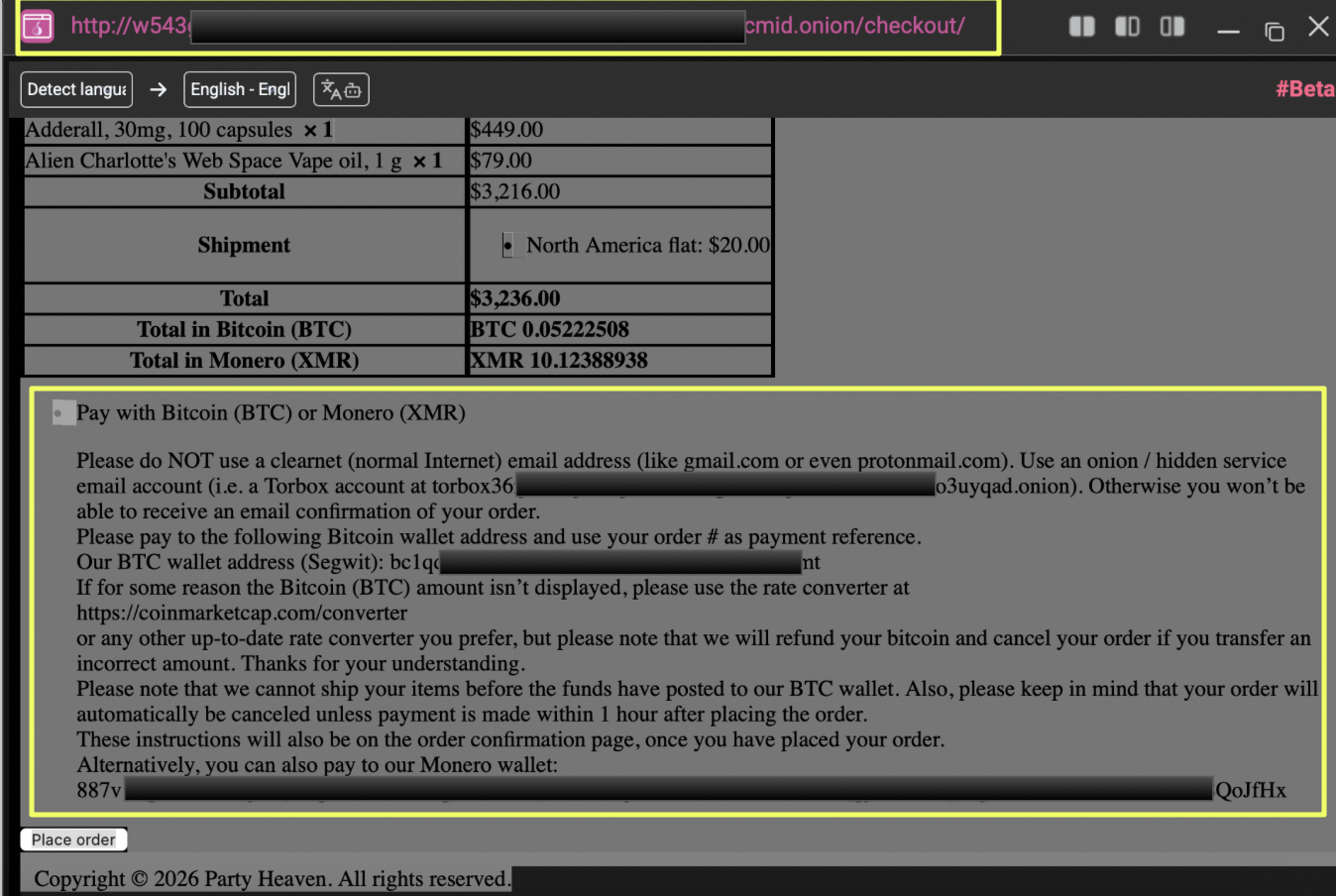
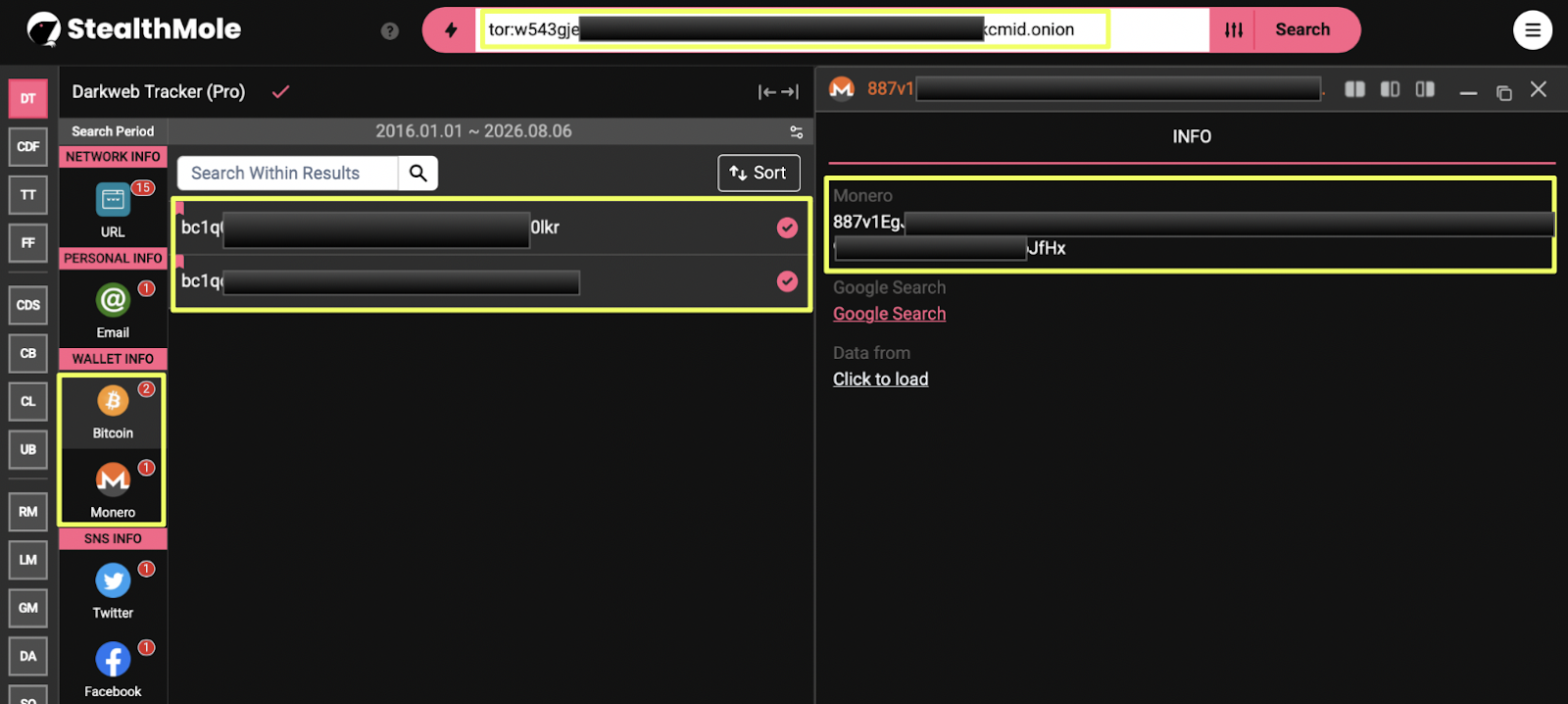
More importantly for the investigation, StealthMole exposed the cryptocurrency infrastructure attached to the storefront. Two Bitcoin addresses were associated with Party Heaven:

  • bc1q0v********************************0lkr
  • bc1qdn********************************dlmt

A Monero address was also identified:

  • 887v1Eg******************************************JfHx
At this point, Party Heaven was no longer simply a storefront with a catalogue of drugs. It had left behind several different kinds of artifacts that could be investigated independently: cryptocurrency addresses, historical web content, contact infrastructure and dozens of indexed product images.

One Monero Address, Another Party Heaven

The Monero address gave the investigation its first indication that the Party Heaven storefront visible today was not the only version of the platform that had existed.

Searching the address in StealthMole’s Darkweb Tracker led to another onion domain:

  • w543g***************************************7bqd.onion
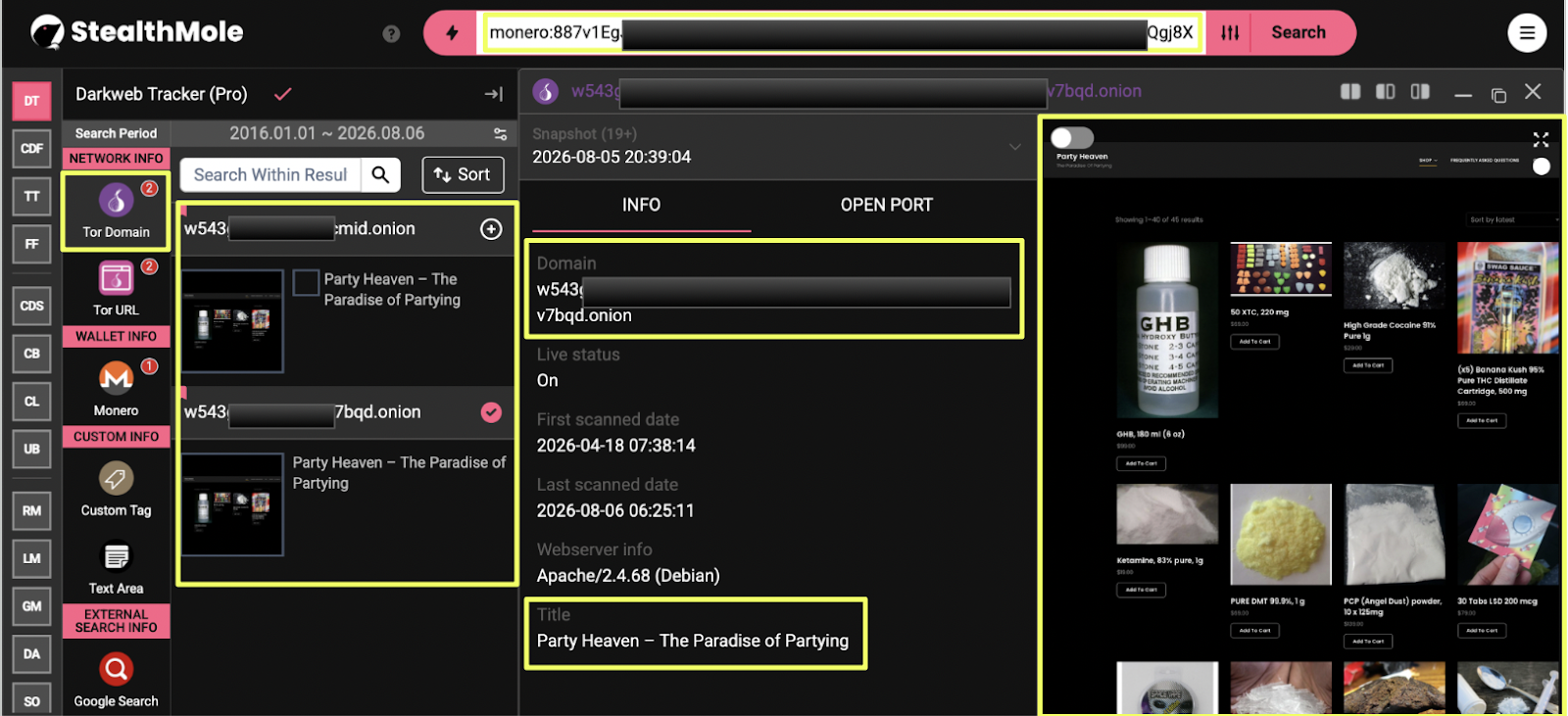
It had been indexed under the same title, “Party Heaven – The Paradise of Partying,” and was first scanned on April 18, 2026. The last recorded scan was on August 6, 2026.

The site carried the same Party Heaven identity and presented a familiar catalogue of drugs through a storefront closely resembling the active domain. One preserved product page, for example, advertised “3-CL-PCP Crystals, 5g” for $199, under the PCP (Angel Dust) category.

There were some differences beneath the surface. While the active Party Heaven domain identified its web server as nginx/1.18.0, StealthMole recorded the inactive domain running Apache/2.4.68 (Debian). This meant visual similarity alone was not enough to simply assume identical infrastructure. However, the combination of the Party Heaven branding, matching storefront characteristics and its appearance during the Monero-address pivot made the inactive onion a much stronger lead than a lookalike website discovered in isolation.

That historical storefront contained another particularly useful source of evidence: its product images.
Rather than treating those photographs simply as illustrations for drug listings, the investigation began using them as searchable artifacts. One image associated with a Nepal hash listing was selected and traced through StealthMole to determine whether the exact same material had appeared elsewhere.

Same Shelves, Different Shop Signs

The Nepal hash image provided the first clear indication that Party Heaven's product catalogue was not confined to Party Heaven.
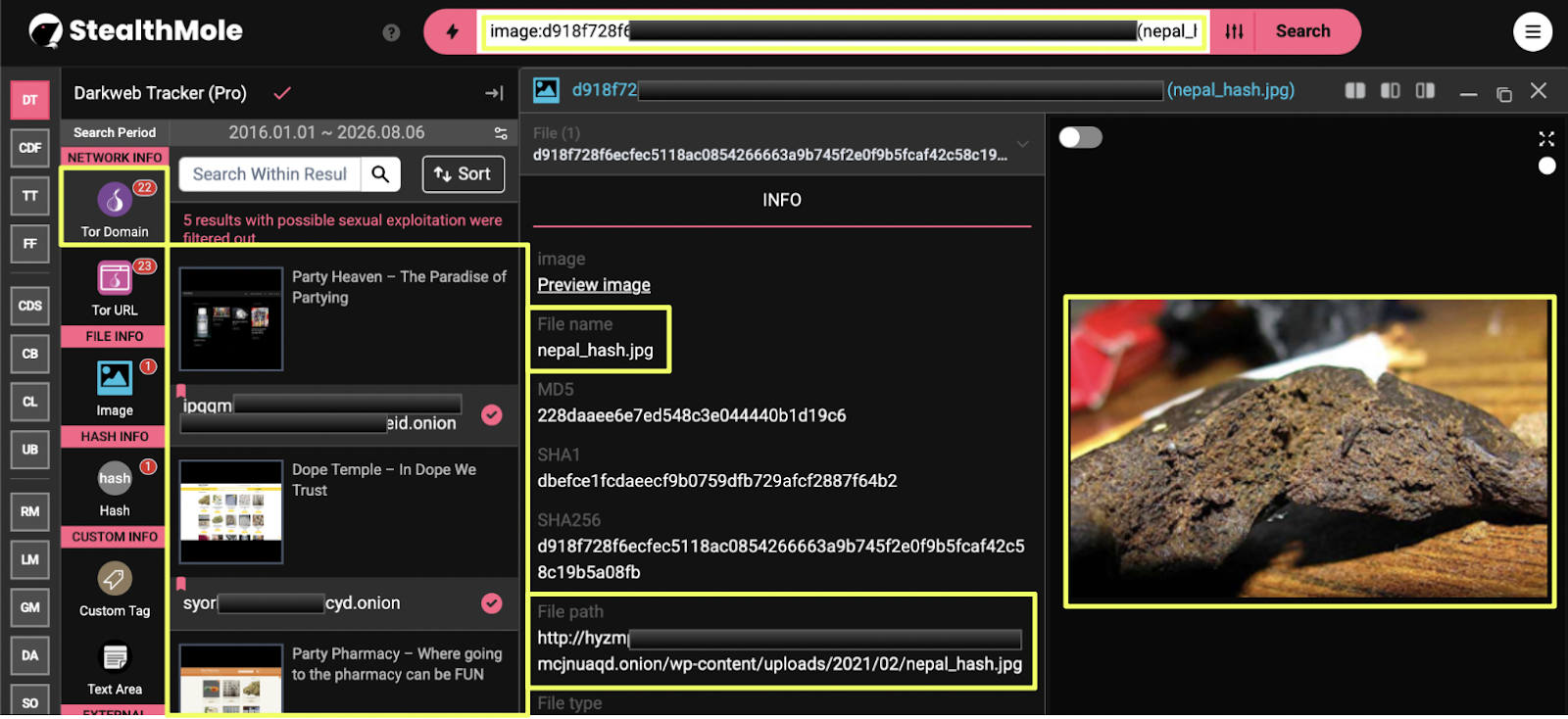
When the image was searched through StealthMole, the same artifact appeared across several other Tor domains. What made the results particularly interesting was that these sites were not presenting themselves as Party Heaven mirrors. They carried entirely different names and branding:

  • syorb4**********************************************ccyd.onion Party Pharmacy – Where going to the pharmacy can be FUN
  • ipqqm**********************************************f2eid.onion Dope Temple – In Dope We Trust
  • h5jaug*********************************************rajqd.onion Party Paradise – Come and Join the Party :)
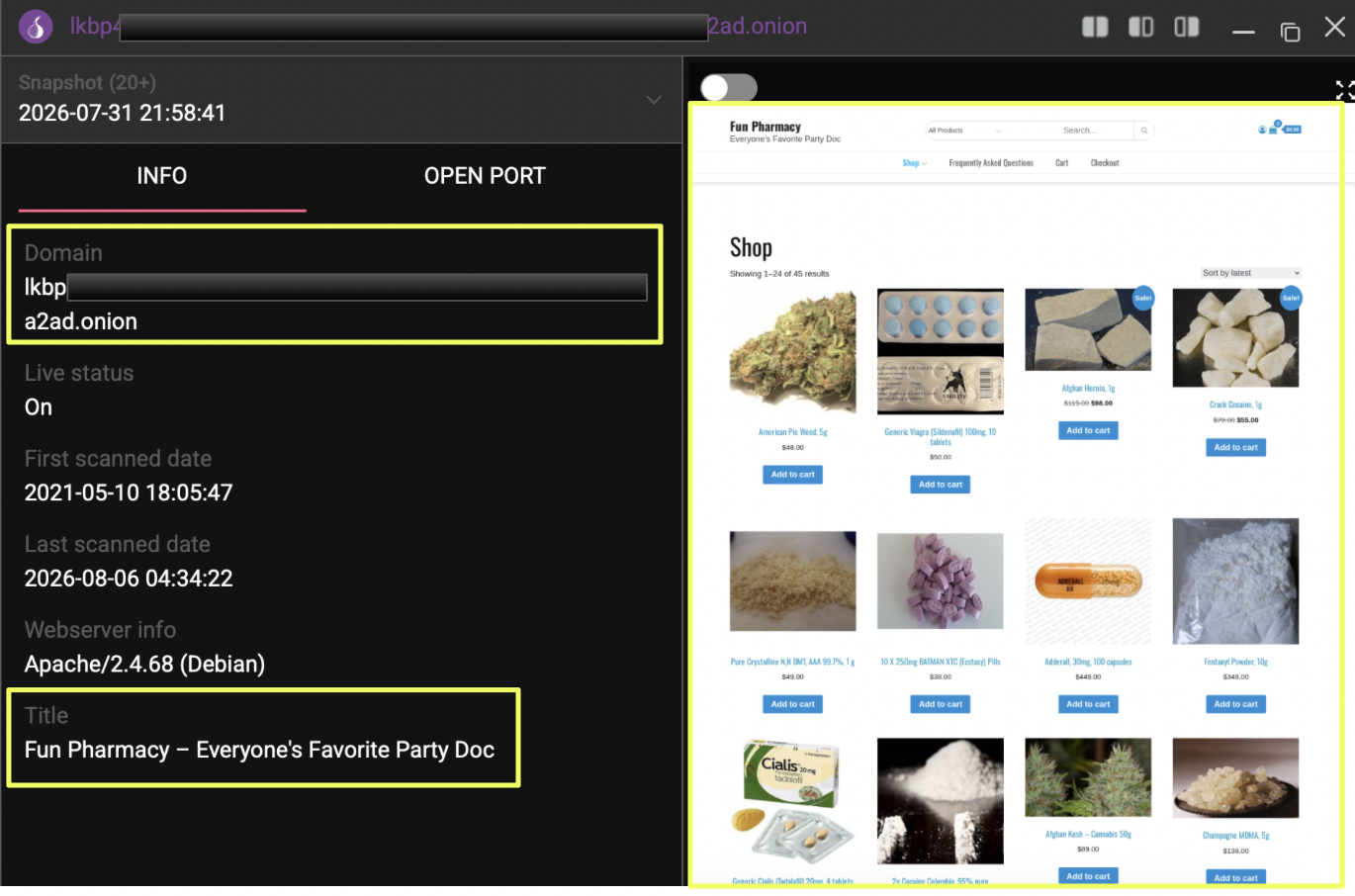
  • lkbp4**********************************************ja2ad.onion Fun Pharmacy – Everyone's Favorite Party Doc

The shared image was enough to put these storefronts on the investigative map, but there were other similarities worth noting. Their names followed a noticeably similar theme, while the storefronts themselves used familiar product-led layouts. Fun Pharmacy, for example, displayed 45 products through a Shop, FAQ, Cart and Checkout structure that closely resembled what had already been observed on Party Heaven. Its catalogue included products such as Generic Viagra and Adderall alongside other drugs and pharmaceuticals.
A second image pivot reinforced the pattern. The same morphine.jpg seen across these storefronts was searched by its exact file hash in StealthMole, which associated it with nine Tor domains. Among them were Party Heaven and additional instances of familiar brands:

  • efcygzbnh5fow3jl5gr6rudejbw7yabixe4c5ggo5iw2mnqlz3yxaqqd.onion Dope King – The King of Partying
  • sloxx2hmdsdme4lynn77old67f52nadaed4rpqbyjnyt54divsqny7id.onion Party Animals – Everything For Your Party Needs
  • yjzto6mzyns4wwwckdbjgdrp3nepbjv4wvm2knqzbx3ycx7udchhlbqd.onion Partylicious – The Party Pros
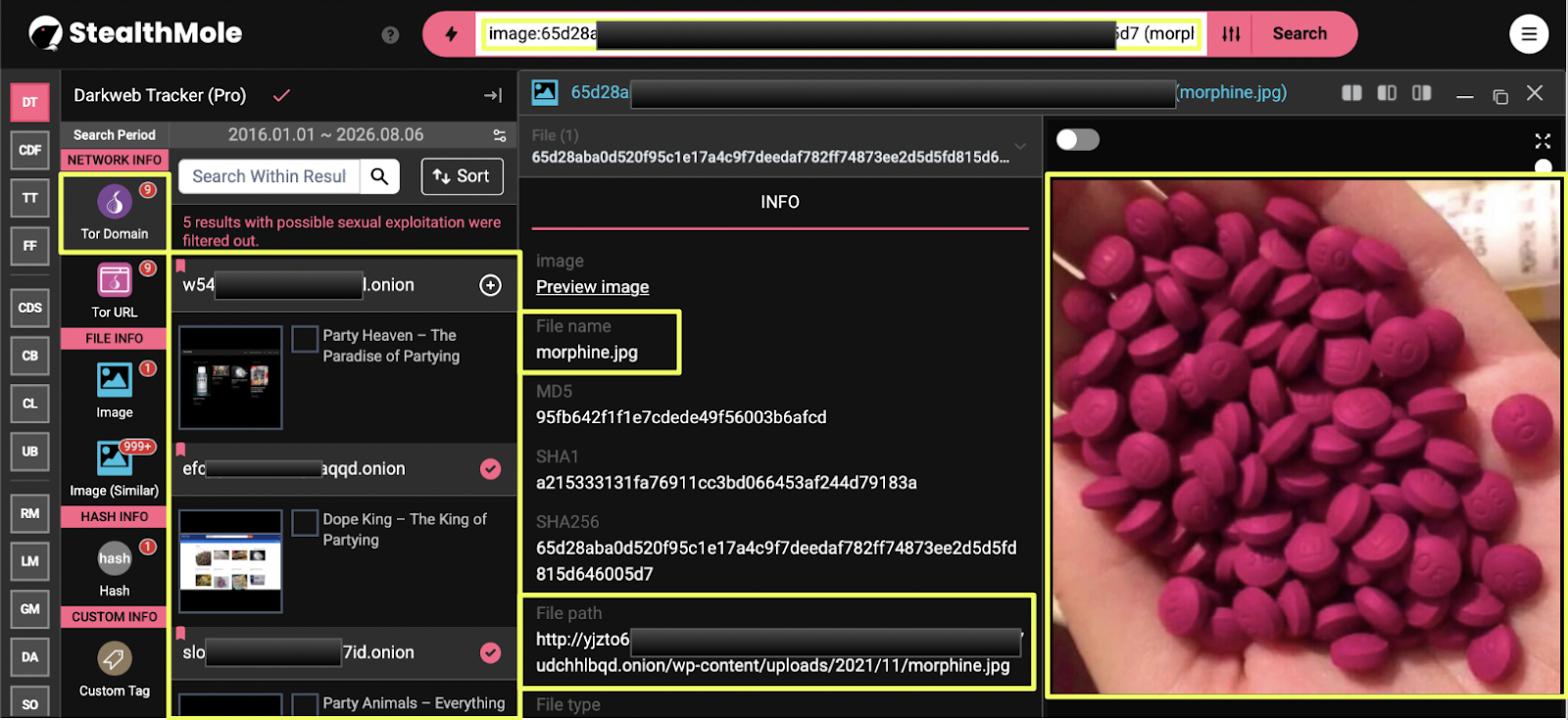
Together, the two image pivots showed the same product material recurring across differently branded storefronts. That was enough to widen the investigation, but not enough to establish common ownership. Product images and storefront templates can be copied or reused, so these domains were treated as content-overlap leads rather than Party Heaven mirrors.

The Wallet That Actually Moved

The first Bitcoin address provided little room to continue.

  • bc1q********************************lmt
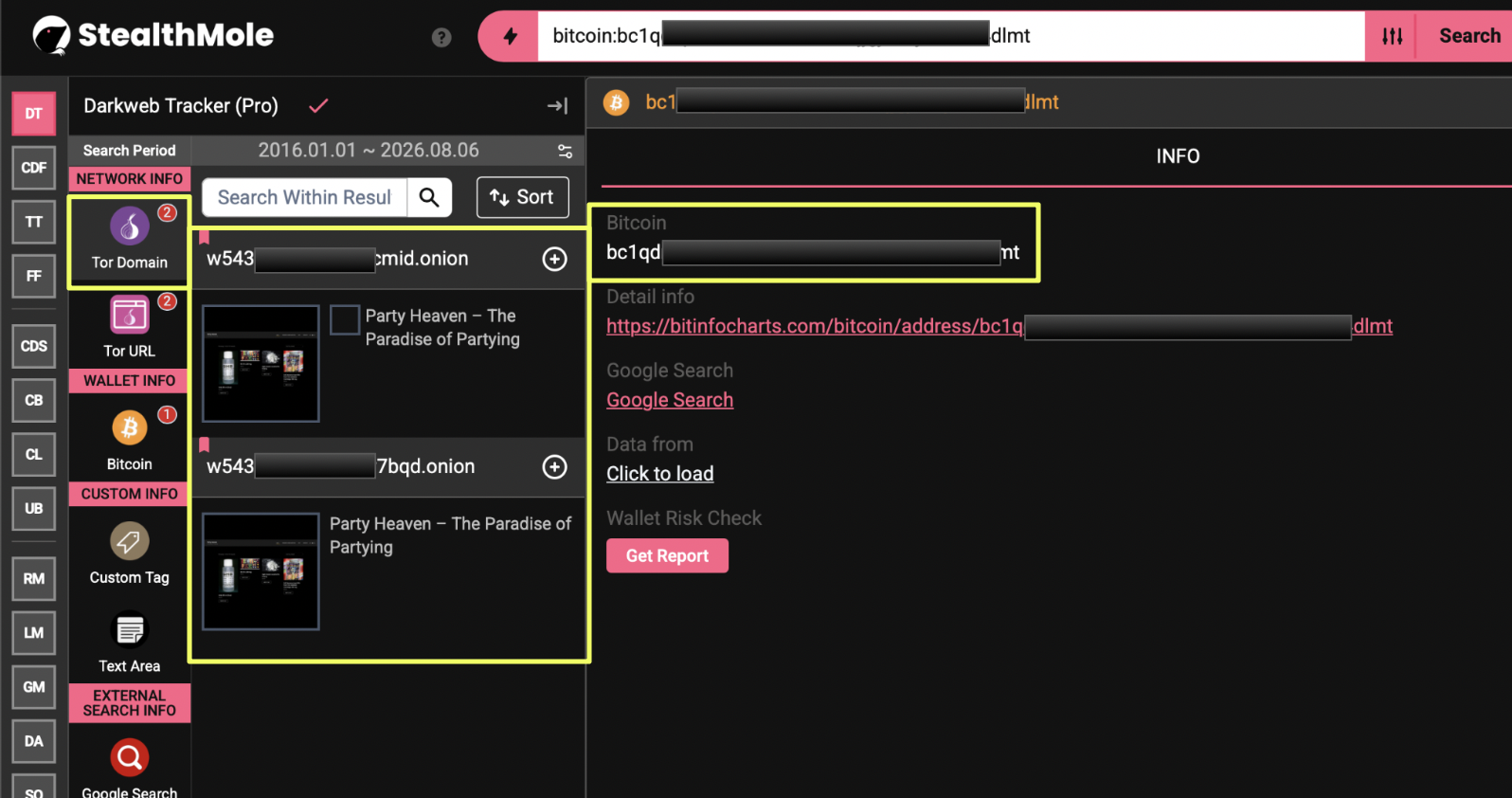
Although the address had appeared directly on Party Heaven's checkout page as a payment option, checking its blockchain history showed no transactions. Whatever its intended purpose on the storefront, there was no financial activity to follow.

The second address told a very different story:

  • bc1q0********************************500lkr
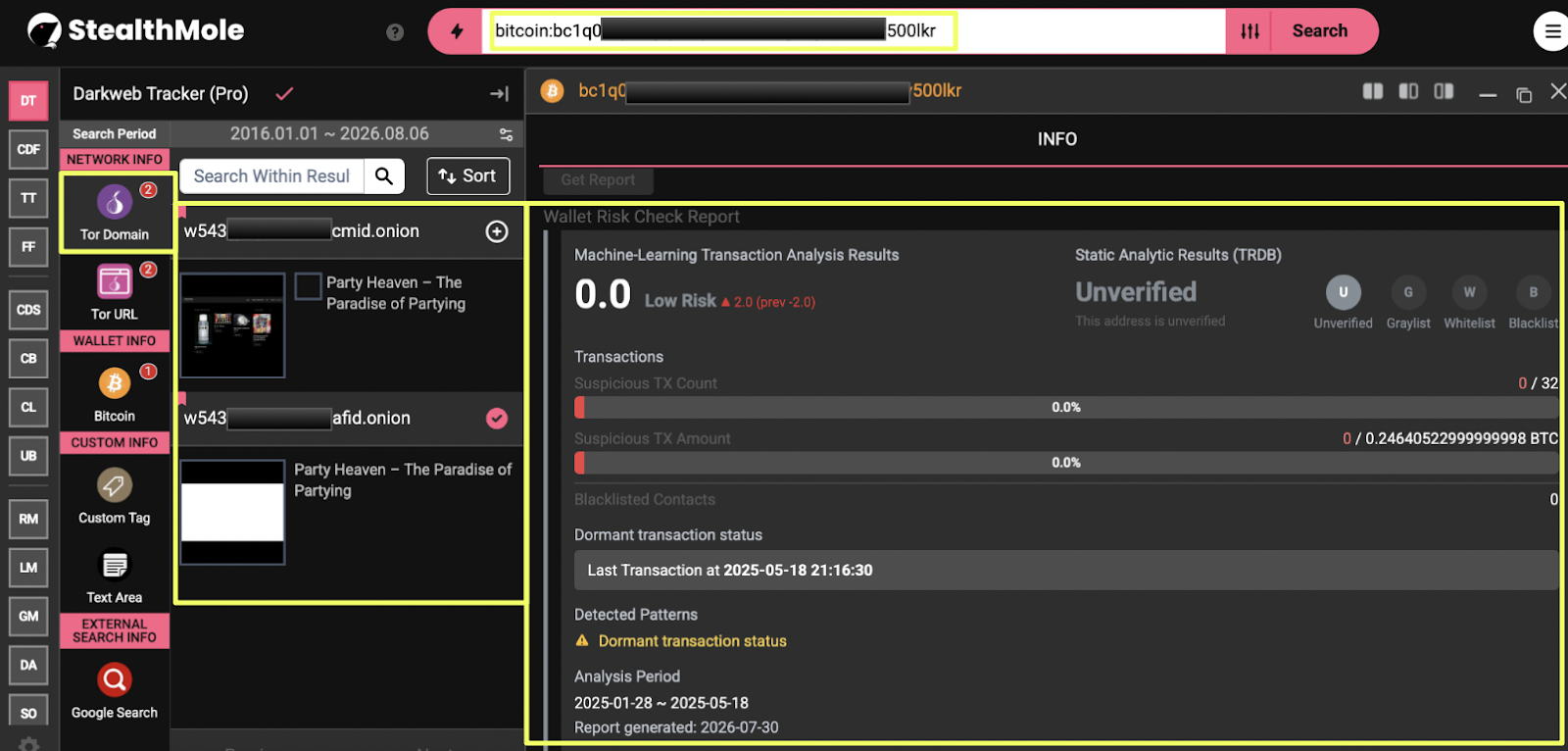
Running it through StealthMole first produced another Party Heaven onion:

  • W543gjeqesapphdx7gtu7cepkp2i2k6cfmcvczt4au4szknsd6d7afid.onion
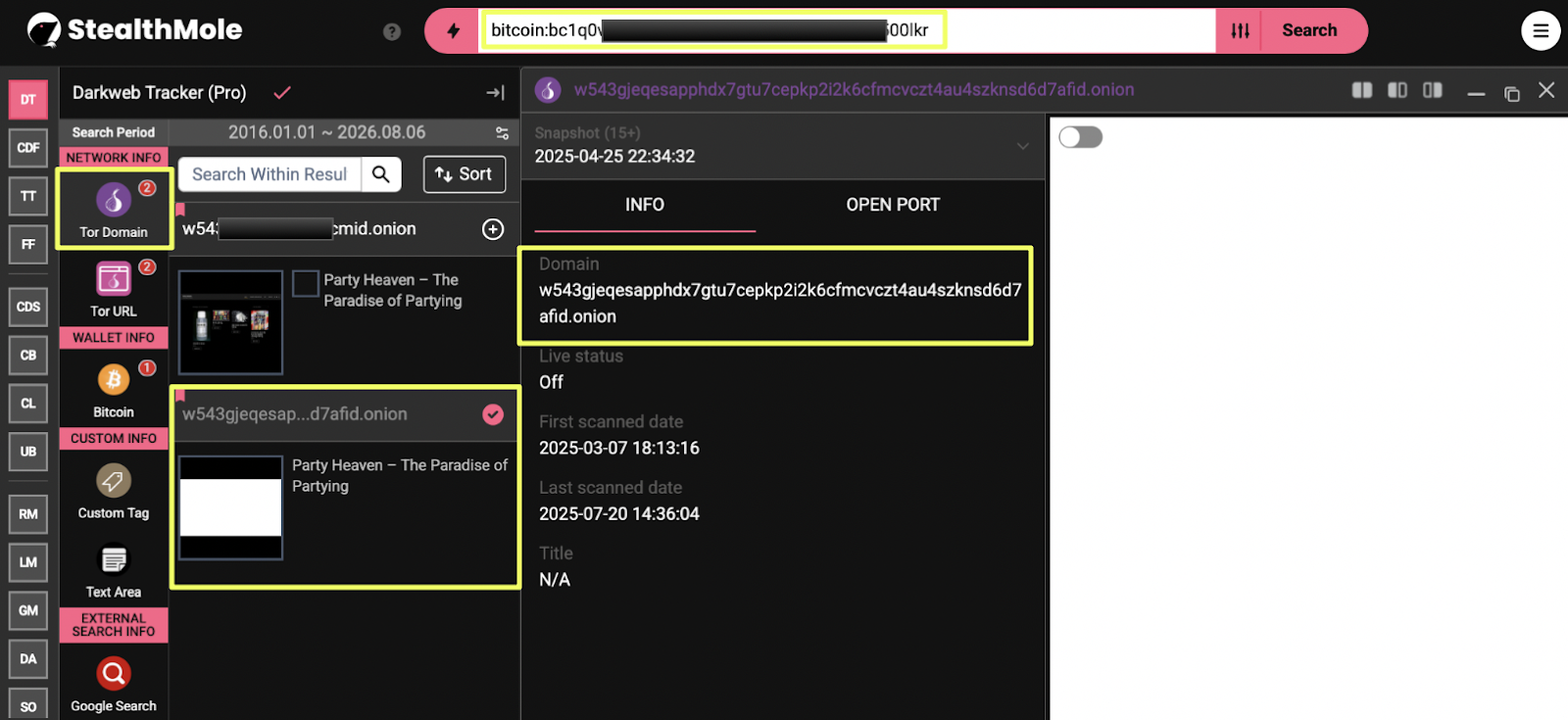
This domain was no longer active. Its association with the Bitcoin address nevertheless provided another route into Party Heaven's past and added a further onion address to the growing collection of storefront infrastructure uncovered during the investigation.

This time, however, the blockchain itself also had something to say.

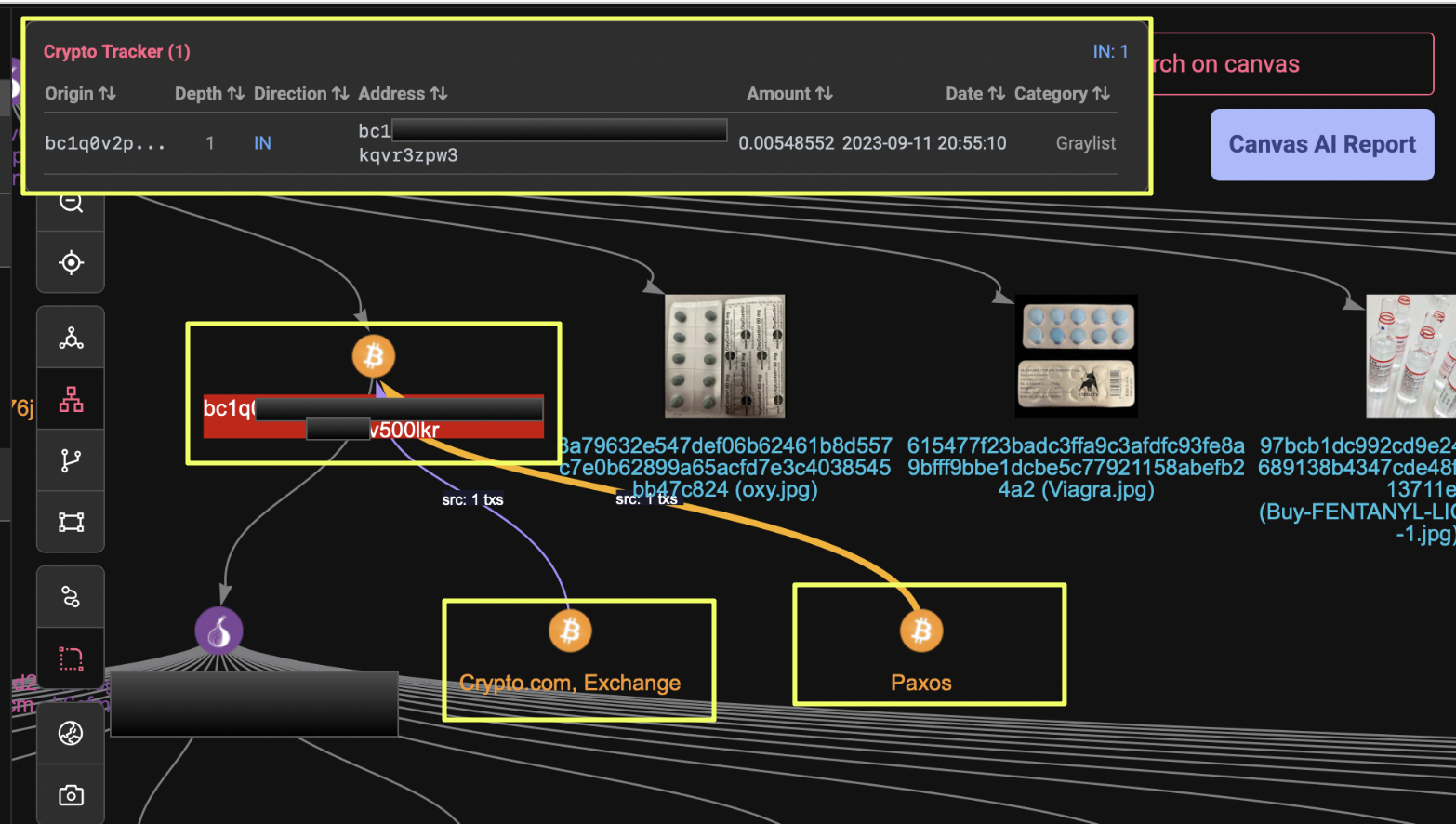
StealthMole's Crypto Tracker showed activity associated with the wallet stretching across several years. The address first received Bitcoin on January 7, 2022, and its last recorded incoming transaction occurred on January 28, 2025. Outgoing activity began on March 25, 2022 and continued until May 18, 2025.
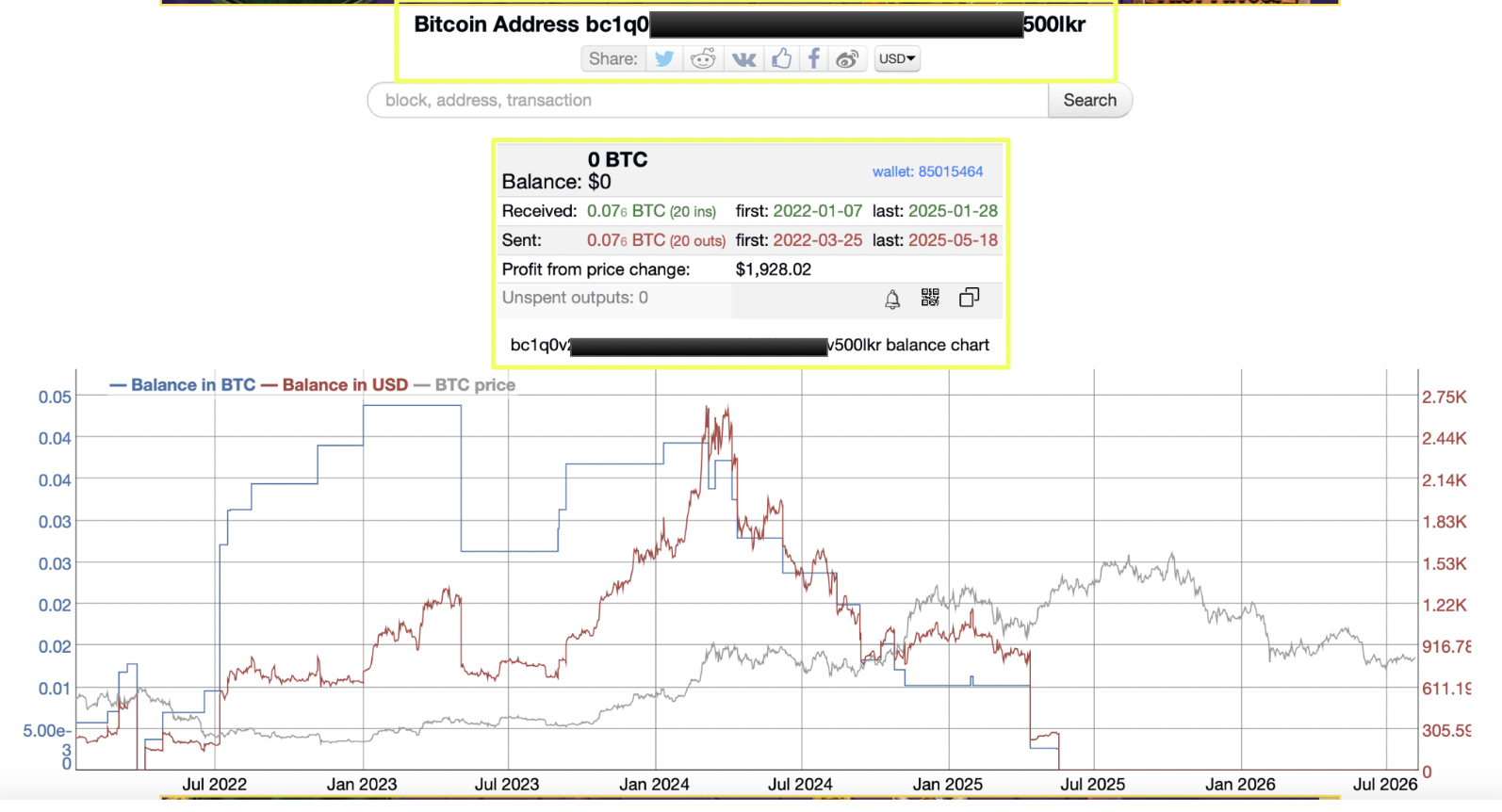
StealthMole's Crypto Tracker also flagged transaction relationships involving addresses attributed to Crypto.com Exchange and Paxos. These connections were useful investigative markers, but they did not identify whoever was behind Party Heaven. A blockchain interaction with an address associated with an exchange or financial service does not, by itself, establish that the Party Heaven operator personally maintained an account there, nor does it reveal the identity of an account holder.
The more consequential finding came from the inactive Party Heaven domain discovered through the wallet.

When w543gjeqesapphdx7gtu7cepkp2i2k6cfmcvczt4au4szknsd6d7afid.onion was examined further in StealthMole, it produced 25 Bitcoin addresses associated with its historical records.
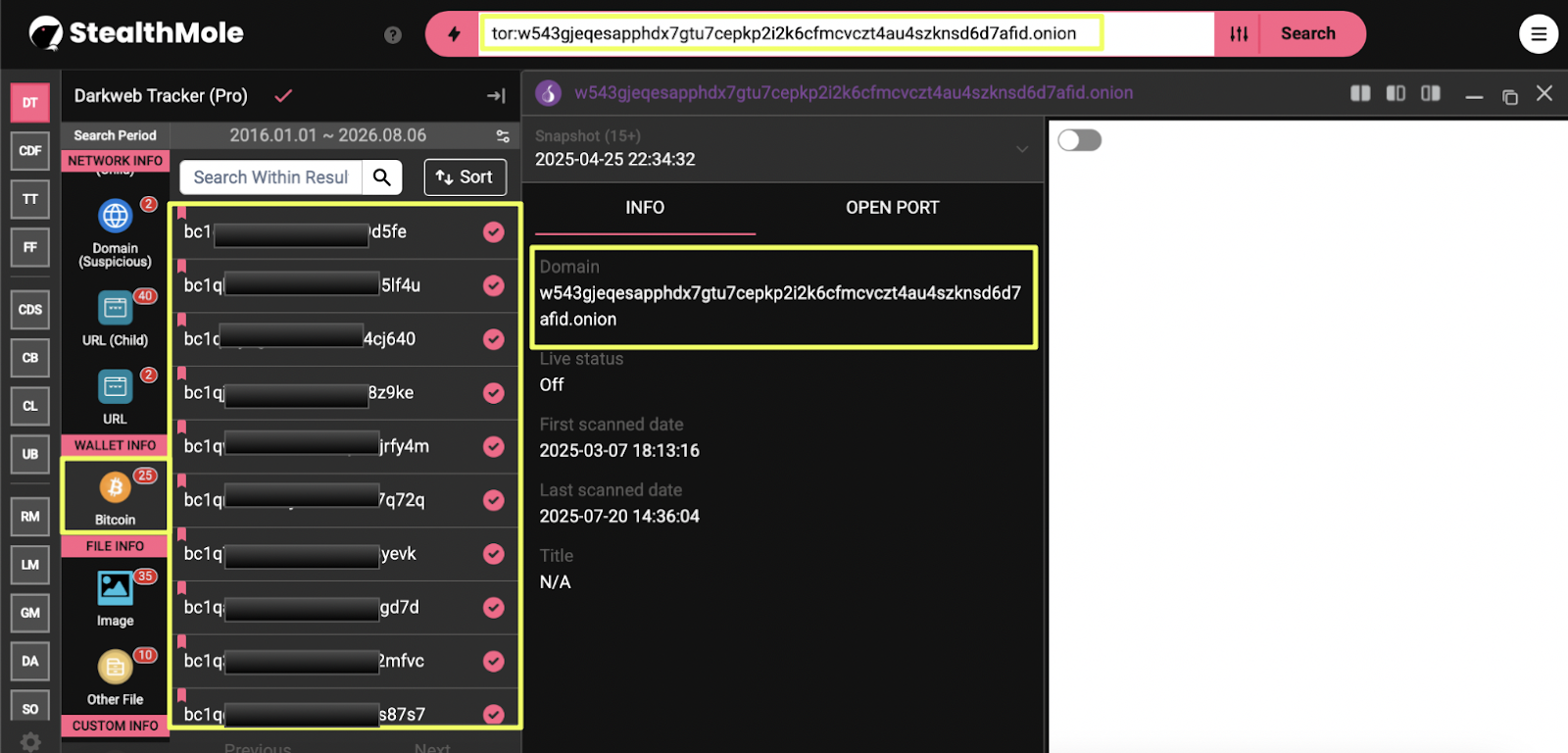
That changed the scale of the investigation again. Until this point, the connections around Party Heaven had largely emerged through mirrors and reused product content. The new dataset provided something different: a collection of cryptocurrency artifacts that could each be followed independently.

Bitcoin Wallets and a Lot More Than Party Heaven

The 25 Bitcoin addresses associated with the inactive Party Heaven domain offered 25 possible directions for the investigation. Most did not provide meaningful blockchain activity, but searching the addresses through StealthMole produced something arguably more useful: several of them appeared alongside other dark web storefronts.
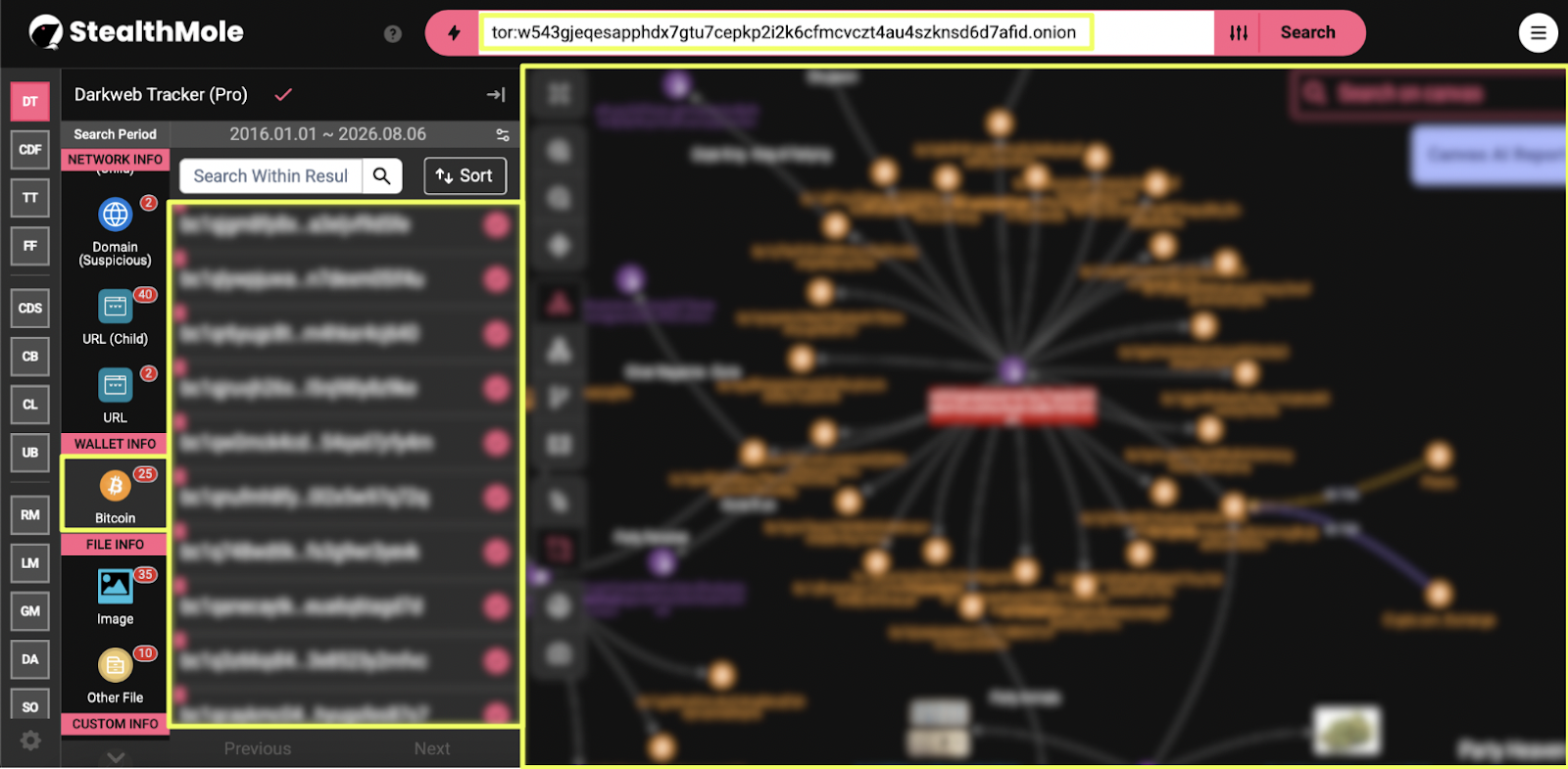
The full set identified from the Party Heaven domain was:

  • Bc1qj*********************************d5fe
  • Bc1ql*********************************lf4u
  • Bc1qr********************************cj640
  • Bc1qj********************************8z9ke
  • Bc1qw*********************************fy4m
  • Bc1q7*********************************yevk
  • Bc1qn*********************************q72q
  • Bc1q7*********************************z3ew
  • Bc1qn*********************************eeyv
  • Bc1qa*********************************gd7d
  • Bc1q3*********************************mfvc
  • Bc1qe*********************************j3a8
  • Bc1qc*********************************87s7
  • Bc1q8*********************************wuaf
  • Bc1q0*********************************0lkr
  • Bc1qp*********************************zs2p
  • Bc1qm*********************************q3uq
  • Bc1q3*********************************h775
  • Bc1qs*********************************z48y
  • Bc1q3*********************************h8nv
  • Bc1q2*********************************y342
  • Bc1q8*********************************dktk
  • Bc1qy*********************************pzjy
  • Bc1ql*********************************v9w2
  • Bc1qy*********************************0v0r

Several addresses immediately opened doors into storefronts carrying names that felt increasingly familiar.

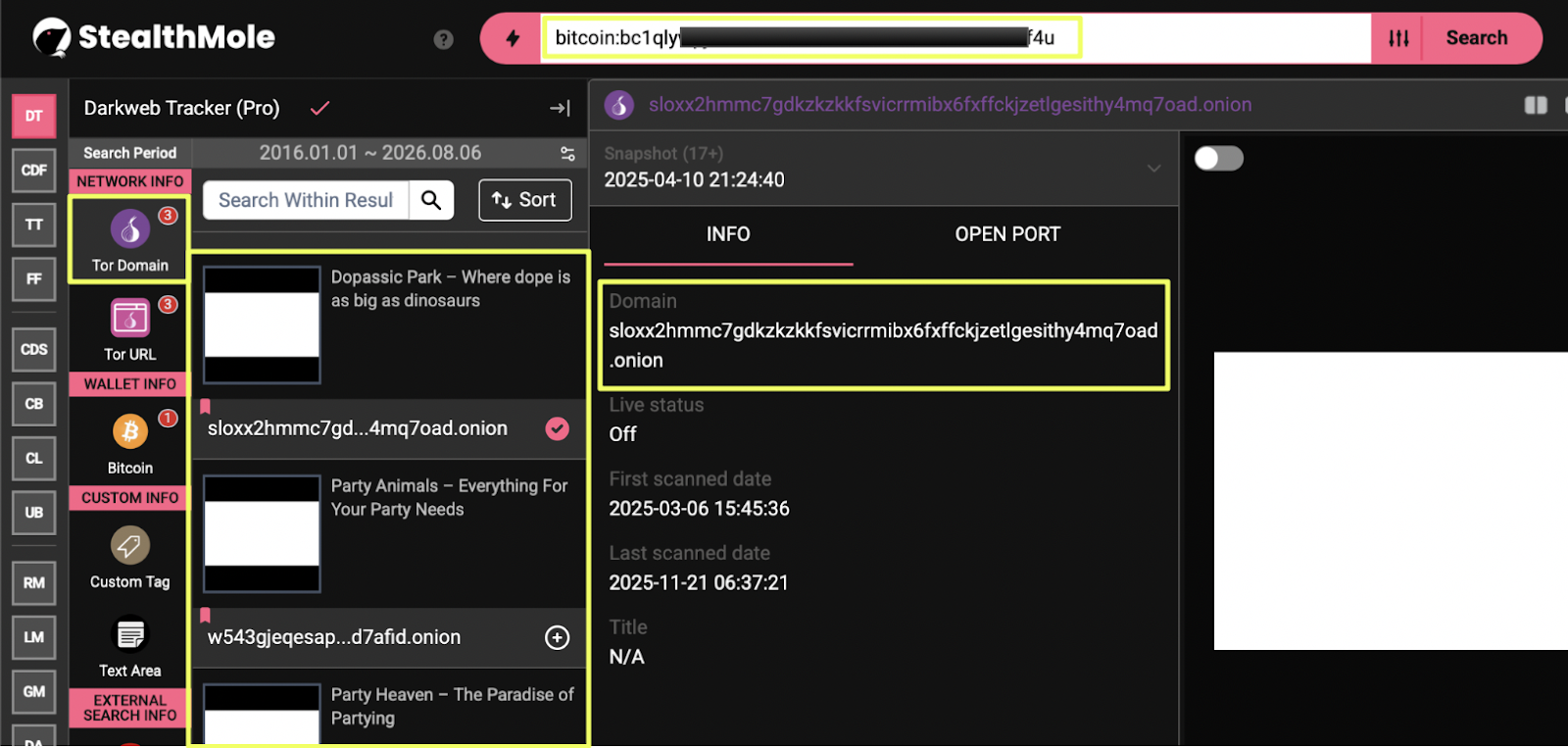
The address bc1qly********************lf4u appeared in connection with an inactive shop called “Party Animals – Everything For Your Party Needs”:

  • Sloxx2hmmc7gdkzkzkkfsvicrrmibx6fxffckjzetlgesithy4mq7oad.onion
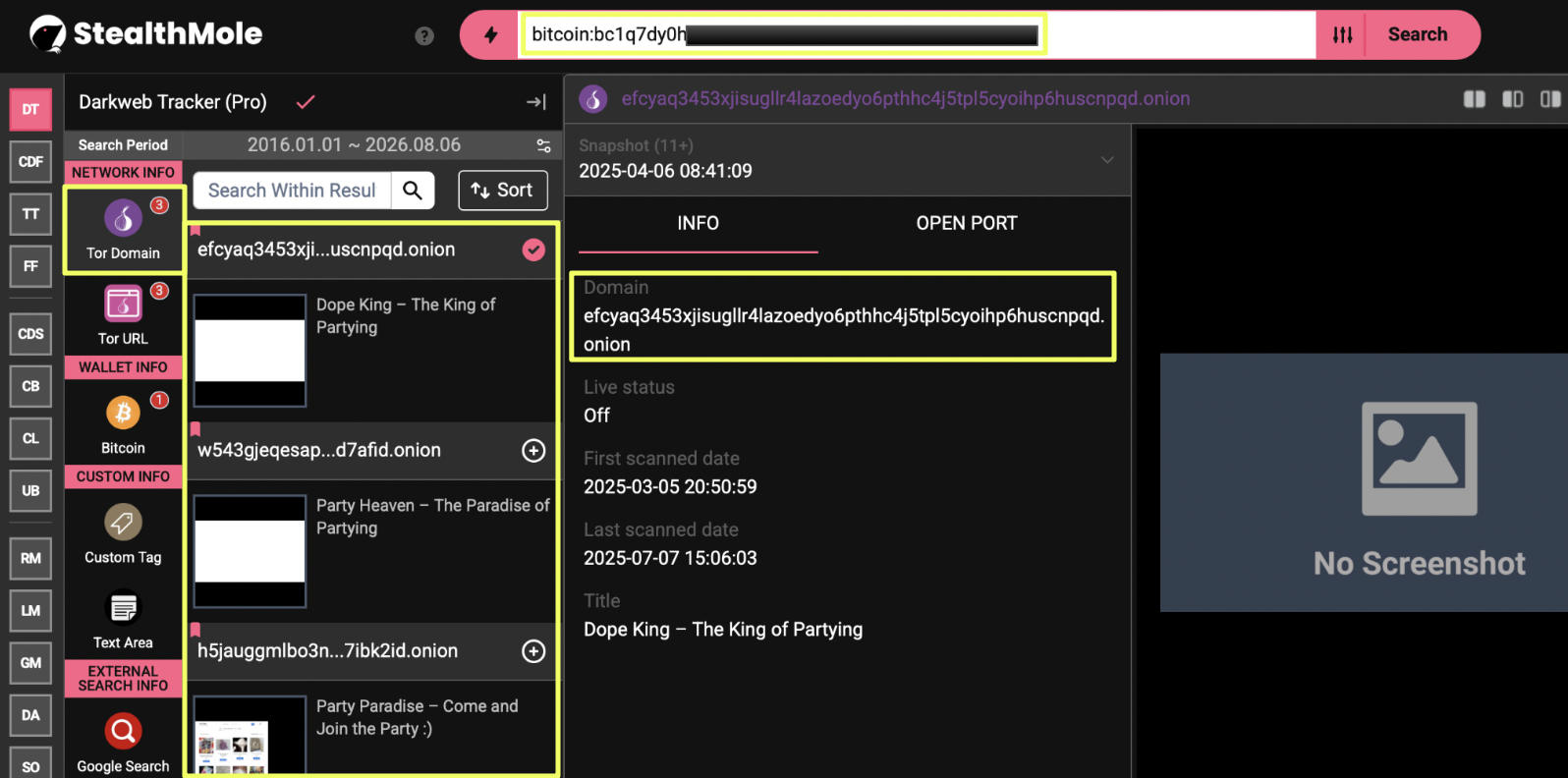
Another address, bc1q7dy**********************z3ew, led to “Dope King – The King of Partying”:

  • efcyaq3453xjisugllr4lazoedyo6pthhc4j5tpl5cyoihp6huscnpqd.onion
Then came Party Paradise. The address:

  • bc1qs************************************z48y

was associated with an inactive storefront titled “Party Paradise – Come and Join the Party :)” at:

  • H5jauggmlbo3ntusetik6uvylwckmjwixaab4htnddoy65qki7ibk2id.onion
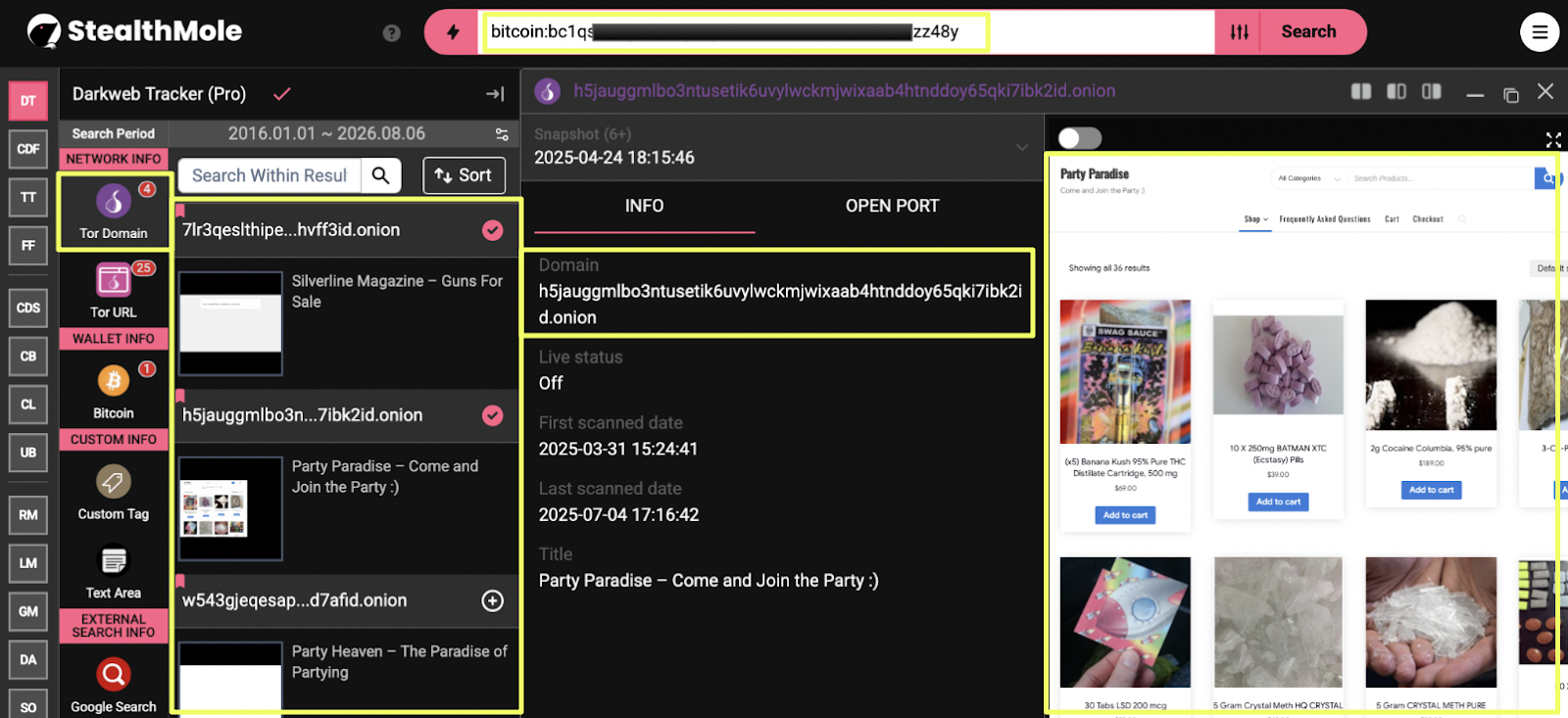
Its archived storefront contained 36 products, with product names and imagery again resembling material encountered elsewhere during the investigation.

The same Bitcoin address also appeared in connection with another inactive onion titled Silver Magazine:

  • 7lr3qeslthipebdvn424wwvb272eowsrw33fracoqjpeohj66hvff3id.onion

That association was recorded, but deliberately not treated as evidence that Silver Magazine formed part of the same drug-storefront cluster. The nature of the site differed substantially from the other findings, and an indexed wallet relationship without further context was not enough to establish why the address appeared there.

Another unexpected result came from:

  • bc1q3****************************mh8nv

StealthMole associated the address with an inactive weapons storefront titled “Guns"R"Us – The 2nd Amendment Store”:

  • 7vugm3oxle3e6z5v2snu5fwvbgajqmt2hw3hgqviaafaqd2levfsubid.onion
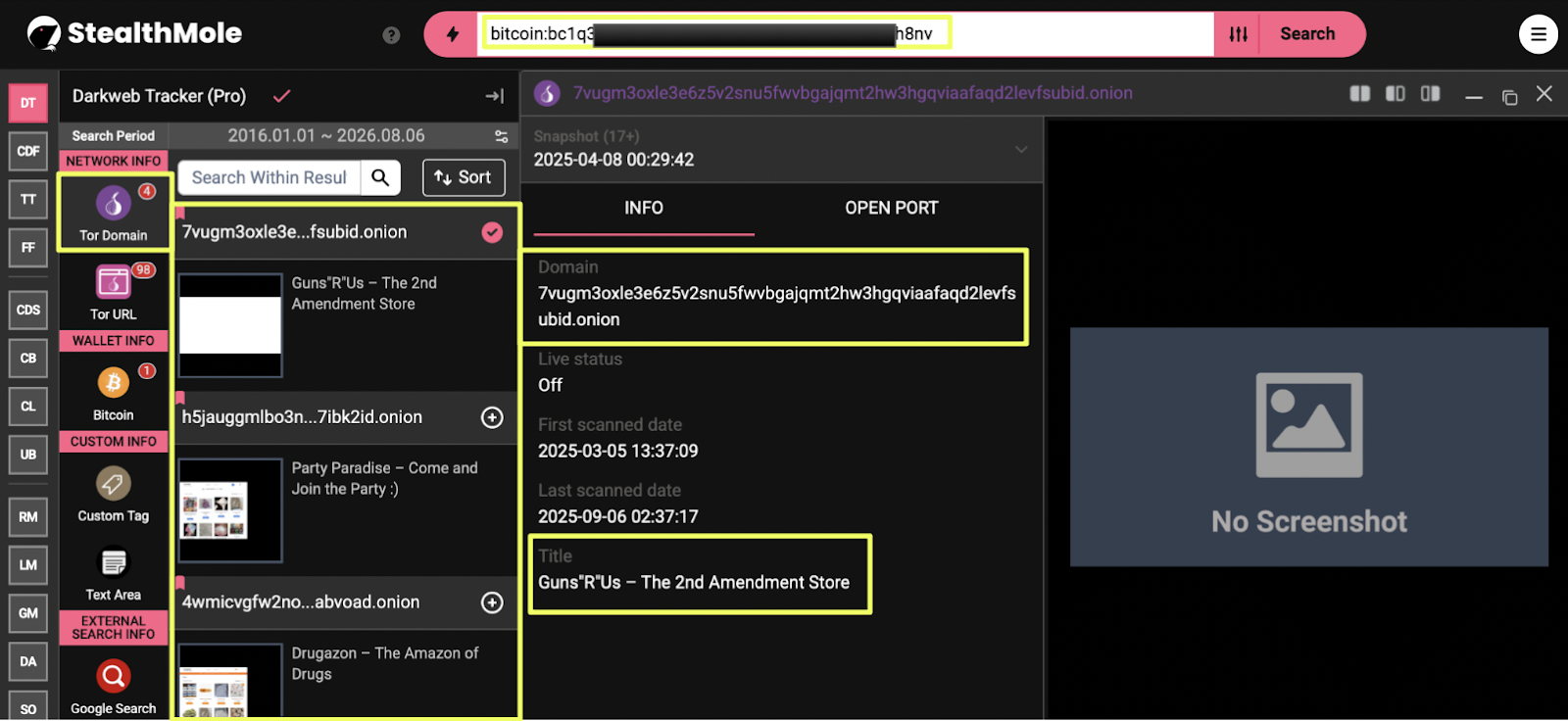
Again, the finding was kept separate from the developing drug-storefront cluster. Without additional evidence explaining the relationship, folding an unrelated weapons shop into the network simply because an address appeared in both datasets would have gone beyond what the evidence could support.

Other pivots stayed much closer to the pattern already emerging.

  • bc1q8******************************dktk

led to “Drugazon – The Amazon of Drugs”:

  • 4wmicvgfw2nodbvlj7ovvfwyxr5guj64sqtnkvwhjtcmonc4ywabvoad.onion
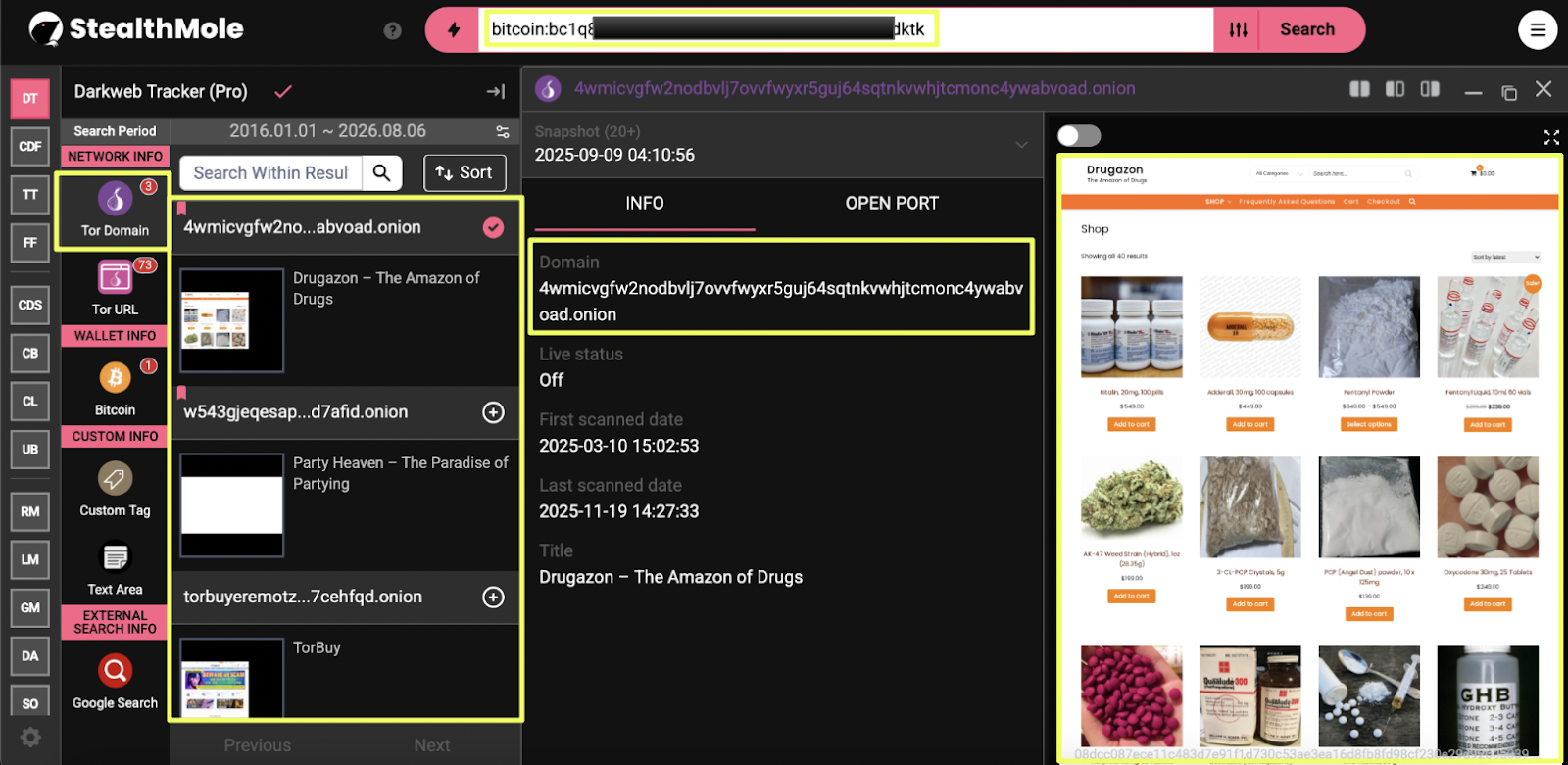
StealthMole had first scanned Drugazon on March 10, 2025, with its last recorded scan on November 19, 2025. Its orange colour scheme distinguished it visually from Party Heaven, but underneath the different branding the similarities were difficult to miss. The archived shop displayed 40 products through the same familiar Shop, FAQ, Cart and Checkout structure, while numerous product photographs, names and prices closely resembled those already observed on Party Heaven.

Finally,

  • bc1ql****************************v9w2

surfaced another inactive storefront, Dopassic Park, at:

  • Hyzmpq2fo637gfuerzwtqzqcpgmu2kyhibd3kfx6aq2vgtniz3eu2rqd.onion
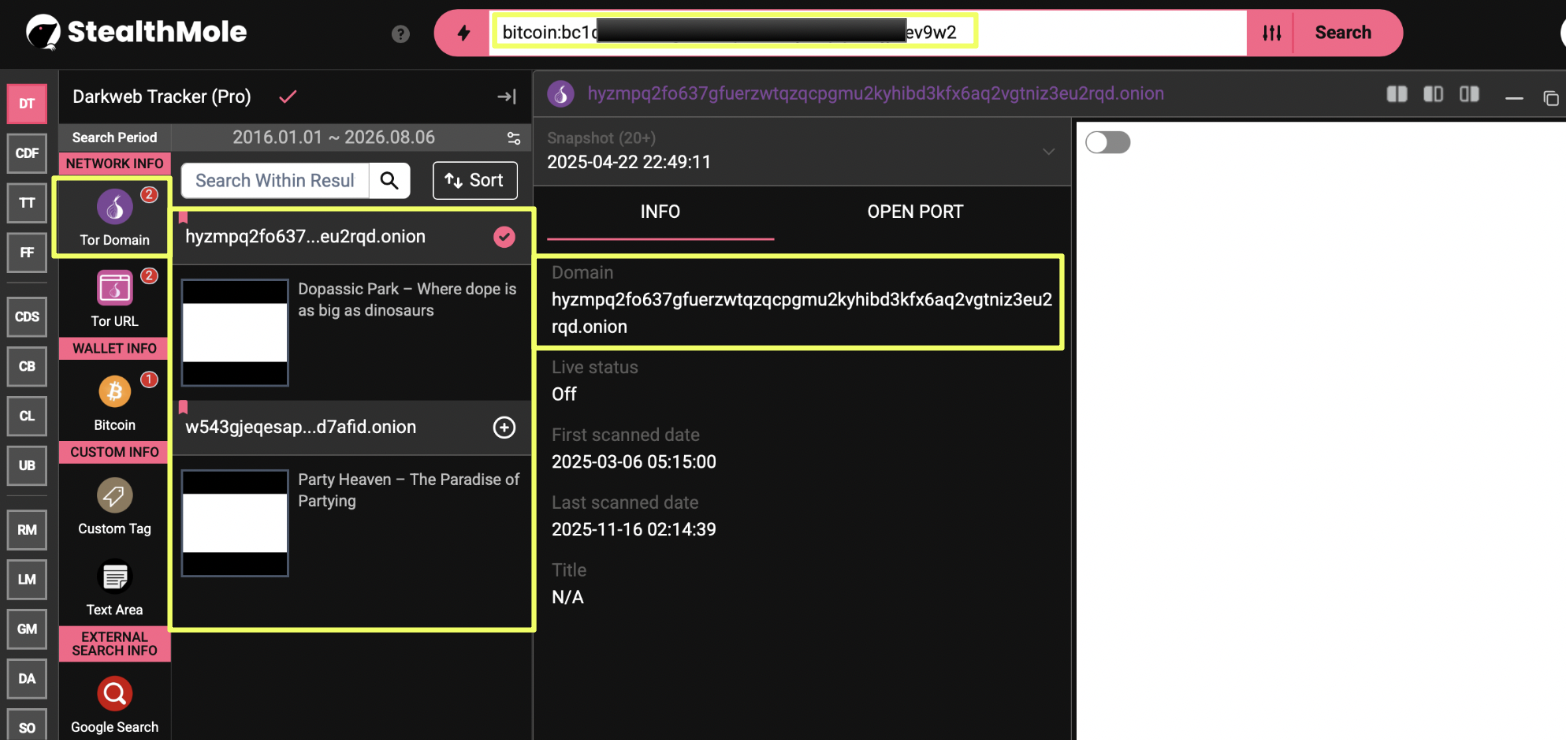
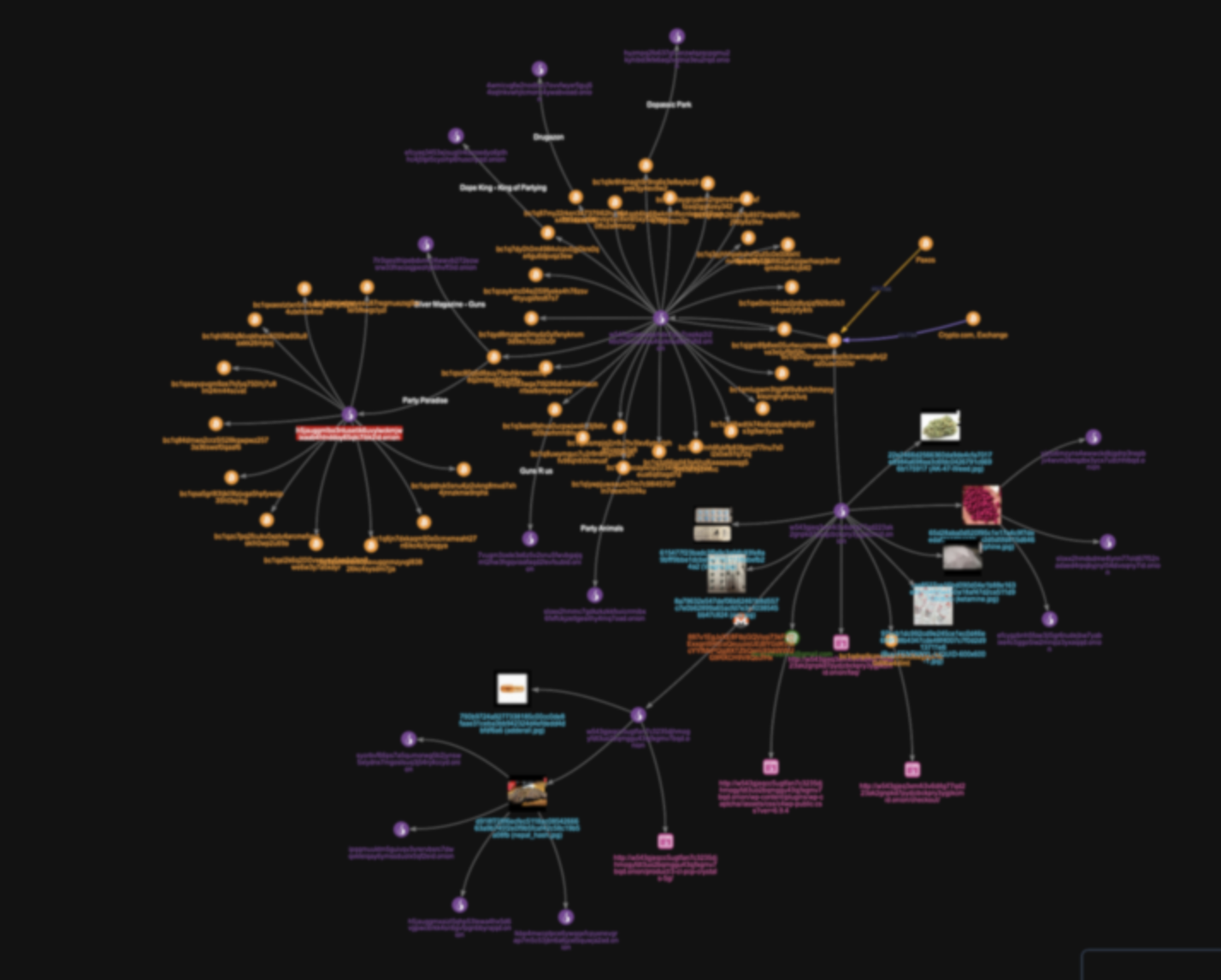
By now, the investigation had reached a very different place from where it started. A single Party Heaven domain had led to a historical mirror, that mirror had exposed a collection of Bitcoin artifacts, and those artifacts were repeatedly surfacing alongside differently branded dark web shops. Not every association carried the same weight, and some were intentionally set aside rather than forced into the emerging picture.

Party Paradise Opens Another Ledger

Party Paradise was worth examining more closely because the connection no longer rested on product imagery alone. The domain had already surfaced through a Bitcoin address found within the Party Heaven-associated dataset, giving the investigation a financial artifact that could be tested from the other direction.

The storefront in question was:

  • H5jauggmlbo3ntusetik6uvylwckmjwixaab4htnddoy65qki7ibk2id.onion
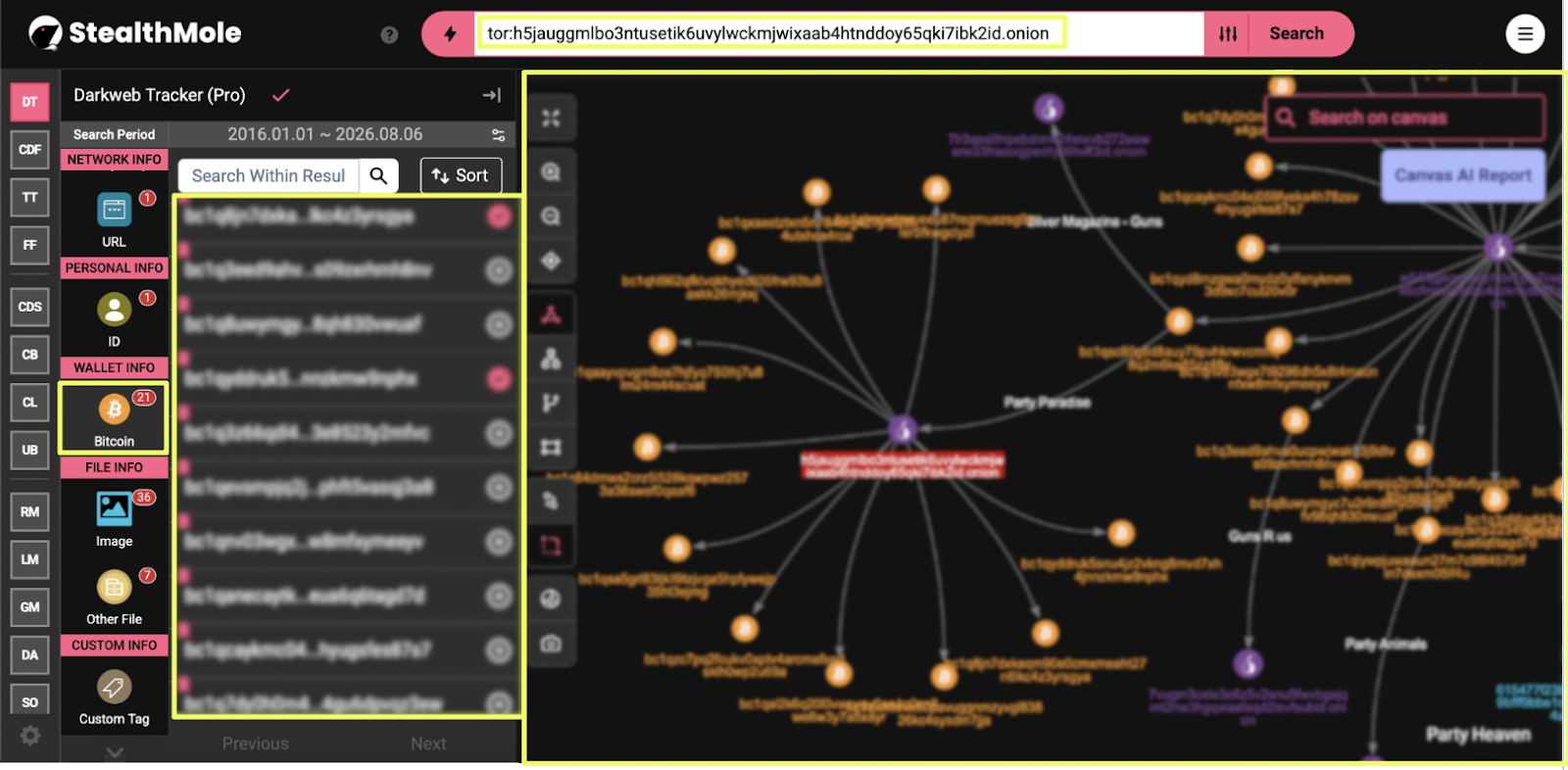
When this domain was investigated independently in StealthMole, Darkweb Tracker returned 21 Bitcoin addresses associated with its historical records:

  • Bc1q**********************************h8nv
  • Bc1q8*********************************wuaf
  • Bc1qy*********************************nphx
  • Bc1q8*********************************sgya
  • Bc1qn*********************************eeyv
  • Bc1qc*********************************87s7
  • Bc1q3*********************************mfvc
  • Bc1qa*********************************gd7d
  • Bc1q7*********************************z3ew
  • Bc1qe*********************************j3a8
  • Bc1q**********************************xayr
  • Bc1q**********************************7jja
  • Bc1q**********************************ejmg
  • Bc1q**********************************u69a
  • Bc1q**********************************jkxj
  • Bc1q**********************************aaf6
  • Bc1q**********************************yevk
  • Bc1q**********************************z48y
  • Bc1q**********************************cvat
  • Bc1q**********************************4rce
  • Bc1q**********************************lyzl

The list became much more interesting when it was compared with the 25 addresses previously surfaced from the Party Heaven-associated onion. Ten Bitcoin addresses appeared in both datasets:

  • Bc1q************************************h8nv
  • Bc1q************************************wuaf
  • Bc1q************************************eeyv
  • Bc1q************************************87s7
  • Bc1q************************************mfvc
  • Bc1q************************************gd7d
  • Bc1q************************************z3ew
  • Bc1q************************************j3a8
  • Bc1q************************************yevk
  • Bc1q************************************z48y

This was a more meaningful overlap than the visual similarities that had first drawn attention to the other storefronts. Party Paradise and the Party Heaven-associated domain were not connected by a single address appearing somewhere in StealthMole's historical data. Nearly half of the Bitcoin artifacts identified for this Party Paradise instance were also present in the Party Heaven-derived set.
Conclusion

What began as a closer look at a single drug storefront ultimately revealed a much broader collection of relationships. Party Heaven appeared across multiple onion addresses, while pivots through its cryptocurrency artifacts and product imagery repeatedly surfaced differently branded shops such as Party Paradise, Party Animals, Dope King, Drugazon, Dopassic Park and others.

The strongest indication of a deeper connection came from the cryptocurrency data. Party Paradise independently surfaced 21 Bitcoin addresses, ten of which overlapped with the 25-address dataset associated with a Party Heaven domain. Combined with recurring product imagery, similar storefront structures and multiple instances of the same brands, the findings suggest these sites were not simply isolated shops encountered by chance.

What the evidence does not establish is equally important. It cannot confirm that every storefront identified in the investigation was operated by the same individual or group. Some relationships were considerably stronger than others, and shared content or indexed cryptocurrency artifacts alone cannot prove common ownership. What StealthMole did reveal, however, was a persistent and interconnected footprint surrounding Party Heaven that extended well beyond the single active storefront where the investigation began.

Editorial Note

Dark web investigations rarely produce absolute answers, particularly when storefronts change domains, reuse content, rotate cryptocurrency addresses, or disappear altogether. The connections identified in this investigation should therefore be understood according to the strength of the underlying evidence rather than treated as proof of common ownership.

The Party Heaven case demonstrates how StealthMole can help navigate that uncertainty by bringing historical Tor records, cryptocurrency artifacts, archived storefronts and recurring digital content together, allowing relationships to emerge that would be difficult to see from any single data point alone.

To access the unmasked report or full details, please reach out to us separately.

Contact us: support@stealthmole.com


Labels: ,

Hitmen for Hire: Inside the Mexican Mafia Marketplace

Dark web has long been home to marketplaces advertising services that range from financial fraud and forged documents to far more serious offerings such as contract violence. While many of these platforms are little more than scams designed to steal cryptocurrency from unsuspecting buyers, others attempt to build credibility by presenting structured marketplaces, vendor profiles, discussion forums, escrow systems, and cryptocurrency payment infrastructure. Whether genuine or fraudulent, these platforms provide valuable insight into how criminal operators market themselves, establish trust, and maintain an online presence within underground communities.

One such platform is Mexican Mafia, a long-running dark web marketplace that presents itself as a directory of gang members and contract killers offering services worldwide. Beyond promoting alleged hitmen, the site also advertises other criminal services, including weapons, fraudulent documents, and opportunities for affiliates to earn commissions by driving traffic to the platform. The marketplace claims to operate through built-in and external escrow services, accepts cryptocurrency payments, and promotes anonymity for both customers and vendors.

This investigation examines the digital footprint surrounding the Mexican Mafia marketplace using StealthMole, tracing its infrastructure across historical and active onion domains, Telegram, cryptocurrency wallets, vendor profiles, and related underground resources. Rather than focusing on the claims made by the platform itself, the investigation follows the artifacts it left behind to understand how its infrastructure evolved and how different components of its ecosystem remain interconnected over time.

Behind the Landing Page

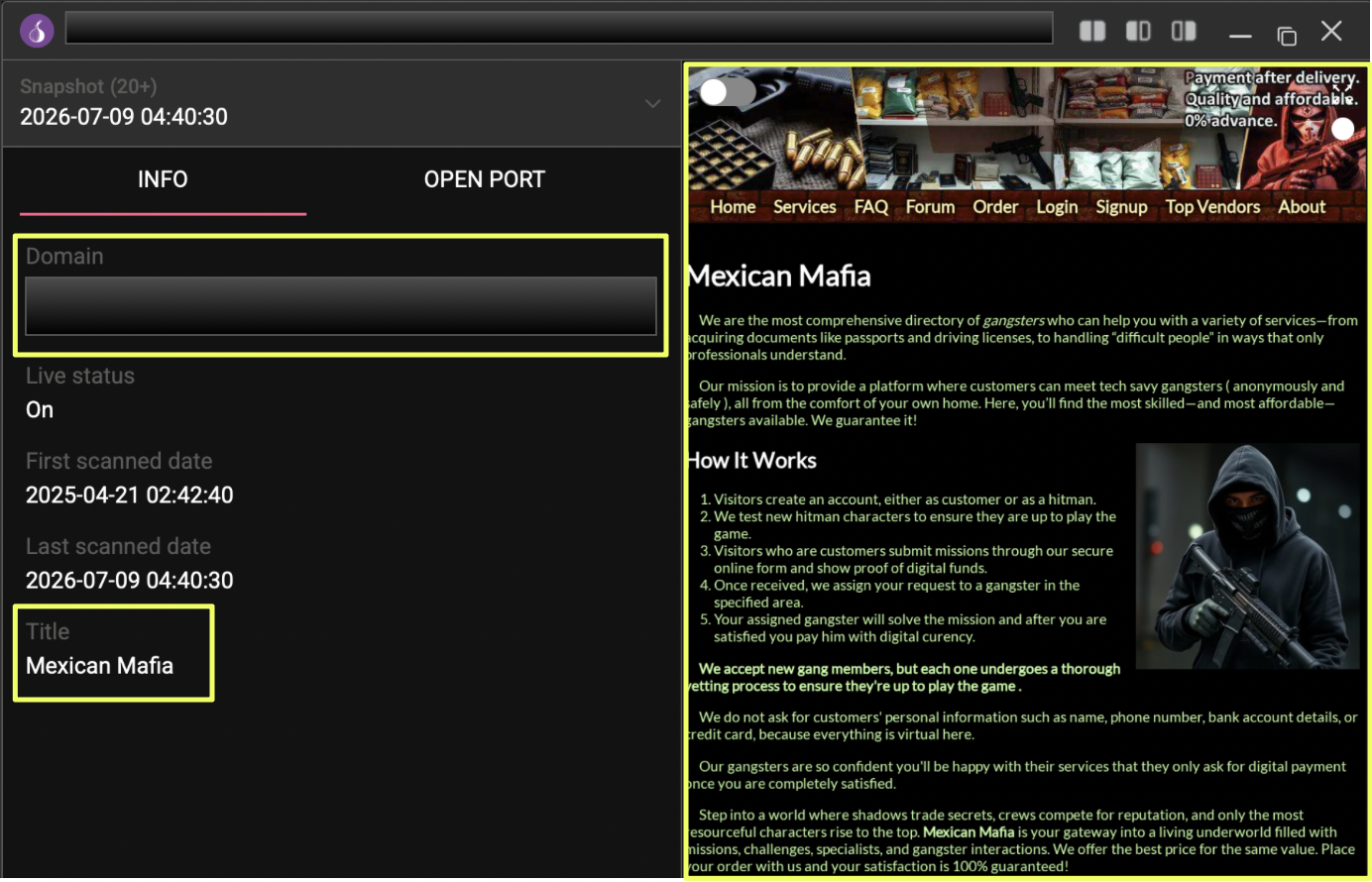
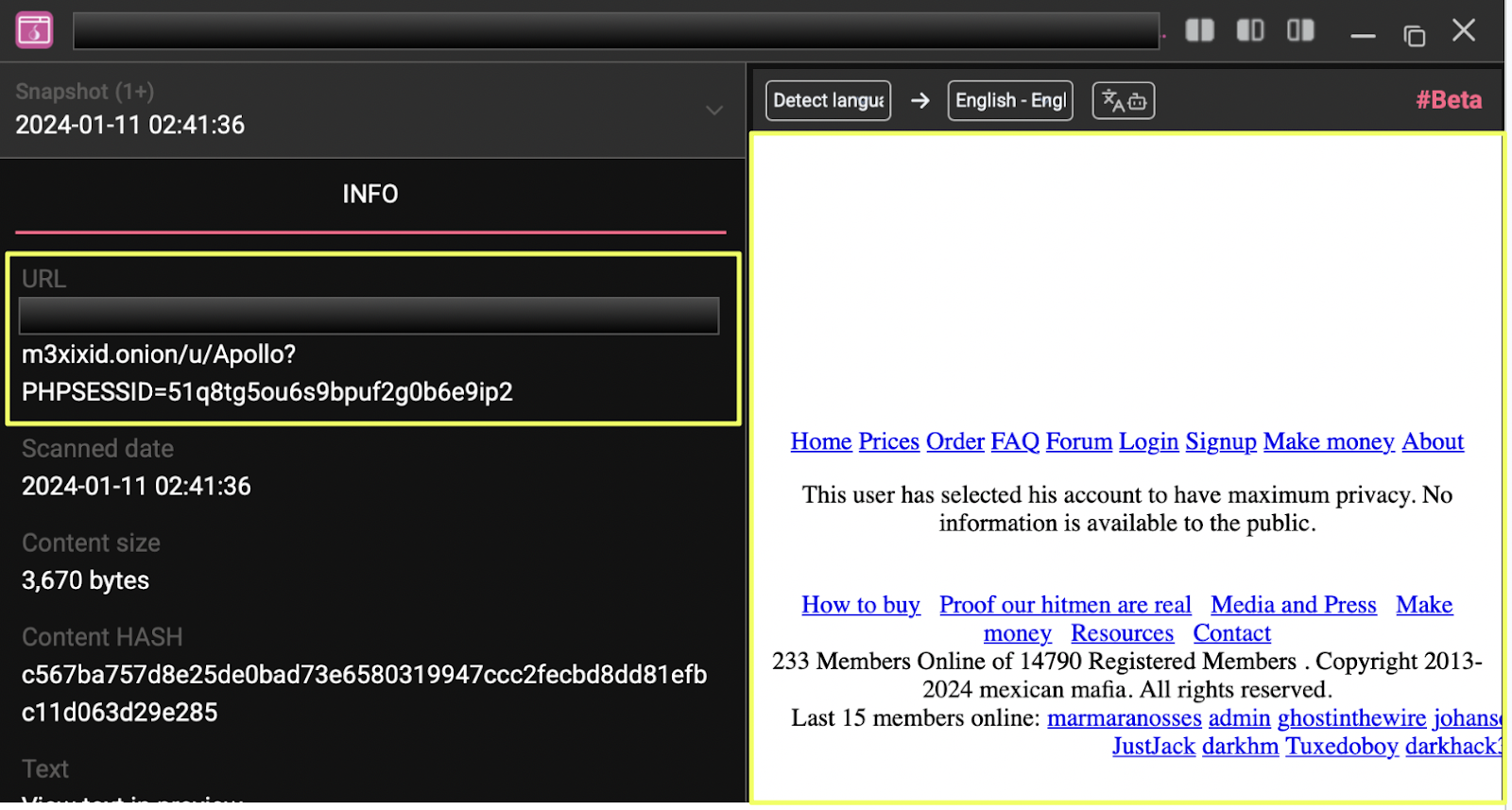
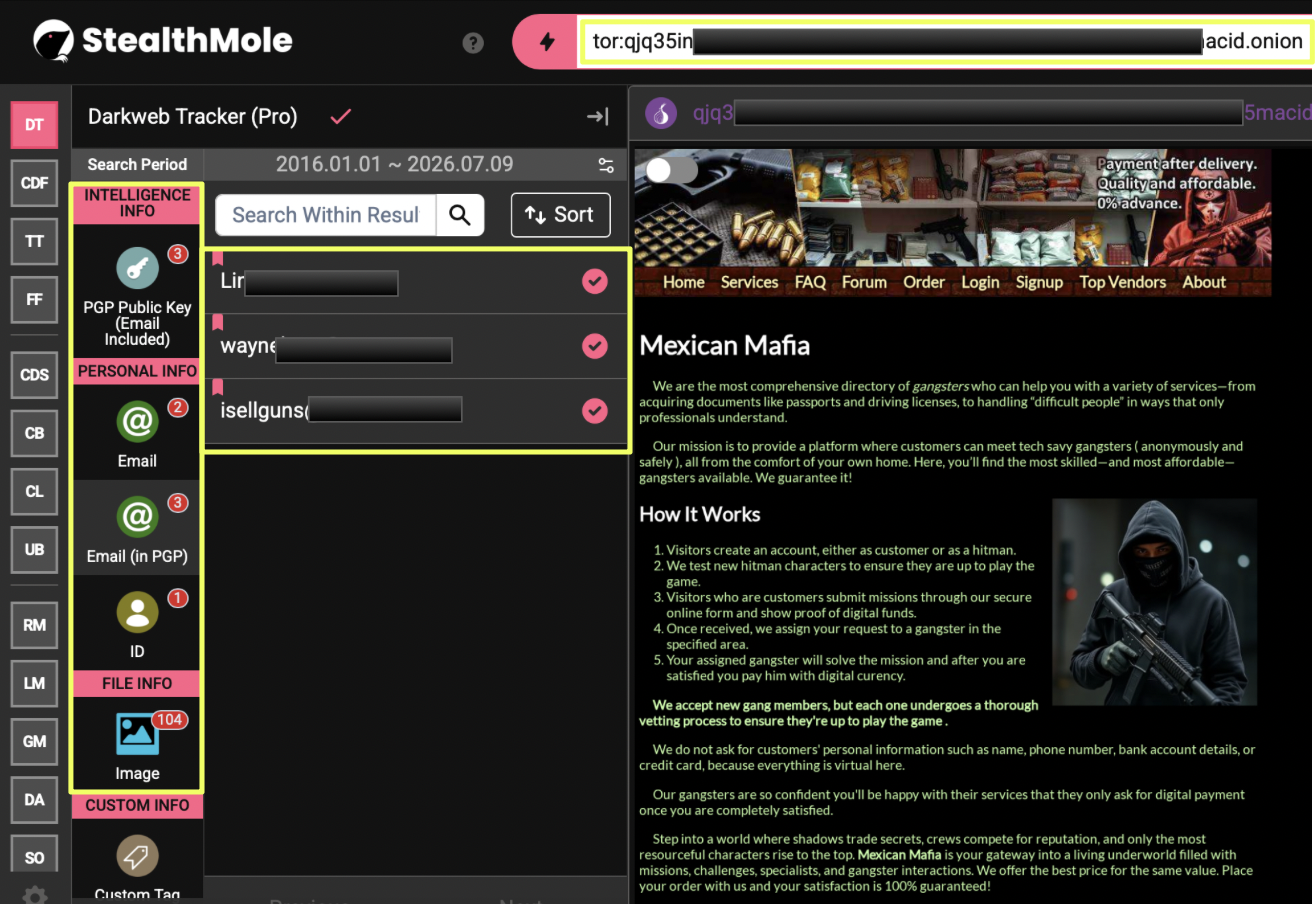
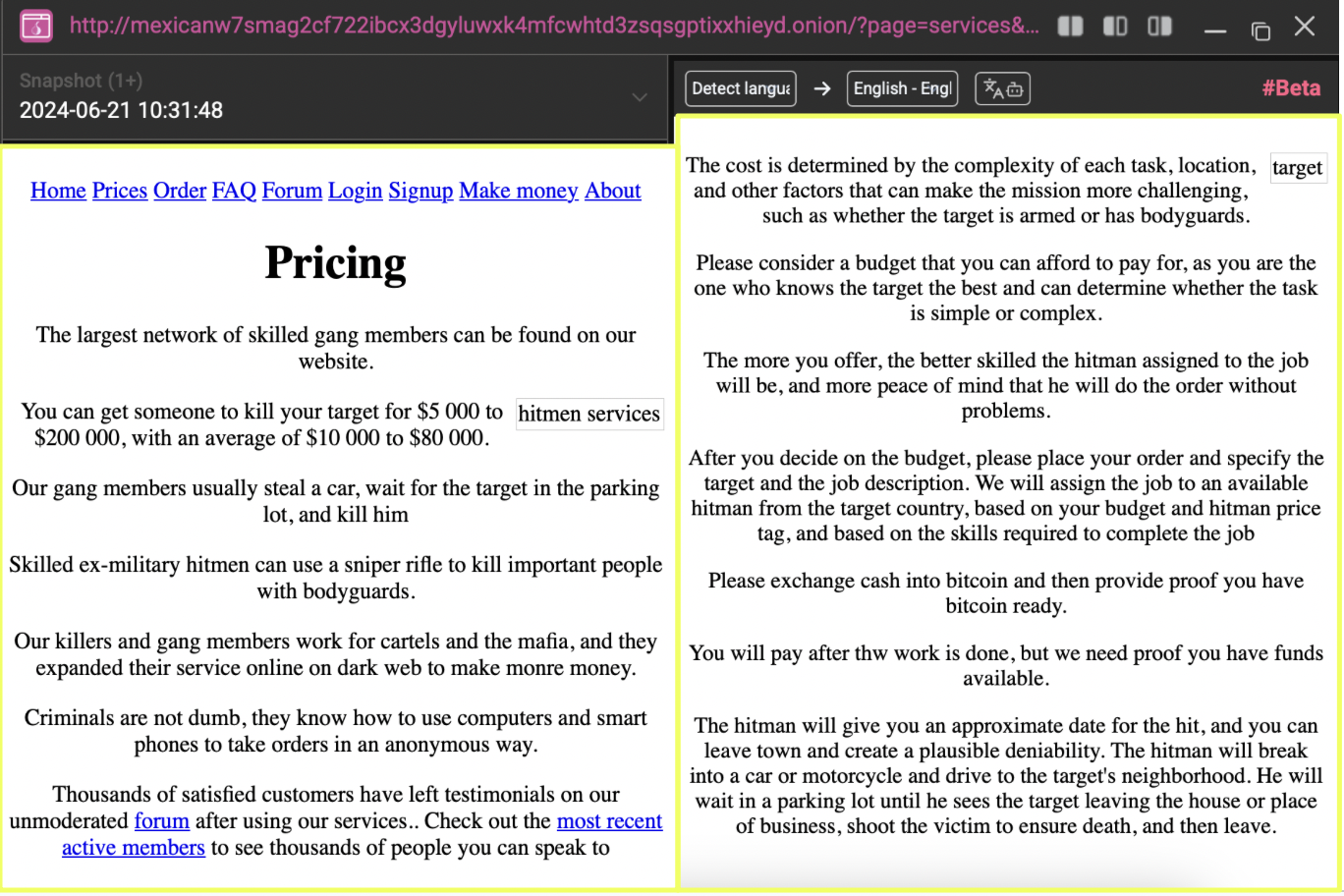
The investigation began with the discovery of an onion domain, which was indexed in StealthMole's Dark Web Tracker under the title "Mexican Mafia." The landing page presented itself as a marketplace where users could allegedly hire contract killers and other criminal service providers through an anonymous, cryptocurrency-based platform.

  • qjq35*********************************************acid.onion

At first glance, the website resembled many other illicit marketplaces operating on the dark web. It promoted a network of "gangsters" offering a range of criminal services, including contract killings, forged documents, and assistance with what it described as "difficult people." The site claimed to protect both buyers and vendors through anonymous communication, cryptocurrency payments, built-in and external escrow services, and a policy of not collecting personal information. It also advertised a workflow where payments would only be released after a requested task had been completed, presenting these features as safeguards intended to build trust among prospective users.

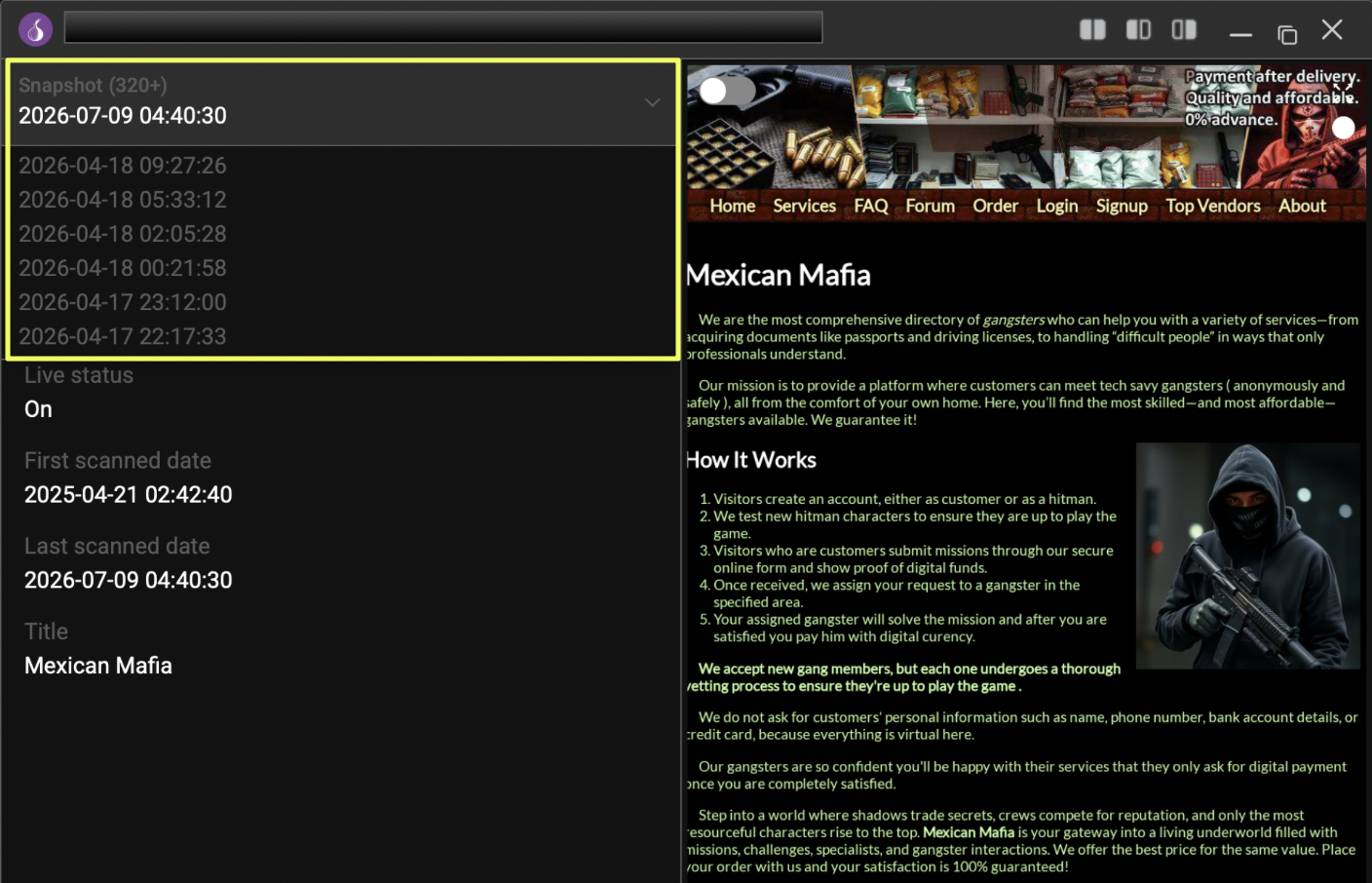
Rather than relying solely on the current version of the website, StealthMole's historical indexing immediately revealed that the marketplace had been observed over an extended period, with more than twenty archived snapshots available for analysis. This indicated that the platform had maintained an online presence across multiple points in time, making it a suitable candidate for a deeper infrastructure investigation. The focus therefore shifted from the marketplace's advertised services to the digital footprint surrounding it, with the objective of determining whether additional infrastructure, recurring identifiers, and historical artifacts could be uncovered beyond what was visible on the landing page.

Beyond a Single Onion Site

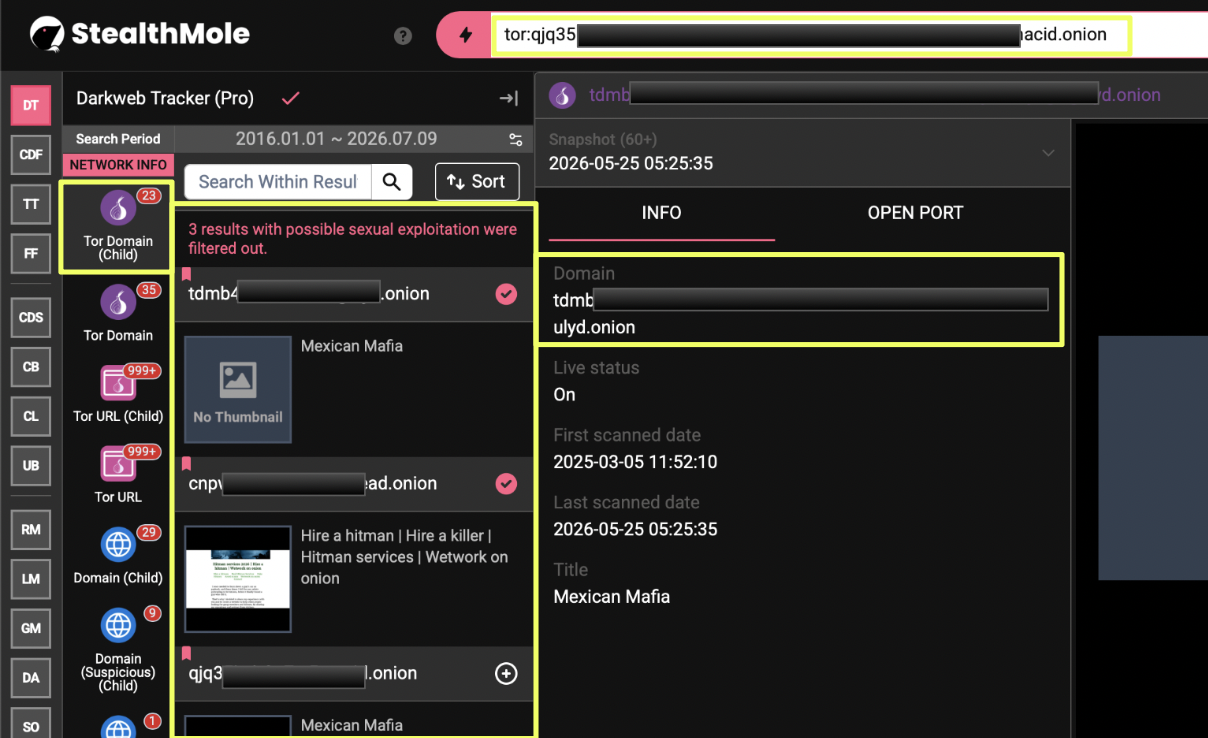
To determine whether the Mexican Mafia marketplace extended beyond its primary landing page, the original onion domain was further investigated using StealthMole's Dark Web Tracker. This quickly revealed that the marketplace was not operating from a single onion service. Historical records identified another active domain using the same "Mexican Mafia" title, suggesting that the operators maintained multiple versions of the platform over time.

  • tdmb4*****************************************gulyd.onion

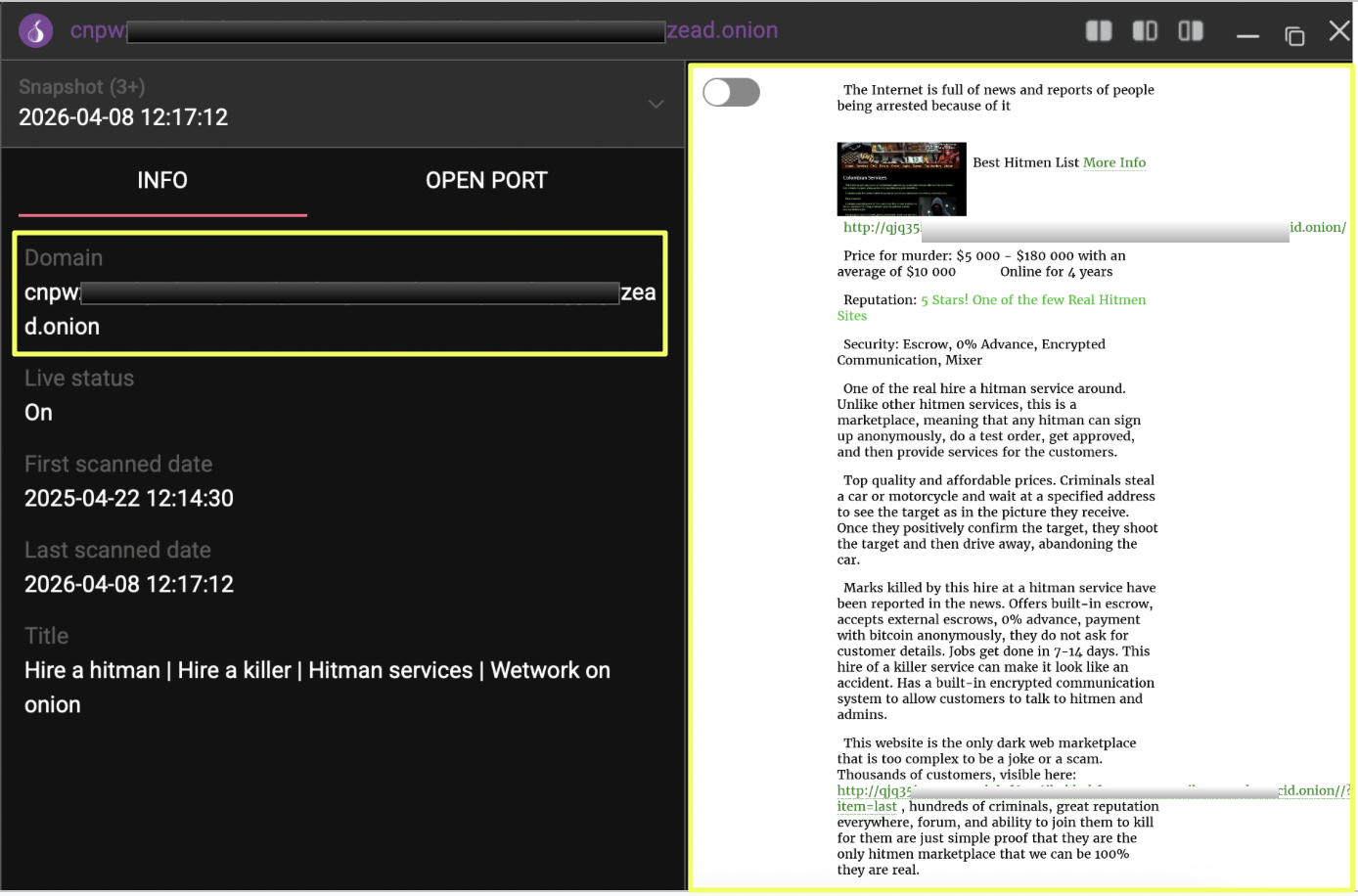
The investigation also uncovered another onion service that functioned as a directory reviewing alleged murder-for-hire websites. The page assigned the Mexican Mafia marketplace a five-star rating and described it as "one of the few real hitman services around." While these statements cannot be independently verified and should be regarded as promotional claims published by another dark web service, the listing confirmed that the marketplace had visibility beyond its own infrastructure.

  • cnpwz**********************************************zead.onion

More importantly, this review page exposed several contact artifacts associated with vendors advertising on the marketplace. Rather than focusing solely on the websites themselves, the investigation shifted towards these reusable identifiers, which often provide more reliable pivot points for uncovering related infrastructure. Among the artifacts recovered were three email addresses together with their associated PGP fingerprints:

Email Address

PGP Fingerprint

L****@dnmx.cc

B384*******************************295

way****@proton.me

1C16*******************************CF2

isellguns@m******com

0786********************************523

Of these, isellguns@m******com stood out as the most promising investigative lead. Unlike the other contact points, this identifier continued to reappear across multiple datasets during subsequent analysis, eventually linking together additional onion domains, vendor profiles, marketplace functionality, cryptocurrency artifacts, and Telegram activity. As a result, the remainder of the investigation pivoted away from the landing page itself and began following this single identifier to determine how extensively the Mexican Mafia marketplace was connected across the underground ecosystem.

Following a Single Identity

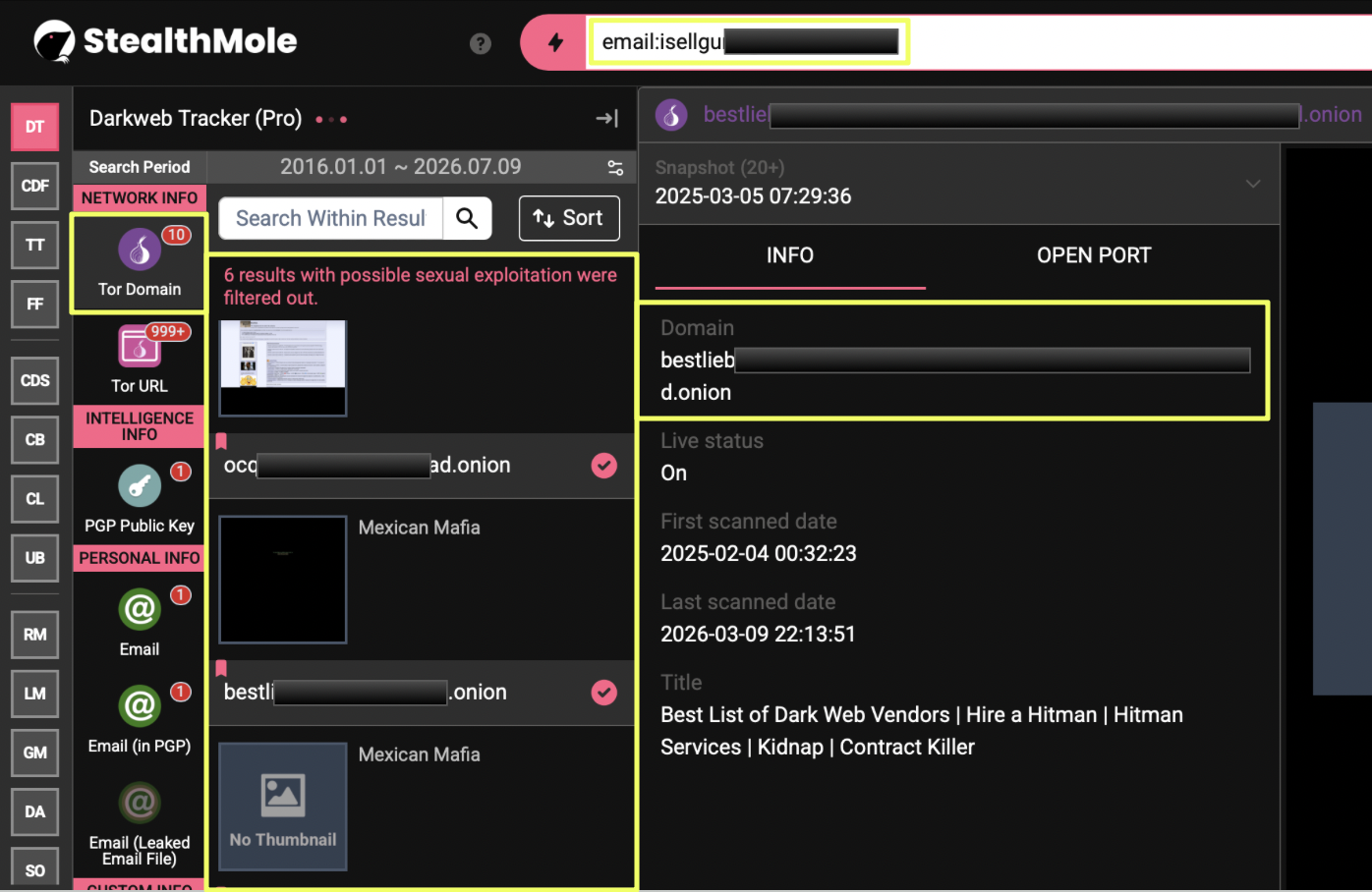
The vendor email isellguns@m******com was selected as the next investigative pivot due to its recurring appearance within the marketplace. Rather than serving only as a contact point, reusable identifiers such as email addresses often reveal infrastructure that is not directly linked from a website itself. To determine whether the address appeared elsewhere within the underground ecosystem, it was further investigated using StealthMole's Dark Web Tracker.

The search immediately uncovered two additional onion domains. The first was an inactive directory titled "Best List of Dark Web Vendors", where the same email address was listed alongside other underground vendors. Although the directory itself could not be directly attributed to the Mexican Mafia marketplace, it demonstrated that the contact information had been advertised beyond the marketplace's own infrastructure.

  • bestlieb**********************************************ryd.onion

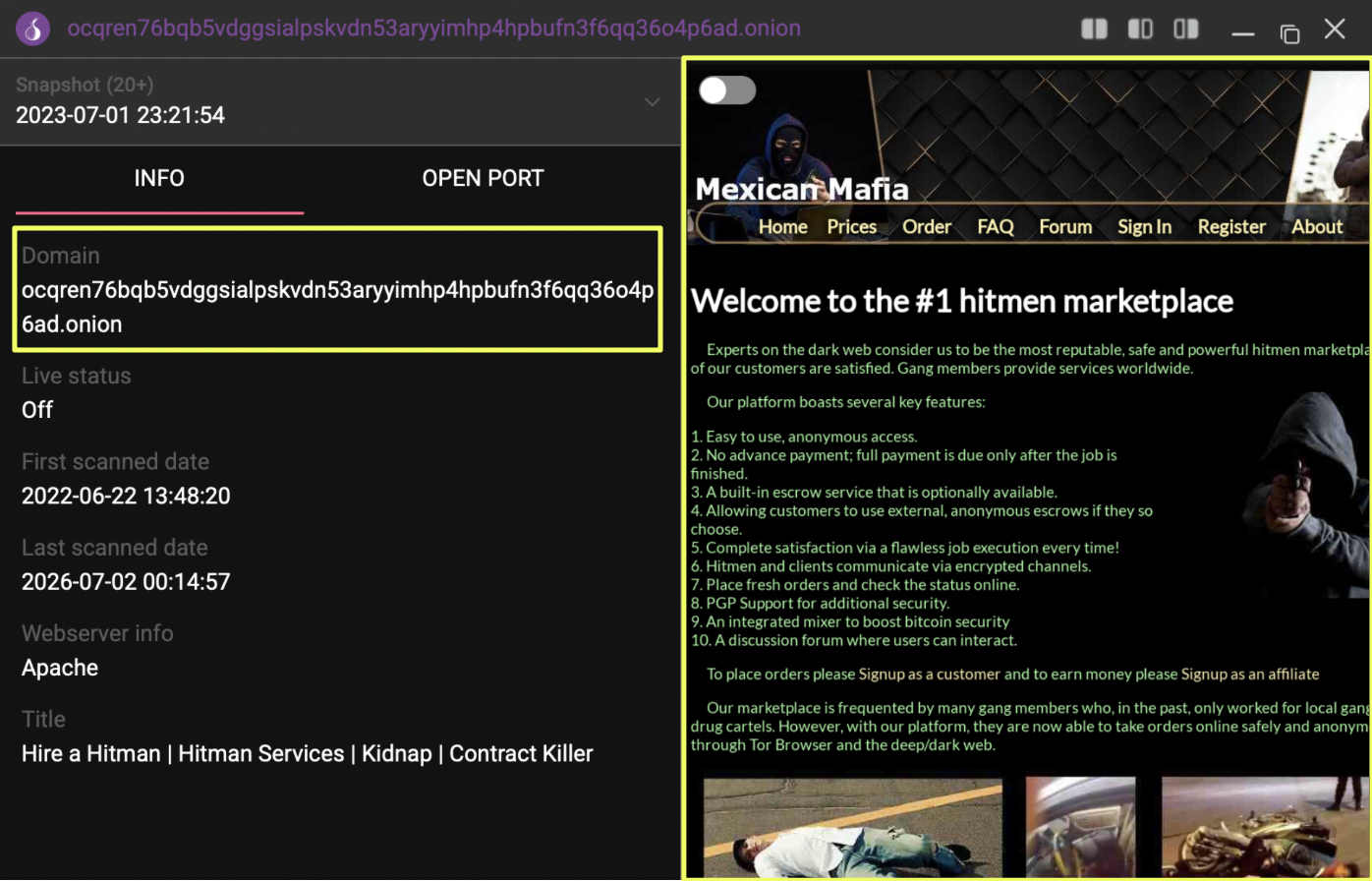
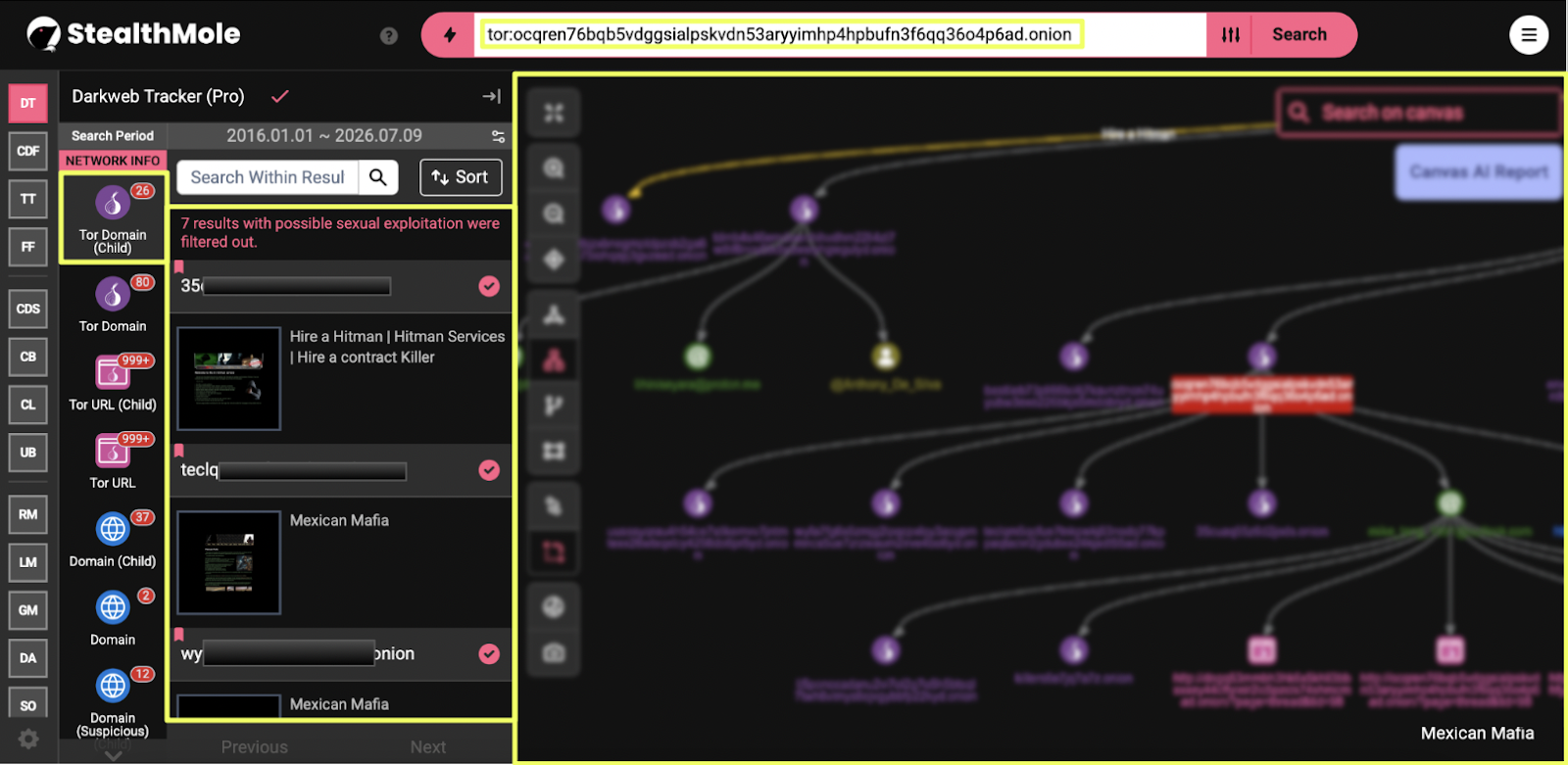
The second discovery proved considerably more valuable. StealthMole identified another active onion service, which presented another version of the Mexican Mafia marketplace. While maintaining the same overall branding and purpose, this deployment contained noticeably different content and exposed parts of the platform that were not visible on the original landing page. Rather than simply functioning as another access point, it provided a broader view of how the marketplace attempted to present itself to prospective customers and vendors.

  • ocqren76bqb5vdggsialpskvdn53aryyimhp4hpbufn3f6qq36o4p6ad.onion

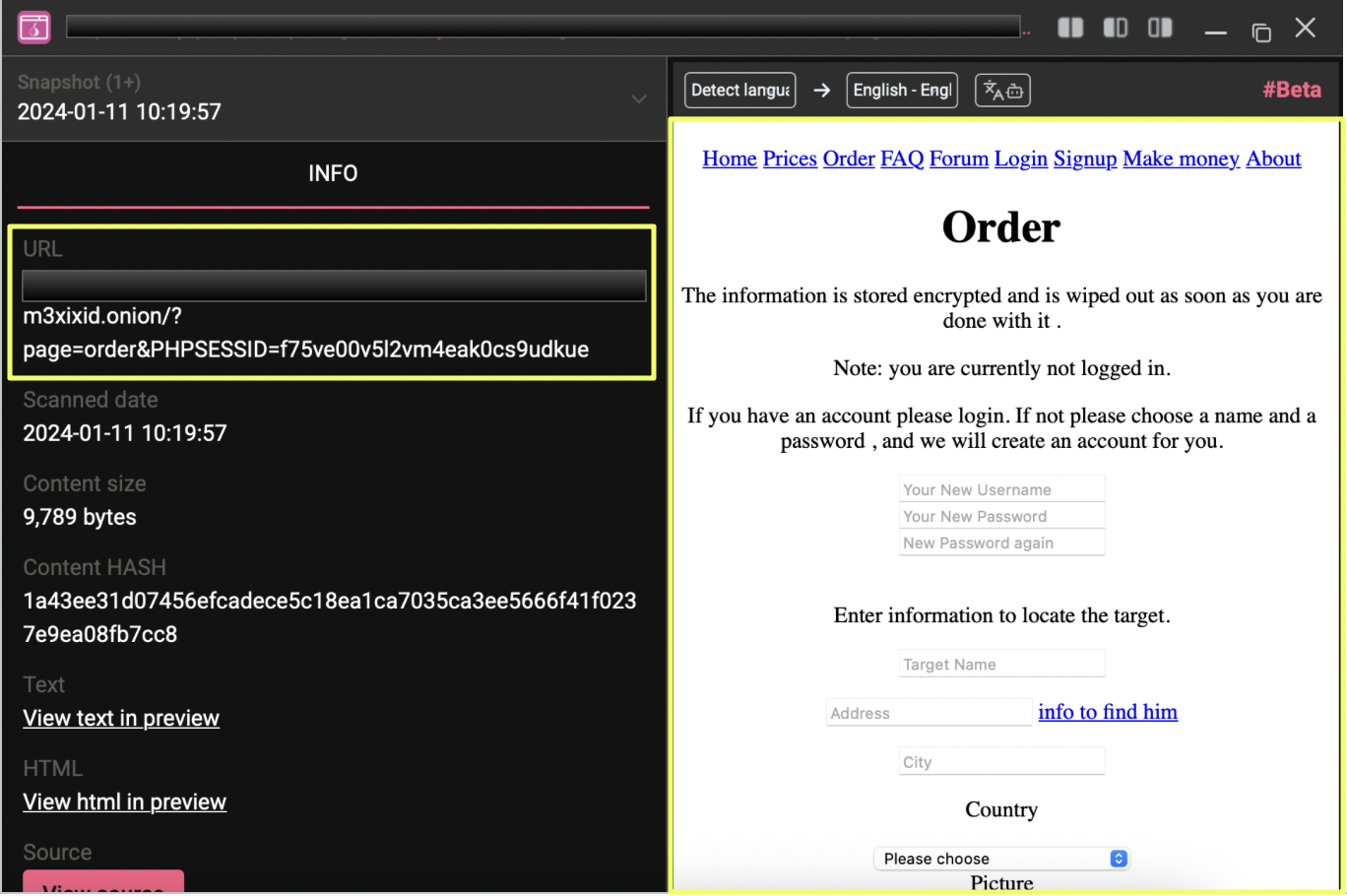
Compared to the original homepage, this version placed greater emphasis on explaining the marketplace's operating model. It promoted features such as encrypted communication, PGP support, built-in and external escrow services, an integrated Bitcoin mixer, and anonymous customer registration. The marketplace also described an order submission process in which customers could provide detailed information about a target, select a preferred service provider, or allow the platform to assign one automatically. Throughout the site, considerable effort was made to portray the marketplace as an organised service rather than a simple criminal advertisement.

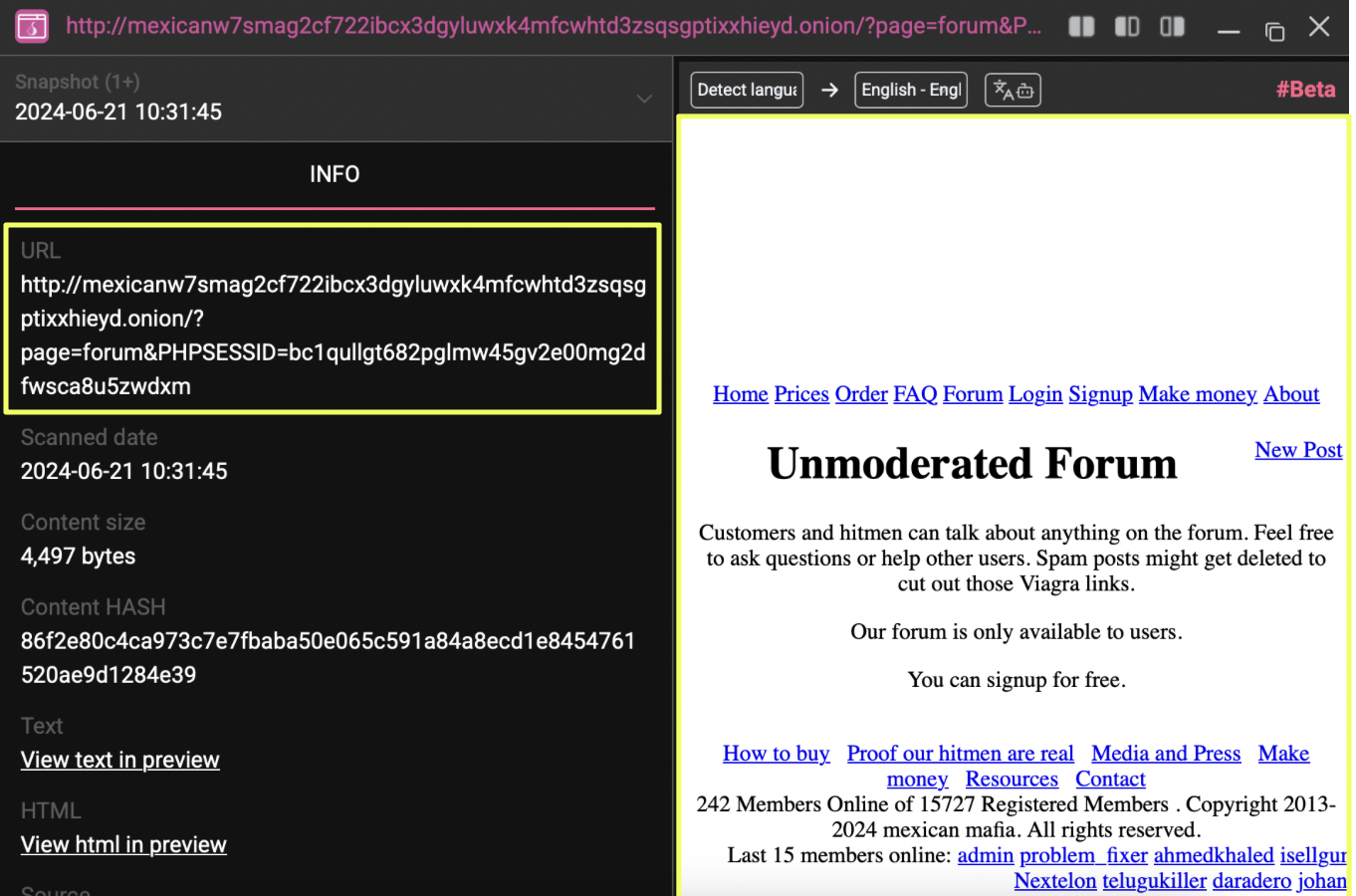
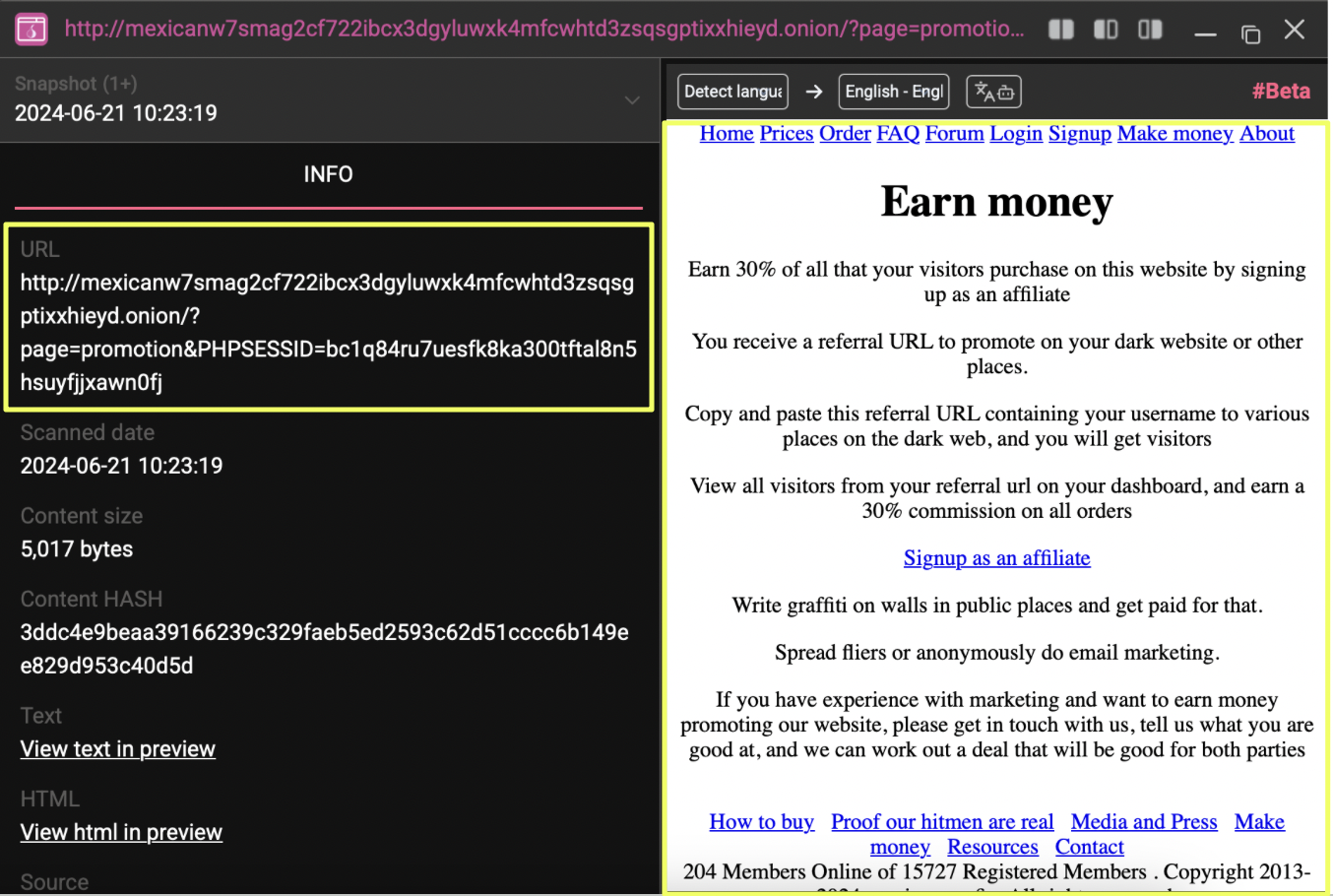
Historical snapshots recovered through StealthMole also exposed features that were absent from the current landing page. These included an unmoderated discussion forum, an affiliate programme rewarding users for referrals, publicly accessible vendor profiles, recent forum discussions, and lists of active marketplace members. Together, these sections suggested that the operators were attempting to cultivate an ongoing user community rather than relying solely on one-off transactions.

One particularly interesting observation was the marketplace's repeated effort to establish credibility. Badges promoting "Top Service," "External Escrows Accepted," and "$0 Down Payment" appeared throughout the site, while separate pages attempted to reassure visitors about anonymity, operational security, and payment protection. Although none of these claims can be independently verified, they illustrate how the operators attempted to reduce scepticism and encourage engagement from potential customers.

Further investigation of this onion service uncovered several additional domains associated with the Mexican Mafia infrastructure:

  • uuss*********************************************o6pr5yd.onion
  • wyfa**********************************************4bo6yd.onion
  • teclqm5qcfue7tnkpwkj63nodq77kppaqtacvr2gdubxx24kjadt55ad.onion
  • 35cuaq55z6d2jods.onion
  • lj5ponocadanu2vi7ol2g7o5h5btsql7twh6vlmys6ejvgybbfp22kyd.onion
  • Killers6e7jq7a7z.onion

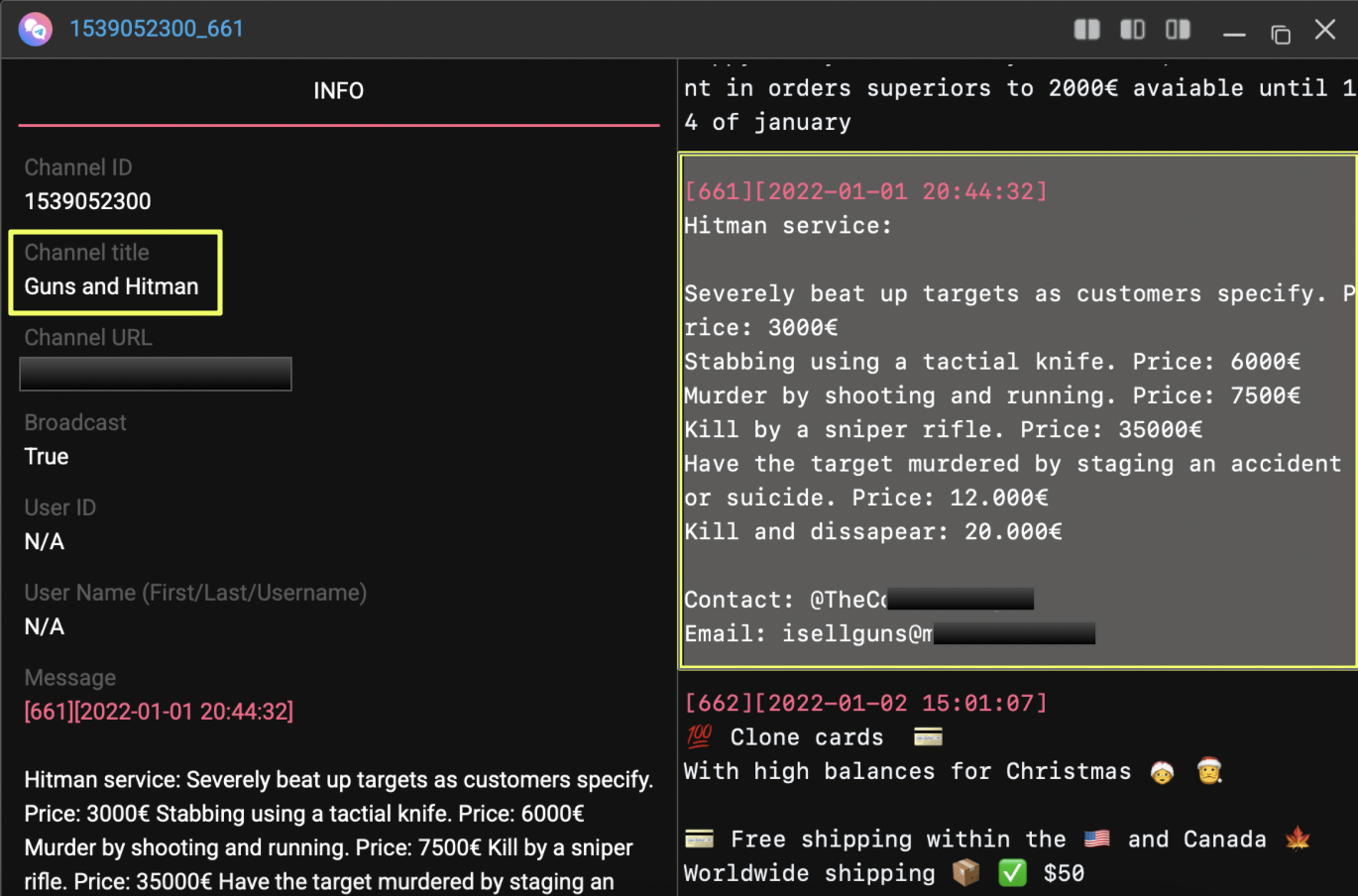
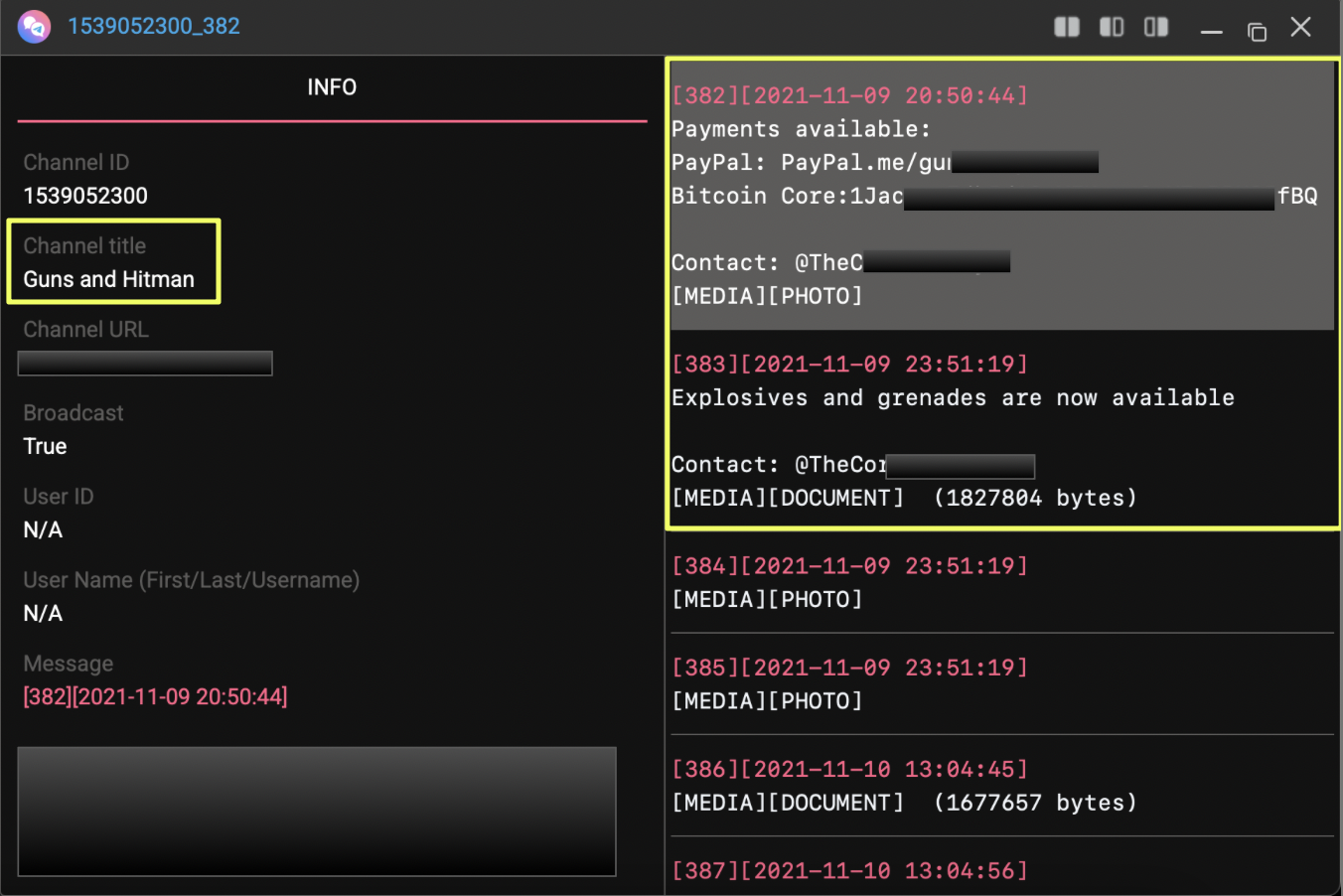
The investigation then shifted to StealthMole's Telegram Tracker, where the same email address, isellguns@m******com, was found in a Telegram channel. Unlike a forwarded message, the email appeared in a post published directly by the channel administrator together with the contact @TheC******y, indicating that it was being actively used as a point of contact. The channel also advertised additional payment methods, including PayPal and the Bitcoin address.

  • PayPal: PayPal.me/gu****in
  • Bitcoin Wallet: 1Jac********************fBQ

The repeated appearance of the same email address across onion services and Telegram made it one of the strongest correlation points identified during the investigation. What initially appeared to be a single vendor contact ultimately connected multiple marketplace deployments, vendor profiles, communication channels, and payment infrastructure, significantly expanding the digital footprint associated with the Mexican Mafia marketplace.

Following the Mirrors

The investigation of isellguns@m*****m also led to the discovery of another Mexican Mafia mirror domain.

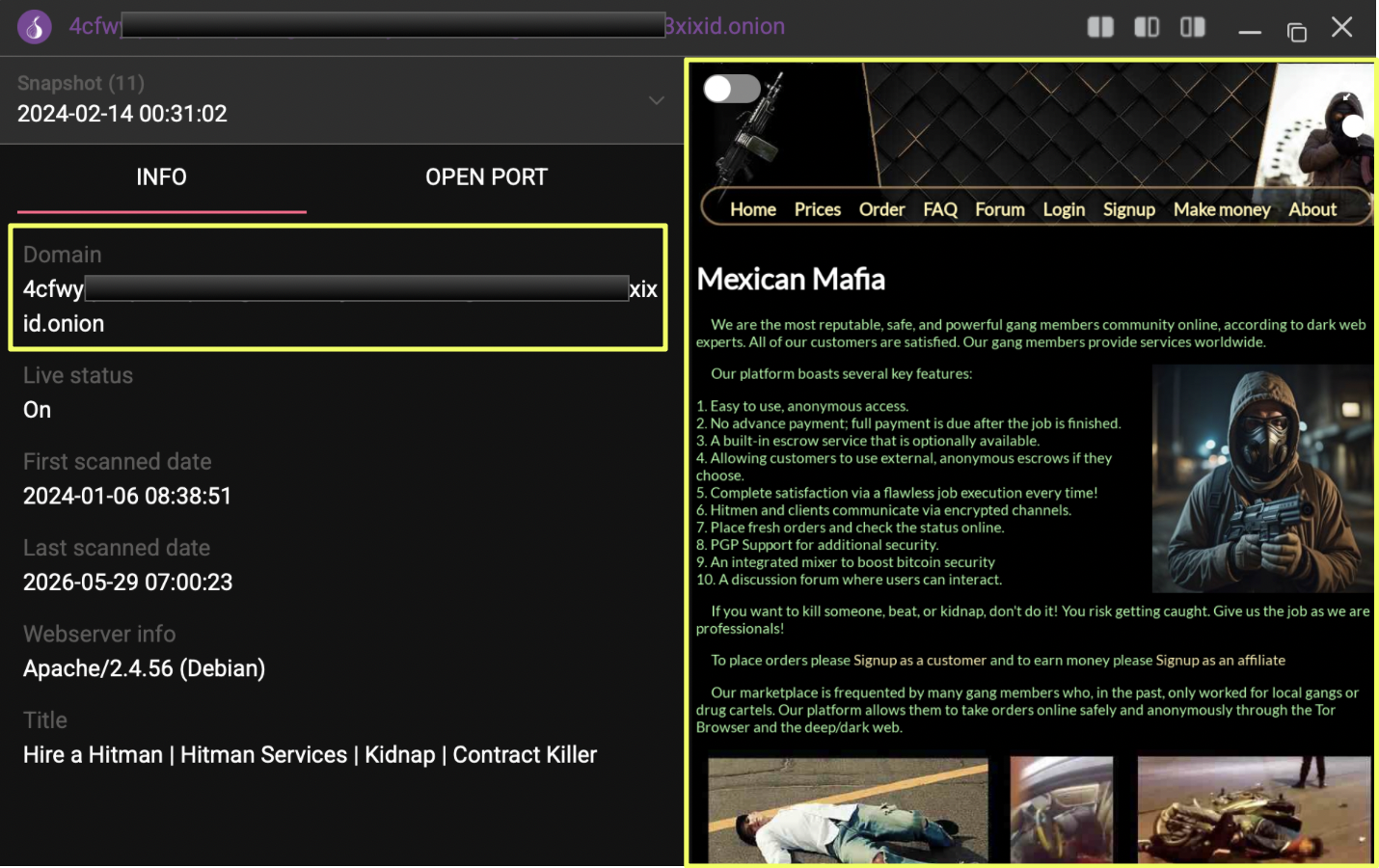
  • 4cfw************************************************xid.onion

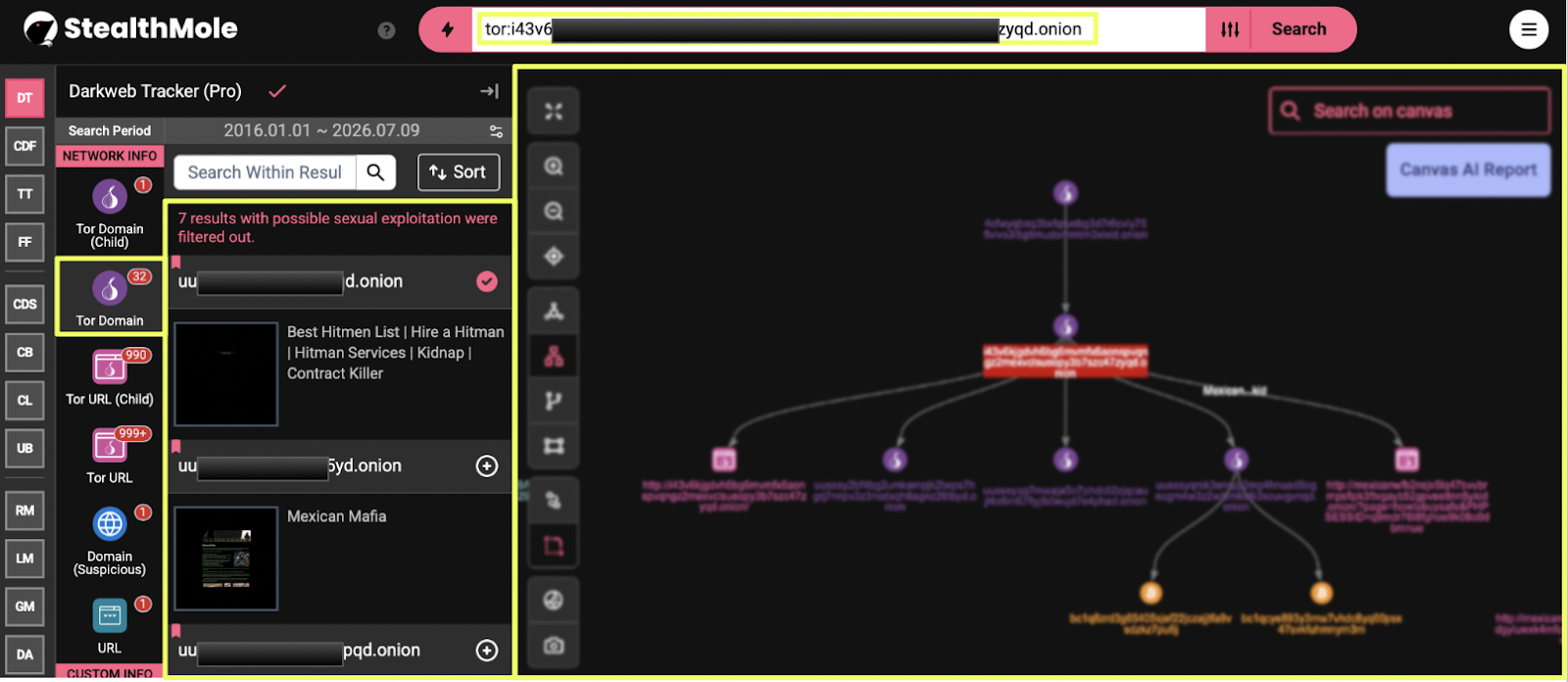
Further analysis of this domain using StealthMole's Dark Web Tracker revealed that the platform itself pointed towards another active onion service, indicating that the operators maintained multiple deployments of the Mexican Mafia marketplace over time.

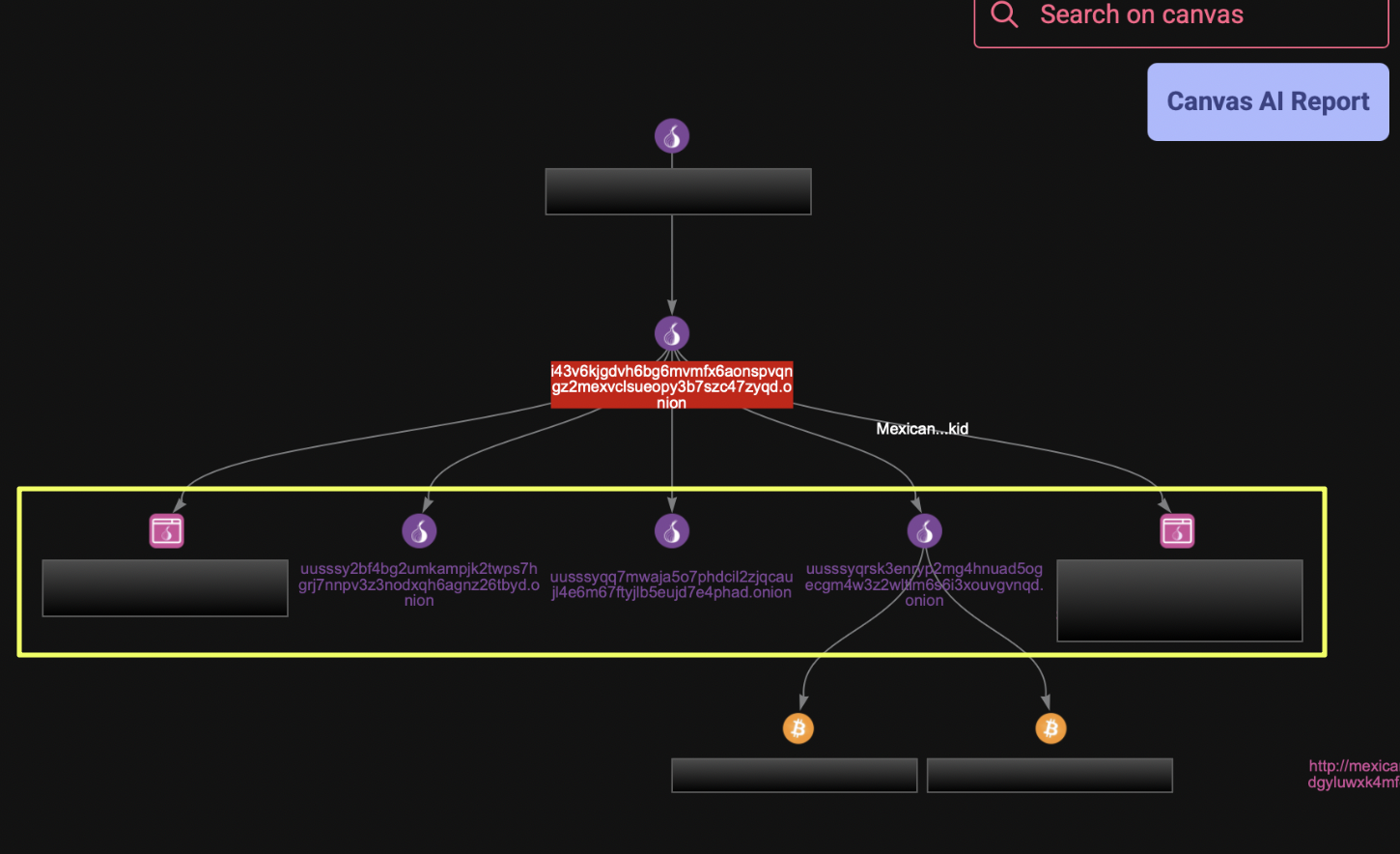
  • i43v6*****************************************zyqd.onion

Unlike the previously recovered domains, this mirror provided additional historical context about the platform and became another valuable investigative pivot. Examination of its archived content uncovered several more onion domains associated with the same marketplace, many of which were no longer active but remained indexed through StealthMole's historical records.

The following mirror domains were identified during this stage of the investigation:

  • uusssy2bf4bg2umkampjk2twps7hgrj7nnpv3z3nodxqh6agnz26tbyd.onion (inactive)
  • uusssyqq7mwaja5o7phdcil2zjqcaujl4e6m67ftyjlb5eujd7e4phad.onion (inactive)
  • uusssyqrsk3enryp2mg4hnuad5ogecgm4w3z2wltlm6s6i3xouvgvnqd.onion (inactive)
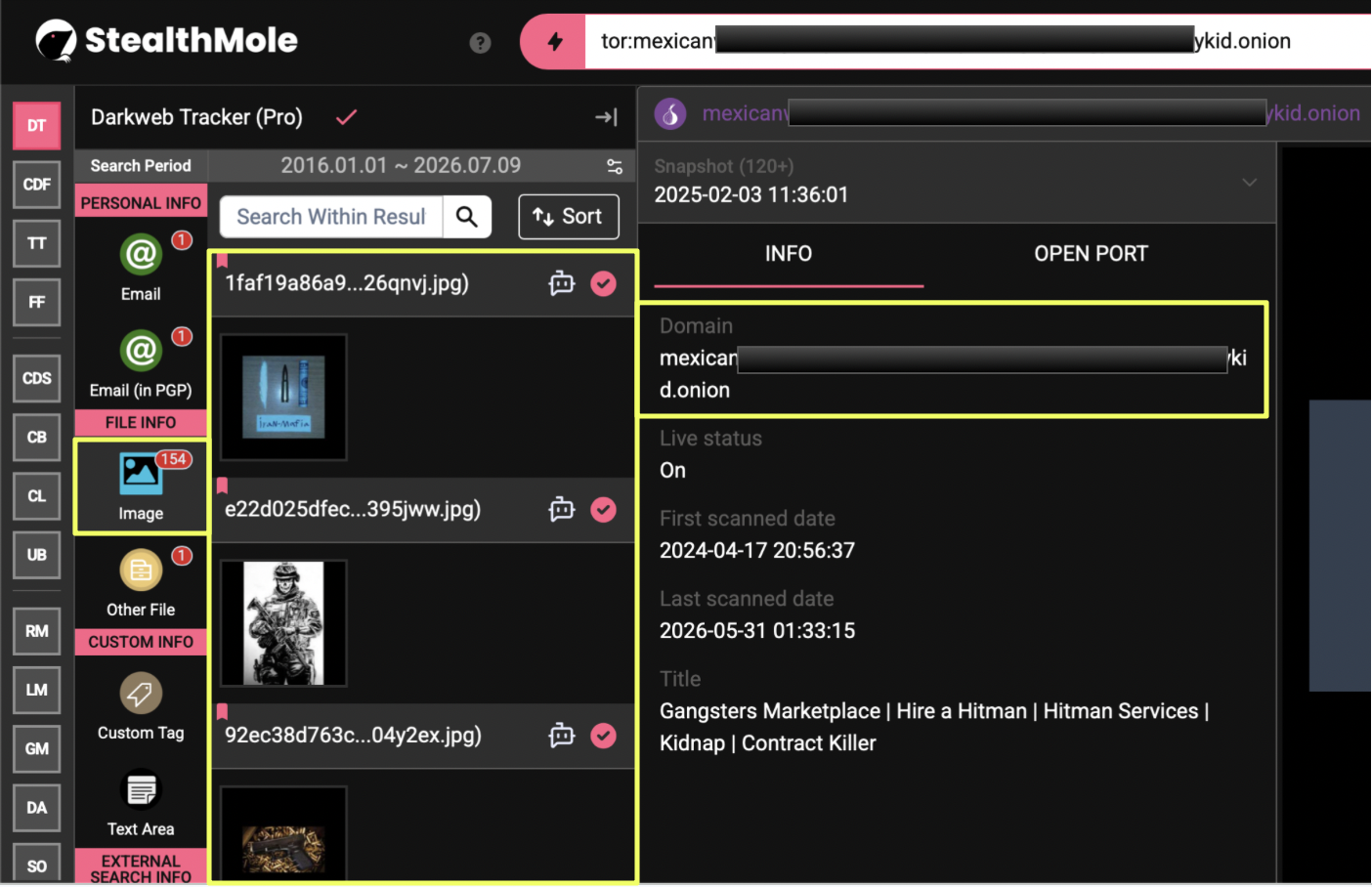
  • mexican**********************************************kid.onion (active)

The recovery of multiple inactive mirrors demonstrated that the marketplace's infrastructure had evolved over time rather than relying on a single persistent onion service. Although several of these domains were no longer operational, StealthMole's historical indexing preserved their relationship to the broader Mexican Mafia ecosystem, allowing the investigation to continue beyond infrastructure that had already disappeared from the live dark web.

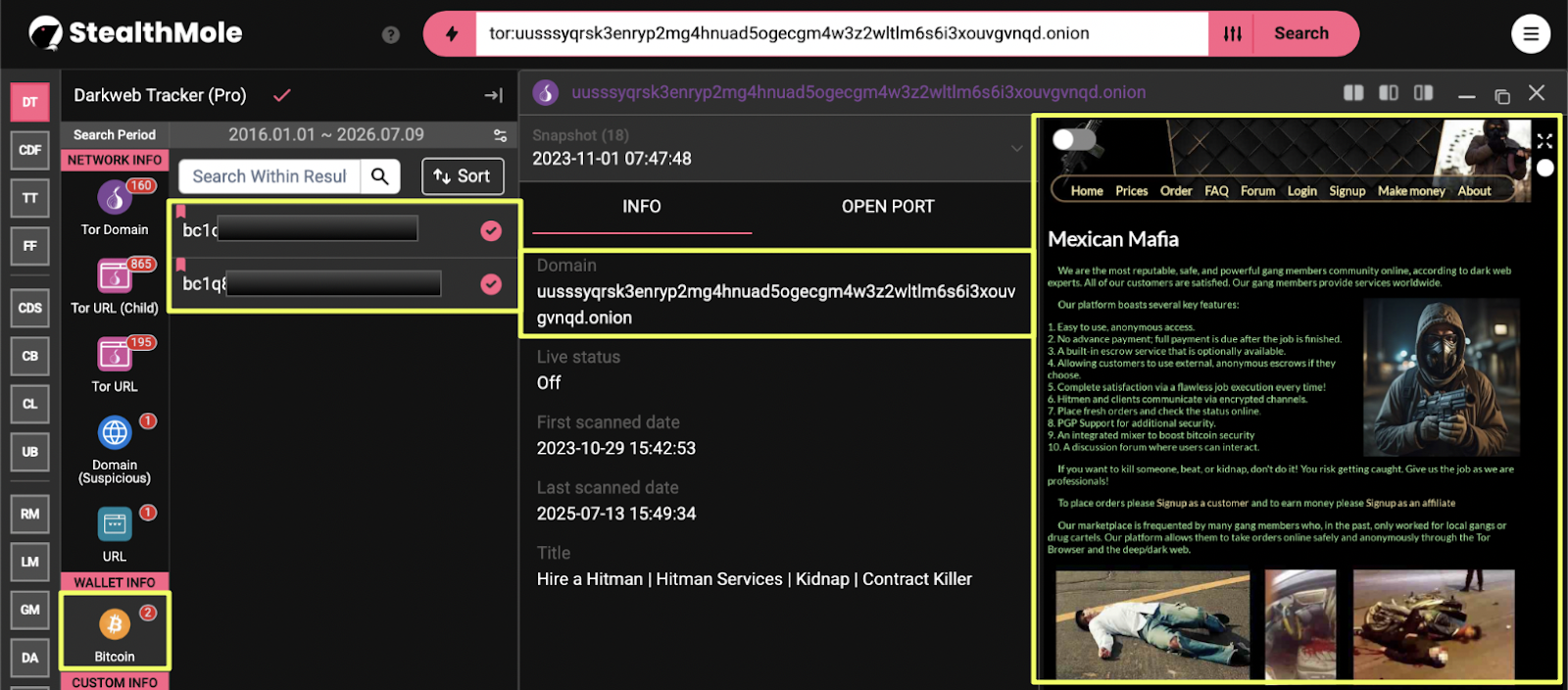
One historical mirror proved particularly useful. Investigation of

  • uusssyqrsk3enryp2mg4hnuad5ogecgm4w3z2wltlm6s6i3xouvgvnqd.onion

revealed two Bitcoin wallet addresses embedded within the archived content:

  • bc1q*********************************7pu6j
  • bc1q**********************************ym3m

Both wallets were examined during the investigation and, at the time of analysis, neither had recorded any blockchain transactions. While this does not indicate how the addresses were intended to be used, it demonstrates that historical marketplace infrastructure preserved payment artifacts that could be investigated independently of the live website.

Hidden in Plain Sight

By this stage, the investigation had already uncovered multiple historical mirrors of the Mexican Mafia marketplace. To determine whether these archived domains contained additional intelligence beyond their webpages, one of the inactive mirrors was examined further using StealthMole's Dark Web Tracker.

  • mexican******************************************kid.onion

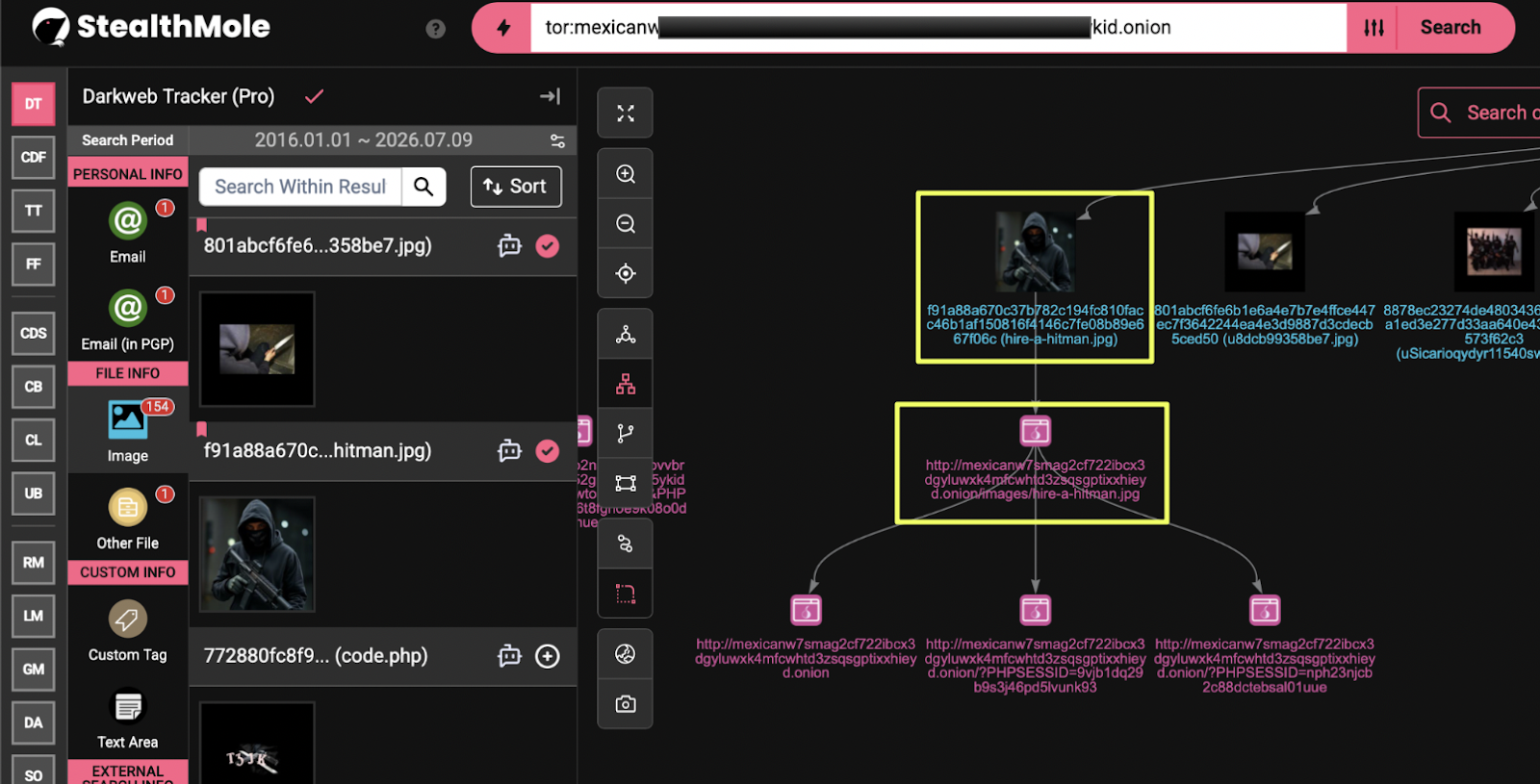
Rather than exposing only archived webpages, StealthMole also preserved media files associated with the marketplace. These included numerous images hosted by the onion service, many of which were used as profile photographs and avatars for vendors and marketplace users. While these images did not independently identify real-world individuals, they provided additional artifacts that could be used to extend the investigation beyond conventional webpage content.

One of these indexed media files proved particularly valuable. Analysis of its associated metadata led to the discovery of another previously unseen mirror of the Mexican Mafia marketplace:

  • mexicanw7smag2cf722ibcx3dgyluwxk4mfcwhtd3zsqsgptixxhieyd.onion

Unlike earlier mirrors, this version contained updated marketplace content that offered additional insight into how the platform continued to evolve over time. Historical snapshots recovered through StealthMole showed that the marketplace retained its core operating model while refining its presentation, expanding navigation menus, and further developing features aimed at both customers and vendors. New sections such as Top Vendors, Top Hitmen, and expanded marketplace guidance reflected an effort to present the platform as an established criminal marketplace rather than a collection of individual advertisements.

The archived pages also continued to promote customer registration, vendor recruitment, affiliate opportunities, and escrow-based transactions, demonstrating a consistent attempt to build trust within the underground community. Although these operational claims cannot be independently verified, their persistence across multiple generations of the marketplace illustrates how the operators sought to maintain a consistent identity despite repeatedly changing infrastructure.

The recovery of yet another mirror through indexed media files highlights an investigative advantage of StealthMole's historical indexing. Rather than relying solely on active onion services, archived media artifacts provided an additional pivot that exposed infrastructure which would have been difficult to identify through conventional browsing alone.

A Trail of Bitcoin

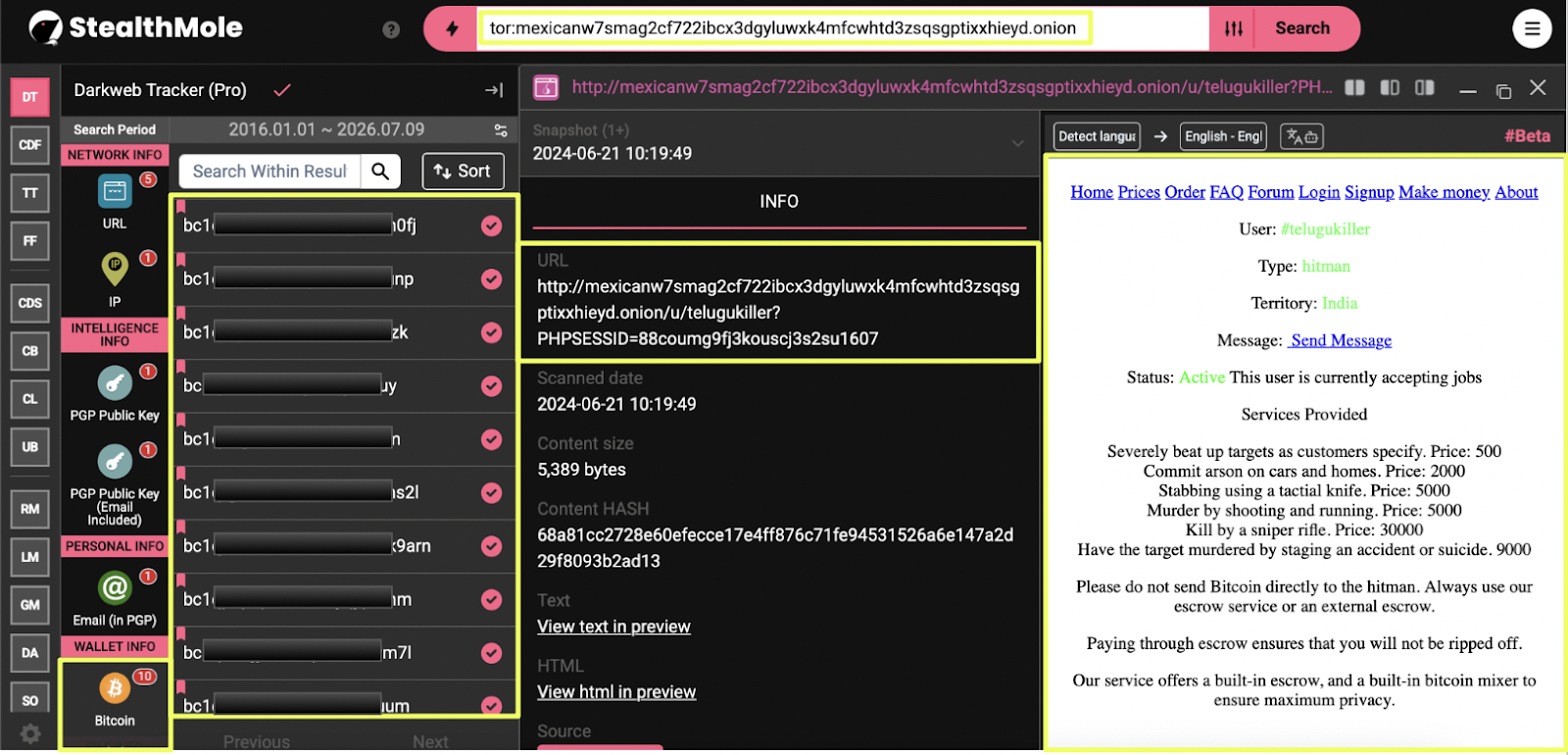
The investigation of this domain marked another turning point. Unlike the previously recovered mirrors, this version exposed a substantial amount of embedded financial infrastructure that could be used as new investigative pivots.

  • mexicanw7smag2cf722ibcx3dgyluwxk4mfcwhtd3zsqsgptixxhieyd.onion

StealthMole identified ten embedded Bitcoin wallet addresses within the archived content of the marketplace:

  • bc1q***********************************0fj
  • bc1q***********************************unp
  • bc1q***********************************nzk
  • bc1q***********************************nuy
  • bc1q***********************************dxm
  • bc1q***********************************s2l
  • bc1q***********************************arn
  • bc1q***********************************2mm
  • bc1q***********************************m7l
  • bc1q***********************************uum

The same recurring email address was once again identified within this mirror, reinforcing the pattern observed throughout the investigation. By this stage, the email had already linked multiple onion domains, vendor profiles, and marketplace deployments. Its continued presence alongside newly recovered cryptocurrency artifacts further strengthened its value as a recurring investigative identifier.

  • isellguns@m*****m

Conclusion

What began as the discovery of a single onion domain ultimately revealed a much broader ecosystem surrounding the Mexican Mafia marketplace. By pivoting through recurring identifiers, historical snapshots, archived media, mirror domains, and cryptocurrency artifacts, the investigation reconstructed multiple generations of the platform and uncovered how its infrastructure evolved over time. Rather than relying on a single website, the marketplace maintained a network of interconnected domains while repeatedly reusing contact information and other operational artifacts across different deployments.

Although the authenticity of the services advertised by the marketplace cannot be independently verified, its digital footprint provides valuable intelligence. This investigation demonstrates how StealthMole can move beyond surface-level discovery by correlating historical infrastructure, recurring identities, and cross-platform artifacts, enabling analysts to build a more complete picture of underground operations that would otherwise remain fragmented.

Editorial Note

Dark web investigations rarely rely on a single piece of evidence. Meaningful attribution is built by correlating multiple independent artifacts across different platforms and periods of time. This case illustrates how StealthMole helps investigators reconstruct hidden infrastructure, preserve disappearing evidence, and connect seemingly unrelated indicators into a coherent investigative narrative.

To access the unmasked report or full details, please reach out to us separately.

Contact us: support@stealthmole.com


Labels: ,

From Lucky 47 to Luhansk Counter Kiev Partisans (Luckp 47): Mapping the Infrastructure Behind a Weapons Marketplace

Darkweb has long provided space for anonymous marketplaces selling weapons, forged documents, hacking services, and other illicit goods. But over the past few years, especially amid ongoing geopolitical conflicts, some of these platforms have started evolving beyond simple criminal storefronts. Instead of remaining hidden in the background, certain marketplaces now attempt to build recognizable identities through aggressive branding, ideological messaging, and carefully curated narratives designed to attract attention within underground communities.

During routine monitoring of weapons-related activity, StealthMole identified a marketplace operating through the Tor network under the name “Luckp 47 Shop.” At first glance, the platform appeared to be another weapons-focused onion service circulating within dark web ecosystems. However, several elements surrounding the marketplace, including its branding style, external references, and connected infrastructure, suggested there was a larger story behind the operation.

What followed was a broader investigation that moved far beyond a single onion domain. By tracing related infrastructure and examining references across underground platforms and Telegram-based communities, the investigation gradually exposed a wider ecosystem of interconnected services, wartime imagery, and overlapping narratives tied to the Luckp 47 operation. Rather than functioning as an isolated marketplace, the platform appeared embedded within a much broader underground environment shaped by conflict-driven themes and anonymous cross-platform promotion.

Incident Trigger and Initial Investigation

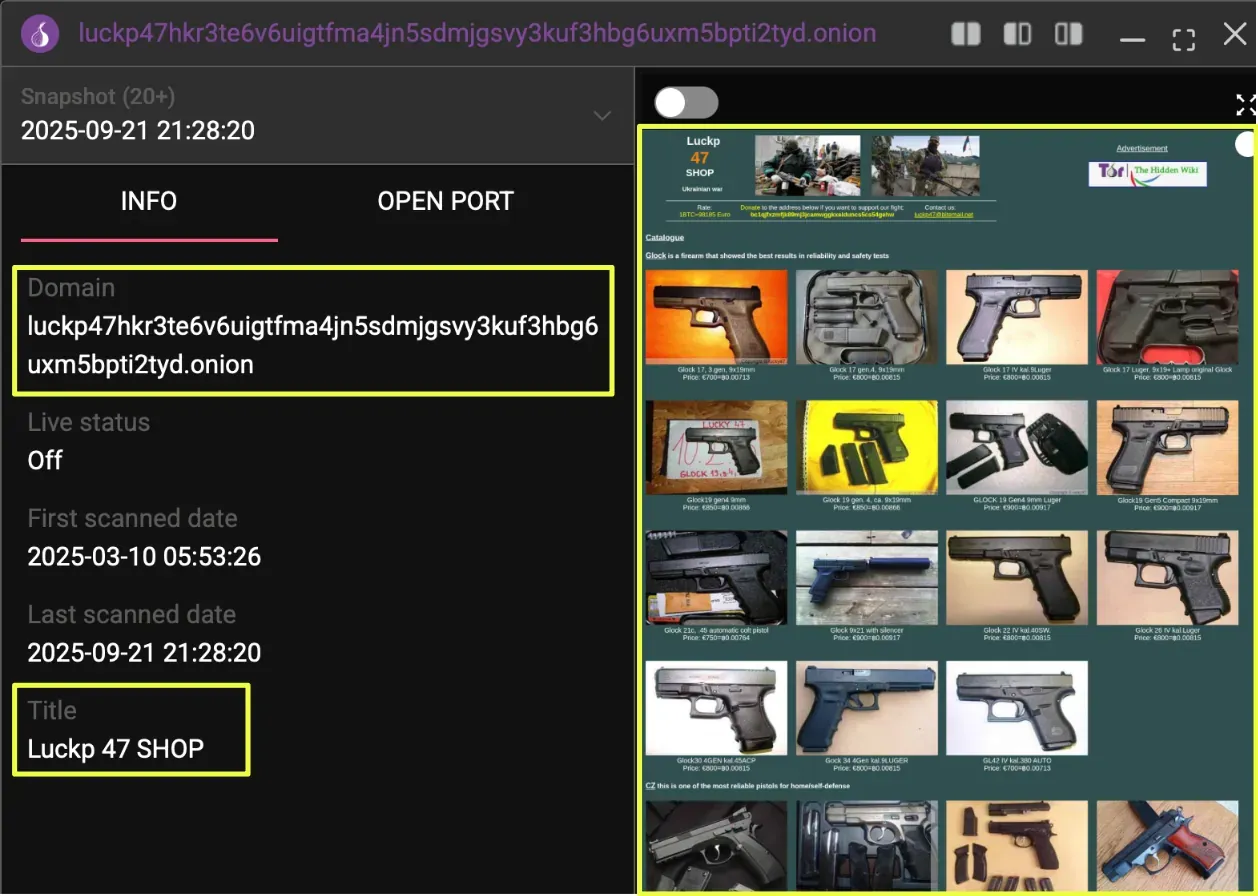
The investigation began while examining unrelated dark web infrastructure through StealthMole, during which an onion domain was identified. Although the marketplace was inactive at the time of access, archived snapshots preserved through StealthMole provided a clear view of the platform’s structure, branding, and operational claims.

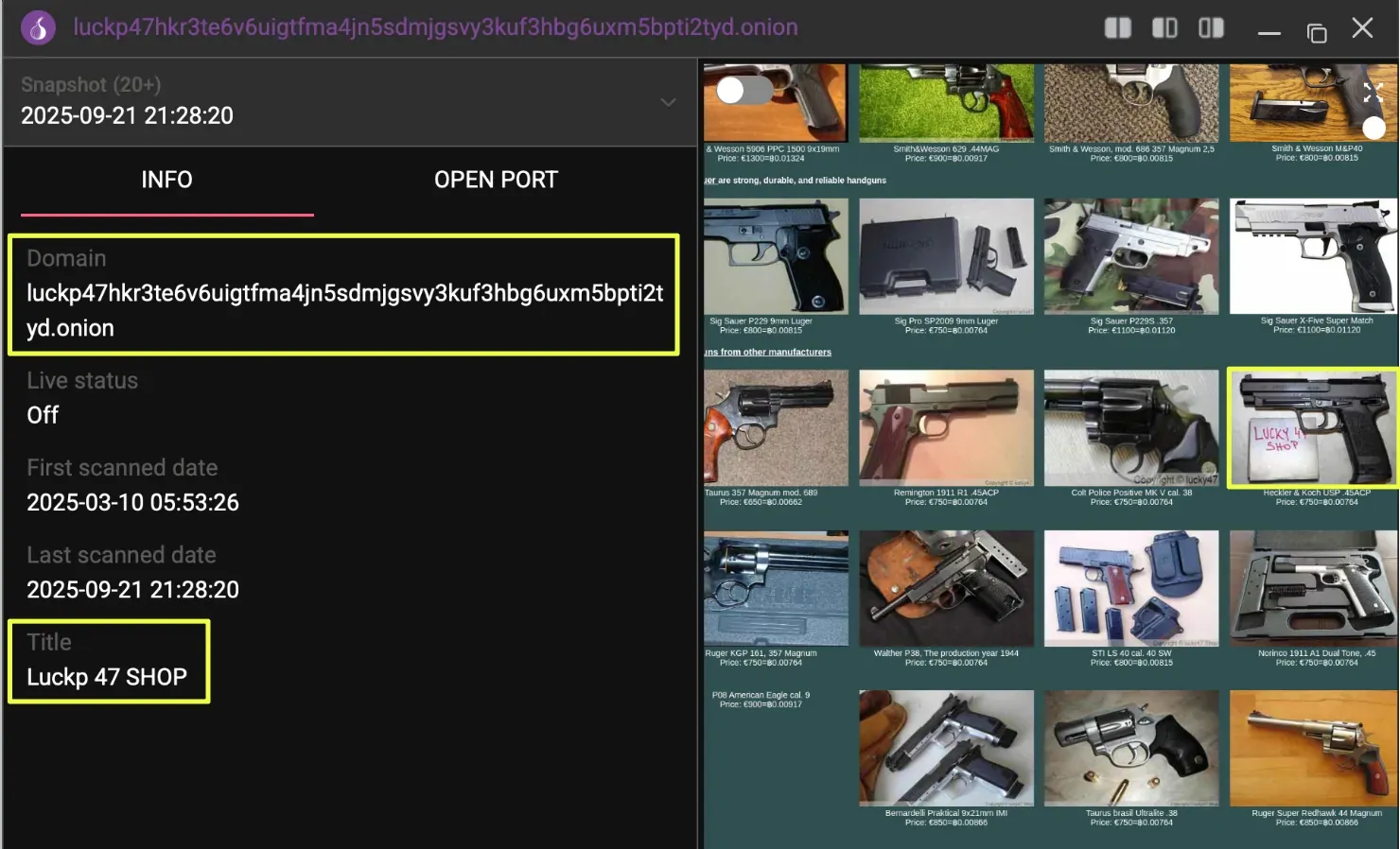
  • luckp47hkr3te6v6uigtfma4jn5sdmjgsvy3kuf3hbg6uxm5bpti2tyd.onion

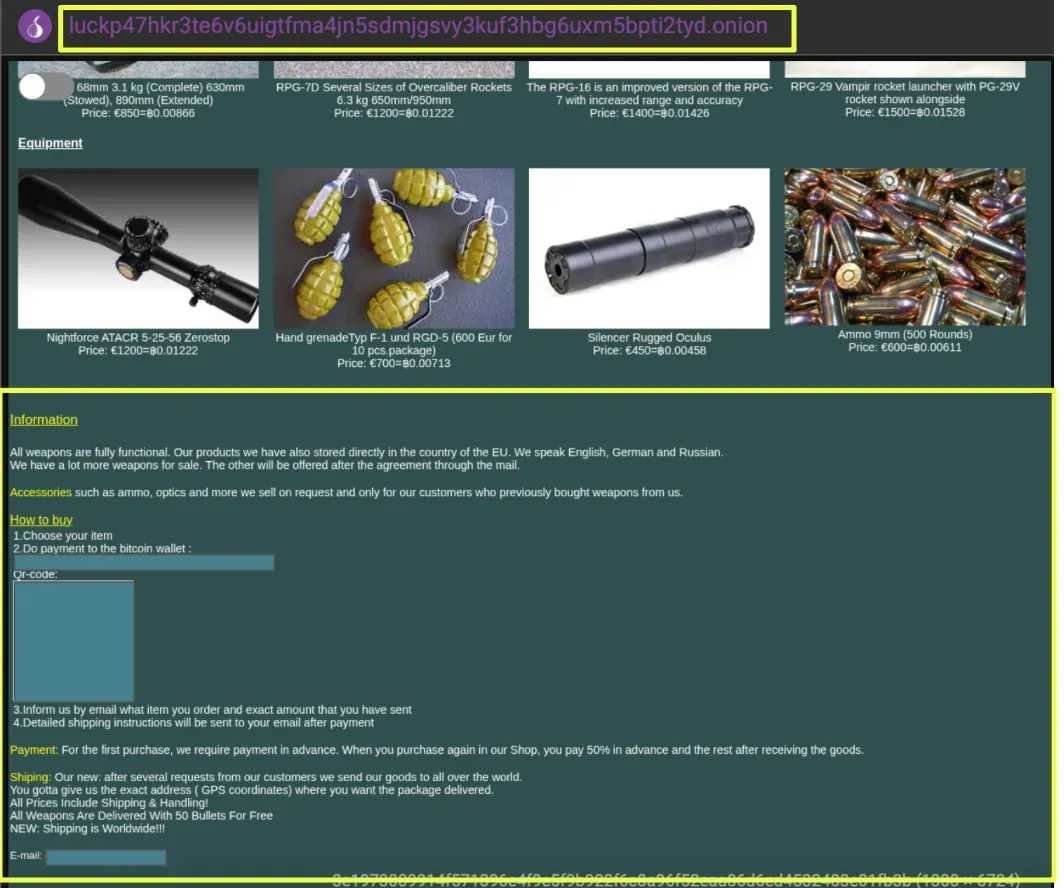
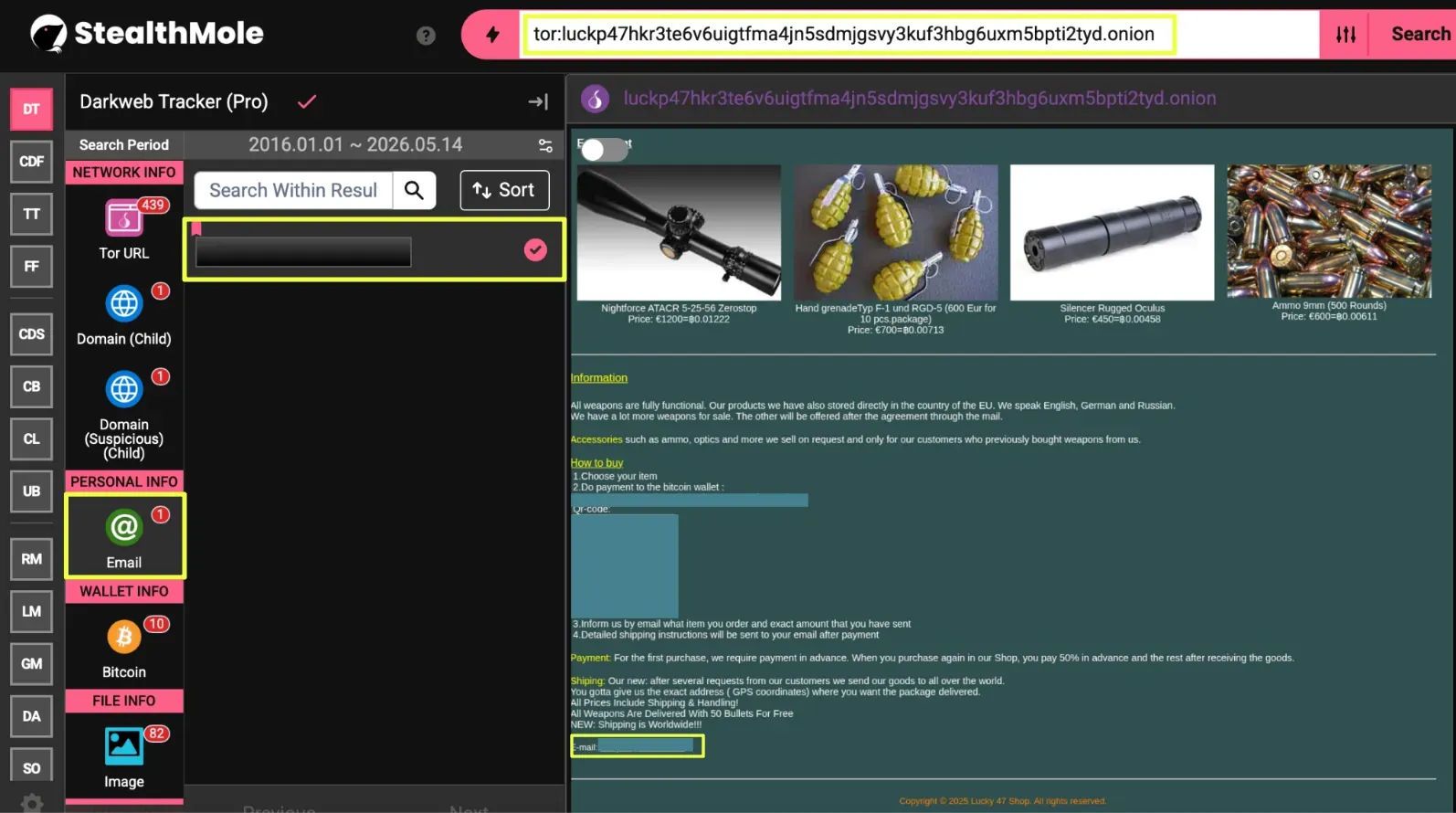
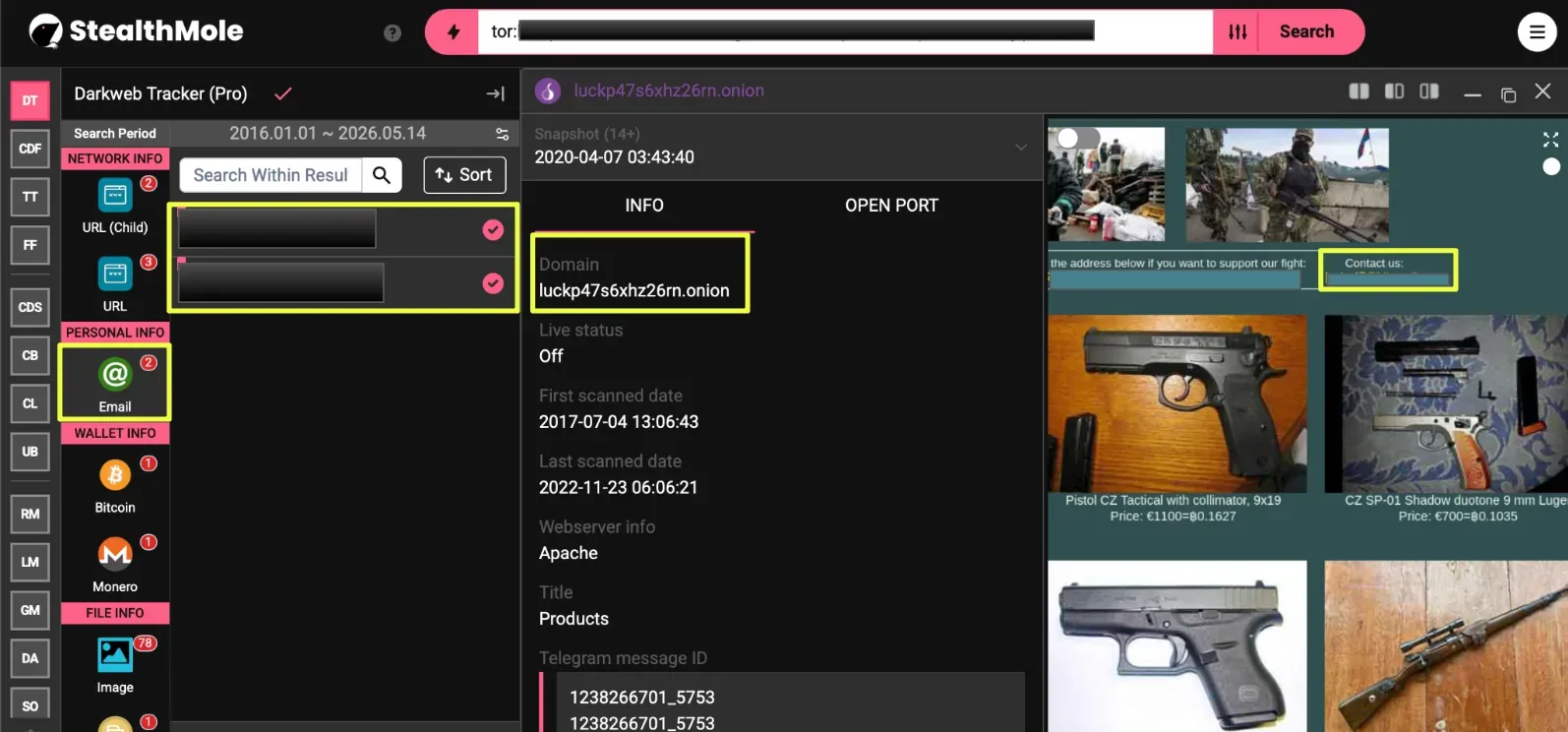
The marketplace operated under the name “Luckp 47 Shop” and presented itself as a weapons-focused storefront offering military-style firearms, launchers, suppressors, ammunition, grenades, and tactical accessories. Listings observed on the platform included RPG-series launchers, rifle optics, ammunition packages, and other combat-related equipment, with product pricing displayed in Euros. The site also claimed worldwide shipping capabilities and instructed buyers to provide delivery coordinates during the ordering process.

Additional details on the homepage suggested the operators were attempting to project legitimacy and operational reach. The marketplace claimed that inventory was stored within the European Union and promoted multilingual support in English, German, and Russian. Payment instructions directed users toward cryptocurrency transactions, primarily Bitcoin, and included a publicly visible BTC wallet alongside QR-based payment guidance.

While the storefront itself was already notable, several visual and operational details immediately stood out during the initial review. Product photographs across the marketplace contained handwritten “Lucky 47 Shop” markings, seemingly intended to reinforce authenticity or marketplace identity. At the same time, the platform’s design, terminology, and overall presentation differed noticeably from many low-effort darknet weapon listings commonly observed across Tor-based marketplaces.

Financial Infrastructure Linked to the Primary Luckp 47 Domain

Following the initial review of the Luckp 47 marketplace, the investigation shifted toward identifying additional infrastructure connected to the primary onion service:

  • luckp47hkr3te6v6uigtfma4jn5sdmjgsvy3kuf3hbg6uxm5bpti2tyd.onion

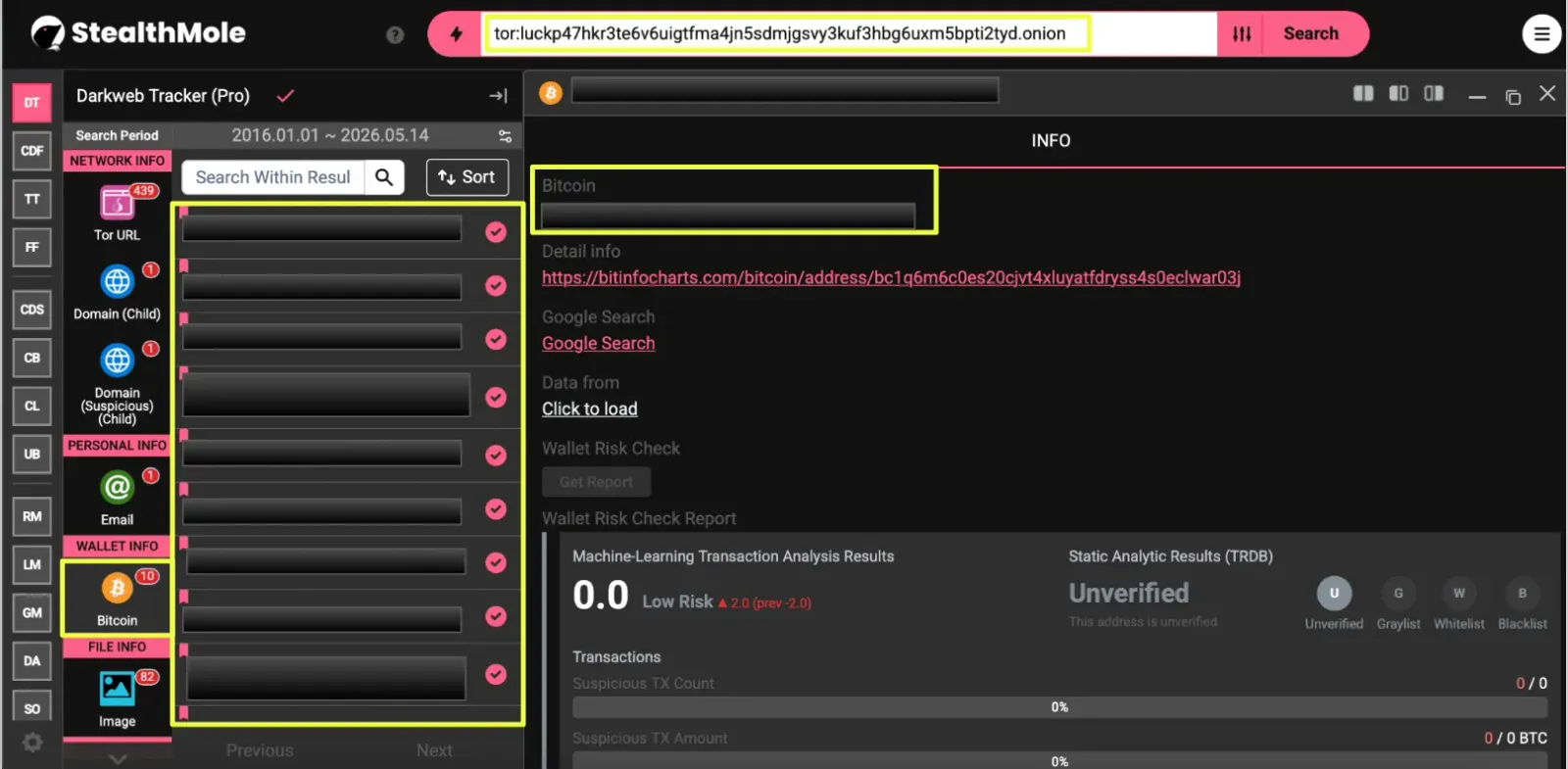
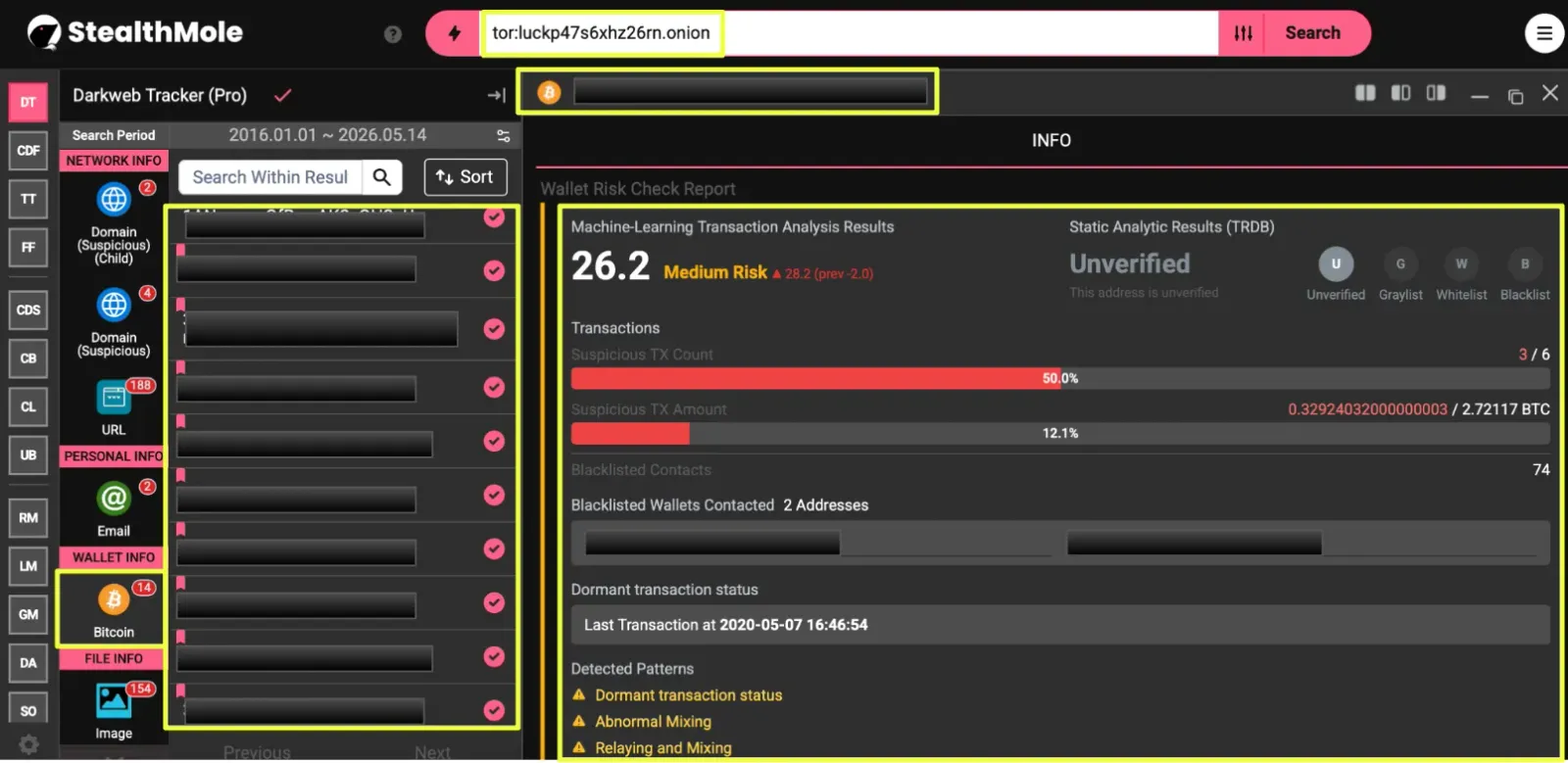
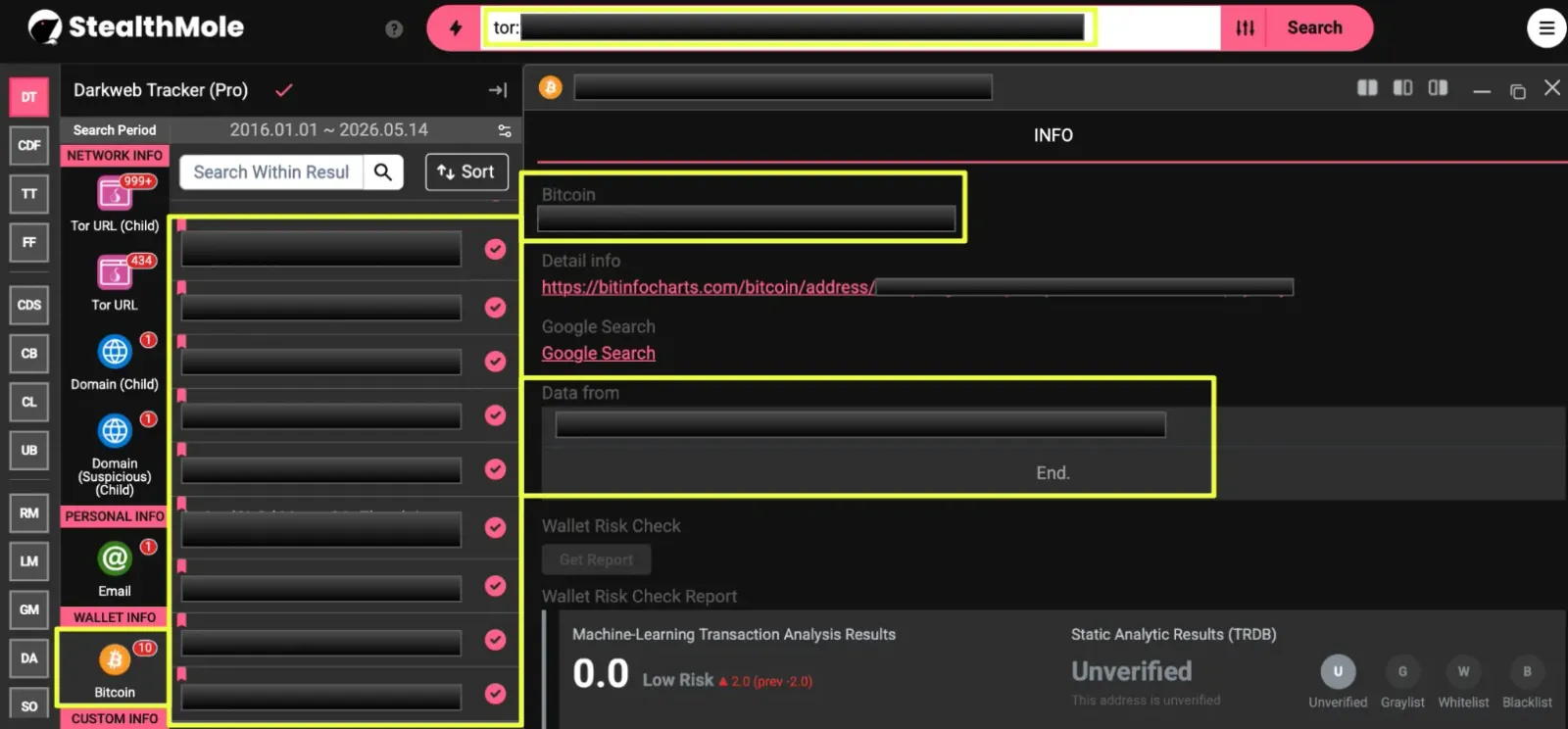
Using StealthMole’s Darkweb Tracker, the domain was found to be associated with multiple Bitcoin wallets beyond the single address publicly displayed on the marketplace homepage. In total, ten BTC wallets were linked to the domain:

  • bc1************************************xgd
  • bc1************************************xyg
  • bc1************************************g4h
  • bc1************************************hql
  • bc1************************************hca
  • bc1************************************fzf
  • bc1************************************uhu
  • bc1************************************lvs
  • bc1************************************ehw
  • bc1************************************03j

One of these wallets, bc1**********************03j, matched the Bitcoin address publicly visible within the marketplace payment instructions, helping validate the association between the domain and the identified wallet cluster.

Interestingly, several of the wallets showed no publicly observable transaction activity at the time of analysis. While inactive wallets alone do not confirm whether the marketplace was fully operational, the presence of multiple associated addresses suggested that the platform may have relied on rotating or pre-generated cryptocurrency wallets rather than a single static payment address.

Beyond the financial infrastructure, archived marketplace images also revealed repeated use of handwritten “Lucky 47 Shop” markings placed directly onto firearm photographs featured within the storefront. Although such imagery does not independently confirm ownership of the weapons displayed, the repeated branding suggested an effort to establish marketplace identity and visual consistency across the platform’s listings.
Expanding the Investigation Through Contact Infrastructure

After documenting the wallet infrastructure tied to the primary Luckp 47 domain, the investigation shifted toward the marketplace’s publicly listed contact information. The homepage of the original onion service referenced the email address:

  • l*****7@b****mail.net

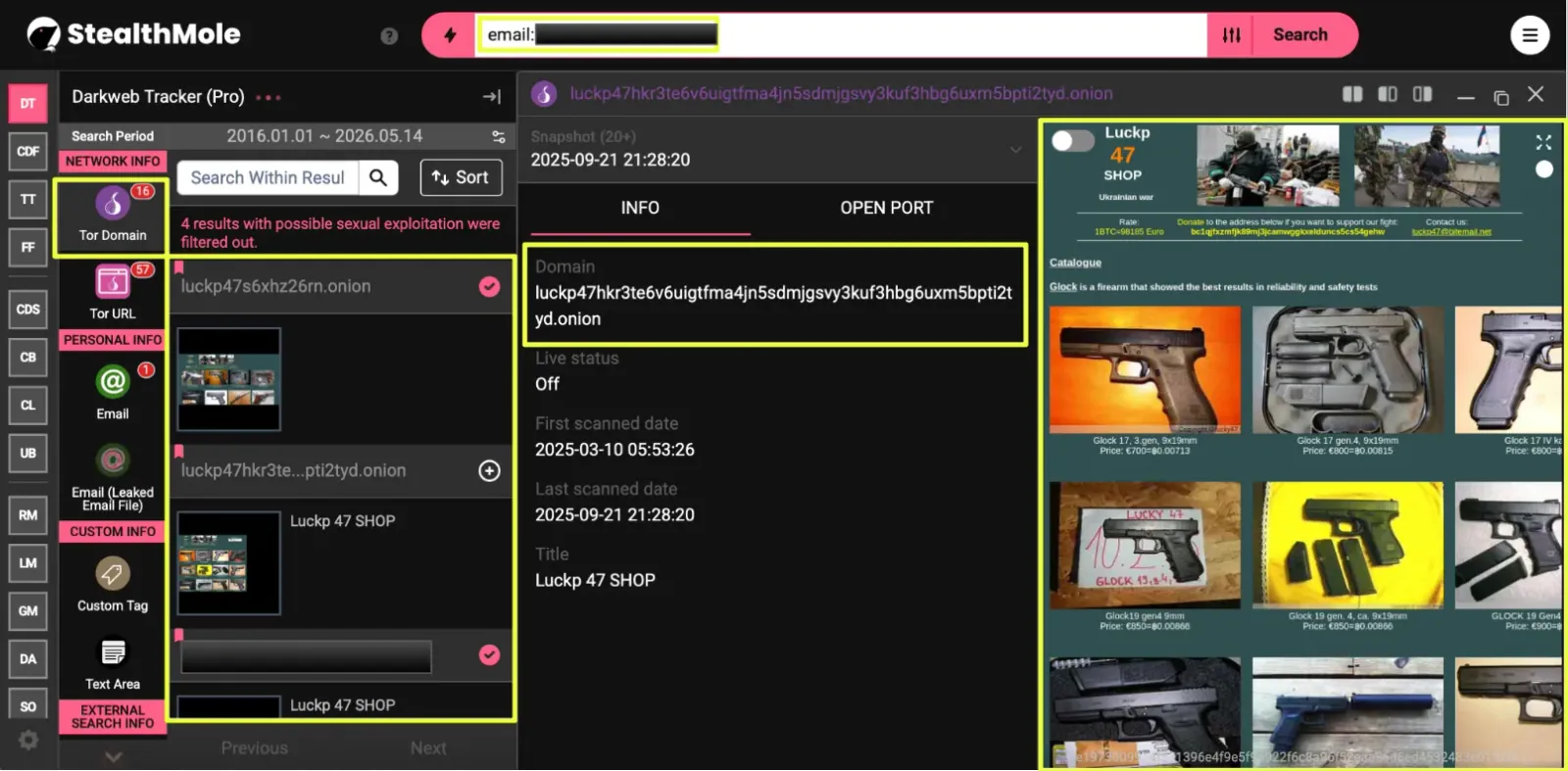
When the address was pivoted through StealthMole, the investigation rapidly expanded beyond the original storefront. Multiple additional onion domains were identified as being associated with the same contact infrastructure, including both active and inactive marketplace deployments.

The following domains were linked to the email address during the investigation:

  • luckp47s6xhz26rn.onion
  • luckp4k5jzwsofw6dulfvmc5clj75ww2ysgcwvj7yfunnc2i7terp4qd.onion
  • luckp4z2byqzvsweqzrtlkffob7wxhdnmcno7tv7wxrnuik5euje4cqd.onion
  • luckp***********************************************igyd.onion
  • 27b**************************************************ryd.onion
  • 27b**************************************************6id.onion

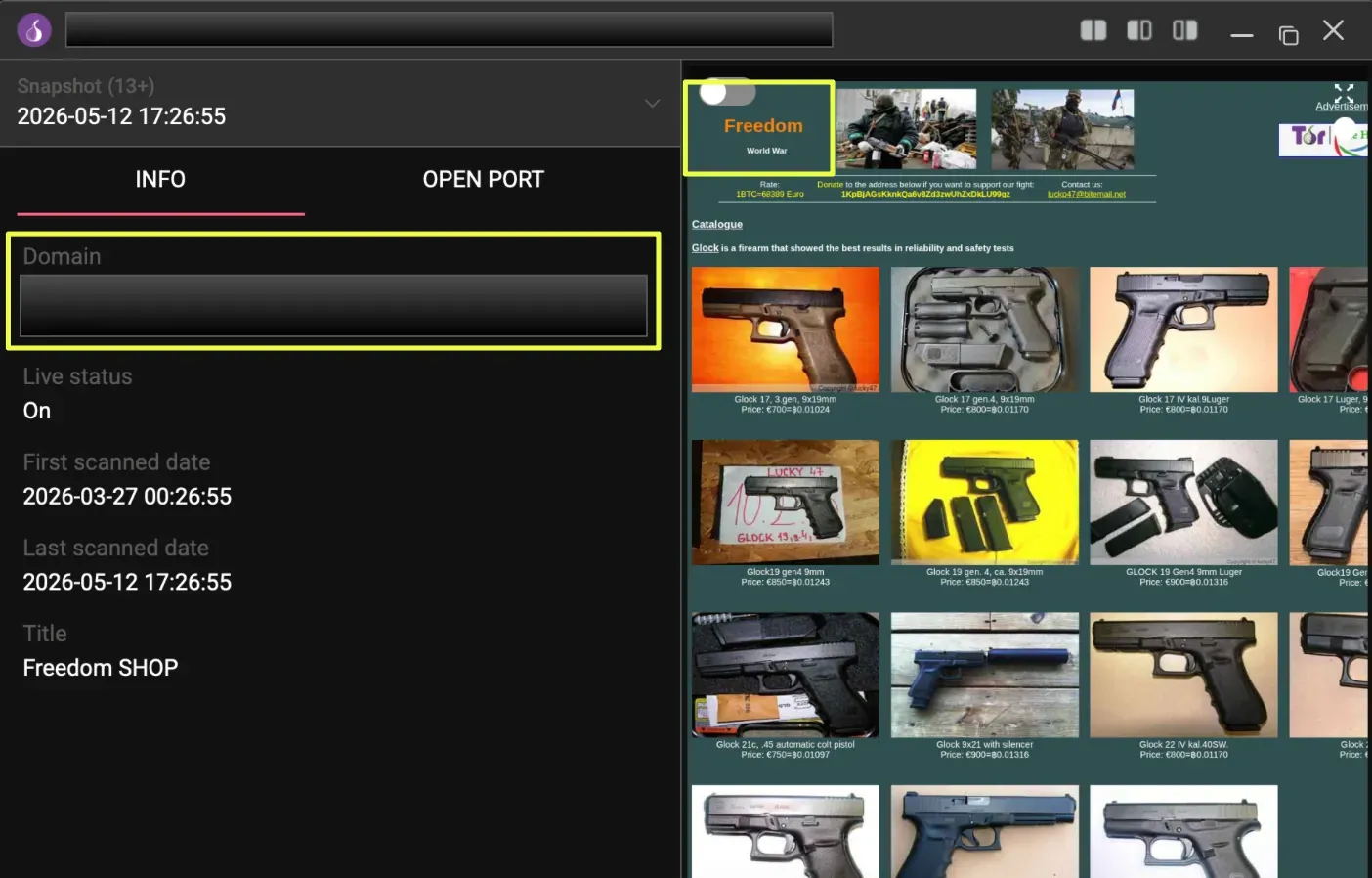
Although the domains did not all use identical branding, several shared noticeable similarities in structure and presentation. Archived snapshots revealed overlapping product categories, reused weapon imagery, similar payment instructions, and repeated marketplace layouts across multiple storefronts. Some domains continued operating under the “Luckp 47 Shop” identity, while others appeared under the name “Freedom Shop.”

The “Freedom Shop” marketplaces were particularly notable because, despite the branding differences, they displayed strong visual and operational overlap with earlier Luckp-related infrastructure. Similar storefront structures, repeated product imagery, and connected cryptocurrency infrastructure suggested that the domains were likely part of a broader interconnected marketplace ecosystem rather than unrelated standalone sites.

The investigation also revealed signs of long-term infrastructure persistence. Older domains used shorter legacy Tor v2 onion addresses, while newer deployments transitioned toward modern v3 onion services. This gradual migration indicated that the infrastructure was repeatedly redeployed and maintained over time rather than abandoned after a single operational period.

Marketplace Evolution and Operational Patterns

As the investigation expanded across the newly identified domains, a recurring operational pattern began to emerge. Several Luckp- and Freedom-related onion services contained large clusters of associated Bitcoin wallets, many of which showed no publicly observable transaction activity. This behavior appeared repeatedly across different marketplace deployments and suggested that the infrastructure relied on rotating or pre-generated wallet pools rather than a single long-term payment address.

For example, the domain:

  • 27bpw*********************************xryd.onion

was associated with ten additional BTC wallets. However, analysis of those wallets showed no recorded transaction activity.

  • bc1************************************w4j
  • bc1************************************hmn
  • bc1************************************4s2
  • bc1************************************x87
  • bc1************************************k2w
  • bc1************************************rrk
  • bc1************************************ese
  • bc1************************************uur
  • bc1************************************g5n
  • bc1************************************3jn

Similar inactive wallet clusters later appeared across multiple other Luckp-related domains, including:

  • luckp42********************************************xigyd.onion
  • luckp4z2byqzvsweqzrtlkffob7wxhdnmcno7tv7wxrnuik5euje4cqd.onion
  • luckp4k5jzwsofw6dulfvmc5clj75ww2ysgcwvj7yfunnc2i7terp4qd.onion

While many of these wallets remained inactive, other parts of the infrastructure displayed clearer signs of operational use. One of the more significant findings emerged from the domain:

  • 27bpwhs**************************************66id.onion

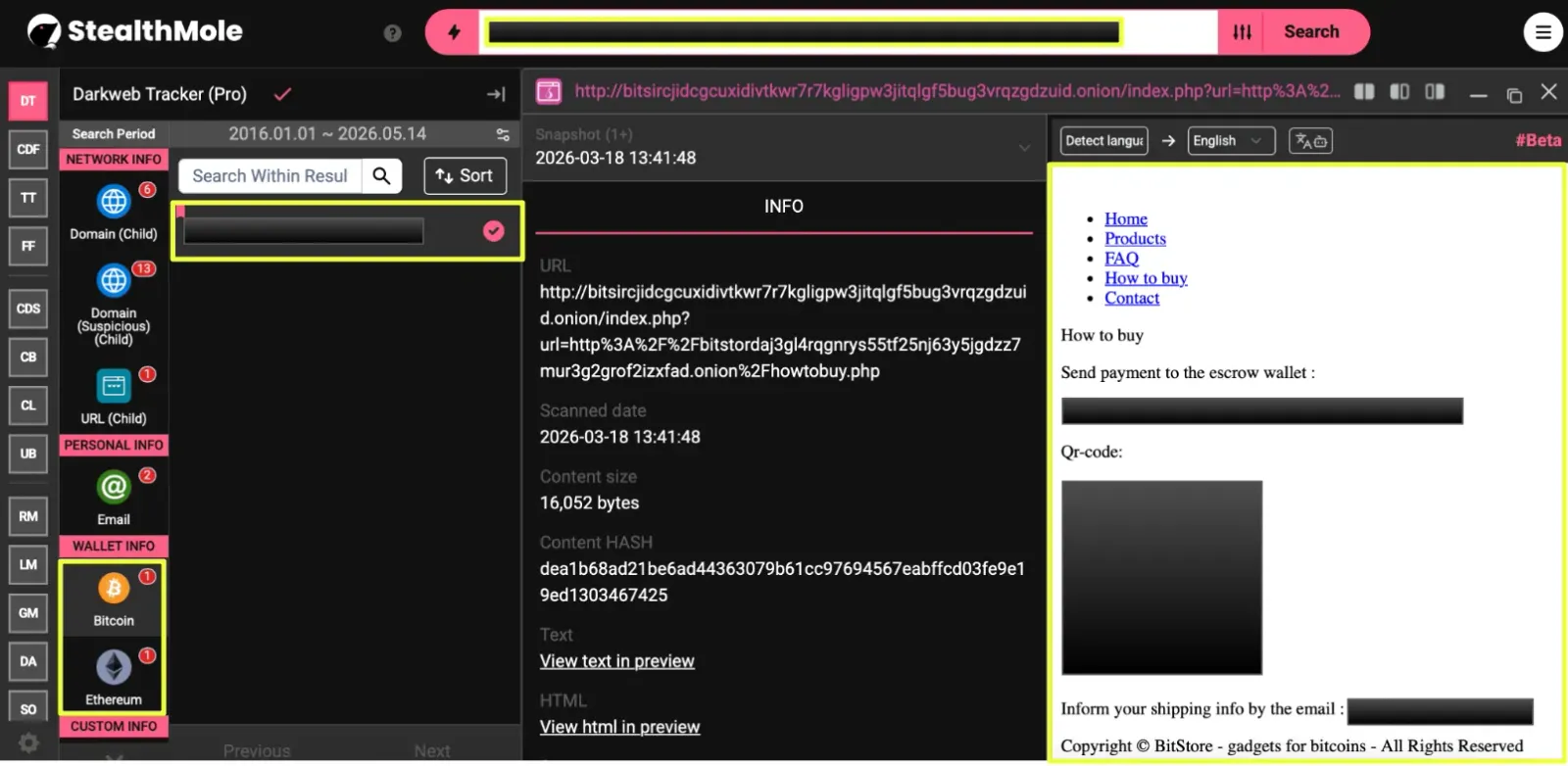
where the following Bitcoin wallet showed observable transaction activity over time. Further investigation revealed that the same wallet also appeared on a separate underground platform identified as “Bitstore,” where it was referenced as an escrow wallet. Although the overlap did not conclusively establish common ownership between the platforms, it demonstrated that parts of the financial infrastructure were circulating across multiple underground services rather than remaining isolated to a single marketplace.

  • 1KpBj*******************9gz

The same domain also introduced Ethereum-based payment infrastructure through the wallet:

  • 0xf5f********************************de0

Unlike earlier Luckp-related domains that primarily relied on Bitcoin, this deployment showed signs of broader cryptocurrency usage. StealthMole tracking linked the Ethereum wallet back to the same onion infrastructure, while associated pages revealed references to external services and hidden wiki-style navigation structures embedded within the marketplace environment.

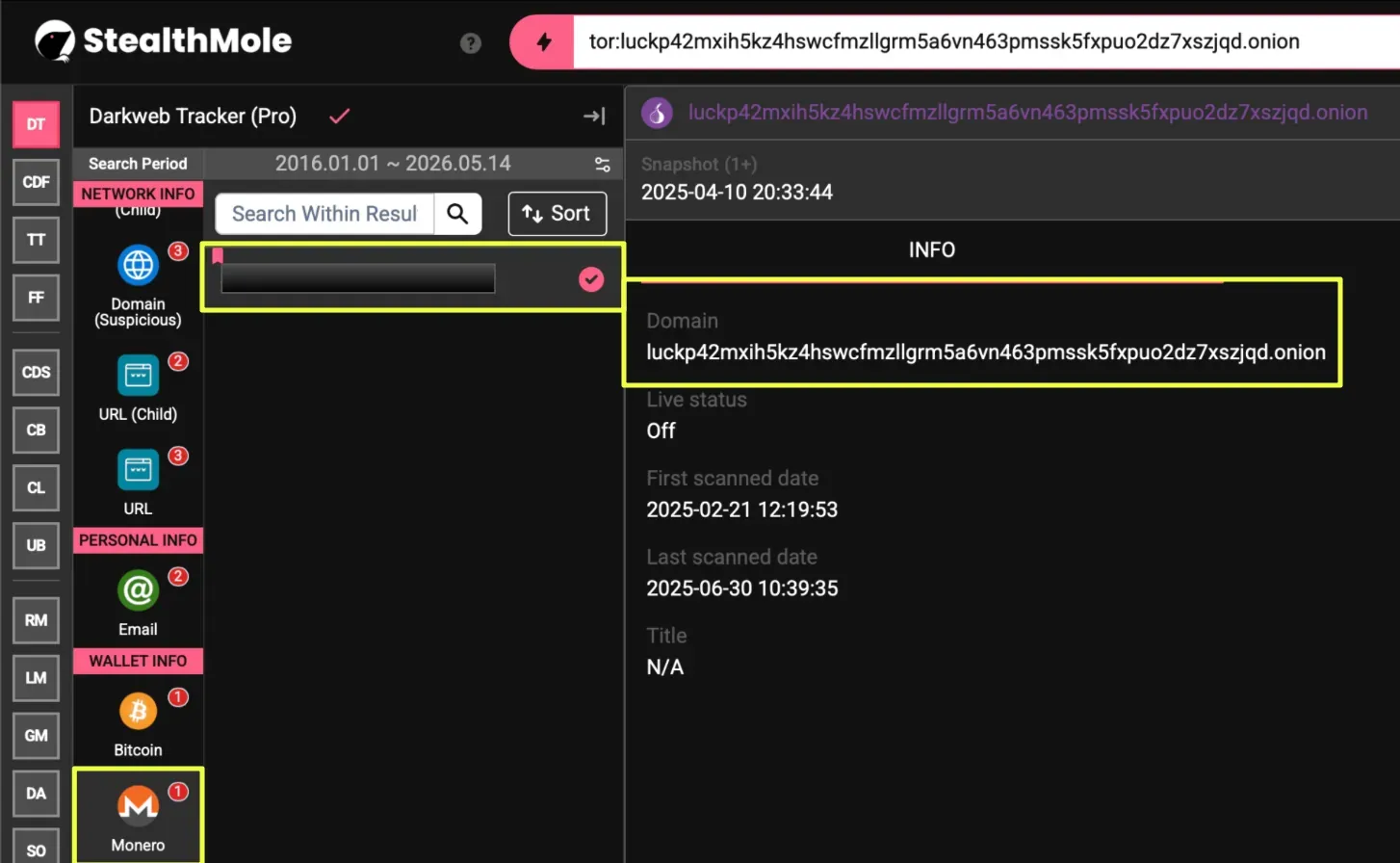
Another notable development appeared during analysis of:

  • luckp42mxih5kz4hswcfmzllgrm5a6vn463pmssk5fxpuo2dz7xszjqd.onion

which introduced Monero payment support through the wallet:

  • 85PKg**********************************************Epa

Unlike earlier storefront snapshots, this domain exposed portions of the marketplace ordering workflow itself. Archived pages displayed shipping information forms, order identifiers, cryptocurrency payment instructions, and checkout-related infrastructure integrated directly into the platform. The use of Monero, a cryptocurrency heavily associated with privacy-focused transactions, marked a noticeable shift from the earlier BTC-centric deployments observed during the investigation.

Uncovering the Meaning Behind “Luckp”

For much of the investigation, the term “Luckp” appeared to function as little more than marketplace branding. Earlier storefronts alternated between names such as “Luckp 47 Shop” and “Lucky 47 Shop,” while associated Telegram mentions and underground references often used the terms interchangeably. At that stage, the marketplace primarily appeared to be another weapons-focused onion service operating within a crowded dark web ecosystem.

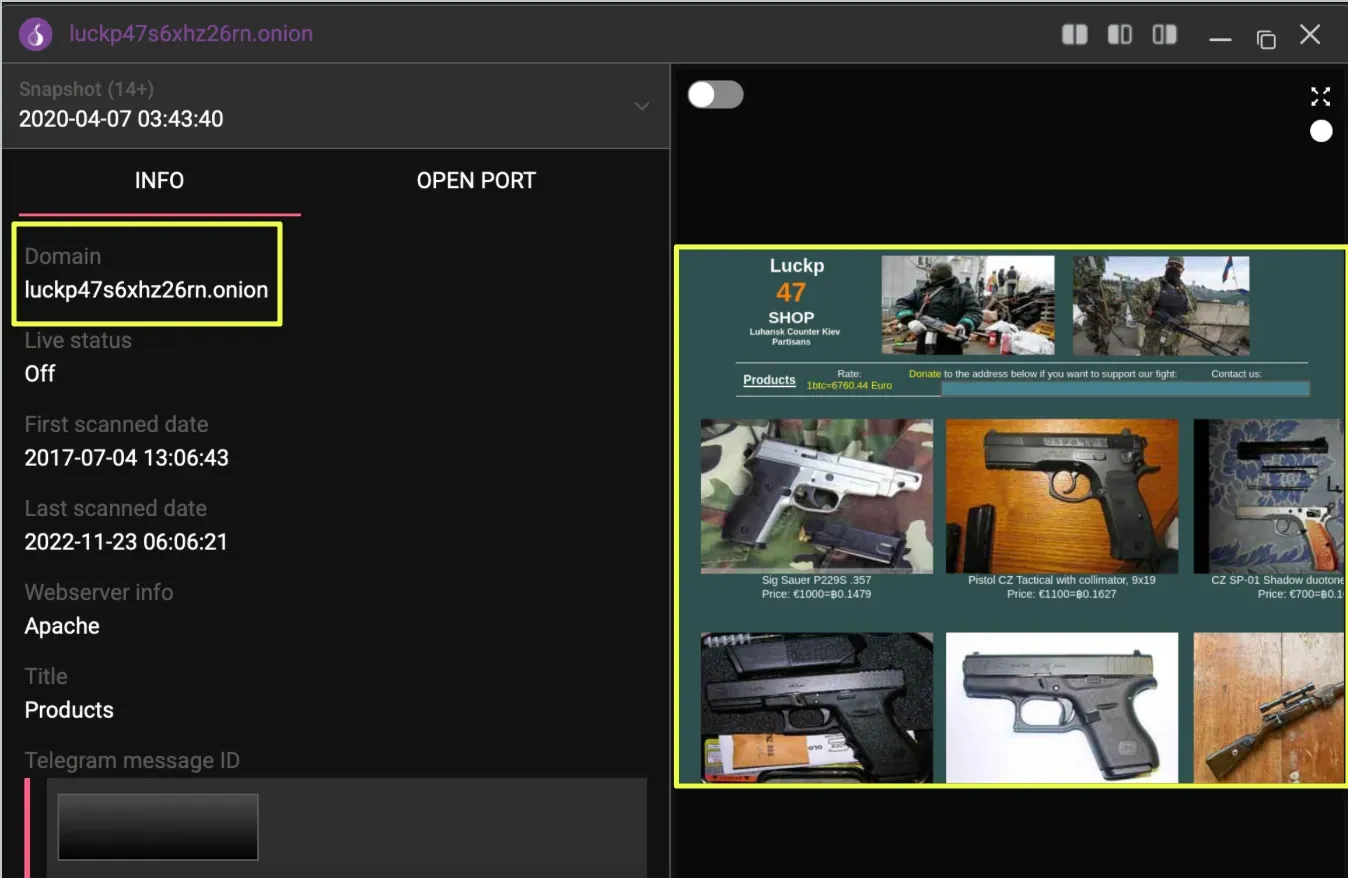
That changed during analysis of the older onion domain:

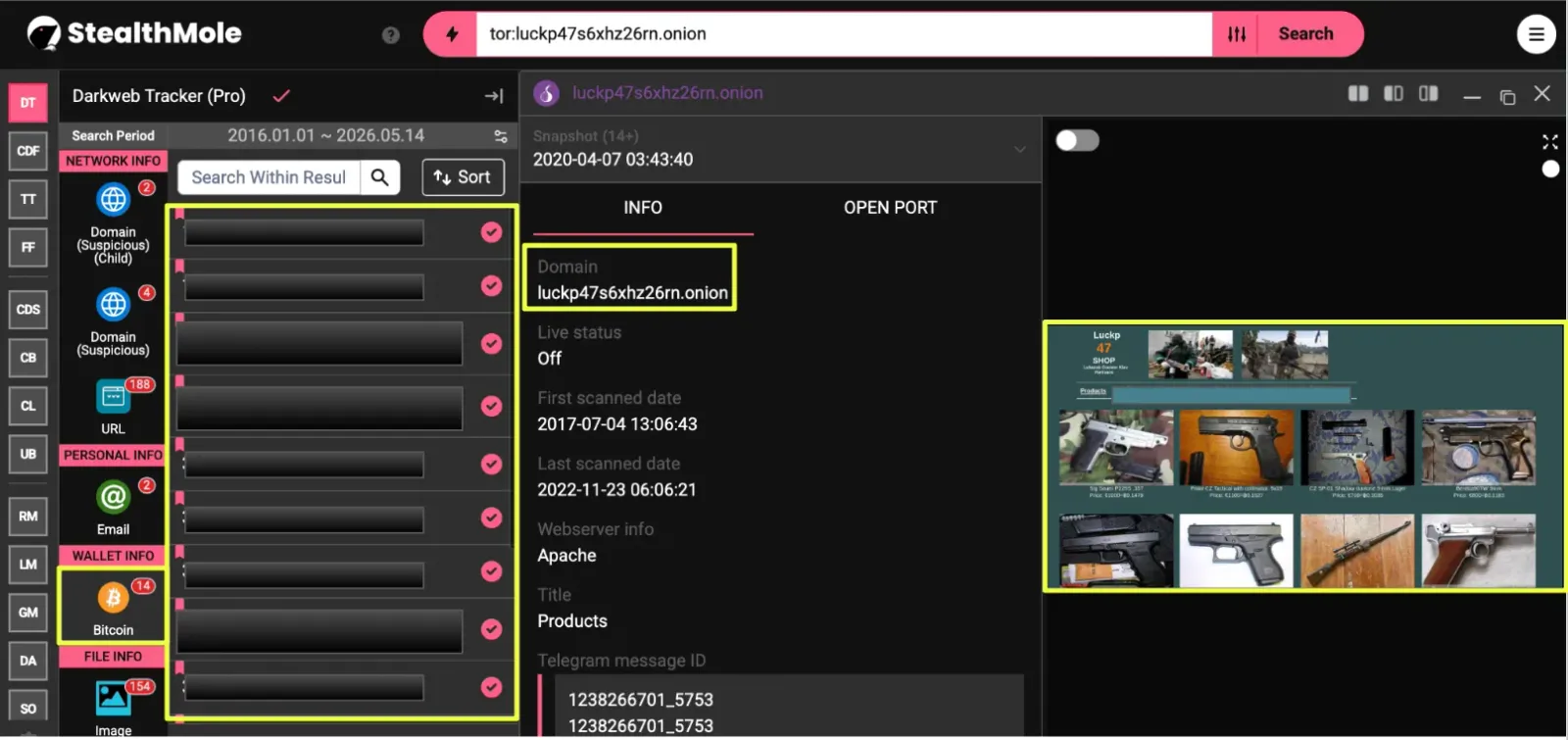
  • luckp47s6xhz26rn.onion

Unlike several of the newer domains identified earlier in the investigation, this marketplace preserved older archived content that exposed additional branding and narrative elements not immediately visible within the more recent infrastructure. One of the most significant discoveries was the appearance of the phrase directly alongside the Luckp branding.

  • Luhansk Counter Kiev Partisans

The wording provided the first clear indication that “Luckp” was likely being used as an acronym rather than a randomly selected marketplace name. This substantially shifted the context surrounding the operation. What initially appeared to be a conventional darknet weapons storefront now carried explicit wartime and conflict-oriented messaging tied to the Russia-Ukraine conflict narrative.

The marketplace itself reinforced this positioning visually. Archived snapshots featured militarized imagery, references to the “Ukrainian War,” and branding themes centered around conflict, insurgency, and resistance-style symbolism. Compared to many generic darknet marketplaces that rely on minimalist storefront designs, the Luckp infrastructure appeared intentionally curated to project a distinct identity rather than functioning solely as an anonymous transaction platform.
At the same time, the investigation did not uncover definitive evidence linking the marketplace to any verified militant organization or real-world armed faction operating within the conflict zone. The branding may have reflected ideological positioning, deliberate marketing, or an attempt to build legitimacy within underground communities already focused on wartime narratives and weapons trafficking.

However, the discovery fundamentally changed the direction of the investigation. The case was no longer centered purely on identifying a darknet marketplace selling weapons. Instead, the infrastructure increasingly appeared to be combining illicit commerce with conflict-oriented branding designed to embed the platform within the broader symbolism and online narratives surrounding the ongoing war.

Transactional Activity and Wallet Rotation Patterns

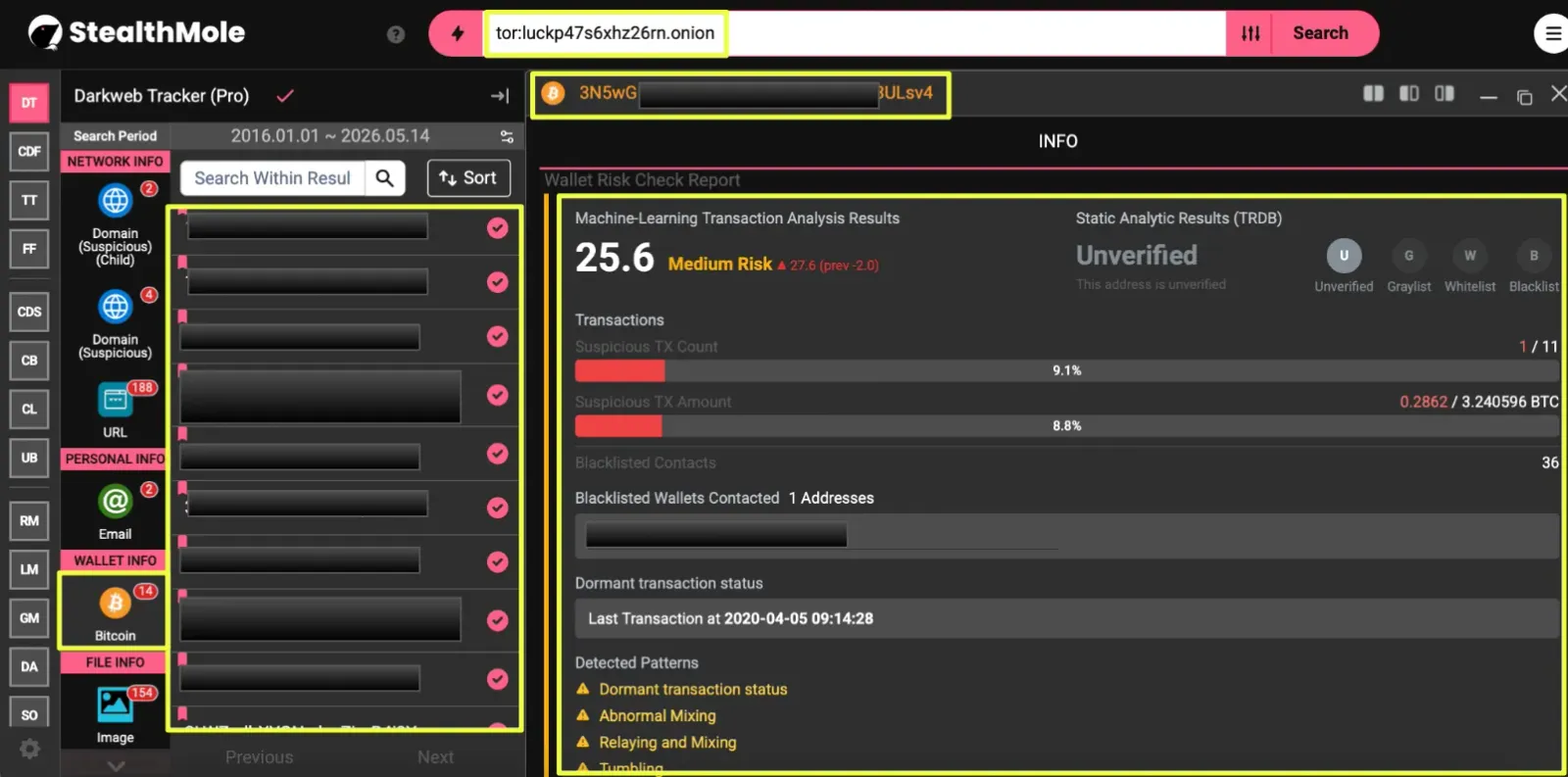
While the ideological and wartime branding surrounding the Luckp infrastructure became clearer through archived marketplace content, the financial activity tied to the older domains revealed another important layer of the operation. Unlike many of the newer Luckp-related onion services that were associated with inactive Bitcoin wallets, the older infrastructure showed sustained transactional behavior spanning multiple years.

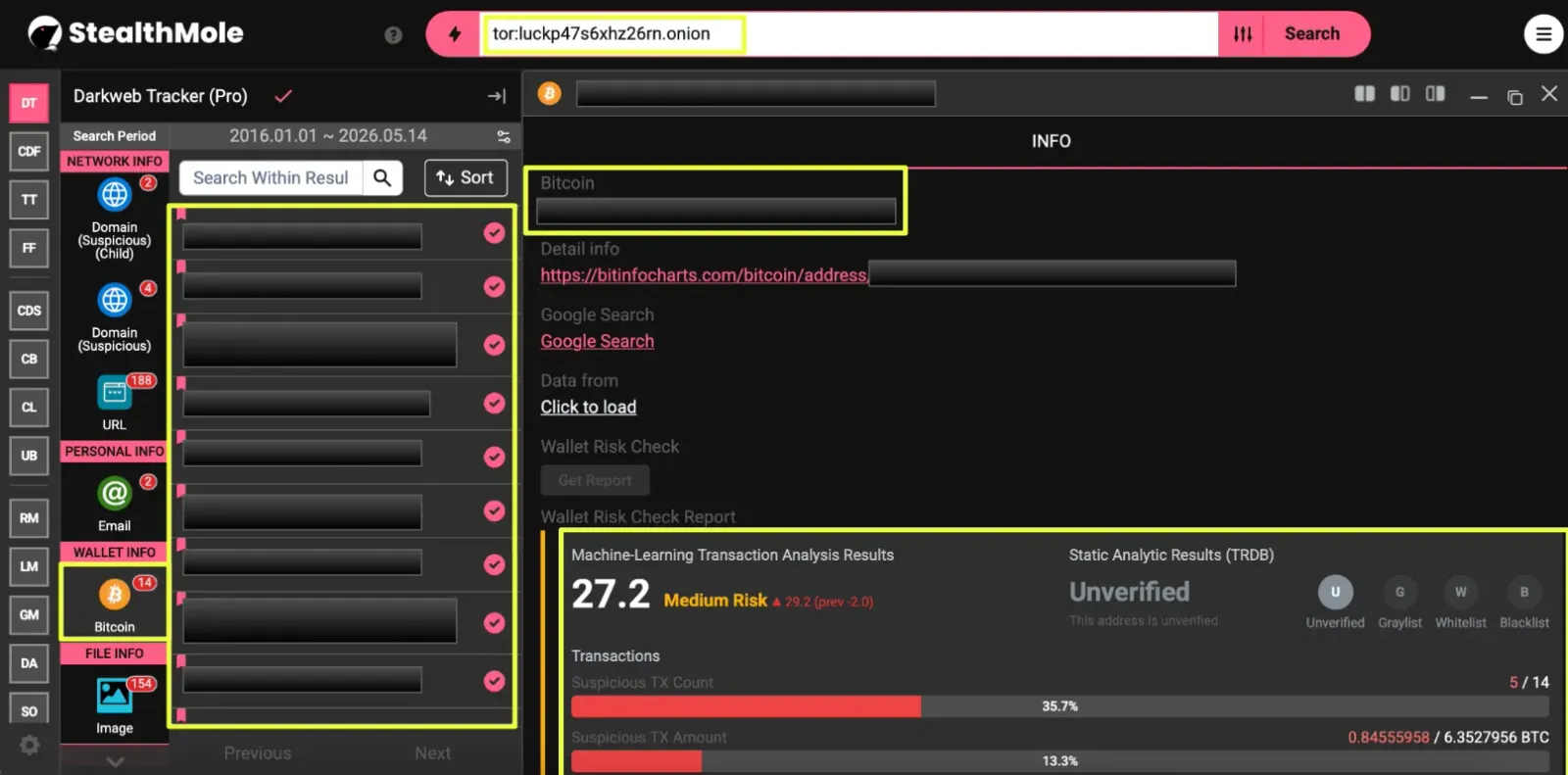
StealthMole identified fourteen BTC wallets associated with:

  • luckp47s6xhz26rn.onion

The wallets included:

  • 1Nkm6B************************Hbze
  • 1ANsmz************************H2aU
  • 3BPtF8************************wnxa
  • 3GNrNc************************QW8b
  • 3N5wGK************************Lsv4
  • 3M8NGA************************mkJX
  • 342bk7************************18NT
  • 3Codt5************************Zfve
  • 3BpHnZ************************ybGL
  • 3LWZed************************i9Yu
  • 329NN8************************cXsh
  • 3Cm8s9************************uKDX
  • bc1qwl************************yzvl
  • 3HLoqZG************************uomS

Several of these wallets displayed observable transaction activity between 2017 and 2023, making this one of the most operationally active parts of the ecosystem uncovered during the investigation.

Early Wallet Activity and Transaction Volume

The older wallets generally showed larger transaction values and more consistent movement compared to the newer infrastructure observed elsewhere in the investigation. Examples included:

  • 1Nkm6***********************Hbze Received approximately 1.527 BTC between 2017 and 2018.
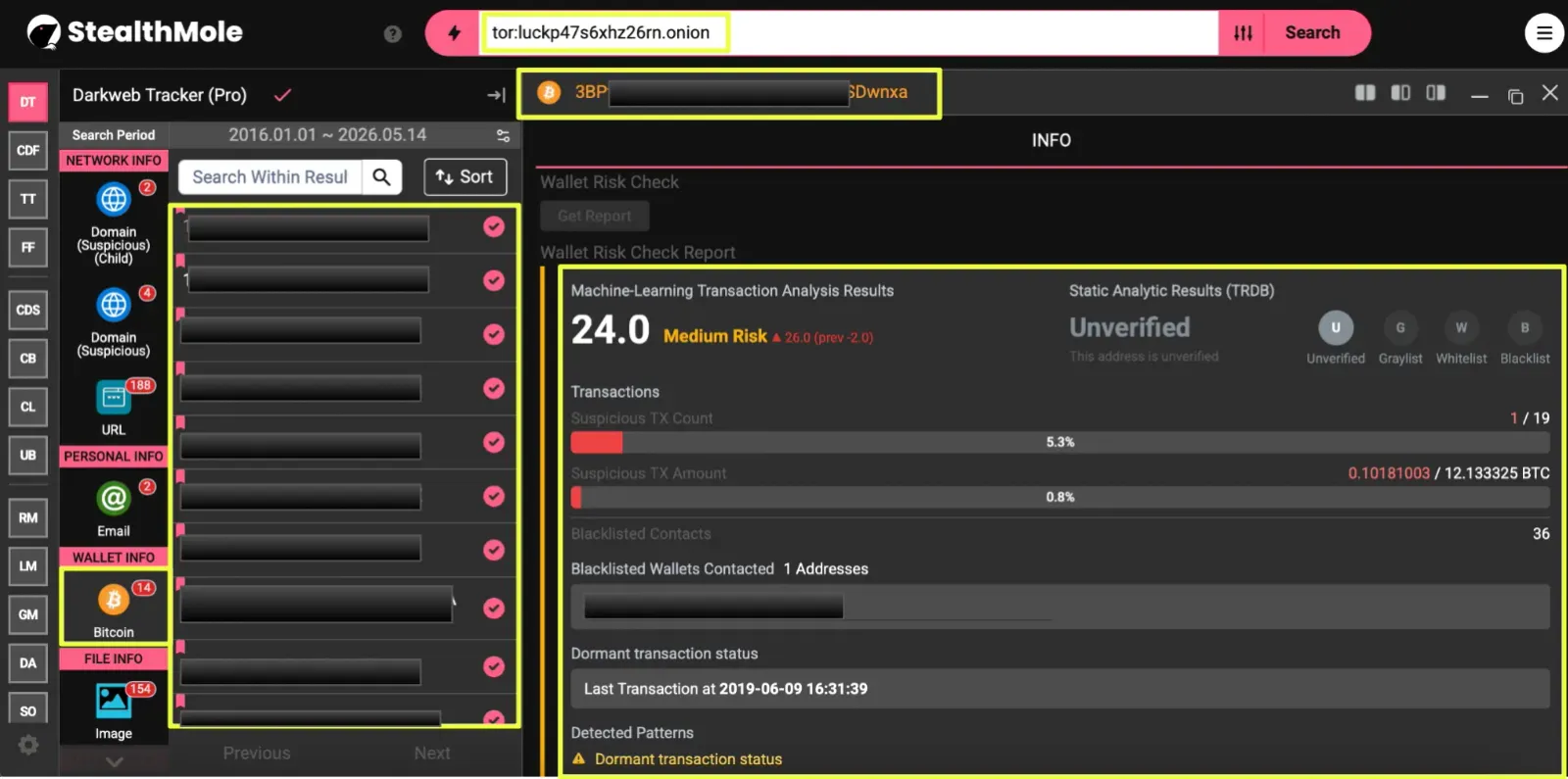
  • 3BPtF**************************Dwnxa Received approximately 1.501 BTC during 2019.
  • 3N5wG***************************Lsv4 Recorded approximately 0.838 BTC in activity during 2020.
  • 342bk*****************************18NT Showed approximately 0.459 BTC in observed transactions.

Several additional wallets also displayed smaller but recurring payment activity over time. Although blockchain analysis alone cannot determine whether the payments were directly tied to successful marketplace transactions, the repeated financial movement across multiple marketplace-linked wallets strongly suggested that at least parts of the infrastructure were operational rather than purely decorative or inactive storefronts.

Repeated Wallet Rotation Behavior

One of the clearest patterns observed throughout the wallet analysis was the short operational lifespan of many addresses. Rather than relying on a single long-term treasury wallet, the infrastructure repeatedly cycled through multiple payment addresses over time.

Across several wallets, the same sequence appeared repeatedly:

  • Wallet receives incoming BTC transactions
  • Funds remain temporarily within the wallet
  • Wallet balance is later drained or reduced to near-zero
  • Activity declines or stops entirely

This behavior appeared across multiple years of activity and was especially visible within the earlier Luckp infrastructure. In many cases, the wallets eventually showed:

  • zero remaining balance,
  • zero unspent outputs,
  • or no further transactional activity after earlier payment periods.

The repeated receive-and-drain pattern suggested that the infrastructure may have relied on compartmentalized payment handling rather than maintaining large long-term wallet balances. Whether this behavior reflected operational security practices, manual fund consolidation, or short-term receiving wallets could not be independently confirmed. However, the consistency of the pattern across multiple addresses indicated that the wallet activity was unlikely to be random.

Gradual Decline in Financial Activity

Another noticeable trend emerged when comparing older wallet activity with newer Luckp-related infrastructure uncovered later in the investigation. Earlier wallets generally handled larger BTC volumes and showed clearer transactional patterns, while later deployments increasingly relied on inactive or near-empty wallet clusters.

Some of the newer wallets associated with later domains received extremely small amounts of Bitcoin or showed no observable activity at all. This contrasted sharply with the older Luckp infrastructure, which demonstrated more sustained financial movement between 2017 and 2020.

The shift may suggest several possibilities:

  • operational decline,
  • fragmentation of the marketplace ecosystem,
  • migration toward alternative payment methods,
  • increased use of privacy-focused cryptocurrencies,
  • or repeated redeployment of partially inactive mirror infrastructure.

Although the exact reason could not be conclusively determined, the financial behavior observed across the investigation indicated that the Luckp ecosystem evolved significantly over time rather than remaining operationally static.

Infrastructure Persistence and Identity Continuity

As the financial analysis expanded across older and newer Luckp-related domains, another pattern began emerging beneath the rotating wallets and changing storefronts: despite repeated infrastructure shifts, several core identifiers remained surprisingly consistent over time.

One of the clearest examples involved the marketplace’s contact infrastructure. The earliest domains identified during the investigation used the email address:

  • luc****7@b****ail.net

However, as additional onion services were uncovered, the investigation revealed that the operators or at minimum the infrastructure behind the marketplaces, continued reusing the “luckp47” identifier across multiple encrypted email providers.

Additional addresses identified through StealthMole included:

  • lu***7@dnmx.su
  • LU***7@DNMX.SU
  • lu****7@sa******l.net
  • lu****7@sa******l.com

The repeated reuse of the same naming convention across separate providers strongly suggested long-term continuity in branding and operational identity. While the surrounding infrastructure evolved over time, the “luckp47” label itself remained persistent across multiple marketplace generations.

The transition between providers was also notable in its own right. Earlier infrastructure relied on Bitemail, while later deployments shifted toward DNMX and Safe-mail services — platforms frequently observed within underground and privacy-focused communities. The migration appeared gradual rather than abrupt, suggesting infrastructure evolution over time instead of a single isolated redeployment.

The onion infrastructure itself reflected a similar pattern of continuity. Older Luckp-related domains used legacy Tor v2 onion addresses, while newer deployments transitioned toward longer v3 onion services introduced after Tor deprecated v2 support. This migration indicated that portions of the infrastructure were actively maintained and adapted across multiple years rather than abandoned after initial deployment.

Additional linked domains continued surfacing throughout the investigation, including:

  • luckp42mxih5kz4hswcfmzllgrm5a6vn463pmssk5fxpuo2dz7xszjqd.onion
  • luckp43xq757gh5w2udd4rl6fqwtie3hab57uwk5bywga4t5x5yxqjqd.onion
  • luckp4bbg3jjytiao7ibd556dvs2fkpfbzcl74my6ku3omweoscmm6ad.onion

Some of these domains were inactive at the time of analysis, while others appeared partially operational or redirected toward related marketplace infrastructure. Despite differences in branding and accessibility, many retained overlapping marketplace structures, recurring imagery, and similar payment workflows.

The investigation also identified traces of the Luckp identifiers outside the onion ecosystem itself. The addresses luc***7@sa****l.net and lu**7@sa***l.com were both observed within leaked files indexed through StealthMole. While the leaked references alone did not independently establish ownership or attribution, they demonstrated that the Luckp identity extended beyond isolated Tor infrastructure and appeared across additional underground data sources.

Telegram Mentions and External Visibility

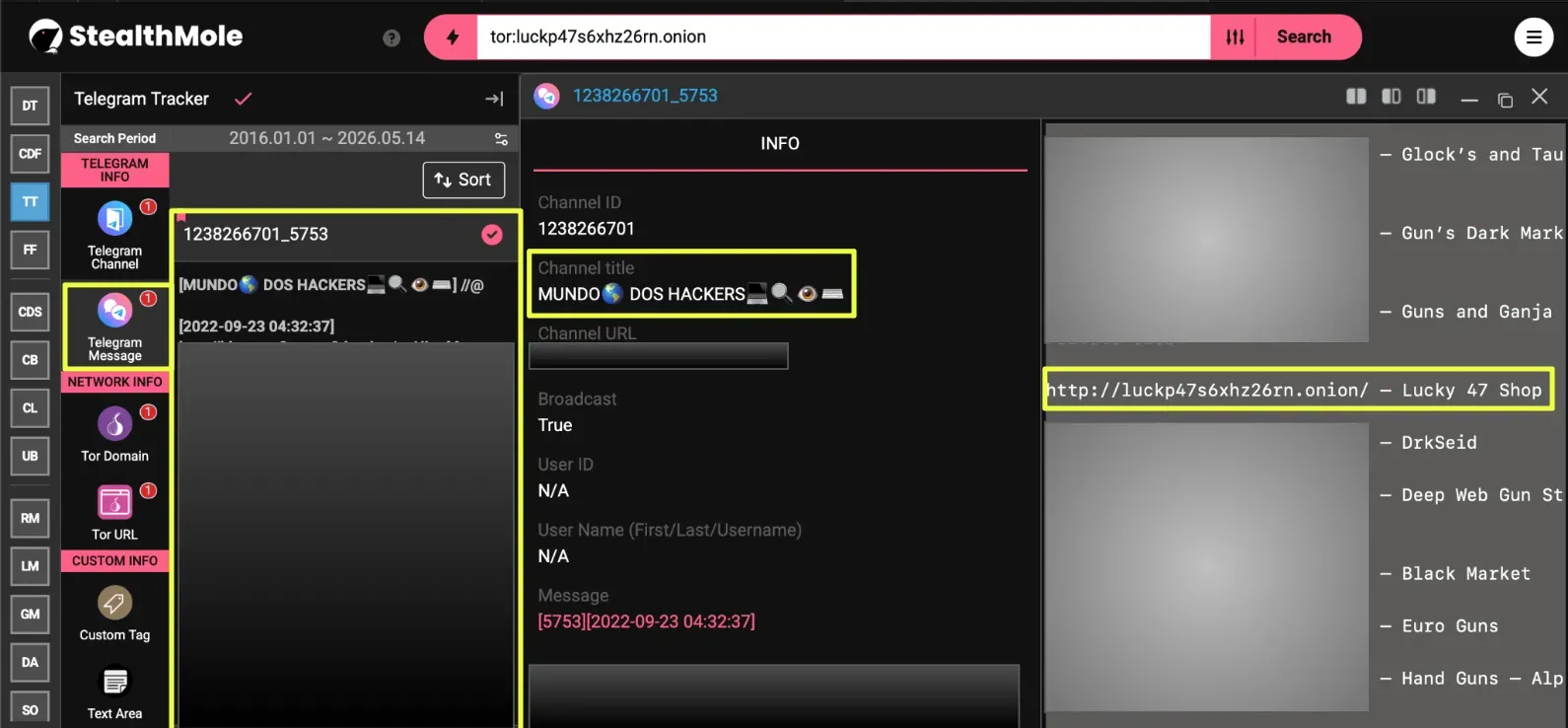
The investigation later expanded beyond the Tor ecosystem itself after StealthMole’s Telegram Tracker identified references to Luckp-related infrastructure circulating through Telegram-based underground communities.

One of the identified mentions referenced the domain within a Telegram message posted in the channel titled Mundo Dos Hackers.

  • luckp47s6xhz26rn.onion

The message appeared to function as a directory-style post containing multiple onion links tied to underground marketplaces and services. Within the listing, the Luckp infrastructure was referenced under the name:

  • Lucky 47 Shop

The Telegram reference was particularly notable because it demonstrated that the marketplace was not relying exclusively on Tor-based discovery. Instead, links to the infrastructure were also circulating through external messaging ecosystems commonly used to distribute dark web resources, marketplace directories, and underground service references.

The naming convention used within the Telegram message also reflected an interesting shift in how the marketplace was being referenced externally. While archived infrastructure later revealed the meaning behind the “Luckp” acronym, the Telegram ecosystem appeared to use the simplified “Lucky 47 Shop” branding instead. Whether this reflected deliberate simplification, informal renaming by third-party users, or broader recognition of the marketplace under a more accessible label could not be conclusively determined.

Conclusion

What began as the discovery of a single inactive onion marketplace gradually expanded into a broader investigation involving linked onion services, recurring cryptocurrency infrastructure, evolving marketplace branding, and years of observable operational activity.

Through StealthMole pivots across wallets, domains, Telegram references, and contact infrastructure, the investigation revealed that the Luckp ecosystem extended well beyond one storefront. Older domains showed sustained Bitcoin activity and clearer operational behavior, while newer deployments increasingly relied on rotating mirror infrastructure, inactive wallet clusters, and alternative cryptocurrency support such as Monero.

The investigation also revealed how the marketplace evolved its identity over time. What initially appeared as “Lucky 47 Shop” later exposed deeper conflict-oriented branding tied to “Luhansk Counter Kiev Partisans,” demonstrating how underground marketplaces can combine weapons trafficking narratives, wartime symbolism, and anonymous infrastructure to build long-term visibility within dark web ecosystems.

Editorial Note

Investigations involving dark web infrastructure rarely produce absolute answers. Marketplaces frequently rotate domains, reuse identifiers, abandon infrastructure, and blur the line between operational activity, propaganda, and reputation-building. StealthMole helped connect fragmented indicators spread across onion services, cryptocurrency wallets, Telegram references, and leaked data, allowing a broader infrastructure picture to emerge from what initially appeared to be an isolated marketplace listing.

To access the unmasked report or full details, please reach out to us separately.

Contact us: support@stealthmole.com

Labels: ,

Learn more about StealthMole

Talk to our team of experts today to learn how you can manage your dark web exposure.
Request demo More Reports

Share this report