The QYU Holdings Trail: Mapping the Corporate and Digital Footprint Behind a $100M Forex Ponzi

QYU Holdings presented itself to the world as a professional foreign exchange trading firm. U.S. federal authorities say it was a Ponzi scheme. Between at least 2015 and June 2023 it is alleged to have taken in around $100 million from investors in the United States, Canada, Panama and elsewhere, and its founder, Darren Anthony Robinson, was charged in the Eastern District of Michigan with eleven counts of wire fraud and one count of money laundering. He cut his court ordered GPS tether in November 2023, left the country, and in August 2026 was added to the FBI's Most Wanted Fraudsters list with a reward of up to $150,000.
Investigating through StealthMole's indexed dark web, credential and leaked file sources, this report follows the QYU brand through the infrastructure it left behind: the domains it registered, the mailboxes that leaked, the offshore funds it stood up, an SEC filing it signed, the corporate records it left in Florida, and a broker license it took out in Dubai. Traced this way, a single wanted poster name opened into a corporate structure spread across five jurisdictions, Wyoming, Florida, the Cayman Islands, Panama and the United Arab Emirates, and surfaced several people documented alongside it.
One principle runs through everything that follows. Darren Robinson stands charged, and the allegations against him remain allegations until a court decides. Everyone else named here is documented only as an affiliate or an officer of a QYU entity. A mailbox, a directorship, a signature or a filing shows that a person was connected to the operation. It does not show that they knew it was a fraud, and none of them appears in any charging document. Where the records prove a connection we say so, where they do not prove knowledge or intent we say that too, and the leads that could not be stood up are set out on their own. No information about anyone's current location was developed.
The Starting Point: A Most Wanted Fraudster
The investigation did not begin with an unknown alias. It began with a wanted poster. On 13 August 2026 the FBI's Detroit Field Office added Darren Anthony Robinson to its Most Wanted Fraudsters list and posted a reward of up to $150,000 for information leading to his arrest and conviction. According to the Bureau, Robinson founded and ran QYU Holdings as a purported professional investment company trading foreign currency, and from at least 2015 to June 2023 he raised an estimated $100 million from investors while, it is alleged, running a Ponzi scheme that paid earlier investors with newer money and funded his own lifestyle.
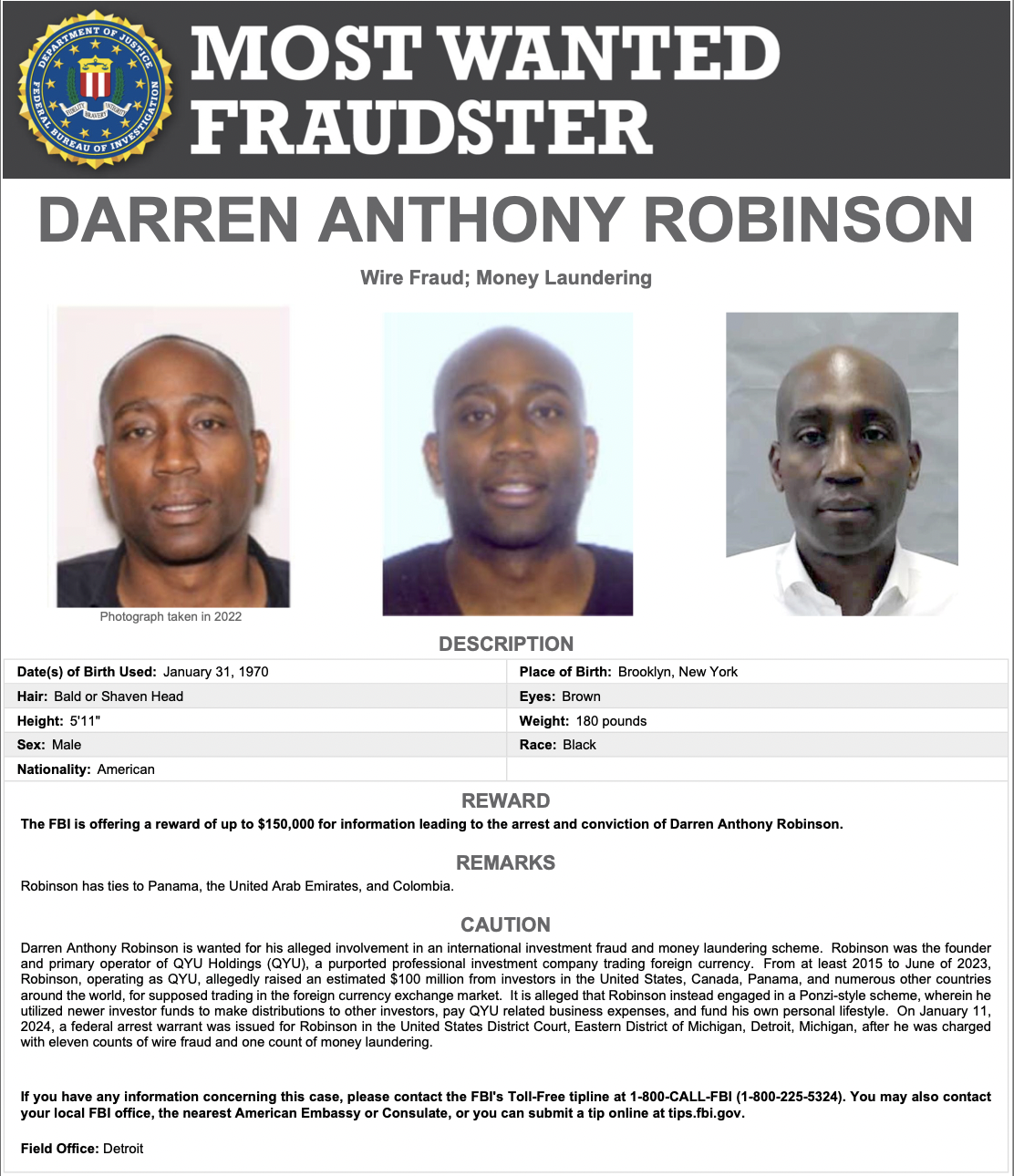
The poster gave a set of identifiers that became the baseline for every record checked afterward:
- Date of Birth (used): 31 January 1970
- Place of Birth: Brooklyn, New York
- Description: Male, 5'11", roughly 180 lbs, brown eyes, bald or shaven head
- Ties: Panama, the United Arab Emirates and Colombia, with an earlier U.S. footprint in Miami, South Florida, suburban Atlanta and Southern California
- Photograph: Taken in 2022
Two enforcement tracks anchored the case. A federal arrest warrant was issued on 11 January 2024 in the Eastern District of Michigan after Robinson was charged with eleven counts of wire fraud and one count of money laundering, and he has been a fugitive since November 2023, when he cut his GPS tether while out on bond and left the country.
Separately, the Commodity Futures Trading Commission won a default judgment and permanent injunction in April 2024 against Robinson and The QYU Holdings Inc. (QYUHI), a Wyoming corporation with a claimed principal place of business in Dallas, Texas, ordering $5,923,515.37 in restitution and a matching civil penalty and finding that the firm had taken $7,196,365.37 from 38 pool participants. The distance between the CFTC's $7.2 million and the FBI's $100 million was itself telling. The regulator had captured one slice of a much larger operation.
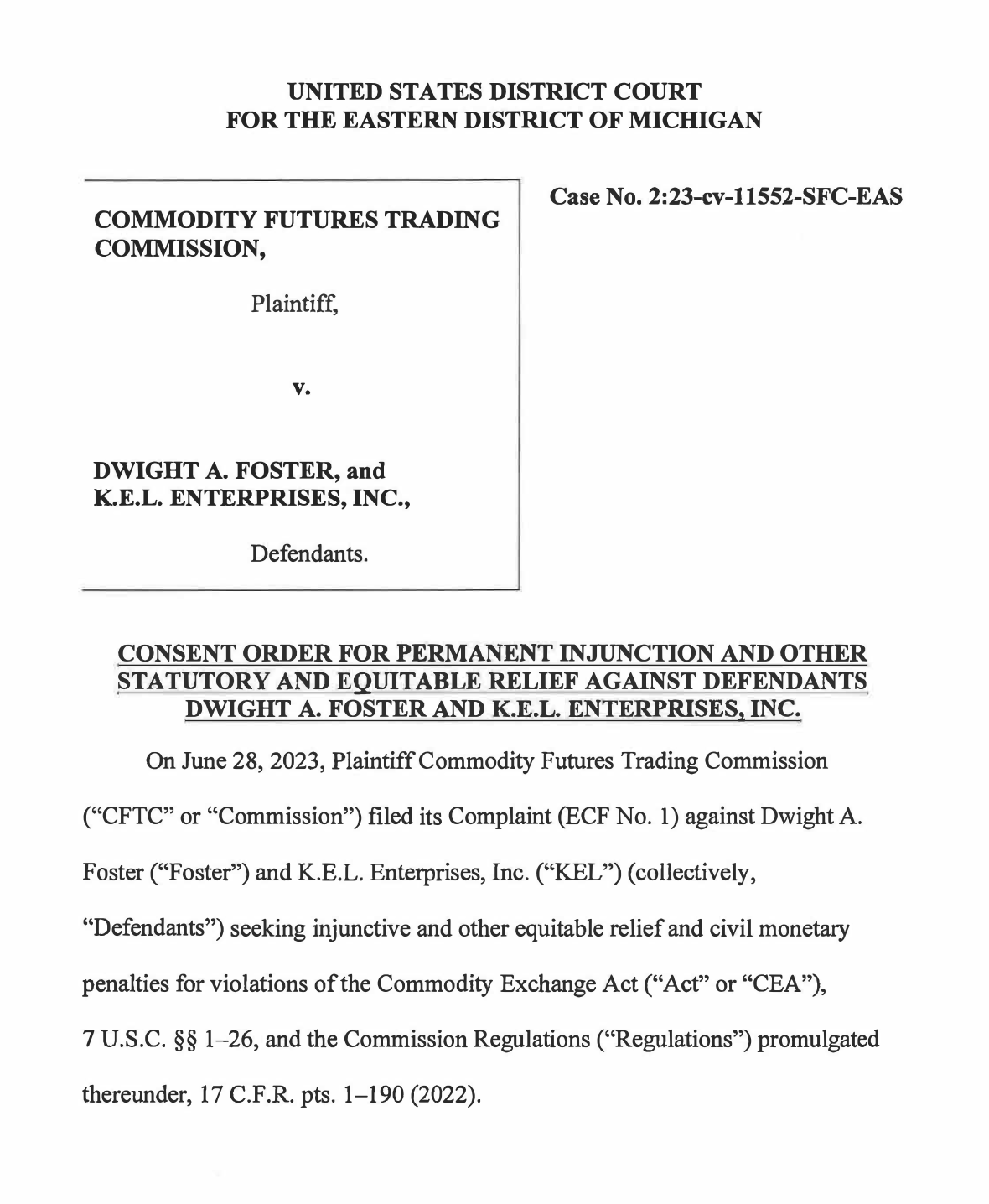
The charging documents also pointed past Robinson himself. A related CFTC action named Dwight A. Foster, a dual U.S. and Canadian citizen, and K.E.L. Enterprises, Inc. for soliciting not less than $13.2 million from at least 45 investors into a QYU related commodity pool (CFTC v. Foster, No. 2:23-cv-11552, E.D. Mich.). QYU had paid a network of client managers, which meant its footprint was never going to end with one person. That is where the trail into the infrastructure began.
The Brand Footprint: Domains and Web Infrastructure
With the public record in hand, the first pivot ran through StealthMole's Darkweb Tracker into QYU's own web presence. There was not one site but a family of them, and each told a slightly different story to a slightly different audience. Mapping them showed the reach of the operation and gave us a set of infrastructure selectors to carry forward.
The domains and subdomains that surfaced:
- u**.qyu*****s.com
The investor facing fund site, describing short term intra day forex, "proprietary market research techniques" and a global macro strategy, and naming a specific vehicle, the Vader Fund.
- t**qyu******scorp.com
A live placeholder branded "The Qyu Holdings Corporation" and pitched around import and export.
- r***s.qyu*********s.com
A login and password reset portal titled "QYU - Login", the account system that would have served investor statements.
- qyutech*******s.com
Tied to the Florida entity QYU Technologies Corp, with contact info@qyu****h.com, +1 (786) 6**-2***7 and an address in Miami.
- qyut******i.com
The site of the UAE broker arm, contact: info@qyut******i.com, +971 5* 6*3 **00
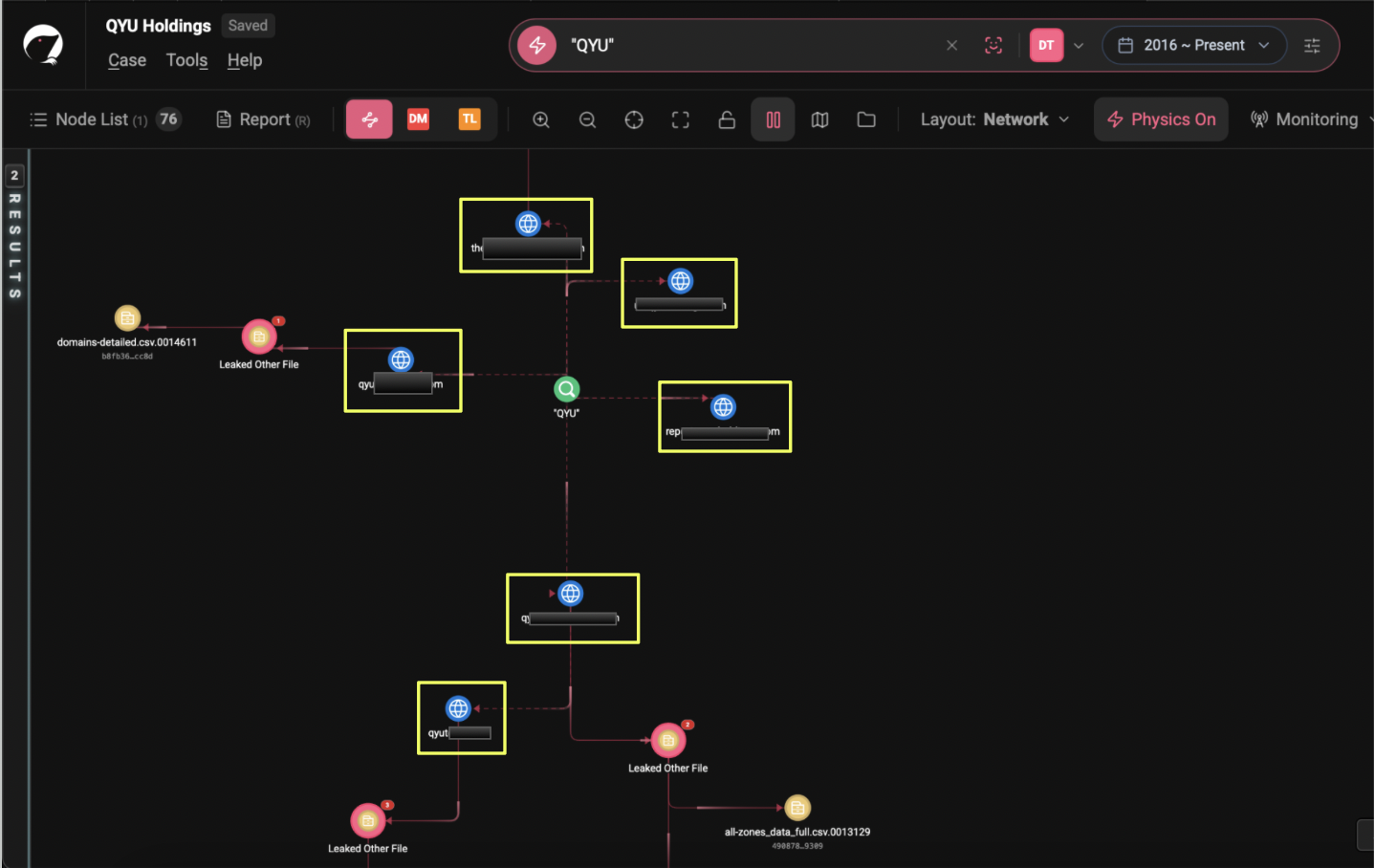
The inconsistency across these properties was itself worth noting. To investors QYU was a professional FX fund. To directories and registries it appeared as a holding company, an import and export firm, an online shopping mall on an abandoned LinkedIn page, and a technology company. An operation said to have raised $100 million wearing several unrelated cover identities is a familiar layering pattern, and here it is documented across five separate web properties.
Each domain went into the file as a selector for passive DNS, historical WHOIS and archive review. So did the marketing language itself, the "Vader Fund" name, the "boutique professional trading firm" self description, and the claim that $100,000 invested in 2014 would have grown past $2 million by 2021 without a single losing month. That kind of copy is distinctive enough to catch again if it were reused under a successor or sibling brand.
Following the Credentials
Pivoting on the first domain qyu*******s.com through StealthMole’s Combo Binder returned 128 credential records. This was a set of real mailboxes with passwords and per record leak dates attached, not addresses guessed from a naming pattern. The distinction mattered. A dataset that carries passwords and timestamps confirms the mailboxes existed and were in use, and it rules out the possibility that any given address is an inference.
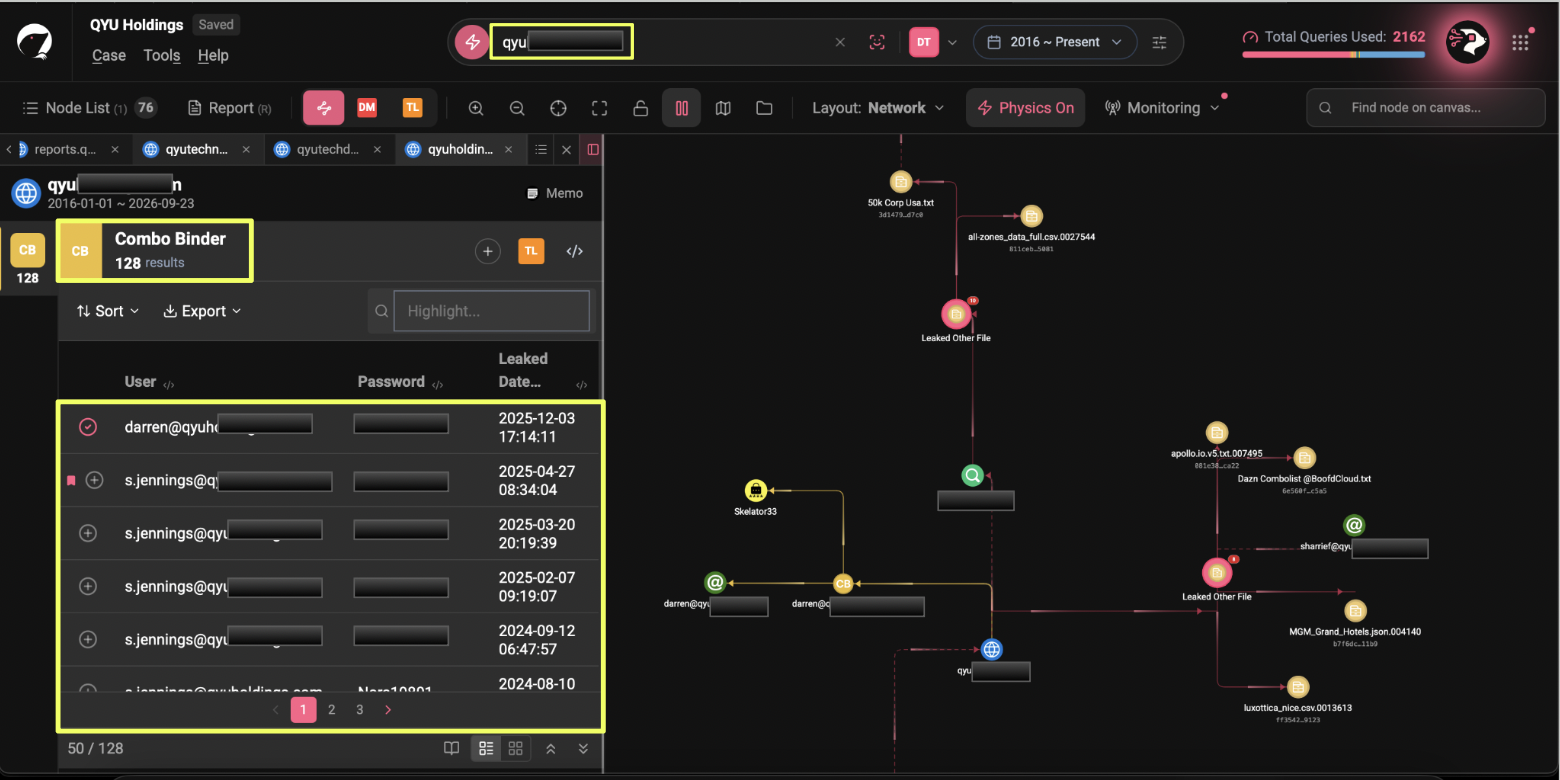
Three of them anchored the people side of the investigation:
- Darren@qyu******s.com
The operator account
- S.jennings@qyu******s.com
Recurring across leak dates from August 2024 to December 2025, with the password changing over time, which pointed to a mailbox in steady use rather than a one off.
- Sharrief@qyu******s.com
A third active staff account
Seeing Darren next to S.jennings and Sharrief on the same corporate domain read the way a small staff on shared mail would. The naming was not consistent, first name, then first initial and surname, then first name again, which meant the rest of the roster could not be guessed by permutation.
At this stage the mailboxes established affiliation. People named Jennings and Sharrief held working QYU accounts. They did not yet tell us who those people were, or what they did. Resolving the names came next.
Putting Names to the Mailboxes
When the qyu*******s.com domain was investigated through StealthMole’s Darkweb Tracker, it returned several leaked file records drawn from third party breaches such as MGM Grand Hotels and Apollo.io. These files show where a mailbox was used to sign up for outside services. They do not indicate that QYU itself was breached, but they carry the same weight for our purposes. The address is real, it belongs to the named person, and it was used as a working email.
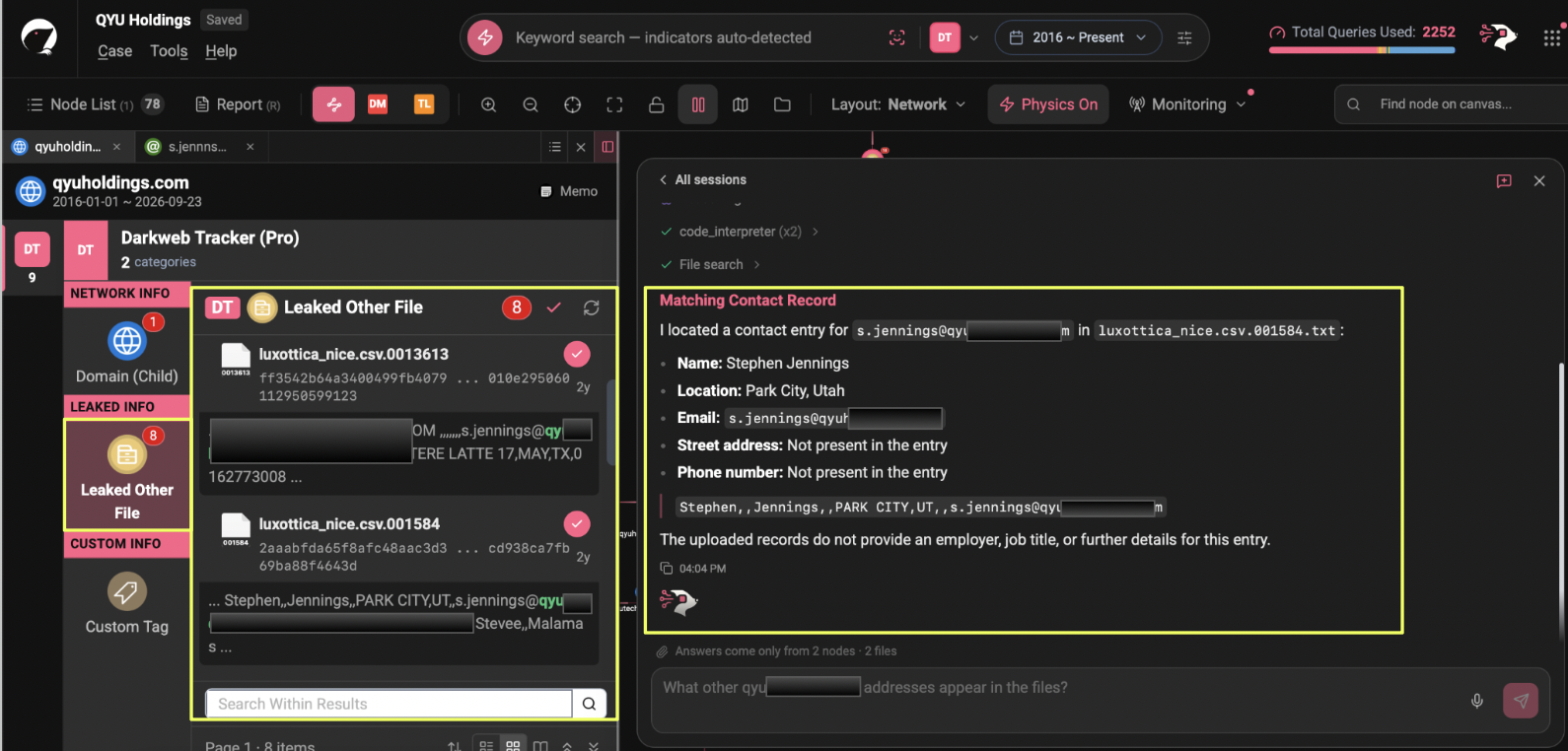
Two records linked s.jennings@qyu*******s.com to a full name and a location:
- Stephen, Jennings, PARK CITY, UT, s.jennings@qyu*****s.com
- a JSON record binding a spelling variant, s.jennns@qyu******s.com, to Stephen Jennings and Sacramento, CA
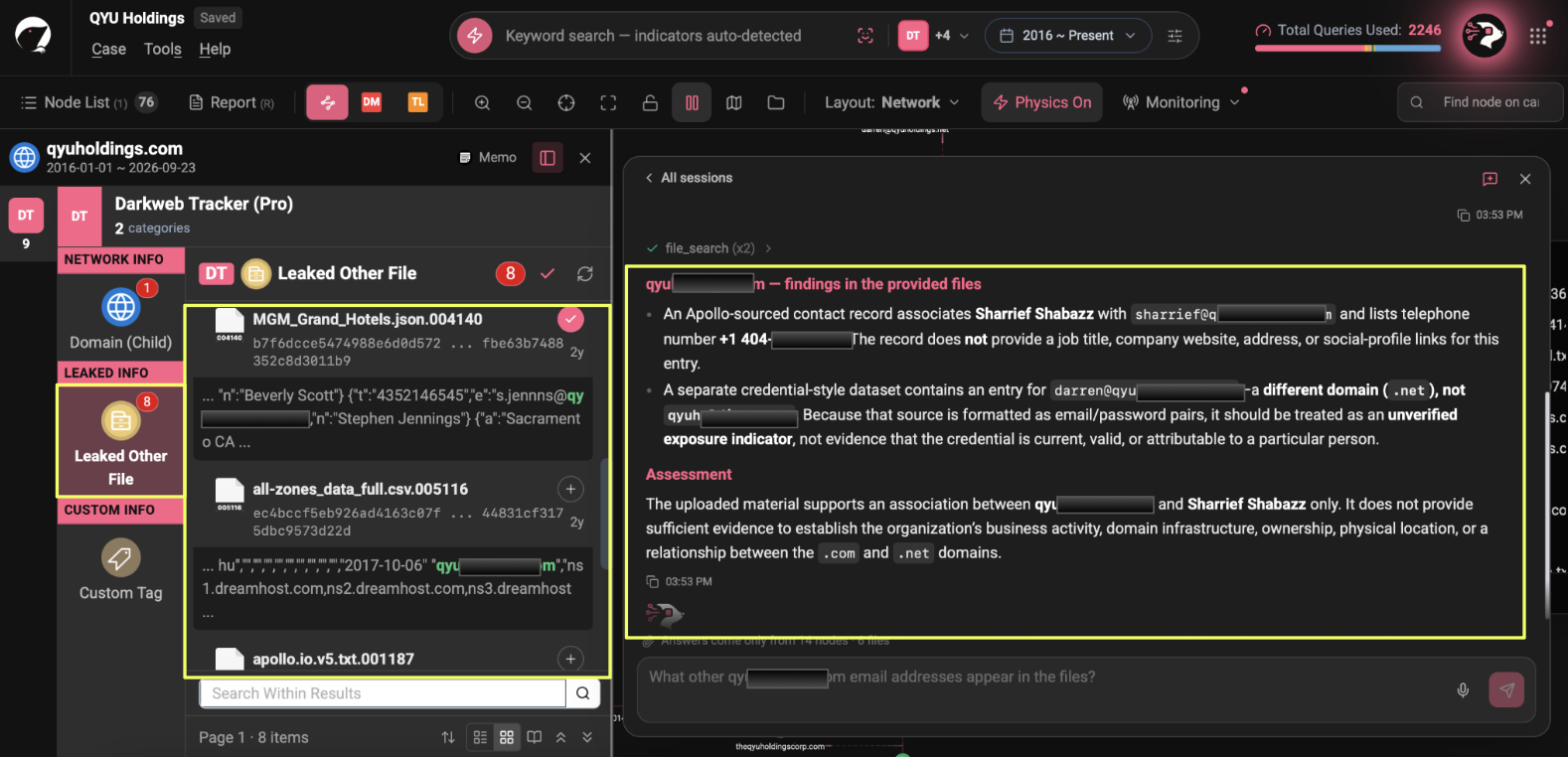
The first name form and the US geography of these records became the anchor for what we call Cluster A, the Jennings figure hard tied to QYU through the mailbox and a SEC filing along with a set of offshore directorships discussed later in this report.
A record in another leak did the same for the third mailbox, resolving sharrief@qyu*****s.com to a full name and adding a phone number:
- sharrief@qyu******s.com, Sharrief Shabazz, +1 (404) 5** 3***1
The 404 area code is Atlanta, which lines up with the FBI's stated suburban Atlanta ties for Robinson rather than cutting against them. The number went into the file as a passive selector.
By the end of this stage, we had three names: Robinson, Jennings and Shabazz, each documented on the QYU mail domain, with Jennings and Shabazz now carrying full names and, for Shabazz, a phone. All three were affiliates on the evidence to hand. Role and any knowledge of the scheme were still unestablished.
The Offshore Layer: Cayman Fund Directorships
Further investigation of Jennings led us to an official register. OffshoreAlert holds Cayman Islands General Registry director details, pulled on 26 June 2023 and cross linked to the Robinson criminal complaint, for a cluster of QYU branded funds. Stephen Jennings appears as a director across them.
The entities on which he is listed:
- QYU Holdings Ltd. (Cayman Islands)
- QYU CI Fund (Cayman Islands)
- QYU Guardian Fund (Cayman Islands)
- Inceptiondx Cayman (Cayman Islands)
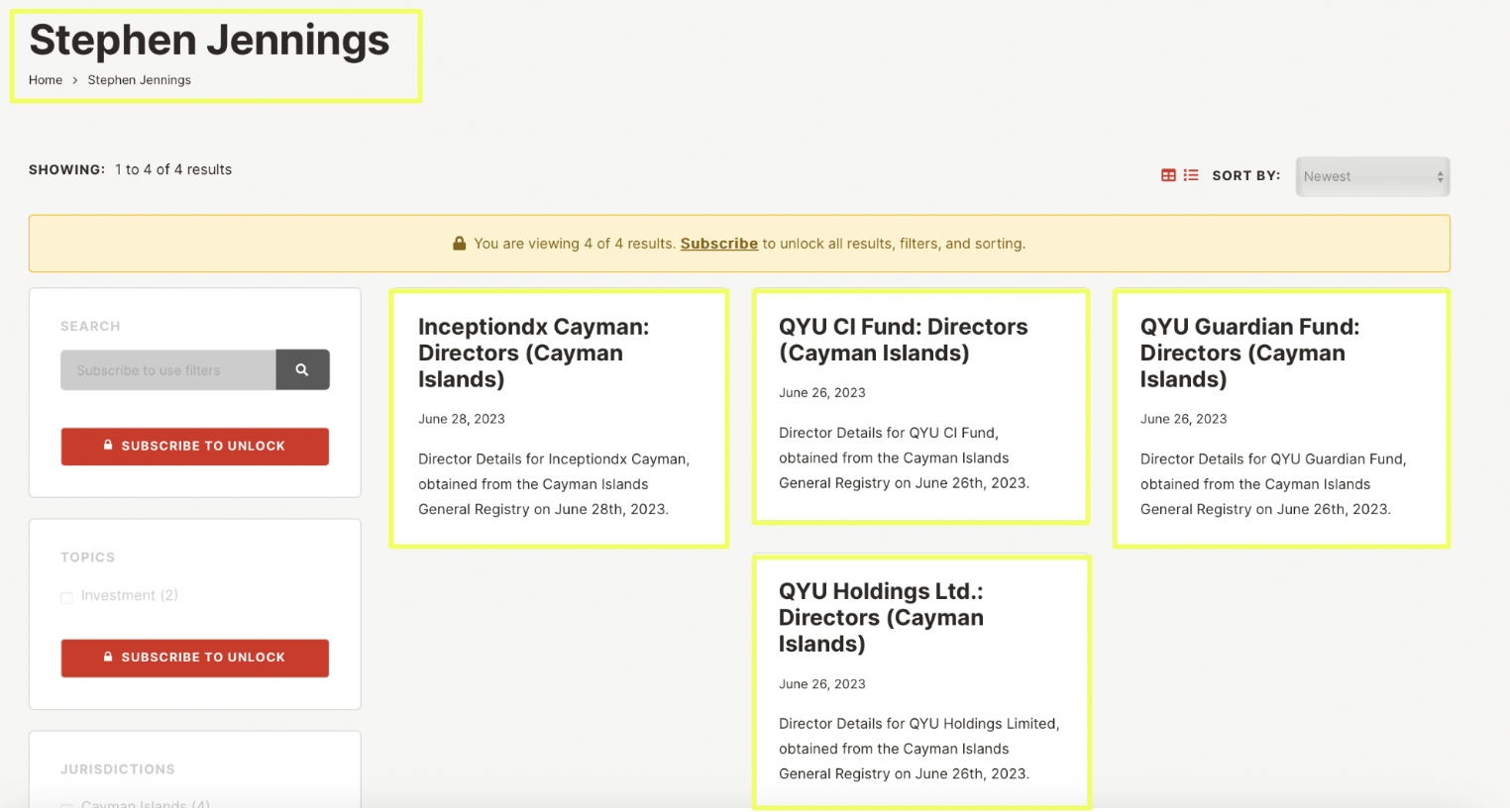
Two things stood out. First, a corporate mailbox on the operating domain, combined with a directorship across the associated funds, is difficult to reconcile with a purely arm’s-length nominee arrangement. More importantly, the two records corroborated each other. Second, the footprint extended across three QYU funds and one additional entity, Inceptiondx, which had almost no public presence beyond the same register. The pattern was consistent with the QYU vehicles and made Inceptiondx a probable sibling entity, worth checking against the QYU funds’ registered office and co-directors.
One caution needs to be kept in mind. OffshoreAlert indexes entities linked to its own reporting and does not represent the full Cayman register. The four listings therefore establish four documented directorships, but they do not show that Jennings held no others. Confirming the full extent of his professional director activity would require checking the CIMA registered directors database rather than relying on OffshoreAlert alone.
A Signature on Record: The SEC Loan
Running Jennings through StealthMole against public filings surfaced the strongest document tying him directly to QYU: an SEC filing signed under penalty. Exhibit 10.14, filed by Predictive Technology Group, Inc., contains a revolving loan agreement between The Qyu Holdings, Inc. and Predictive Technology Group, Inc.
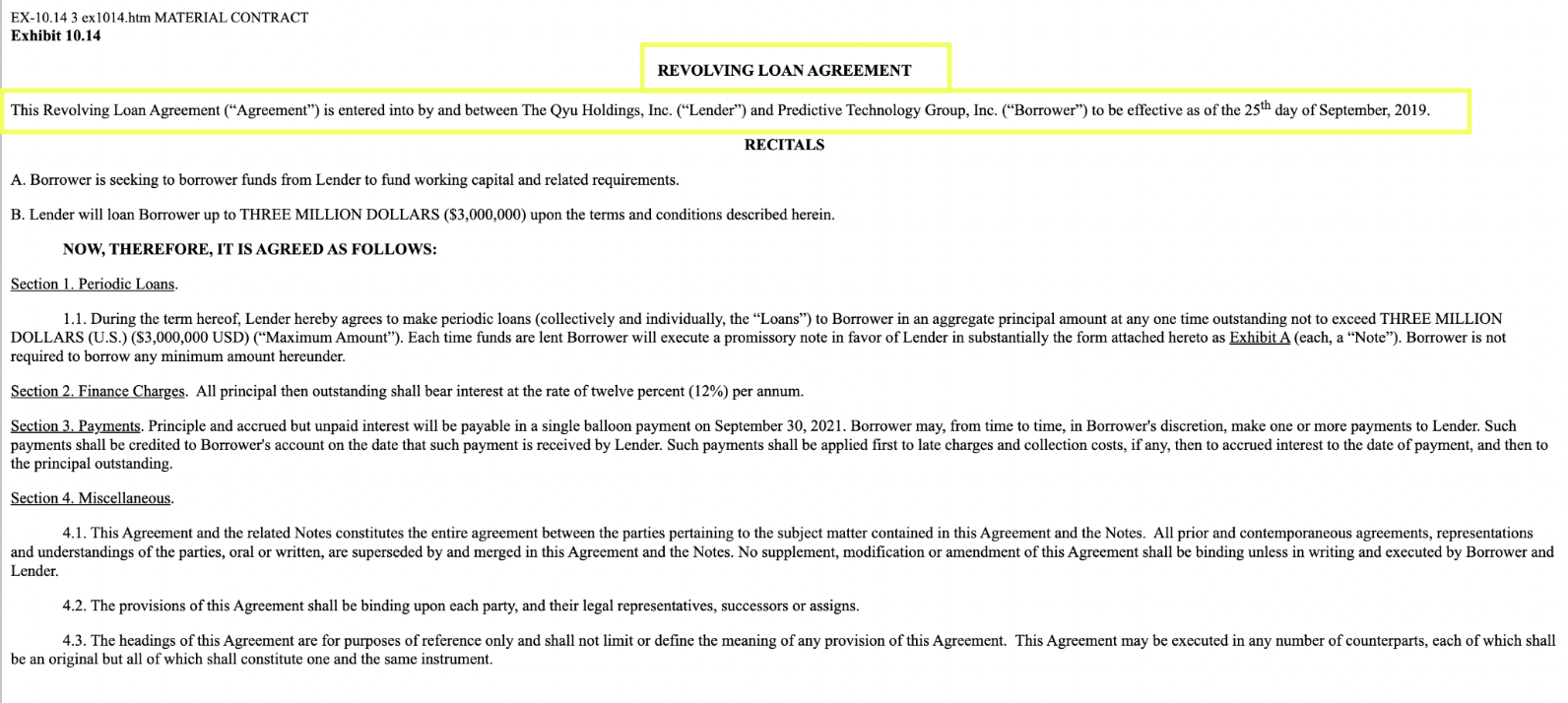
The agreement was effective 25 September 2019 and provided up to $3 million at 12 percent interest, with repayment due on 30 September 2021. The lender's notice address lists Stephen Jennings in Miami, Florida.
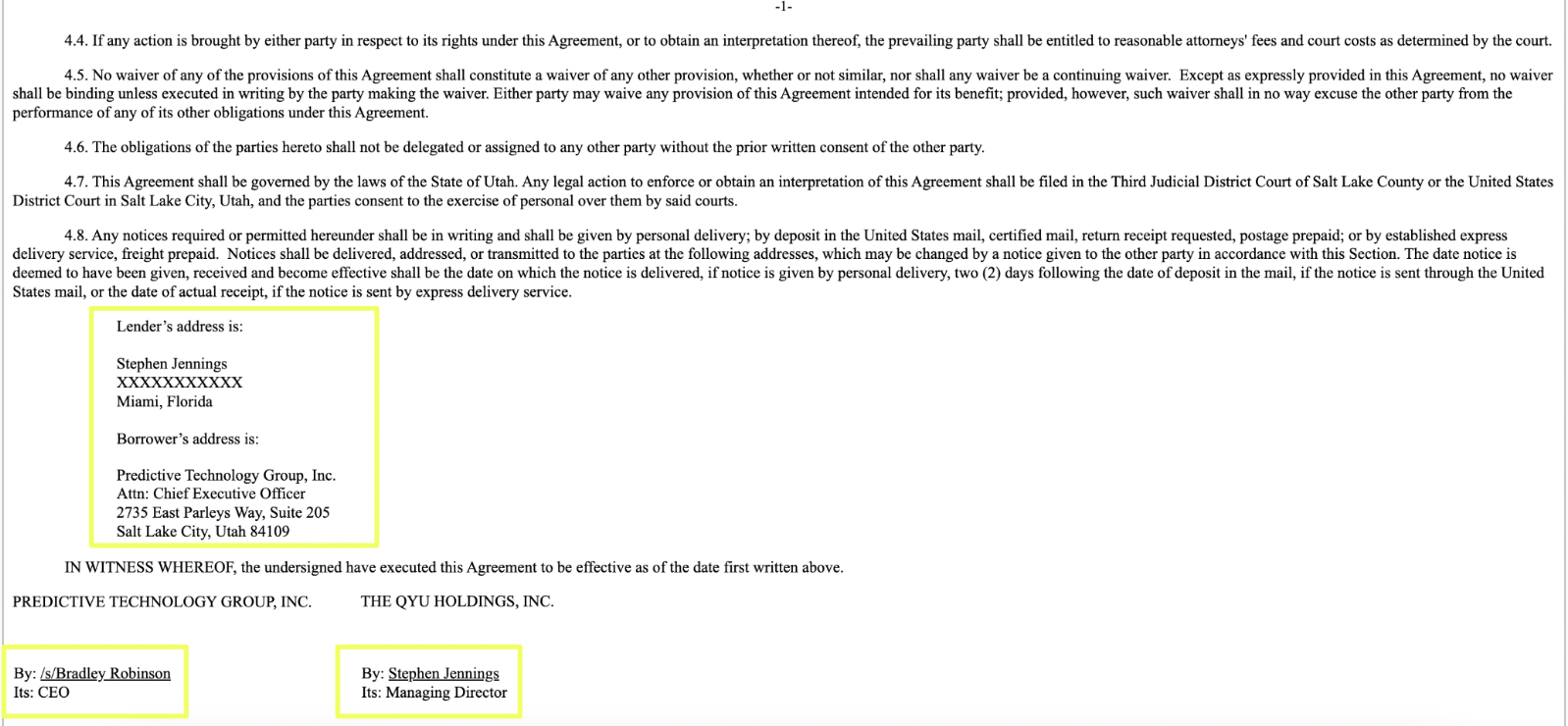
The signature block is the key piece:
- THE QYU HOLDINGS, INC. By: Stephen Jennings, Managing Director
- Predictive Technology Group, Inc. By: Bradley Robinson, CEO
This moved Jennings from a name appearing across QYU-related records to a documented executive of the core QYU entity. The filing also lines up with the QYU mailbox, the Cayman directorships and the LinkedIn profile identifying Jennings as Managing Director at Qyu Technologies in Miami.
The loan opened a second line of investigation. The $3 million went to Predictive Technology Group, a company that was facing SEC scrutiny around the same period and was later the subject of published fraud allegations. The use of QYU funds in that transaction therefore became a separate question, examined further under the Predictive Technology Group section.
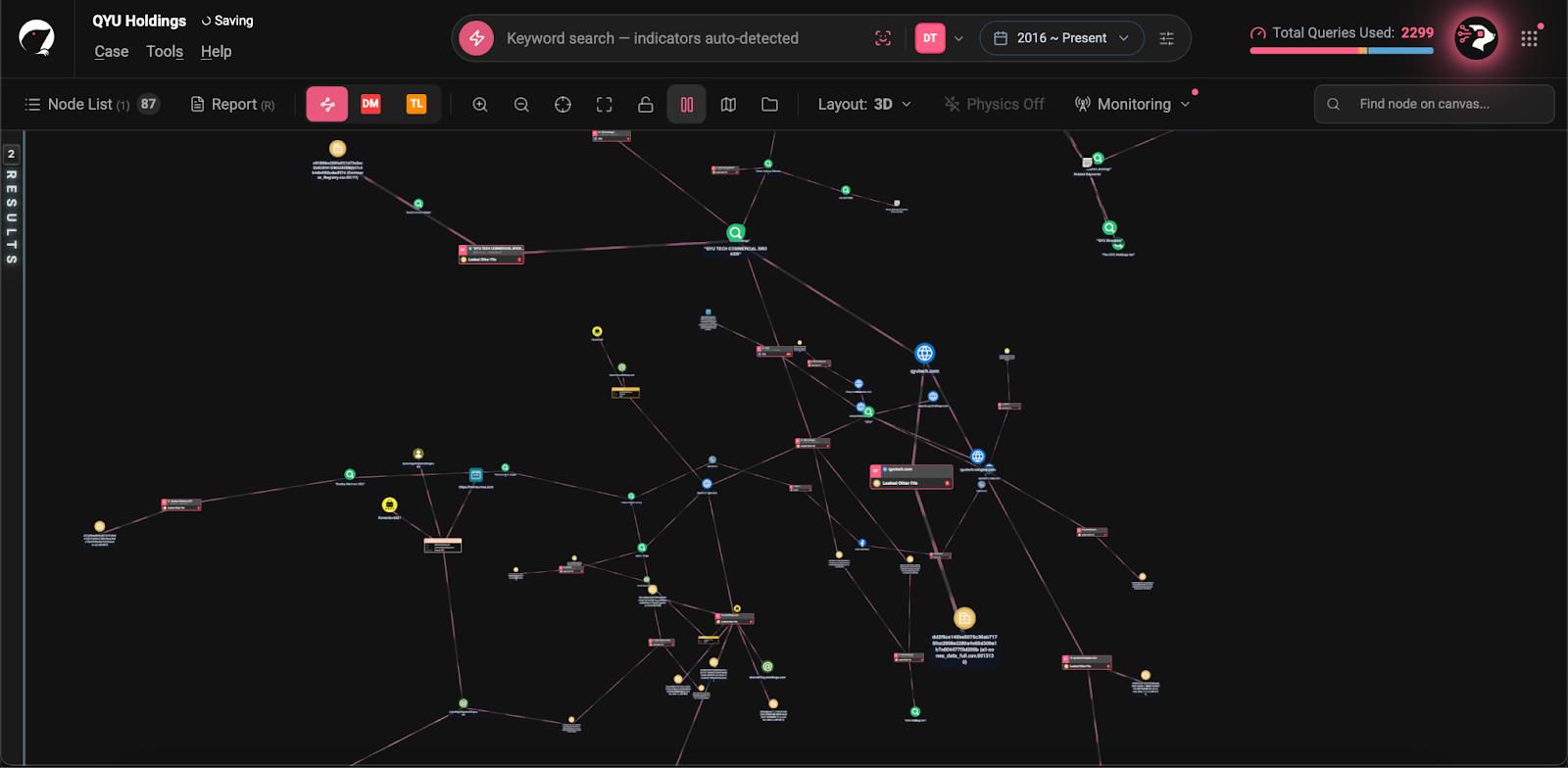
The document establishes Jennings' role at QYU, but not his knowledge of or involvement in the alleged fraud. He does not appear in the charging documents reviewed, and the CFTC's findings identify Robinson as controlling the accounts into which investor funds were diverted.
The Corporate Spine: Florida Filings
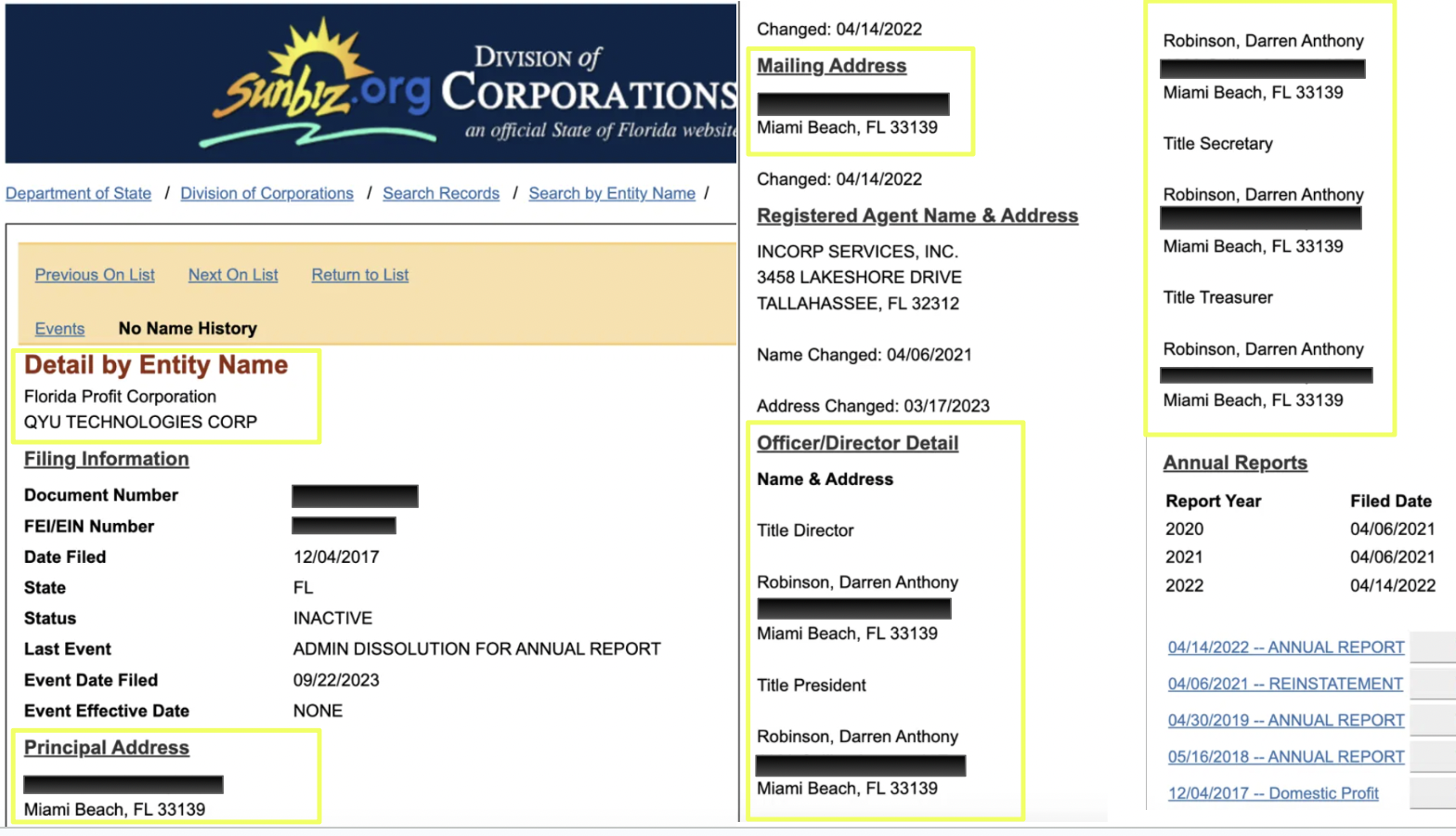
The U.S. corporate structure was also documented through signed Florida Division of Corporations filings. Two QYU-related entities were registered at the same Miami Beach address.
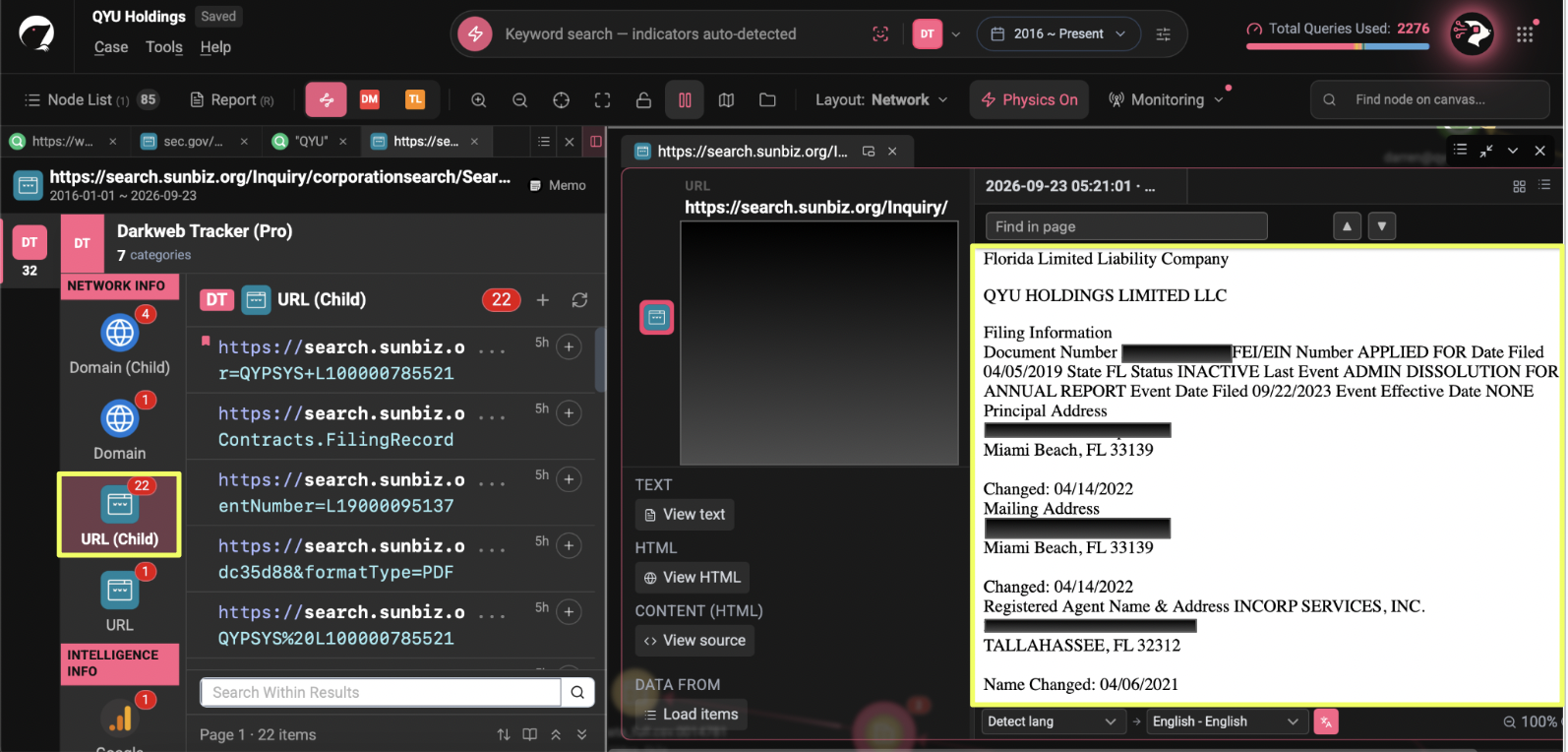
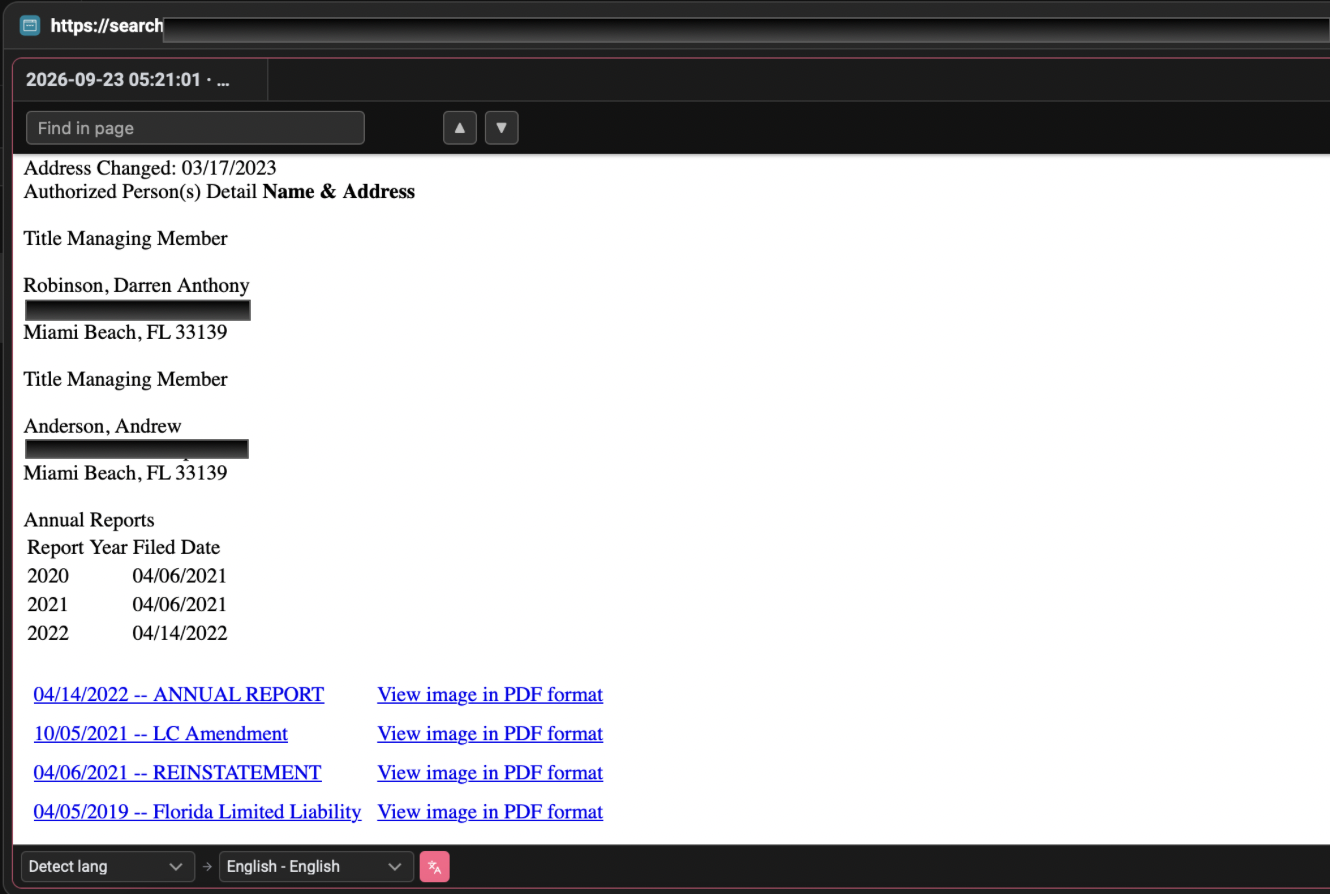
QYU Holdings Limited LLC, document number L19********137, was filed on 5 April 2019 and later administratively dissolved on 22 September 2023. Its principal address was 1*** C***** Ave, Miami Beach, FL 33139, with earlier filings showing Apt 8C. The filing lists Darren Anthony Robinson and Andrew Anderson as authorized persons.
QYU Technologies Corp, document number P17*******659, EIN 83-2*******75, was filed on 4 December 2017 and dissolved on the same date as the LLC. It used the same Miami address. Across the available annual reports, Darren Anthony Robinson is listed as Director, President, Secretary and Treasurer. The articles describe the company's purpose as a "Commodity Trading Advisor", directly connecting the entity to the forex operation.
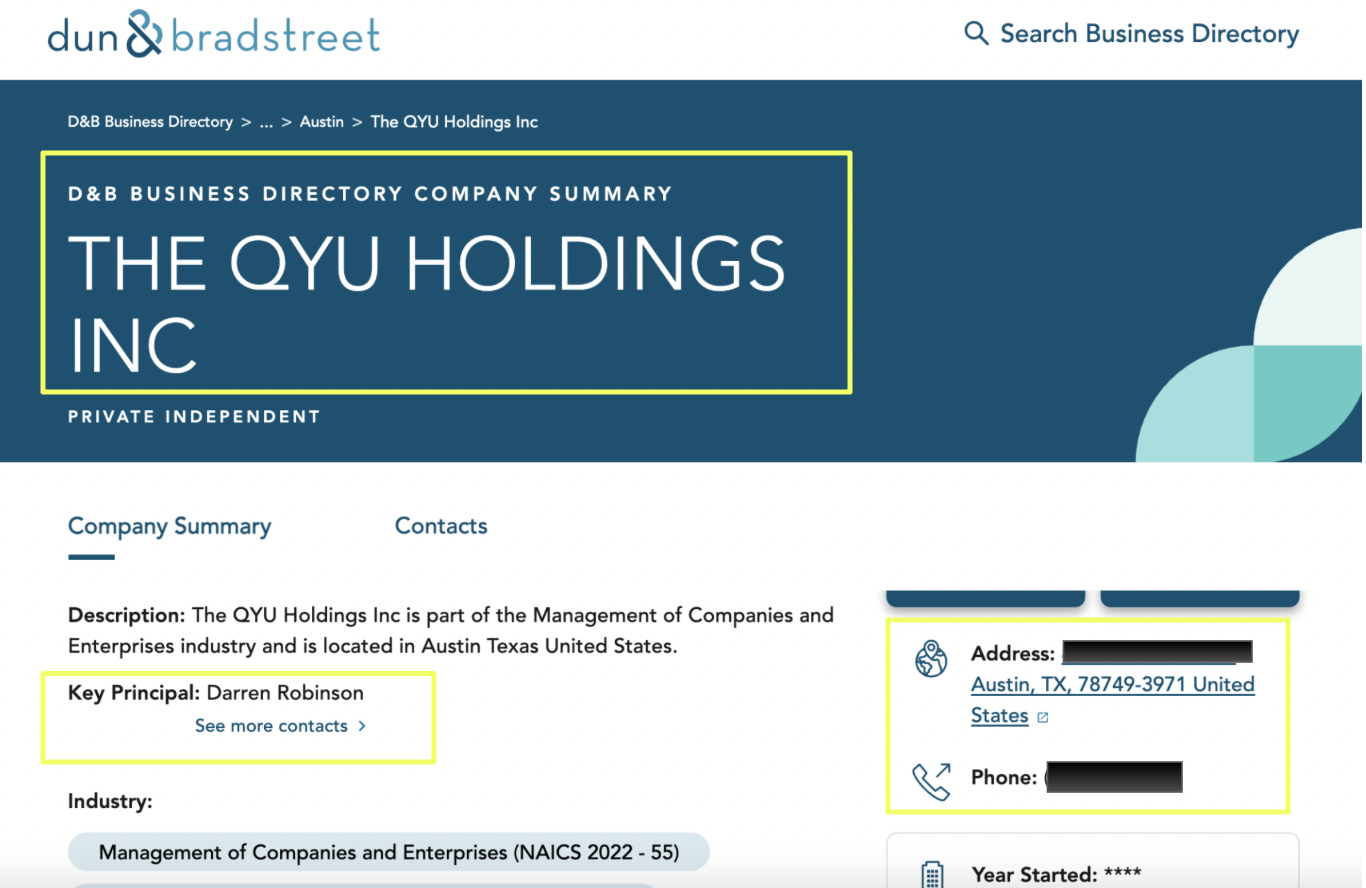
Separately, the charged Wyoming entity, The QYU Holdings Inc., surfaces in Austin, TX. A Dun & Bradstreet company profile lists Darren Robinson as Key Principal at the address and gives a Dallas phone number. A StealthMole leaked file independently records the same address as a QYU registration address. Street View shows the property as a single-family residence rather than a commercial premises.
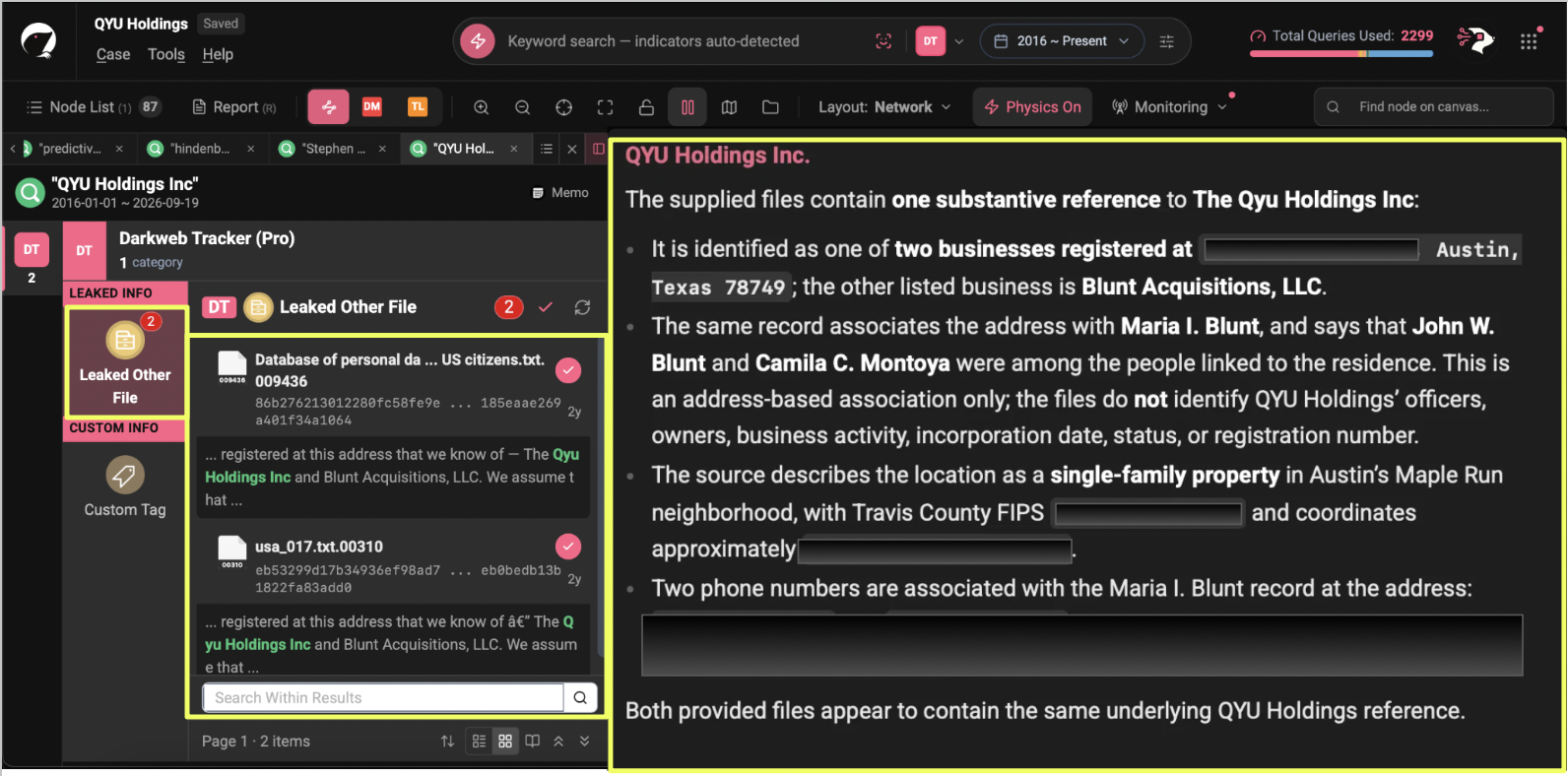
The shared address and dissolution date linked the two Florida entities, with both dissolved on 22 September 2023, the same period as the CFTC complaint and the wider collapse of the scheme. Andrew Anderson also emerged as a new QYU-associated name through the LLC filing.
The physical footprint follows the same pattern. Both the Miami Beach address and the Austin address are residential properties rather than conventional business premises. This is consistent with the QYU entities operating without a clearly identifiable Florida or Texas office.
The Dubai Arm
The FBI's reference to QYU's UAE connections led to a registered entity in Dubai. A company register record lists QYU TECH COMMERCIAL BROKER L.L.C., registration number 941444, established on 15 March 2021 and listed as active.
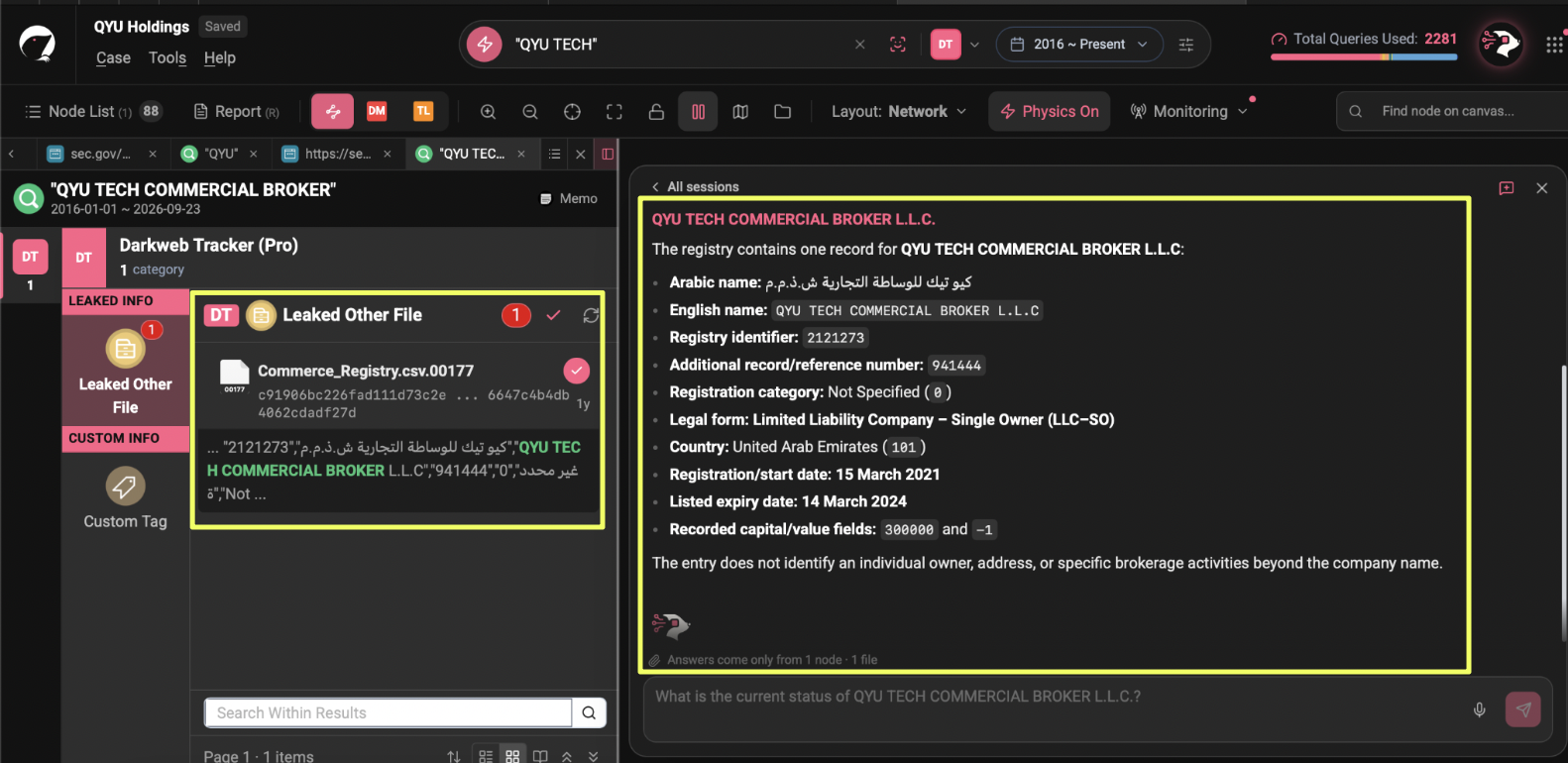
The record provided four selectors:
- Website: qyutechdubai.com
- Email: info@qyutechdubai.com
- Phone: +971 ** 673 0**0
- Address: B*****a Heights, 1***8 Al S******r Tower 1, Dubai
WikiFX also carries a profile for the broker and describes it as unregulated. This was treated as supporting context rather than a regulatory finding, since WikiFX is an aggregator rather than a regulator. The profile did, however, provide a useful link. It describes the Dubai broker as running a "Qyu Technologies CTA" platform on MT4.
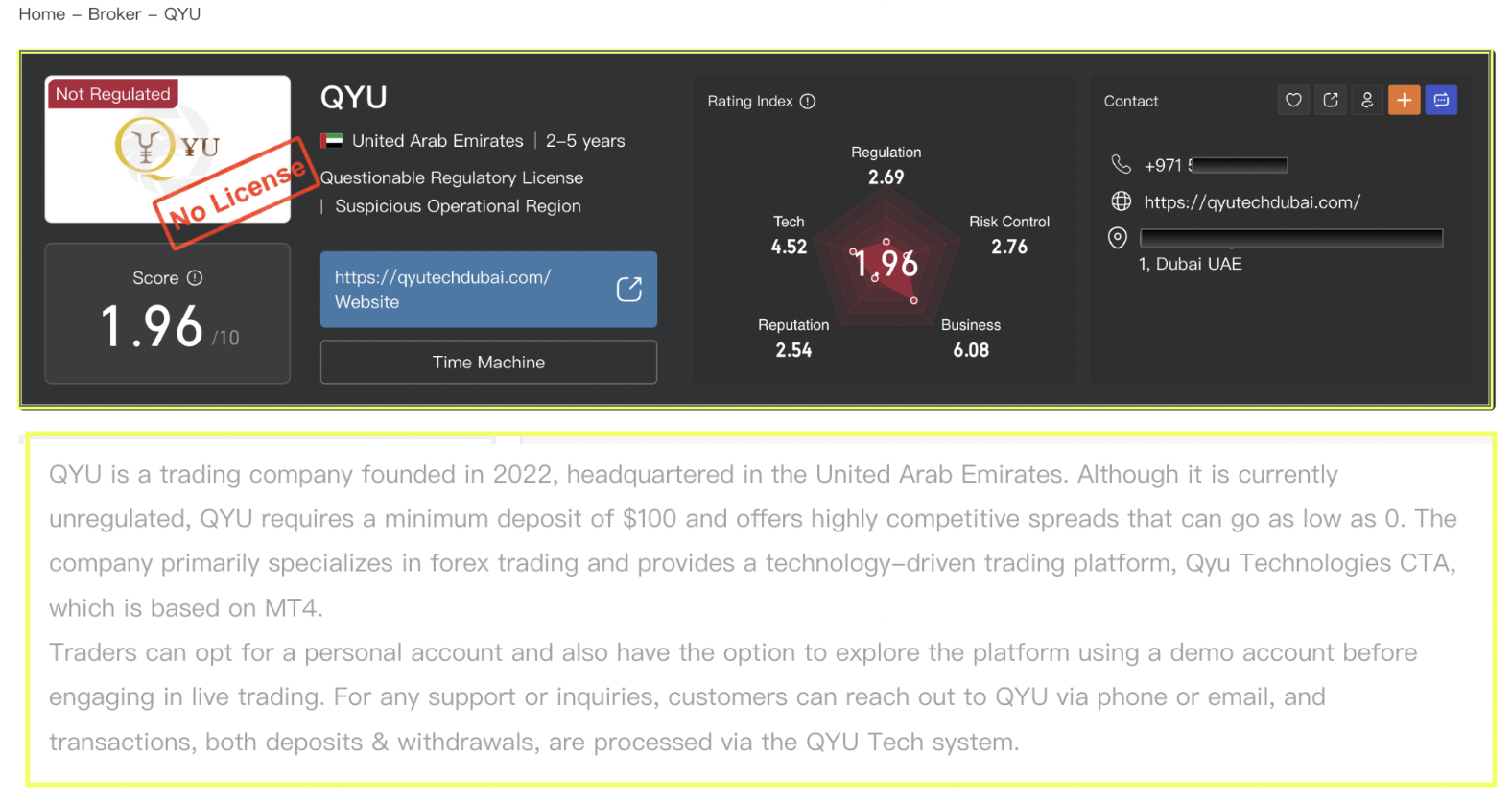
That description connected back to the U.S. side. QYU Technologies Corp's SunBiz filing lists its corporate purpose as "Commodity Trading Advisor", while the Miami-facing Qyu Technologies profile describes a CTA model where trades are executed through the client's brokerage account using MT4. The Dubai entity was therefore not just using the QYU name. Its advertised product pointed back to the same Qyu Technologies CTA model documented in the U.S.
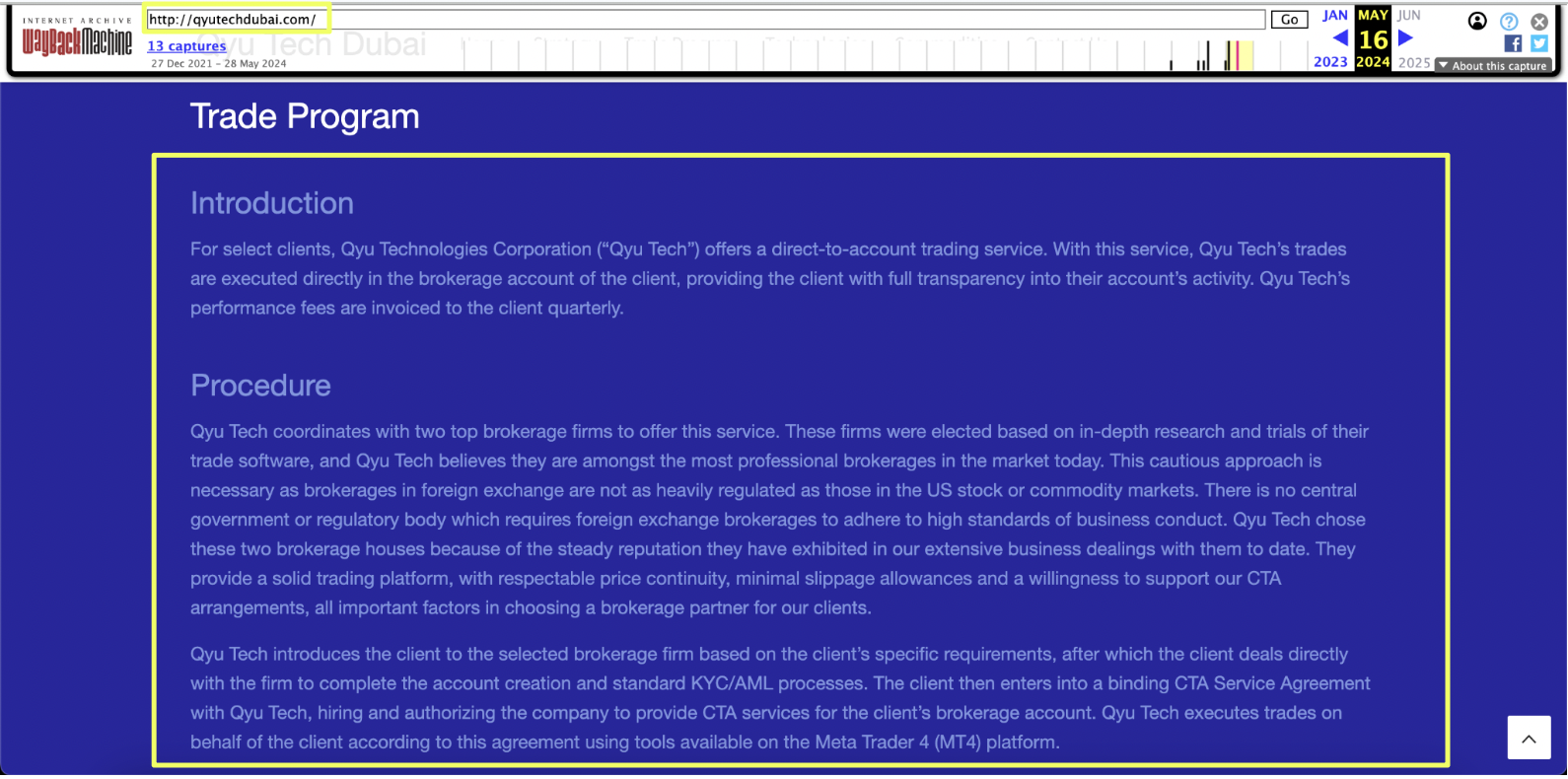
QYU Tech Dubai - 16 May 2024
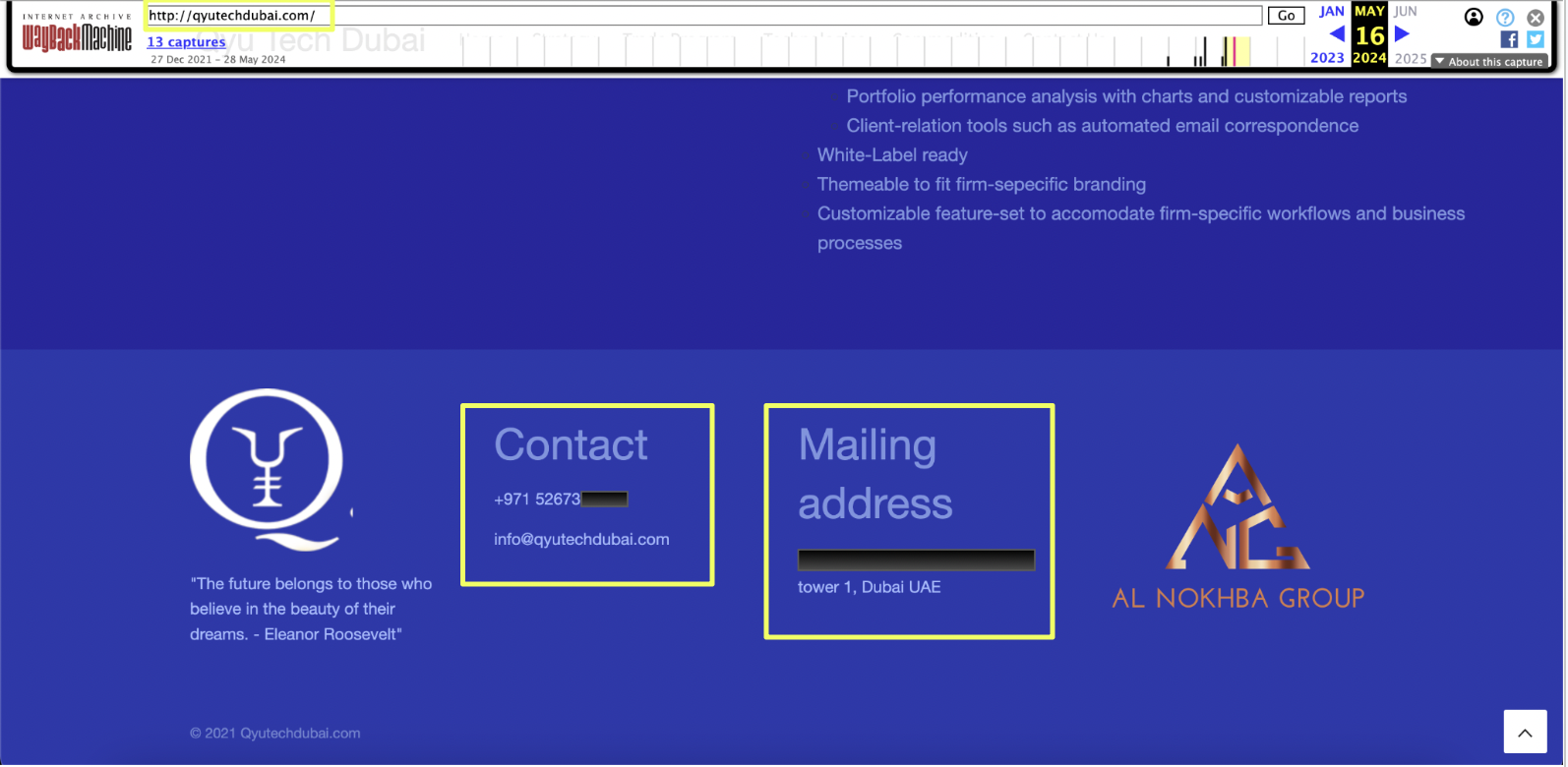
QYU Tech Dubai Contact & Address - 16 May 2024
The branding provided another link. The Miami entity uses qyutech.com, while the Dubai company uses qyutechdubai.com. The shared qyutech root is consistent with the Dubai entity being a geographic extension of the same brand rather than an unrelated company using the QYU name.
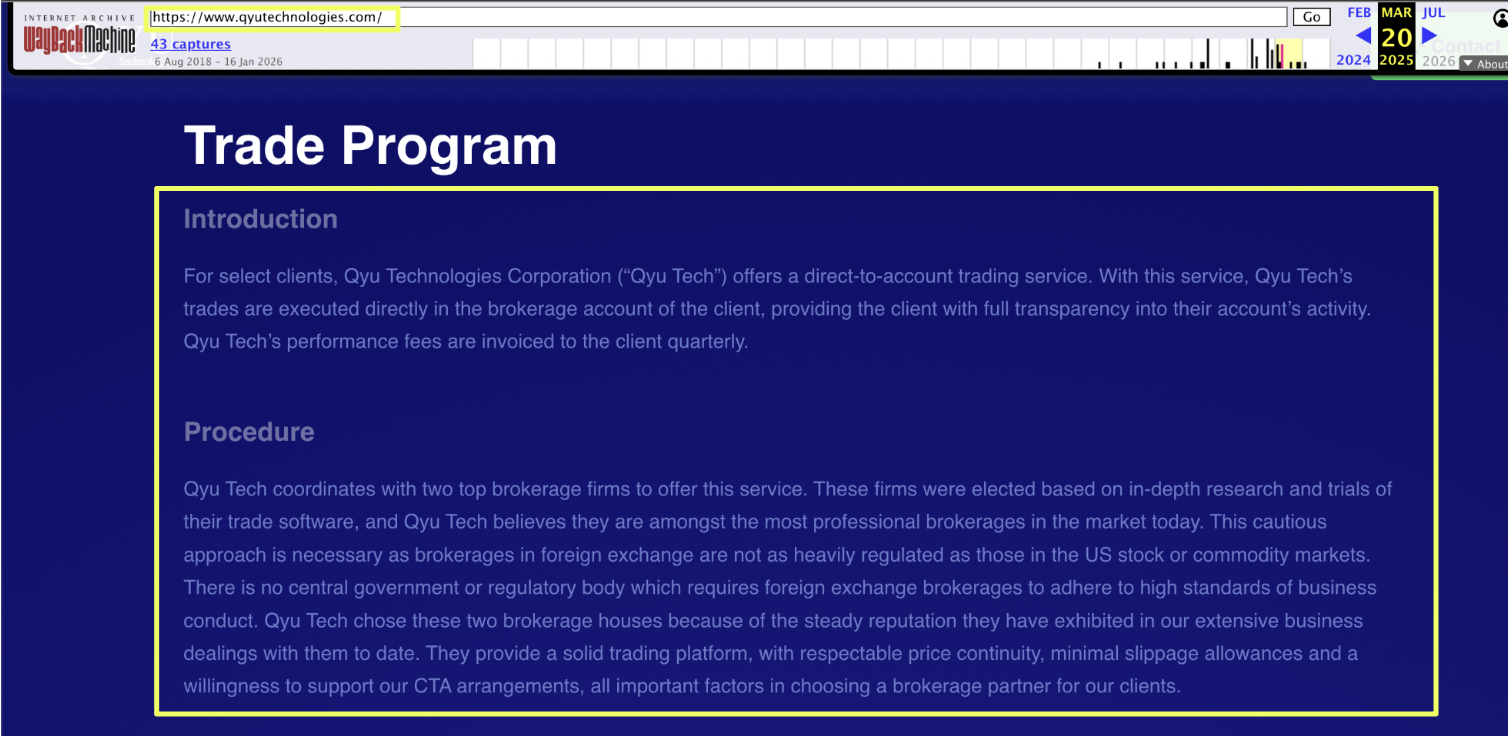
QYU Technologies - 20 March 2025
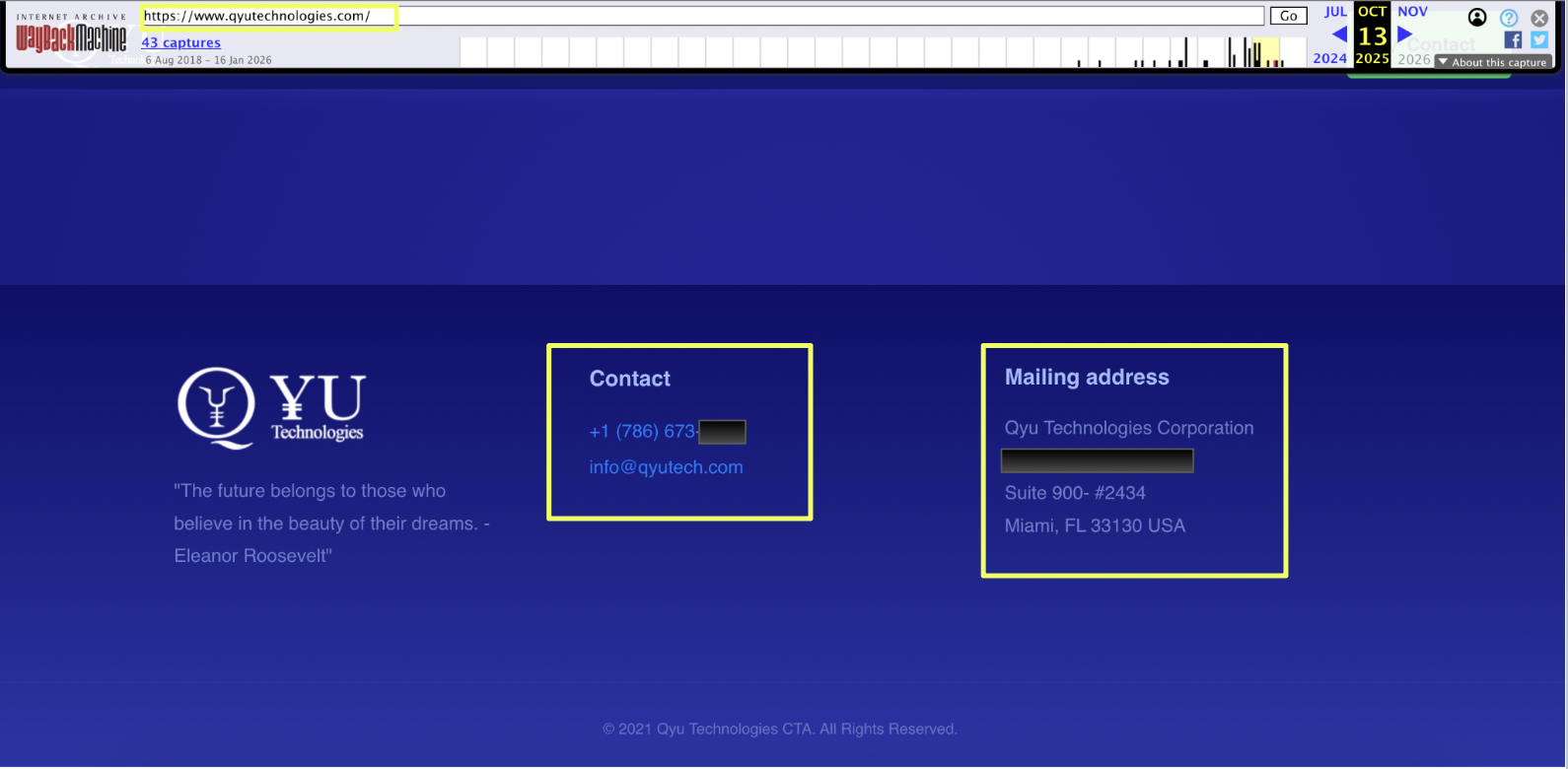
QYU Technologies Contact & Address - 13 October 2025
There is also a person-level connection. Stephen Jennings is documented as Managing Director of The Qyu Holdings Inc. in the SEC loan and separately identifies himself as Managing Director of Qyu Technologies in Miami. That is the same Qyu Technologies entity whose CTA model is referenced in the Dubai broker profile.

The Dubai registration therefore added more than another jurisdiction to the QYU footprint. Taken together with the CTA description, shared qyutech branding and Jennings' documented role, it connected the Dubai broker to a specific U.S. entity through the product it advertised.
The Predictive Technology Group Connection
The QYU loan led directly to Predictive Technology Group (PTG) and its CEO, Bradley C. Robinson. The SEC filing identifies Robinson as the person who signed the agreement on behalf of PTG.
The relationship was supported by two additional public records. An SEC Division of Corporation Finance comment letter dated 17 May 2019 addressed Robinson as CEO and raised questions around PTG's consolidation policy, variable interest entities and Juneau ownership figures. A later Hindenburg Research report also examined PTG and its management and alleged fraud.
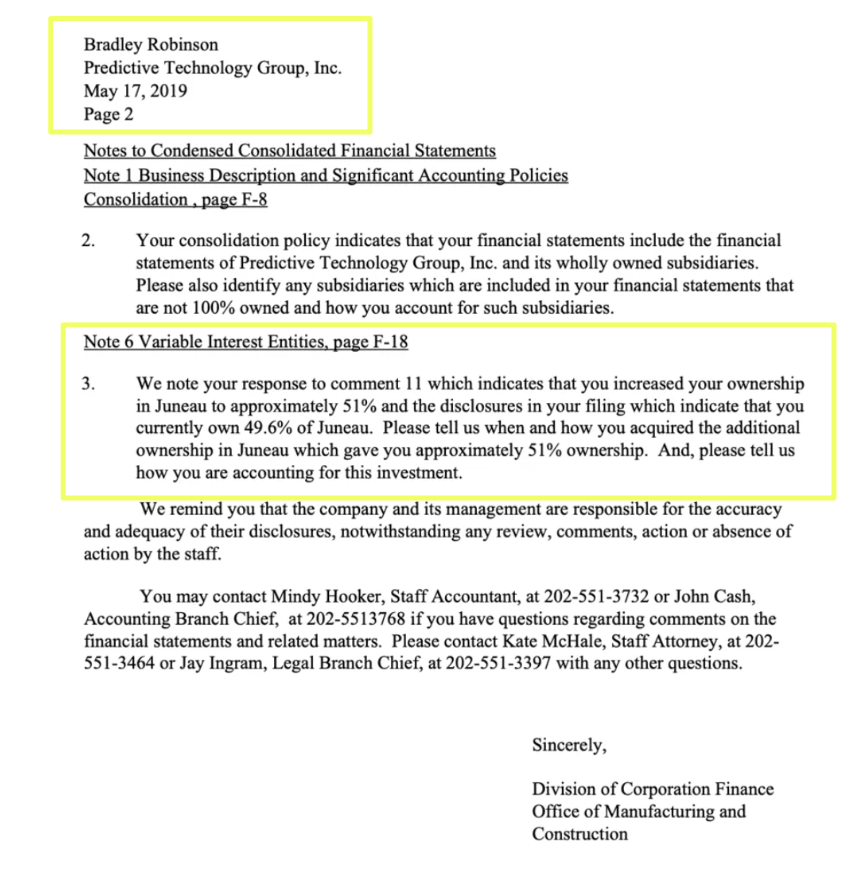
PTG's own 10-K references the QYU loan. This makes the $3 million transaction a documented financial link between the two entities and provides a clear record to follow through the company's related-party disclosures.
Leads Documented but Excluded
Several records surfaced during the investigation but could not be tied to the QYU individuals with enough confidence to include them in the assessment.
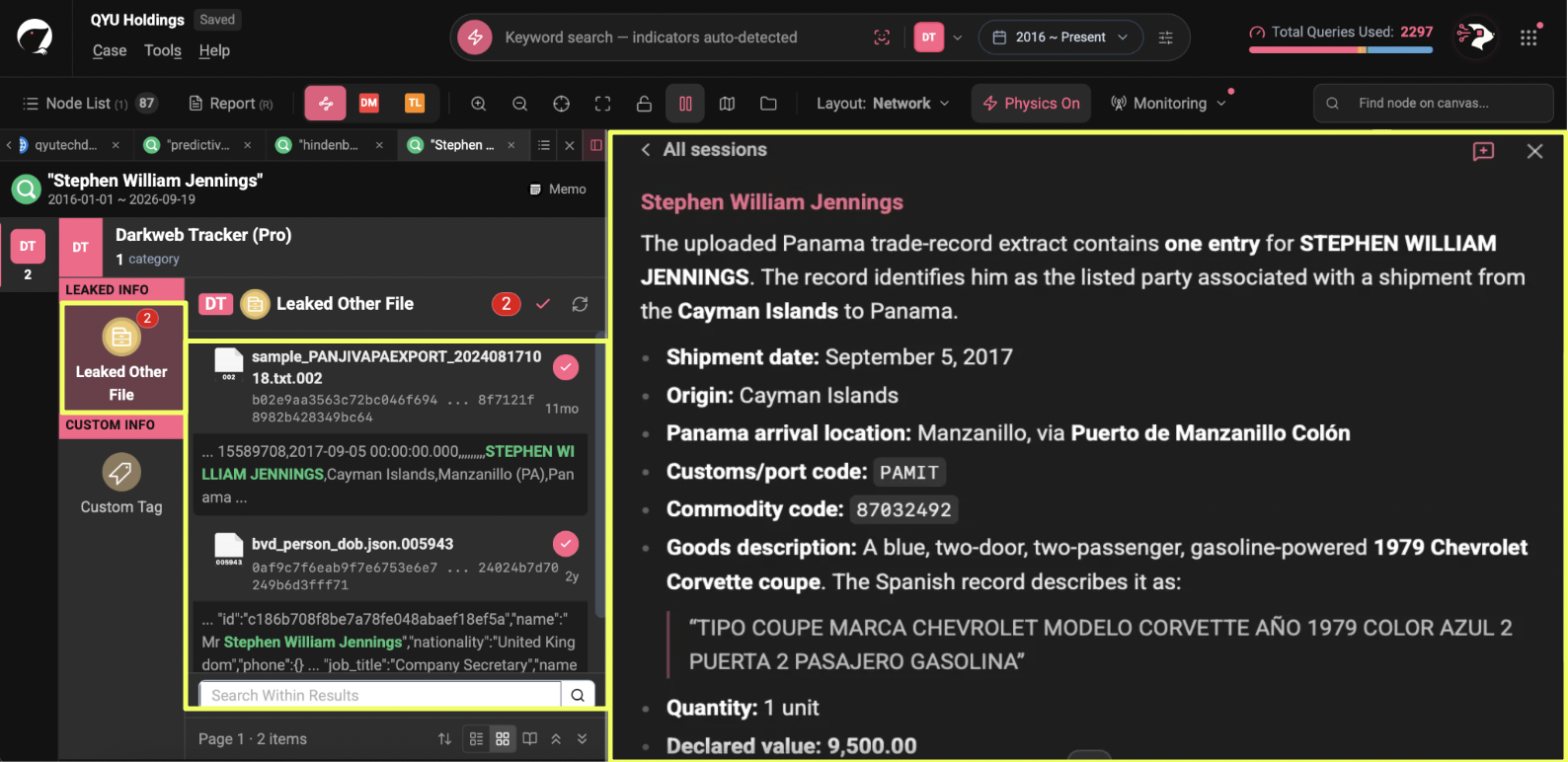
One such lead was the name Stephen William Jennings. StealthMole returned a Bureau van Dijk record identifying a UK national and Company Secretary, a Panjiva record involving a 1979 Chevrolet Corvette shipped from Cayman to Panama, and a Dun & Bradstreet record connected to an Ontario company. The records shared the name and some of the same geography as the QYU Jennings, but no hard selector connected them to the Miami-based individual. They were therefore kept as a separate candidate identity. The idea of a Canadian branch was not supported by the available evidence.
Assessment: Entities and People
The findings are grouped by the strength of the evidence. Tier 1 covers individuals who were charged. Tier 2 covers documented affiliations or roles where the person's involvement or knowledge has not been established and no charges have been brought. Items marked as open are unresolved identity or relationship questions. Items marked as excluded are covered in the previous section, along with the reasons they were not included.
Entities
Entity Name | Jurisdiction | Identifier / Reg # | Documented Officers | Status / Role |
The QYU Holdings Inc. (QYUHI) | Wyoming, USA | 2013-0*******08 | Darren Robinson | The charged forex pool entity |
QYU Holdings Limited LLC | Florida, USA | L19******137 | Darren Robinson, Andrew Anderson | Dissolved 2023 |
QYU Technologies Corp | Florida, USA | P17******659, EIN 83-2****075 | Darren Robinson (sole) | Purpose "Commodity Trading Advisor"; dissolved 2023 |
QYU Holdings Ltd, CI Fund, Guardian Fund | Cayman Islands | Cayman registry | Stephen Jennings, Eric Robinson (Guardian) | Offshore funds |
Inceptiondx Cayman | Cayman Islands | Cayman registry | Stephen Jennings | Probable sibling entity, to resolve |
QYU Tech Commercial Broker LLC | UAE (Dubai) | 94****4 | Not resolved | Active; flagged unregulated (WikiFX) |
QYU Holdings Corporation | Panama | Not on file | Not resolved | Offshore arm |
People
Name | Hardest evidence | Status |
Darren Anthony Robinson | Federal indictment; CFTC default judgment; signed Florida filings | Tier 1, charged (allegations pending) |
Stephen Jennings | SEC Exhibit 10.14 signed as Managing Director of The Qyu Holdings Inc; Cayman directorships; QYU mailbox; self reported LinkedIn MD | Tier 2, documented senior officer; role and knowledge not established; not charged |
Andrew Anderson | Signed Florida filing (Treasurer, 2021); Managing Member, QYU Holdings Limited LLC | Tier 2, state filed co officer; role and knowledge not established; not charged |
Sharrief Shabazz | QYU mailbox; phone +1 404 5********1 | Tier 2, affiliated; role and knowledge not established; not charged |
Dwight A. Foster, K.E.L. Enterprises | Named in CFTC v. Foster (feeder pool) | Charged in separate civil action |
Eric Robinson | Tagged on QYU Guardian Fund directors; separately named as Bradley Robinson's brother at PTG | Open, same person question unresolved |
Bradley C. Robinson | PTG CEO (SEC letter, bio); signed PTG side of the QYU loan | Documented PTG executive; no established QYU fraud role; not a QYU officer |
"Stephen William Jennings" (BvD, Panjiva, D&B Ontario) | Name and partial geography match to Cluster A | Open, not confirmed same individual |
Conclusion
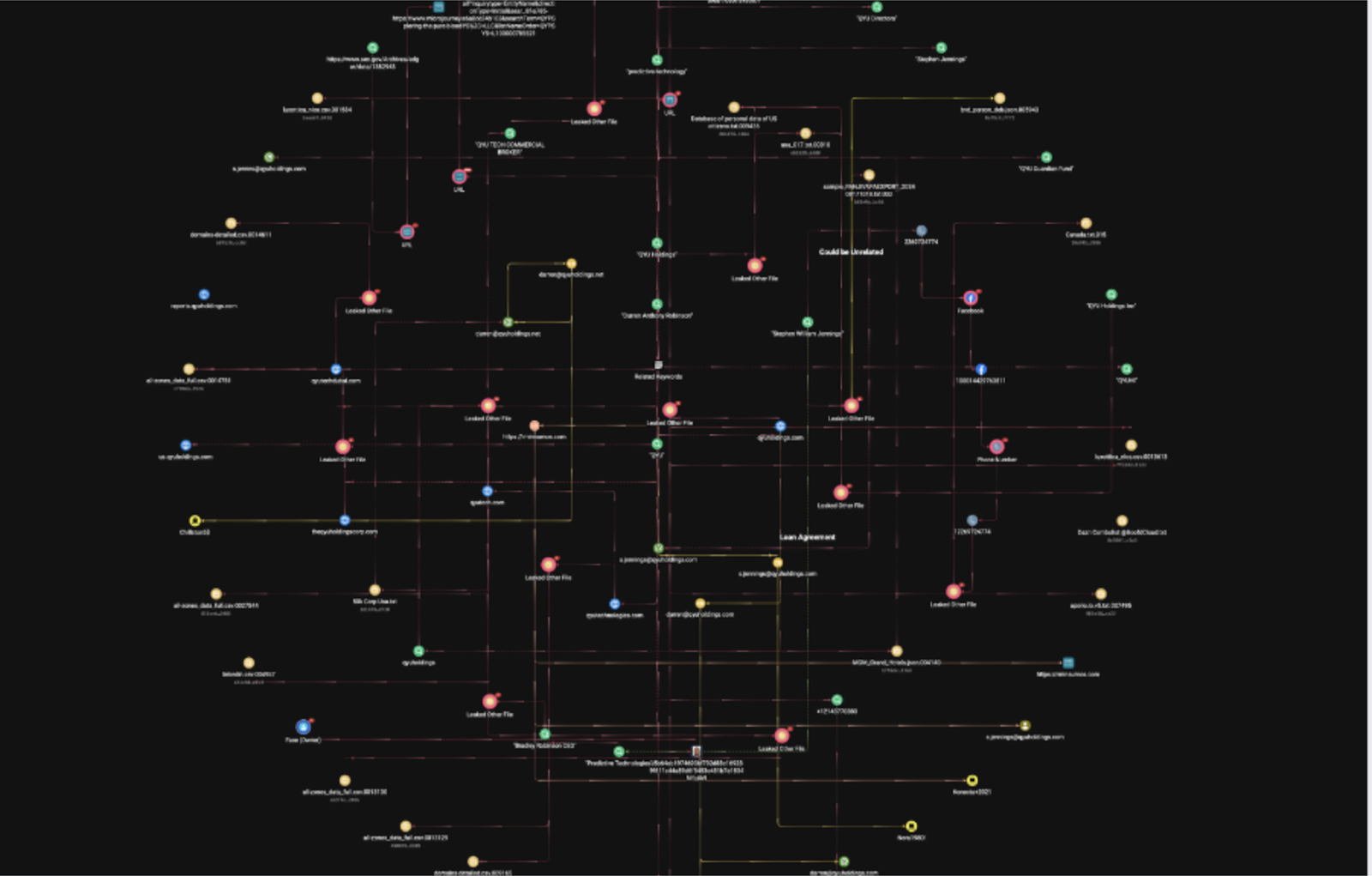
The investigation started with a single name on a wanted poster and gradually built into a wider QYU network across five jurisdictions. StealthMole's Darkweb Tracker first mapped the related domains and identities. Combo Binder surfaced the mailboxes, while leaked file records reviewed through MoleChat helped connect those mailboxes to real names. From there, each selector opened another part of the structure: offshore records showed the fund directorships, an SEC filing put Stephen Jennings' signature and Managing Director title on The QYU Holdings Inc., Florida filings documented the U.S. entities, and a UAE registration provided a hard corporate record for the Dubai operation.
The strength of the case came from how these records connected. Credential data, offshore registers, SEC filings, state records and the UAE registration repeatedly pointed back to the same QYU branding, addresses and small group of names. No single record showed the full picture, but taken together they provided a much clearer view of how the network was structured.
At the same time, the investigation did not establish more than the records could support. Darren Robinson is the individual charged in the case. Stephen Jennings, Andrew Anderson and Sharrief Shabazz are documented in QYU-related roles, but their knowledge of or involvement in the alleged fraud was not established in the material reviewed. The Eric Robinson and Stephen William Jennings identity questions remain open, while the Blunt and Montoya address link and the registered agent staff were excluded.
The QYU operation therefore did not resolve through one decisive record. It came together by following the same names, domains, mailboxes, addresses and corporate records across different sources and keeping confirmed links separate from leads that could not be verified. That process is what turned a single name into a documented, multi-jurisdiction picture of the network.
Editorial Note
Dark web and fraud investigations rarely produce a clean attribution from the start. Names can overlap, records can be incomplete, and a shared mailbox or address does not automatically establish a person's role or knowledge. In this case, StealthMole helped move the investigation from surface-level identifiers to deeper records across credentials, infrastructure, registries and corporate filings, while allowing weaker leads to be separated from the findings that could be supported.
To access the unmasked report or full details, please reach out to us separately.
Contact us: support@stealthmole.com
Labels: Featured, Fraud Platform


