Blueprint of a Dark Web Cash Factory: Mapping the Old New Money Operation
Old New Money presents itself as a straightforward cash vendor on the dark web, offering only two products: a minimalist interface, and a single contact point. Yet behind that simplicity lies a structure far more elaborate than what appears on the surface. The marketplace projects an image of long-standing reliability while promising access to untraceable bills, creating a brand identity that relies heavily on confidence and perceived longevity.
What makes this platform notable is not merely the products it advertises, but the ecosystem that surrounds it. StealthMole’s dark web intelligence tools surfaced a dense trail of replicated Tor mirrors, recurring infrastructure patterns, and overlapping cryptocurrency indicators that reveal a vendor actively shaping its persistence strategy. These elements give the operation a sense of scale and continuity that contradicts its modest presentation.
This report explores the platform’s public-facing design, its deeper infrastructure signals, and the operational habits that emerge when these pieces are examined together. Each section builds on verifiable evidence gathered through StealthMole, outlining how Old New Money maintains visibility, protects its workflows, and positions itself within the broader counterfeit economy.
Incident Trigger & Initial Investigation
The investigation began when StealthMole’s dark web tracker surfaced an active Tor service advertising the name Old New Money. At first glance, the site appeared unassuming: a simple landing page promising access to pre-shred and counterfeit currency. Its uncluttered structure made it easy to overlook, yet the fact that it was active, coherent, and fully accessible made it a candidate worth examining more closely.
- 3gczh************************************************cbid.onion
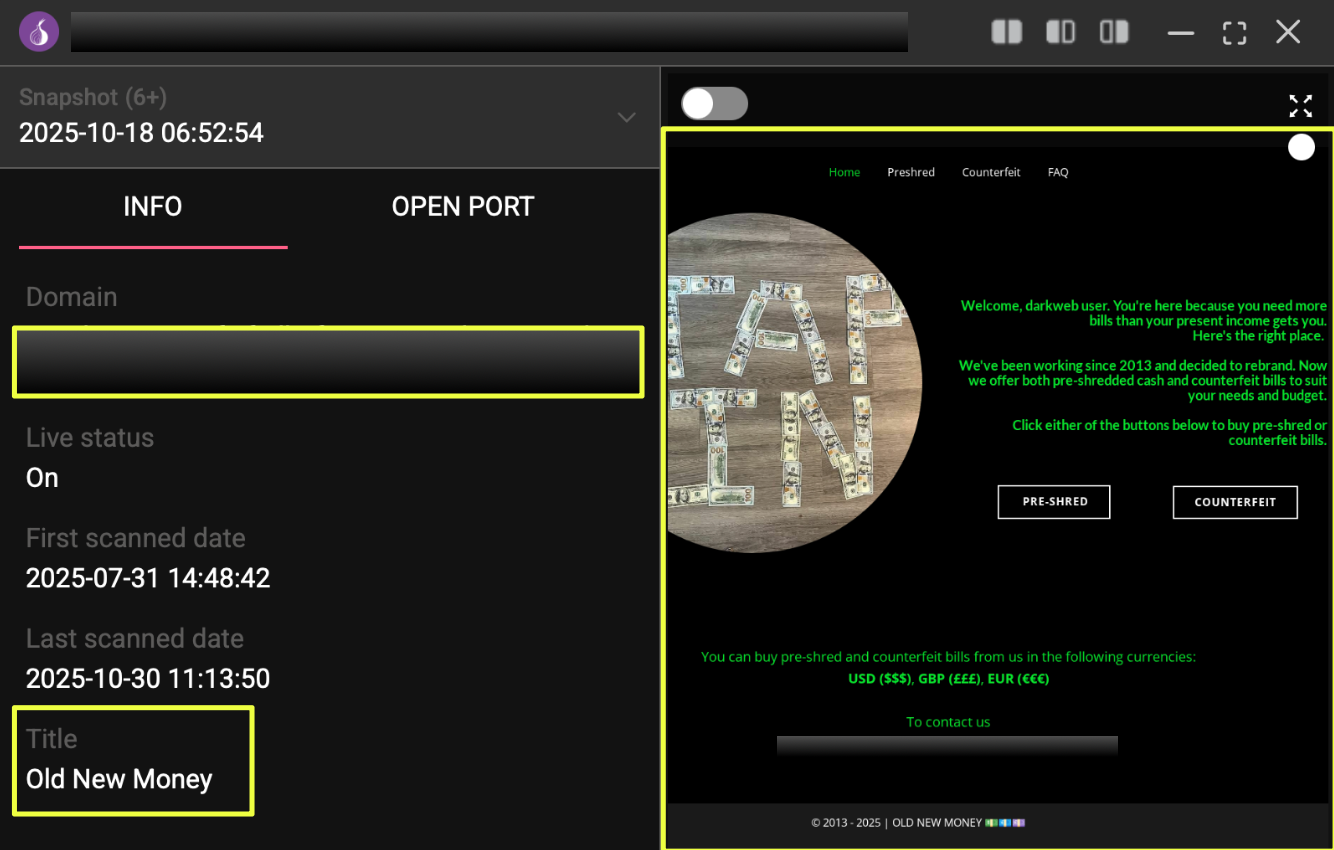
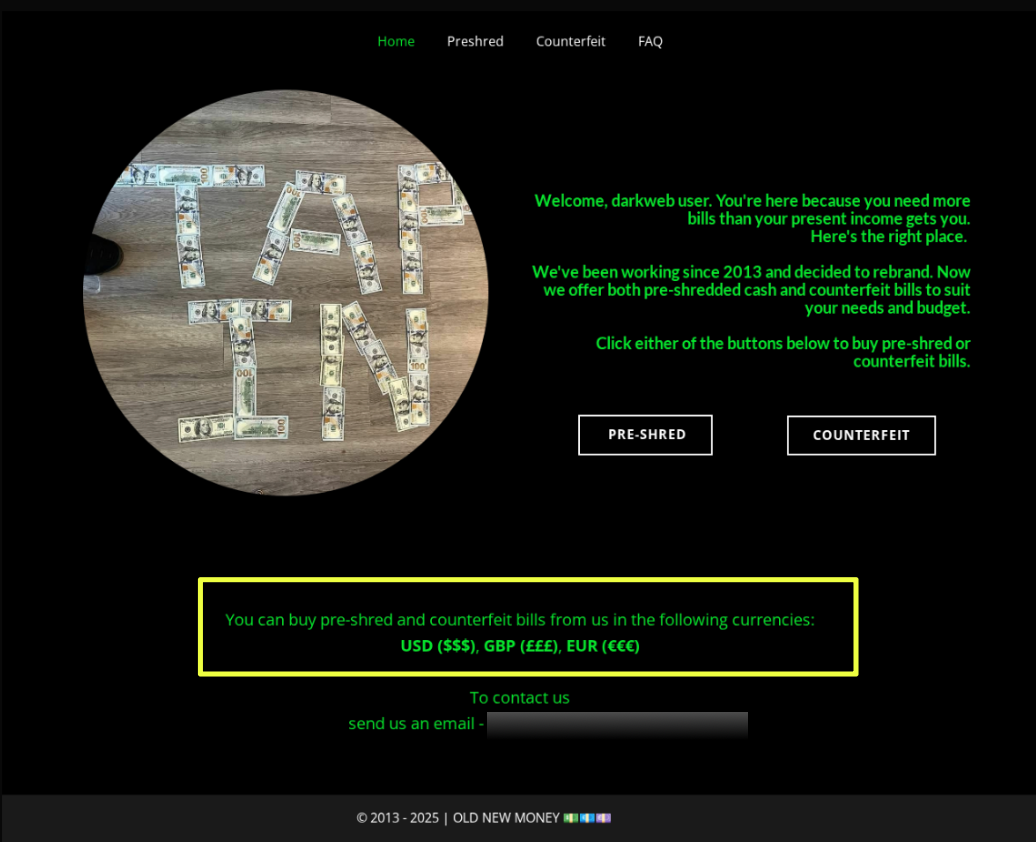
Exploring the site revealed that its simplicity was deliberate rather than accidental. Each product category led to neatly arranged pages with consistent design, fixed pricing, and a scripted order flow that left almost no extraneous detail visible. What stood out was not what the site showed, but what it didn’t: no payment addresses, no account system, and no technical clues exposed on the surface. The absence of operational detail suggested that the visible pages represented only one layer of the platform.
Using StealthMole, the initial Tor address led to the identification of a broader ecosystem of related services. Numerous mirror domains active between 2023 and 2025 reproduced the same structure and content, indicating deliberate replication rather than incidental duplication. This expansion provided the first indication that the platform’s footprint extended well beyond a single service, steering the investigation toward the vendor’s infrastructure patterns, payment traces, and the clustering of digital artifacts linked to the operation.
Platform Structure & Public-Facing Content
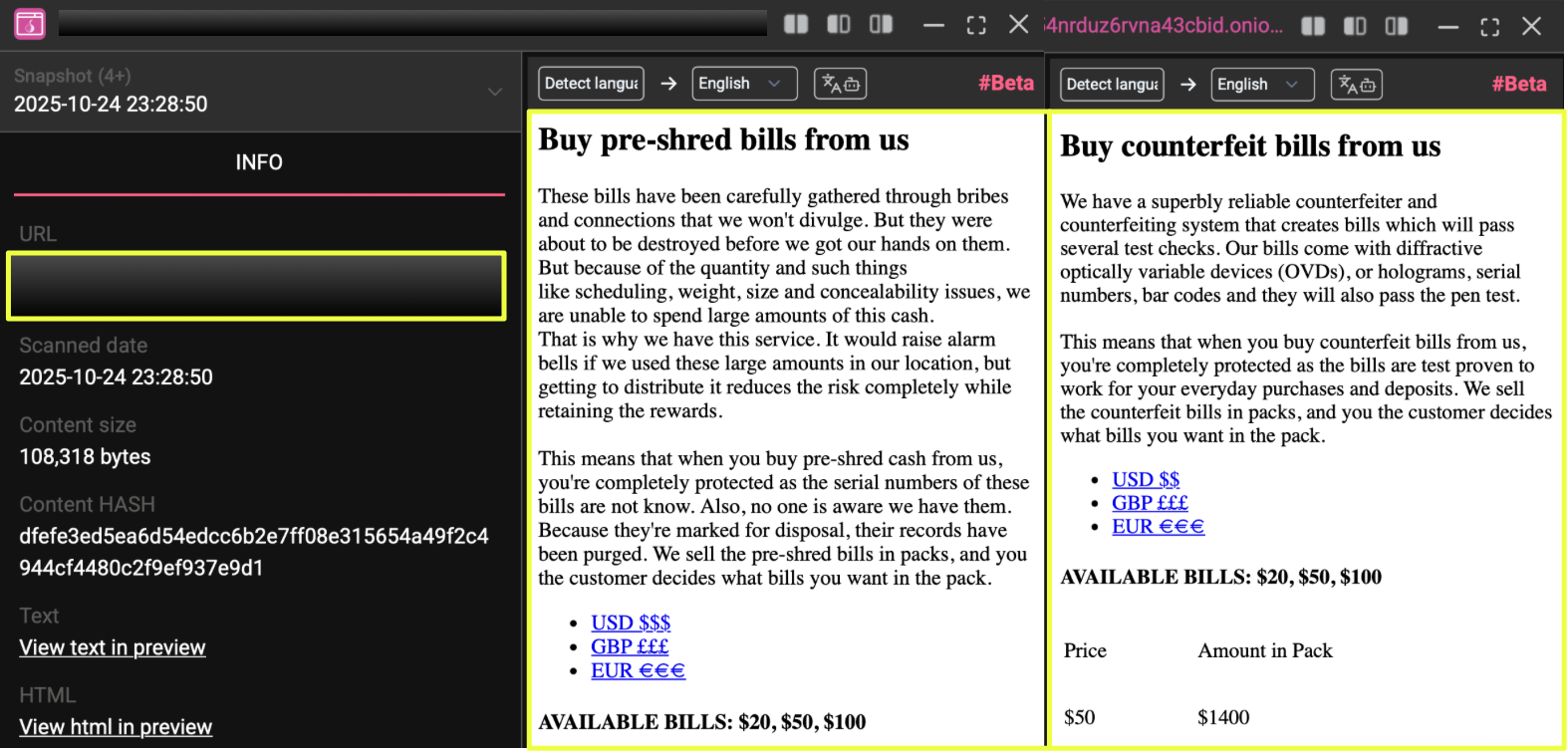
Old New Money website revealed a layout that was far more organized than its sparse landing page suggested. The marketplace is built around two clearly separated product categories: pre-shred currency and counterfeit bills, each presented with preset bundles, fixed denominations, and standardized pricing across USD, GBP, and EUR. The design offers no variations, upsells, or hidden menus, reinforcing the platform’s intention to appear stable and predictable to potential buyers.
Each product page follows the same rhythm: a short justification for the offering, a list of available note sizes, and a pricing table that remains identical from one currency to the next. Delivery options, too, mirror one another with flat-rate tiers and defined timelines, giving the impression of a vendor that wants its processes to feel routine. This consistency aligns with the platform’s broader attempt to project reliability, even though none of the claims can be externally verified.
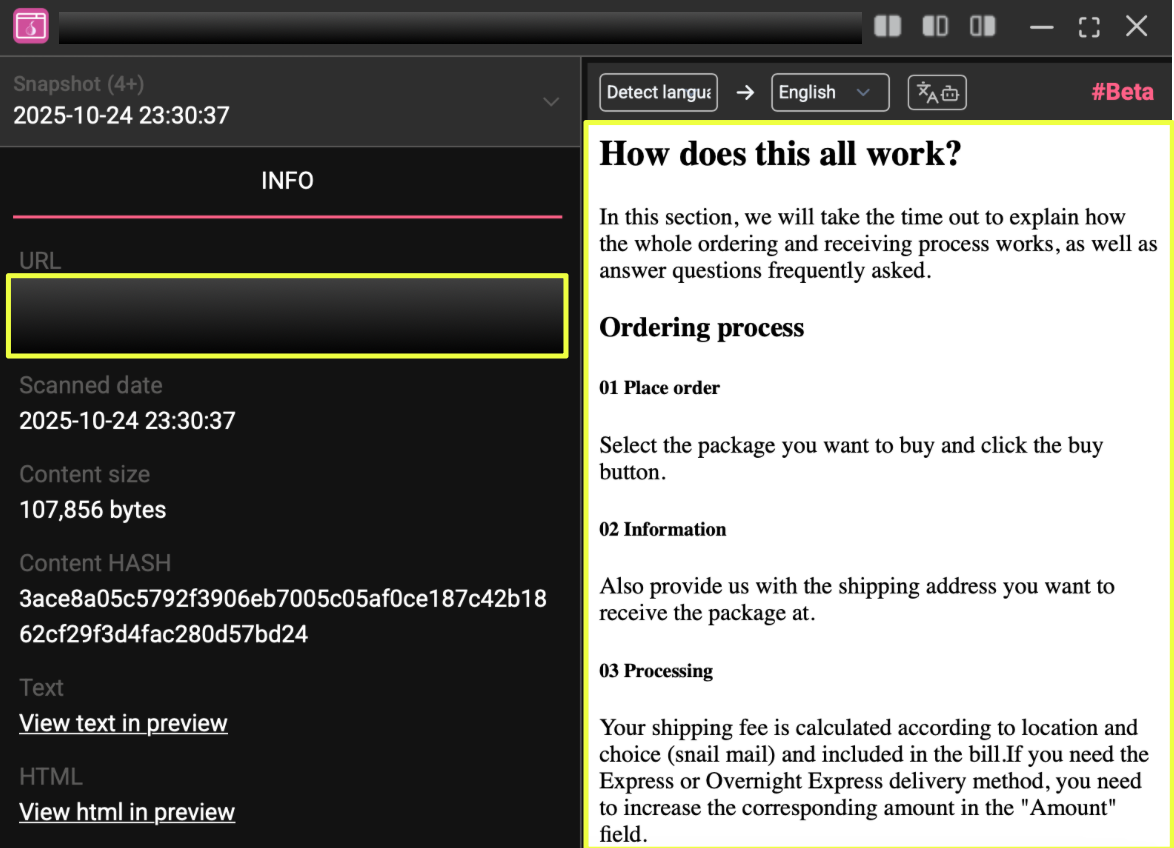
A separate FAQ and order-flow section rounds out the customer-facing side of the marketplace. Here, the operator outlines a step-by-step purchasing sequence, from selecting a package to receiving a shipment disguised within everyday postal materials. Notably, even in this instructional space, the platform avoids revealing operational details: no cryptocurrency addresses, no transaction history, and no technical markers appear anywhere on these static pages. The result is a curated environment that discloses only what is necessary to move a buyer toward the payment stage, while withholding the mechanisms that keep the marketplace running behind the scenes.
Infrastructure & Mirror Network
As analysis moved beyond the site’s surface, the surrounding infrastructure revealed far more about Old New Money’s operational habits than its minimal interface initially suggested. Pivoting from the primary domain led StealthMole to a wide constellation of Tor mirrors that reproduced the marketplace exactly. These mirrors were not scraped fragments or partial replicas; each one preserved the same layout, pricing, workflow, and even the same single point of contact: Ol*******y@firemail.cc. Its presence across the ecosystem became one of the strongest identifiers linking the domains together.
- 3gczh***********************************************cbid.onion
Among the many mirrors active between 2023 and 2025, several remained accessible and fully functional, including:
- countx***********************************************hvyd.onion
- 2e4ks***********************************************mdad.onion
- 7ncow***********************************************wyad.onion
- aciz************************************************rdqd.onion
- eb6b7***********************************************zpqd.onion
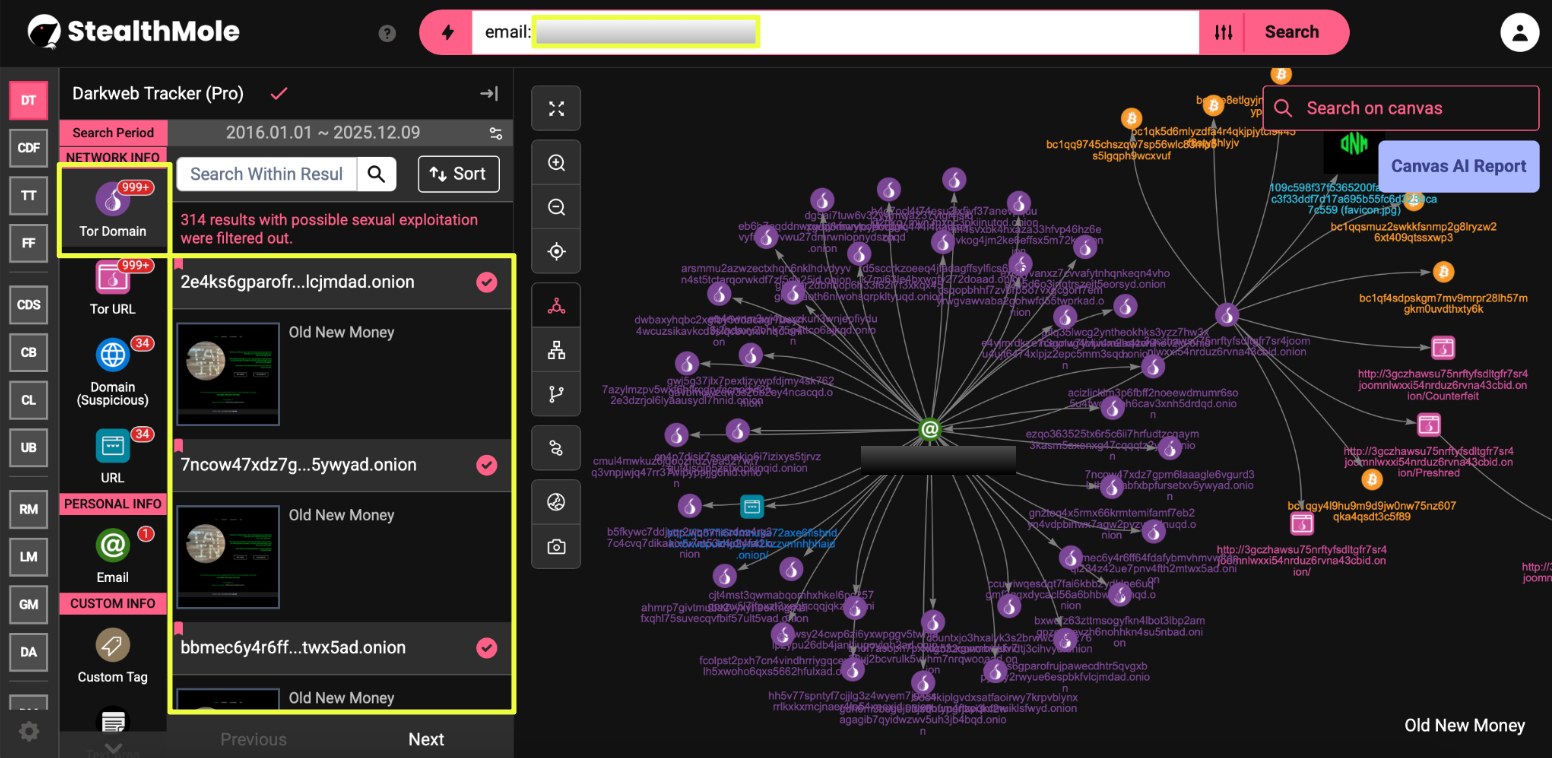
All mirrored not just the visual structure but the same communication channel, reinforcing that this network is operator-driven rather than the result of independent cloning. The uniformity across pages and branding indicates a deliberate replication strategy meant to preserve continuity as individual addresses inevitably drop offline.
A separate pivot from one of the detected Bitcoin addresses, bc1******************e56, surfaced another active domain:
- lxu7*************************************6cad.onion
This domain contained a cluster of nine cryptocurrency addresses, including overlaps with wallets observed earlier. While this alone does not confirm direct linkage, the recurrence of shared indicators across both email- and wallet-based pivots shows how tightly connected the operation’s digital artifacts are within the dark web landscape.
- bc1qnvwsj6gc9j6yzxea6tmv0pxl86pf8e2r7a27sn
- bc1qf4sdpskgm7mv9mrpr28lh57mgkm0uvdthxty6k
- bc1qr40ayhhvshuy4v88atf95h845q8vpppp0pxee4
- bc1qavpyqntvu5vjmq534qys8ekelshrqeg4cwznzx
- bc1qe8etlgyjn80hu2728lxeph7dfc7yp0vr30re56
- bc1q5fnpvlj86n400xg7ms8anvazxqtfv5344lq9w0
- bc1qclw9yfw6z02jgzceplm2fltwxgeljpy6gxjmwa
- bc1q7yumd9vjuqxujc74s25vvaa3nx9yxsx678hhdn
- bc1q2zy3hmcmw88khu4dkqfswpfn66ehstyne6mv98
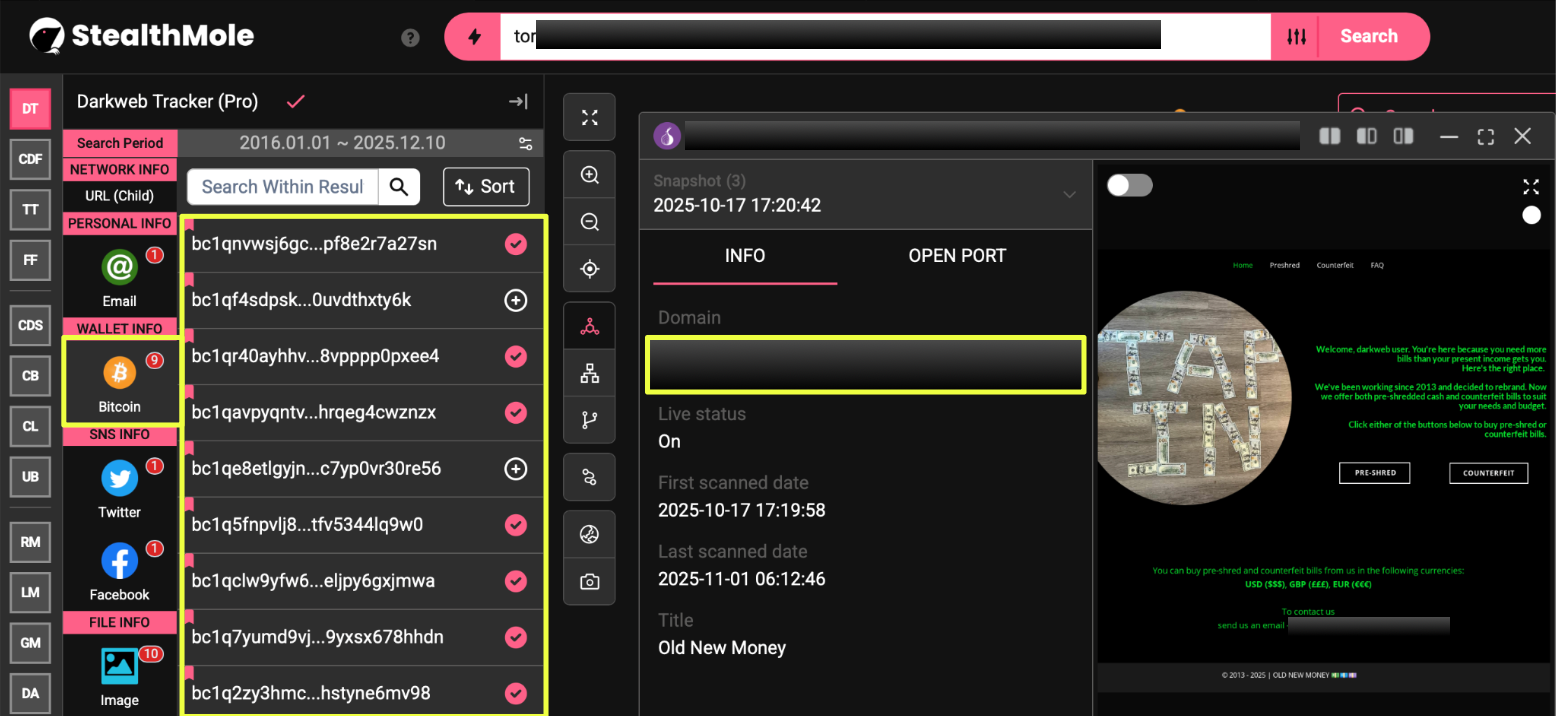
Taken together, the mirrored domains, repeated contact point, and recurring wallet traces portray an operation that prioritizes redundancy over innovation. Old New Money sustains itself through replication rather than redesign, ensuring consistent accessibility across an ever-shifting network of Tor services. This distributed architecture forms the backbone of the marketplace’s persistence strategy and explains how it continues to circulate despite the instability inherent to dark web hosting.
Payment Indicators & Cryptocurrency Footprint
Although Old New Money presents a polished ordering workflow, its public-facing pages reveal nothing about how payments are actually processed. The marketplace provides no static cryptocurrency addresses, no embedded QR codes, and no transaction history; instead, it instructs buyers that a wallet “is given to you” during checkout. This suggests a per-order address assignment system, but without visible payment screens, the mechanism remains deliberately concealed from passive observers.
StealthMole’s data fills part of this gap. During the broader infrastructure analysis, six Bitcoin addresses were detected in association with the primary domain’s activity window. None of these appeared on the marketplace’s static pages, which places them in the category of unconfirmed operational artifacts, likely gathered from hidden payment screens, user interactions, or historical captures rather than from any element of the site’s current interface. Their presence indicates activity around the platform but does not, on its own, confirm direct usage.
- bc1qgy4l9hu9m9d9jw0nw75nz607qka4qsdt3c5f89
- bc1qf4sdpskgm7mv9mrpr28lh57mgkm0uvdthxty6k
- bc1qk5d6mlyzdfa4r4qkjpjytcl9445f8sty8hlyjv
- bc1qqsmuz2swkkfsnmp2g8lryzw26xt409qtssxwp3
- bc1qe8etlgyjn80hu2728lxeph7dfc7yp0vr30re56
- bc1qq9745chszqw7sp56wlc83mp5s5lgqph9wcxvuf
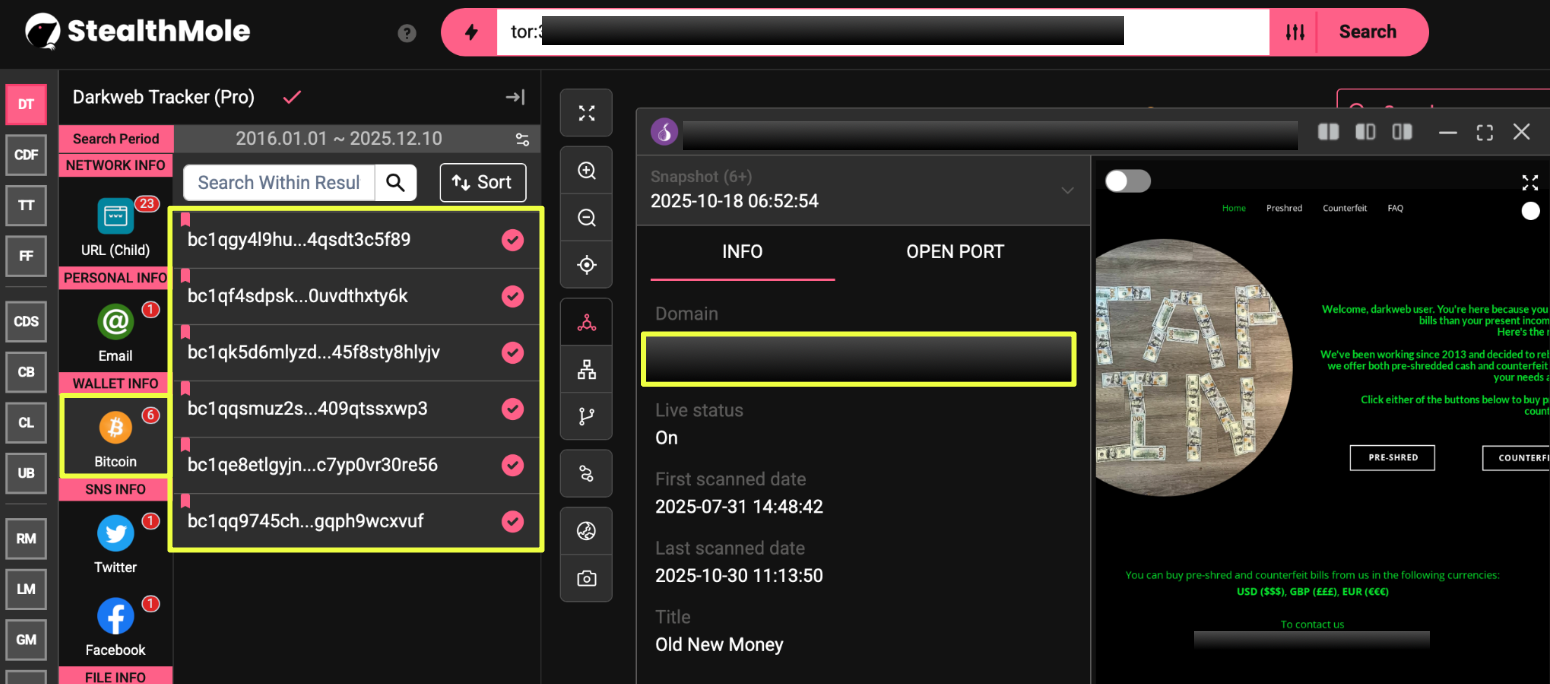
Collectively, the absence of on-page payment details, the appearance of wallets across mirrored domains, and the recurring cluster patterns highlight a payment system that operates beneath the surface rather than alongside the marketplace’s public content. The resulting footprint is fragmented but coherent enough to map patterns of reuse and distribution, offering insight into how the vendor structures its transactions without openly exposing its financial pathways.
Assessment
Old New Money operates with a level of consistency that distinguishes it from opportunistic or short-lived darknet vendors. Its mirrored infrastructure, repeated across numerous Tor domains, indicates an operator who prioritizes persistence over reinvention. Rather than modifying features or expanding its offerings, the marketplace maintains an unchanged template and relocates it across new addresses as older ones fall away. This pattern points to a strategy built around quiet continuity, staying available without drawing unnecessary attention.
The marketplace’s public-facing pages are curated to appear trustworthy while withholding operational detail. Product descriptions, pricing tables, and delivery claims remain uniform across all observed mirrors, but none of these elements reveal how the vendor actually manages transactions or communication. This separation between presentation and process suggests an intentional effort to insulate critical components from casual observation, reserving payment and logistical mechanisms for controlled, buyer-initiated interactions.
StealthMole’s pivots provide the clearest view into this otherwise hidden layer. The recurrence of Bitcoin addresses across multiple captures, coupled with the discovery of additional domains linked through wallet traces, shows that Old New Money exists within a broader ecosystem of related artifacts. Although these indicators do not confirm the exact structure of the vendor’s payment system, they highlight a footprint that extends beyond a single domain and persists through repeated redeployments. When viewed together, the marketplace’s stability, redundancy, and selective opacity portray an operation built for longevity within its niche, supported by infrastructure that favors resilience over sophistication.
Conclusion
Old New Money ultimately presents itself as a marketplace that thrives on predictability, not complexity. Its structure, mirrors, and supporting artifacts form a pattern of steady operation: a vendor that does not evolve its interface or diversify its services, yet manages to remain present across shifting Tor domains. The consistency of its public pages, combined with a carefully concealed payment layer, creates an environment where only the essentials are displayed and everything transactional occurs out of view.
The wider ecosystem uncovered through StealthMole shows that the platform does not exist in isolation. Wallet traces, additional domains, and recurring digital markers reveal a footprint that extends beyond a single site, suggesting an operator who has learned to distribute risk without altering the marketplace’s identity. While the inner workings of its payment infrastructure remain opaque, the surrounding signals outline a system designed to function quietly and repeatedly, regardless of how often its entry points change.
Taken together, the evidence portrays a vendor that relies on stability, redundancy, and limited disclosure to sustain its presence. Old New Money’s longevity appears to come not from innovation but from consistency, an operation that endures by keeping its methods simple, its presentation uniform, and its critical processes deliberately out of sight.
Editorial Note
This case highlights how even the simplest darknet markets can mask extensive operational frameworks. Old New Money’s static interface suggests a modest operation, yet StealthMole’s pivots uncovered a distributed ecosystem that would be easy to miss without structured analysis. The value of this investigation lies not in any single artifact but in how those fragments, domains, mirrors, wallet traces, and repeated design patterns, come together to reveal the vendor’s underlying strategy. As with many long-running darknet entities, the most telling signals appear between the lines, in the infrastructure that persists quietly behind the pages users see.
To access the unmasked report or full details, please reach out to us separately.
Contact us: support@stealthmole.com
Labels: Darkweb Marketplace
.svg)
.svg)
.svg)