NamasteLSD: The Vendor That Disappeared, the Brand That Remained

For nearly three years, NamasteLSD built a recognisable presence in the dark web drug trade, selling LSD, MDMA, ketamine, 2C-B and other substances through darknet markets, a private onion store and a Telegram bot. Operating from Europe and shipping internationally, the vendor had established a product catalogue, accumulated customer reviews and built a following that extended from Western Europe to India by 2021.
The investigation focused on two questions: what could be established about NamasteLSD's operations, and whether the vendor was still active. Tracing its activity across Tor, Dread, Telegram and Reddit helped reconstruct the vendor's history and the accounts it used to operate. However, the investigation also uncovered a separate issue. In October 2026, NamasteLSD-branded infrastructure was still appearing in scans and advertisements, raising questions about who was behind the activity.
The distinction between the original vendor and the later use of its name is important. Continued activity under an established brand does not necessarily mean the original operator has returned. Without separating the two, researchers risk attributing activity to the wrong actor, while buyers may mistake an unauthorized operation for the original vendor.
A Name, a Store and a Page Full of Answers
The investigation began with a search for "NamasteLSD" in StealthMole's Darkweb Tracker. The search returned more than a thousand Tor domains, but most were link directories and search engines that had indexed the vendor's name. Buried among those results was the vendor's private store.
- Private store: namastehtkkctyoa.onion
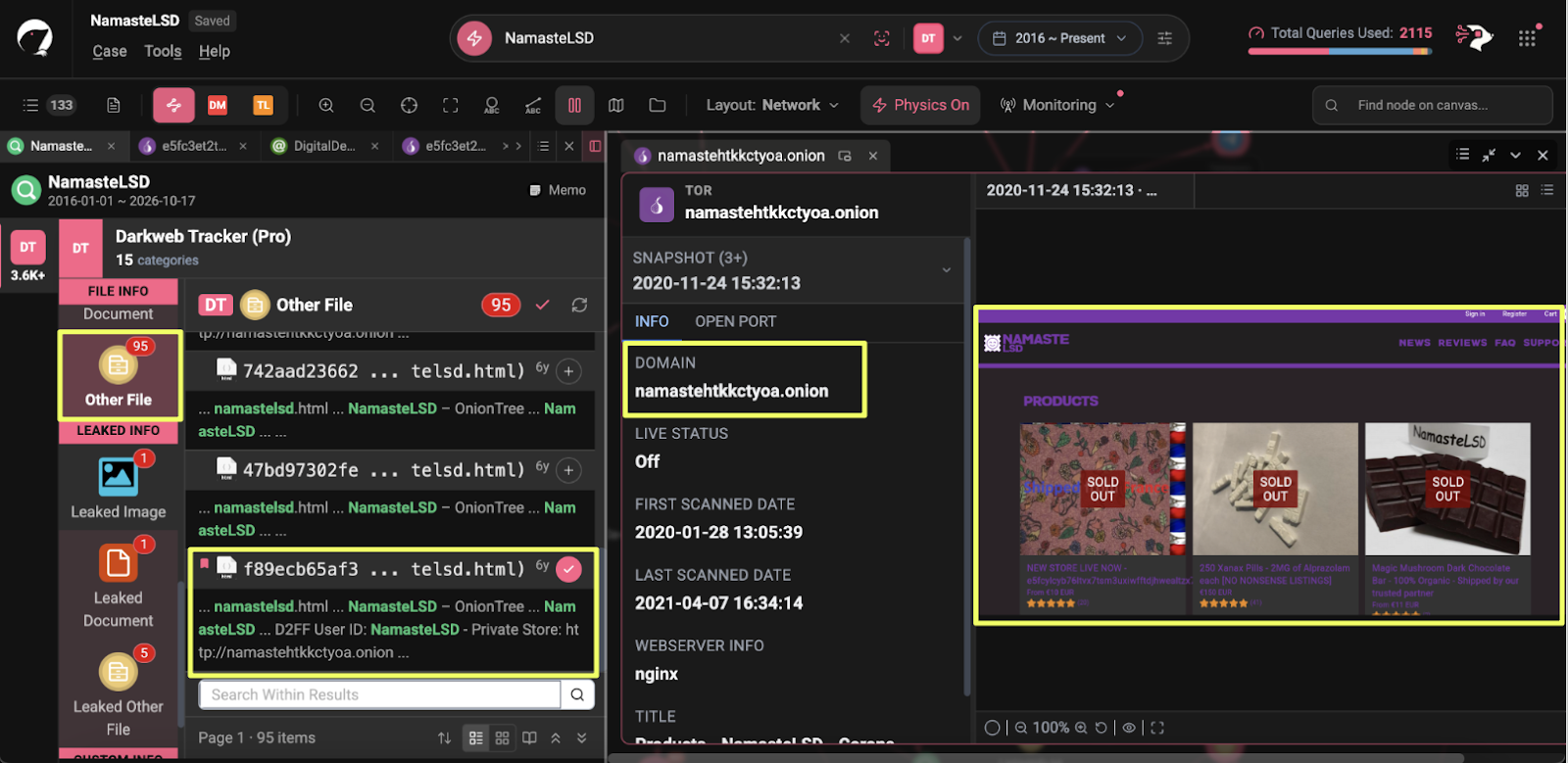
StealthMole listed the store multiple times between 2020 and 2021, capturing its product pages, news feed, support page and FAQ. The FAQ dated 5 March 2021 provided the starting point for tracing the vendor's online presence. What was meant to answer routine customer questions turned out to be one of the most useful sources in the investigation. It documented the accounts, contact channels and platforms NamasteLSD used to communicate with customers.
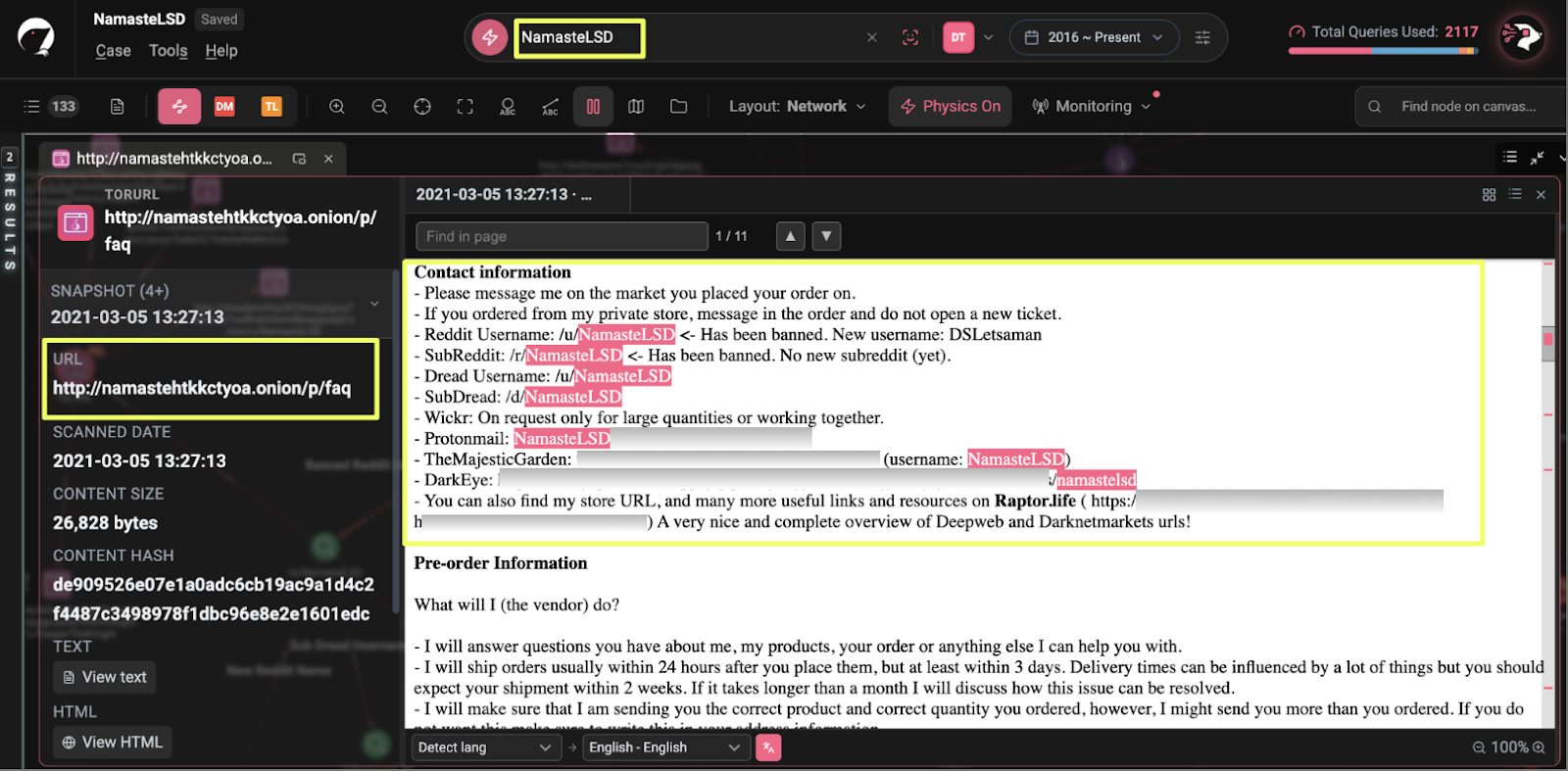
The contact details provided several leads to follow:
- Dread username: /u/NamasteLSD
- Subdread: /d/NamasteLSD
- Reddit username: /u/NamasteLSD, marked as banned, with DSLetsaman listed as a replacement account
- Subreddit: /r/NamasteLSD, also marked as banned
- Email: NamasteLS**********@protonmail.com
- TheMajesticGarden profile: u=7******0, under the username NamasteLSD
- Wickr: Offered for bulk orders or potential collaboration
The FAQ also pointed to a DarkEye review profile and directed customers to the Raptor link directory. These details provided a way to move beyond the store itself and examine the accounts and services associated with the name.
Built to Be Trusted, Built to Keep Moving
NamasteLSD's own records reveal how the vendor managed its identity, handled shipments and kept its sales channels running when the main store was unavailable. PGP signatures connected its public identity across platforms, while the store's FAQ documented a shipping network and several alternative ways for customers to place orders.
Identity that could be verified
PGP was central to how NamasteLSD established its identity. A May 2019 news post announcing Monero payments was signed with an earlier key. In October 2019, the vendor introduced a new RSA-4096 key and published it with a signature from the old one, allowing customers to verify the transition.
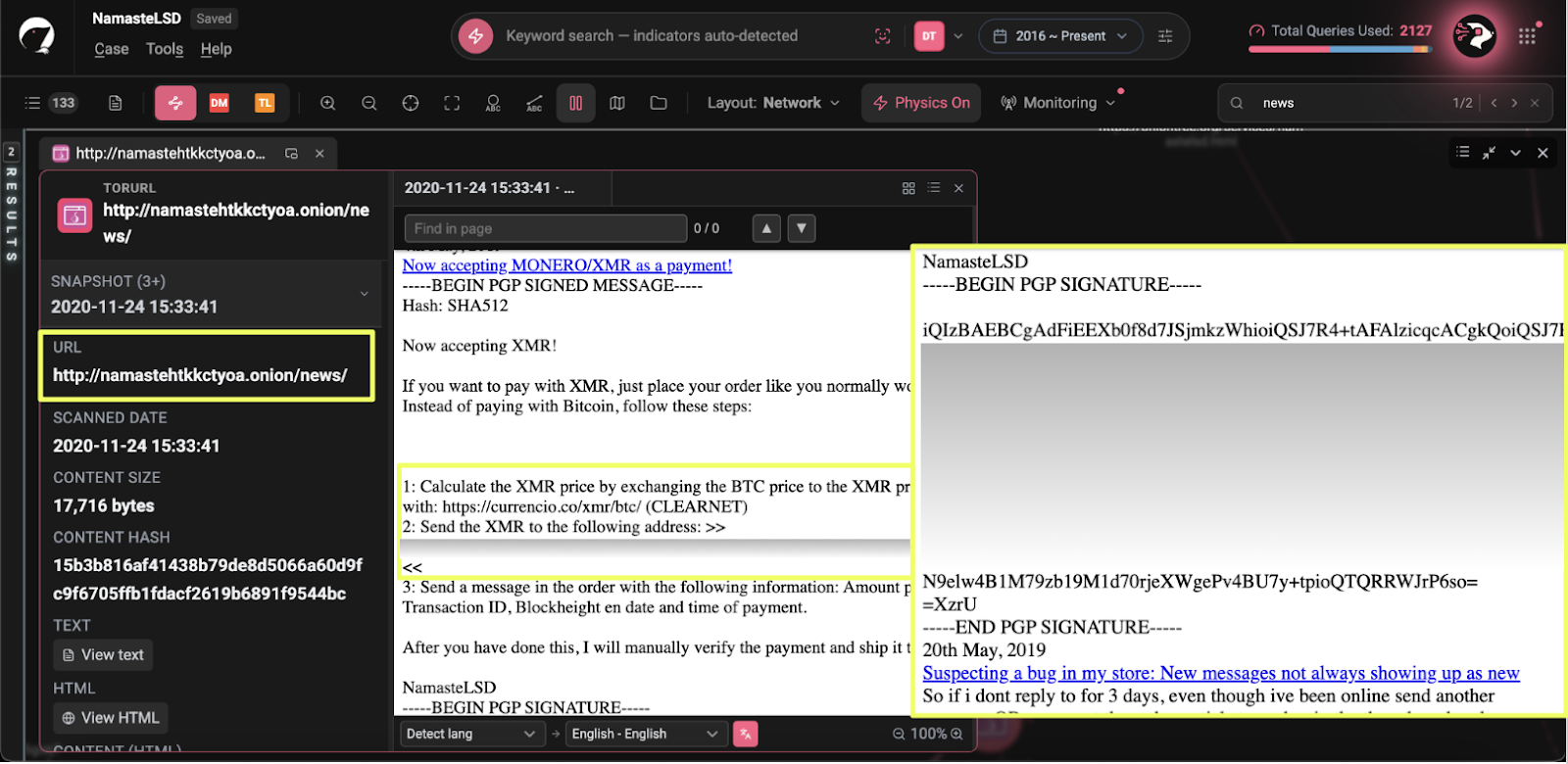
The two fingerprints recorded in the investigation are:
- Earlier key: 5DBD*******************************AD0
- New key, introduced in October 2019: E8468**************************D2FF
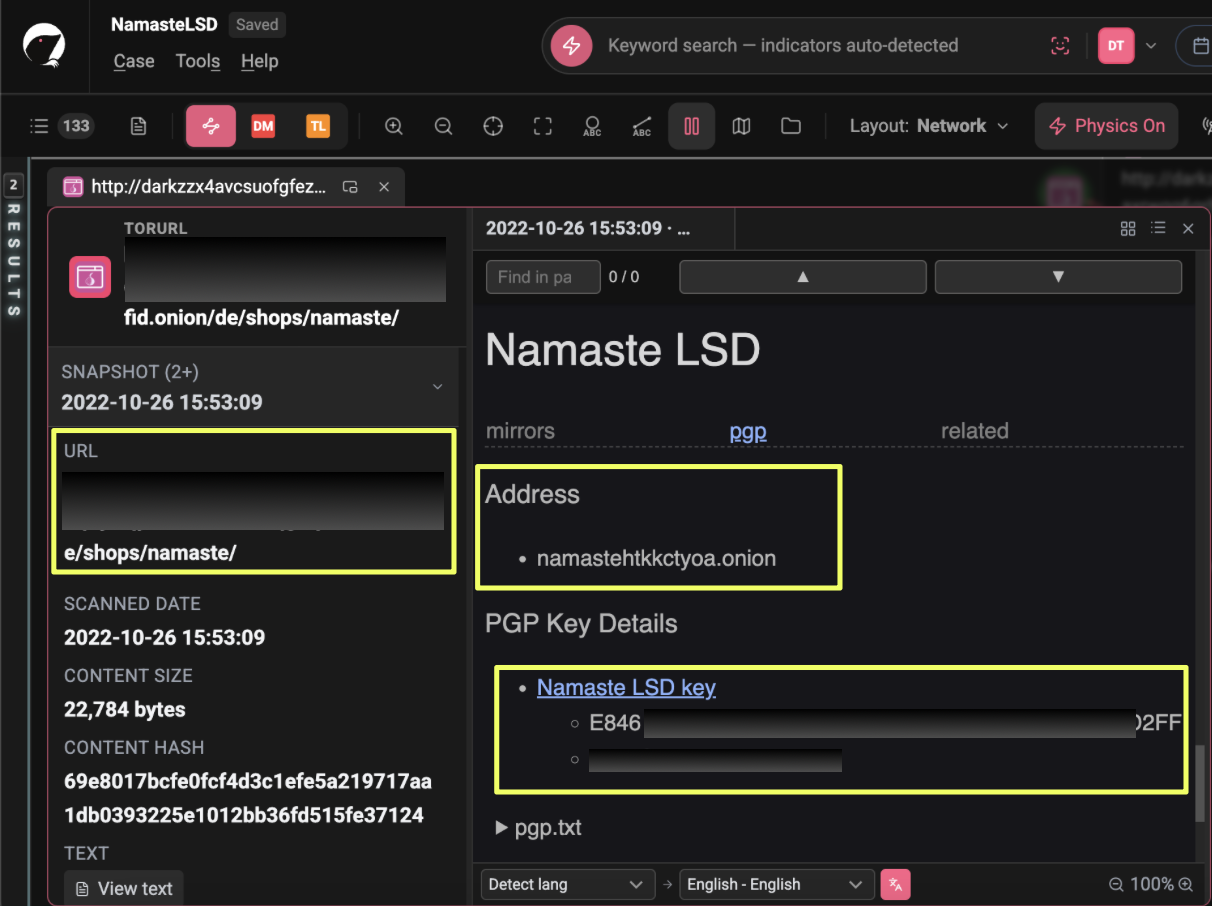
The user ID embedded in the new key identifies the NamasteLSD private store and an email address. The key was configured to expire on 13 October 2020, one year after its stated creation date.
- Private Store: http://namastehtkkctyoa.onion
- Email Address: NamasteL**********M@protonmail.com
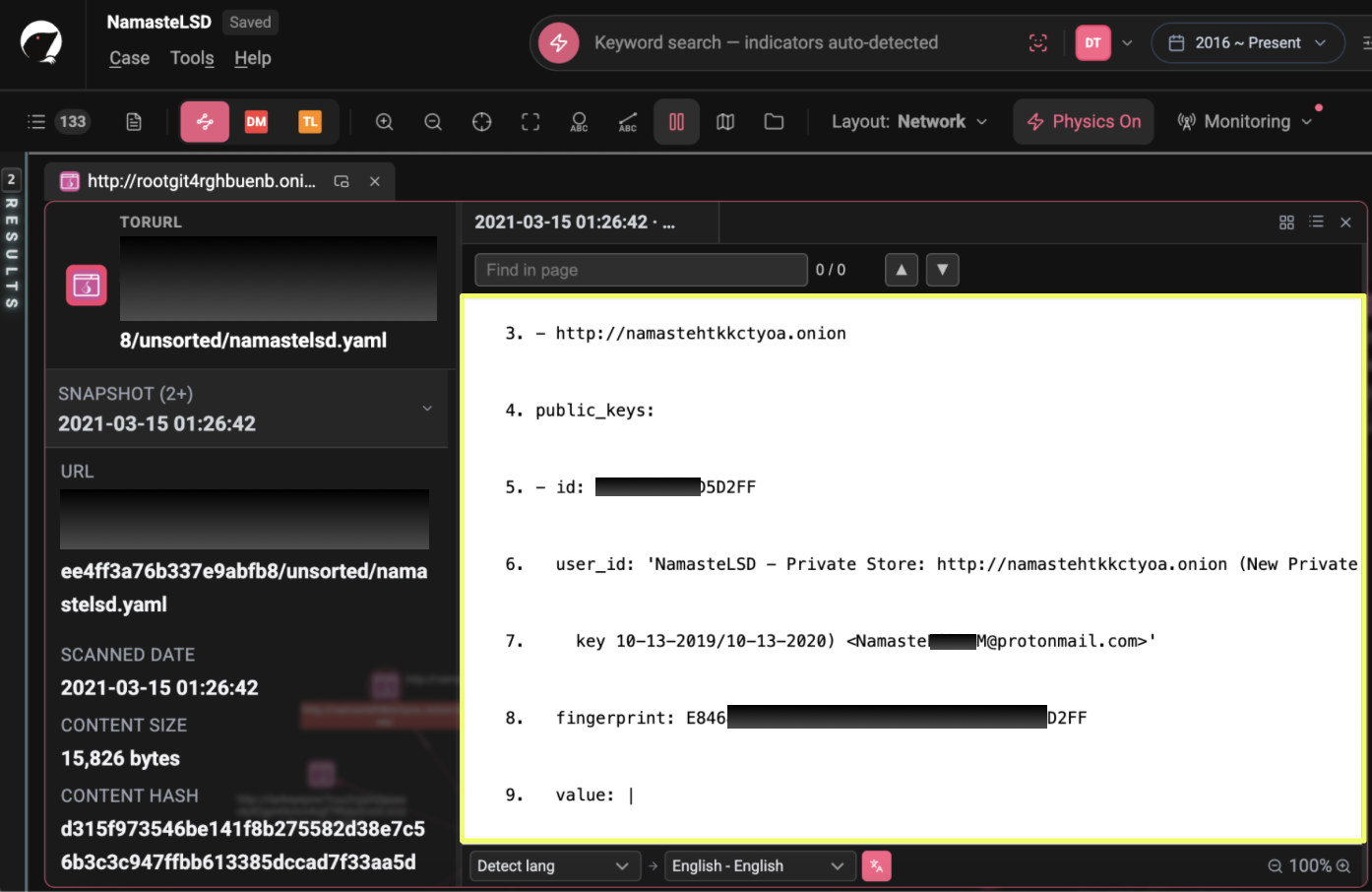
The same fingerprint appeared on OnionTree and DarknetLive, both indexed by StealthMole. A signed statement in the store's FAQ, dated November 2019, also authorized a New Zealand reseller to sell NamasteLSD's LSD domestically.
- Authorized reseller: HaletianTaboo
- Market: New Zealand
- Signing key ID: 2906**********FF
- Monero address: 841RN****************************************or2cc
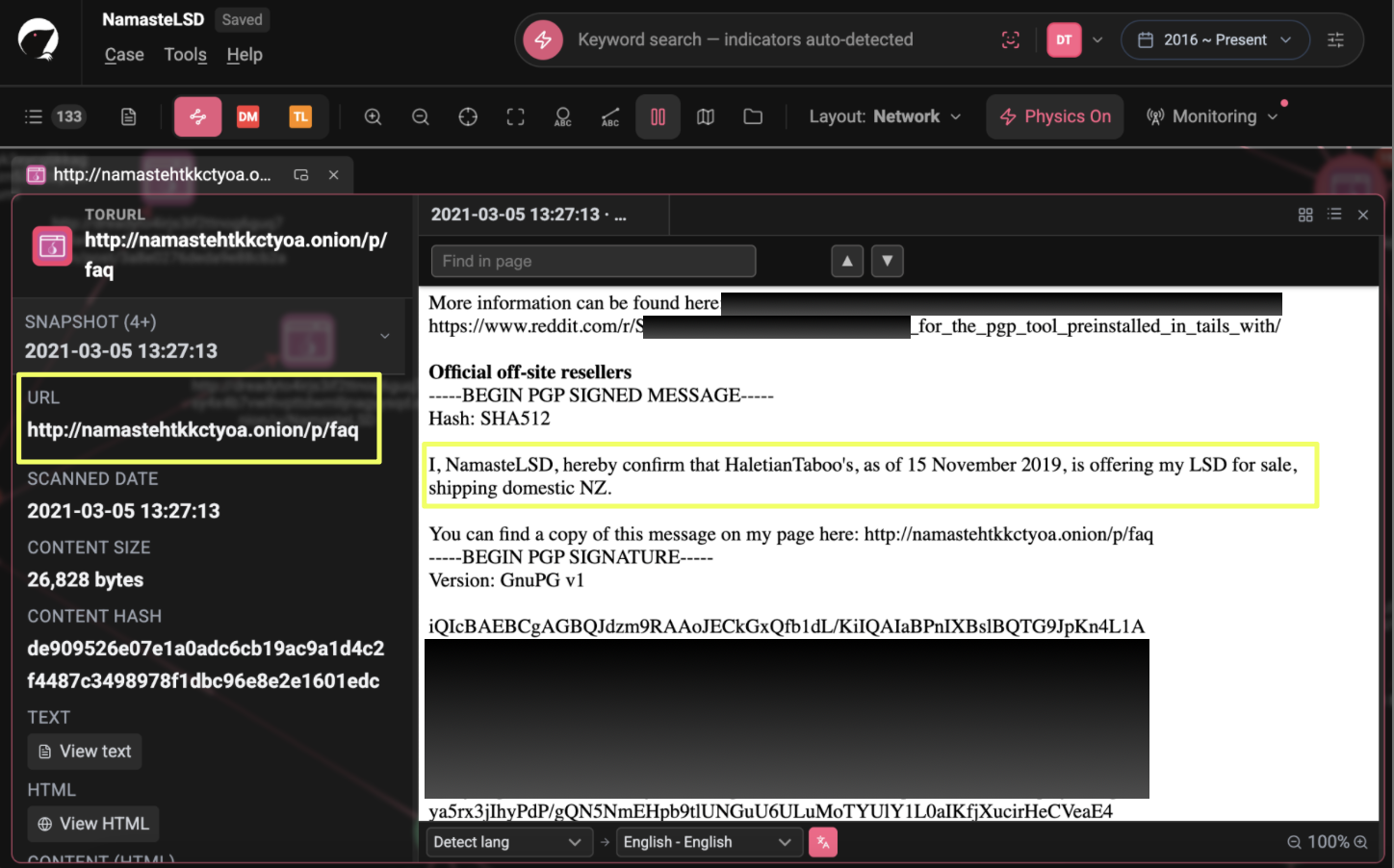
These records show how NamasteLSD used signed messages to maintain continuity between its store, payment announcements and reseller arrangements. The reseller statement is particularly relevant because it documents an explicit commercial relationship rather than just another account using the same name.
Logistics designed around getting caught
The store's FAQ also described how orders were shipped. NamasteLSD identified the Benelux region as its shipping base and explained why tracked parcels were handled differently. According to the vendor, tracked shipments required visits to postal counters, where cameras could expose the person sending the package.
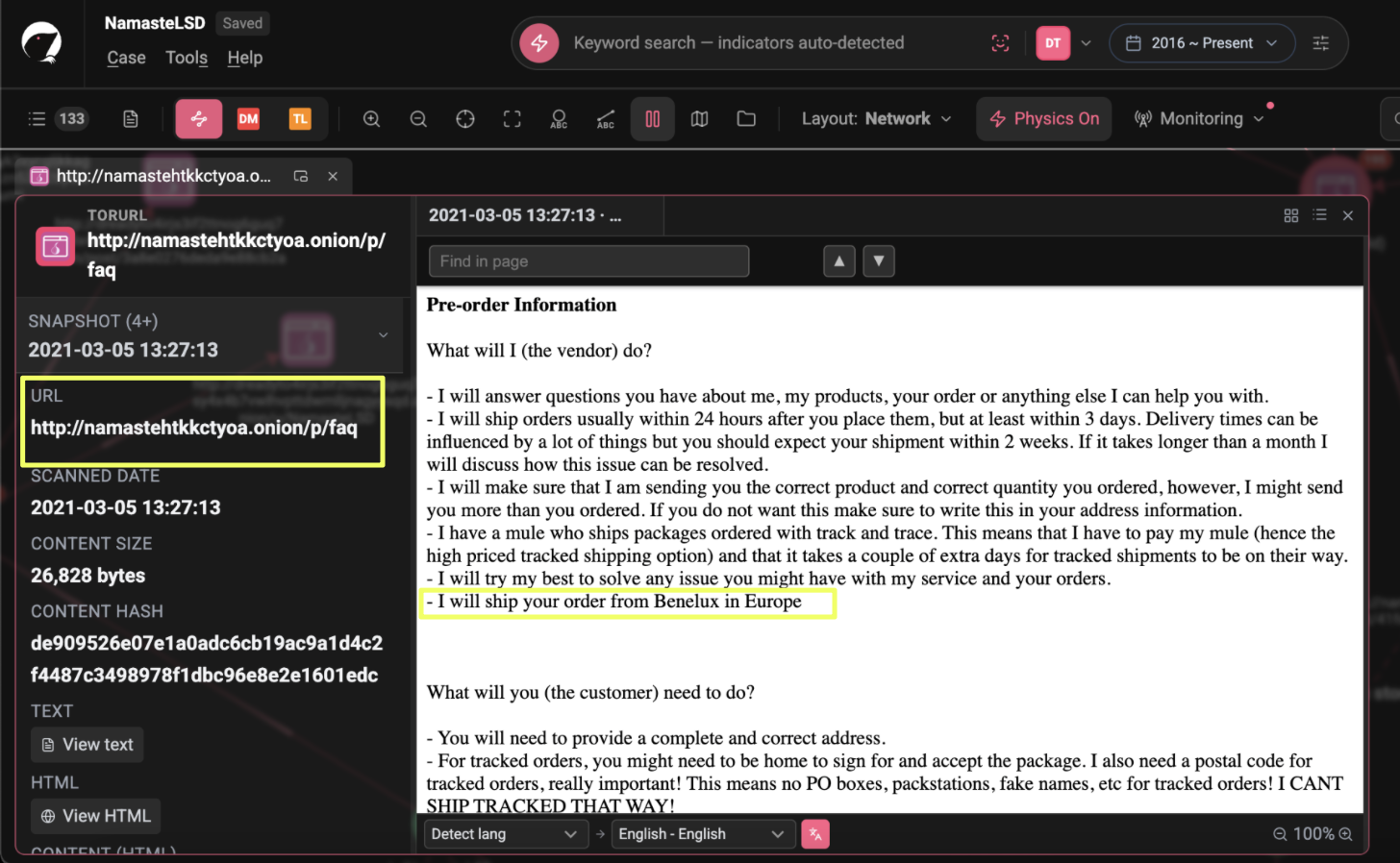
The vendor described using multiple people to move parcels rather than repeatedly relying on the same location. For bulk orders, it also offered drivers and dead drops. A November 2020 vendor review published by Darknet Inside described an additional option for larger customers: couriers could carry goods across European borders and post them from within the destination country.
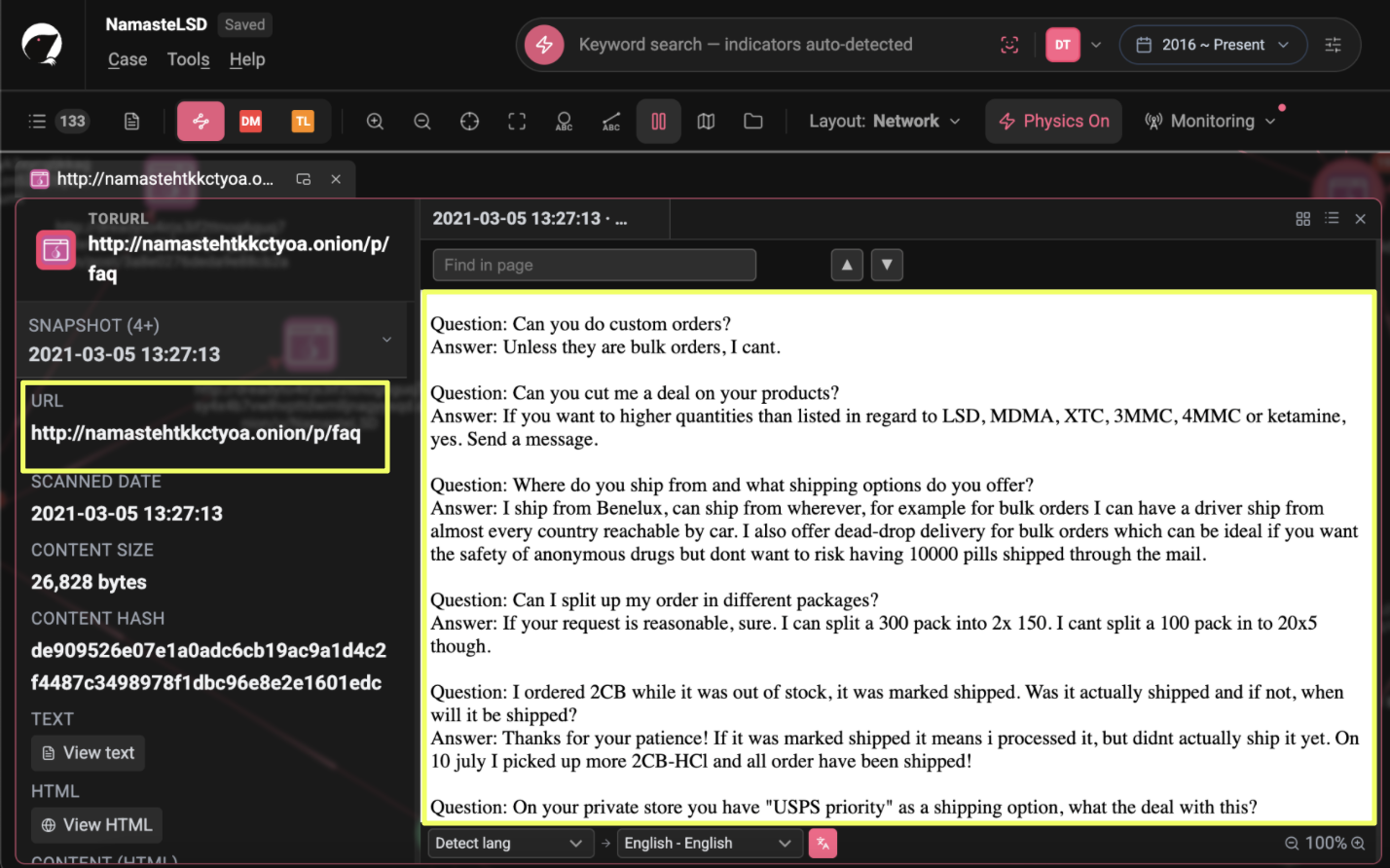
The store also offered two product tiers with different levels of customer support. Standard listings included support and reship options, while cheaper "No-Nonsense" listings came with limited assistance and no guaranteed refund. This gave buyers a choice between lower prices and a more supported purchase.
More than one door in
NamasteLSD maintained several sales and contact channels alongside its private store. A copy of the DarknetPhoneBook v2.0 PDF, captured by StealthMole in March 2021, listed the following:
- Jabber: namas****p@creep.**
- Telegram: @namaste********bot
- Telegram URL: https://t.me/namaste******t
- Darknet markets: Dark, Dark0de, Aurora, ASAP and ToRReZ
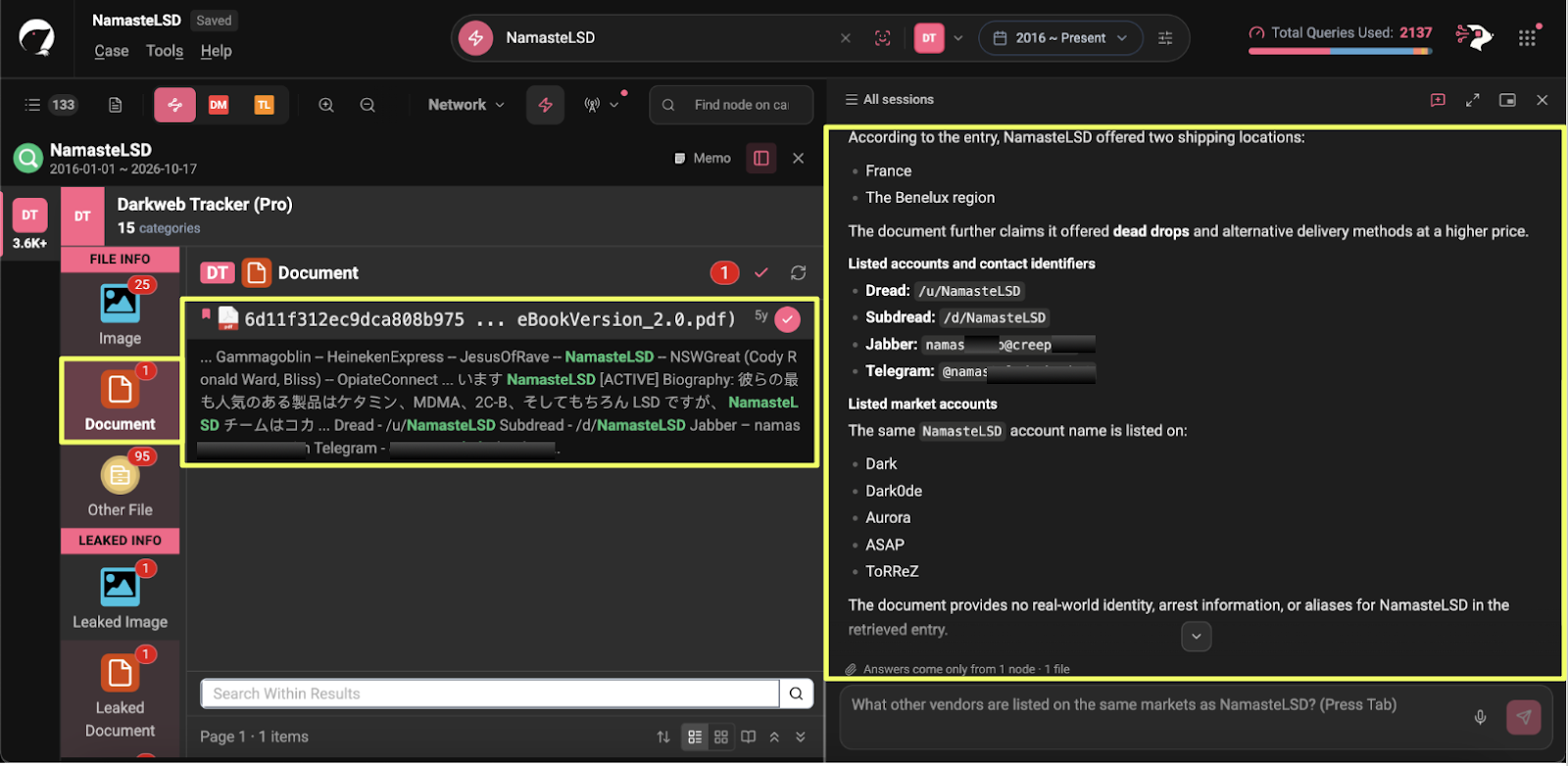
The store also promoted the Telegram bot on its subdread, describing it as "DDOS proof". This was relevant because the FAQ acknowledged repeated DDoS attacks against the onion store. The Telegram bot provided another channel through which customers could reach the vendor, although the available records do not establish how consistently it remained operational during outages.
Other entries in the FAQ referred to orders placed through Nightmare Market and Cryptonia. Separately, DarknetLive's coverage of the July 2019 Nightmare breach identified /u/NamasteLSD among the vendor accounts compromised in the incident. This places the account within the reported breach, but does not by itself establish what information was exposed or how the incident affected the vendor's operations.
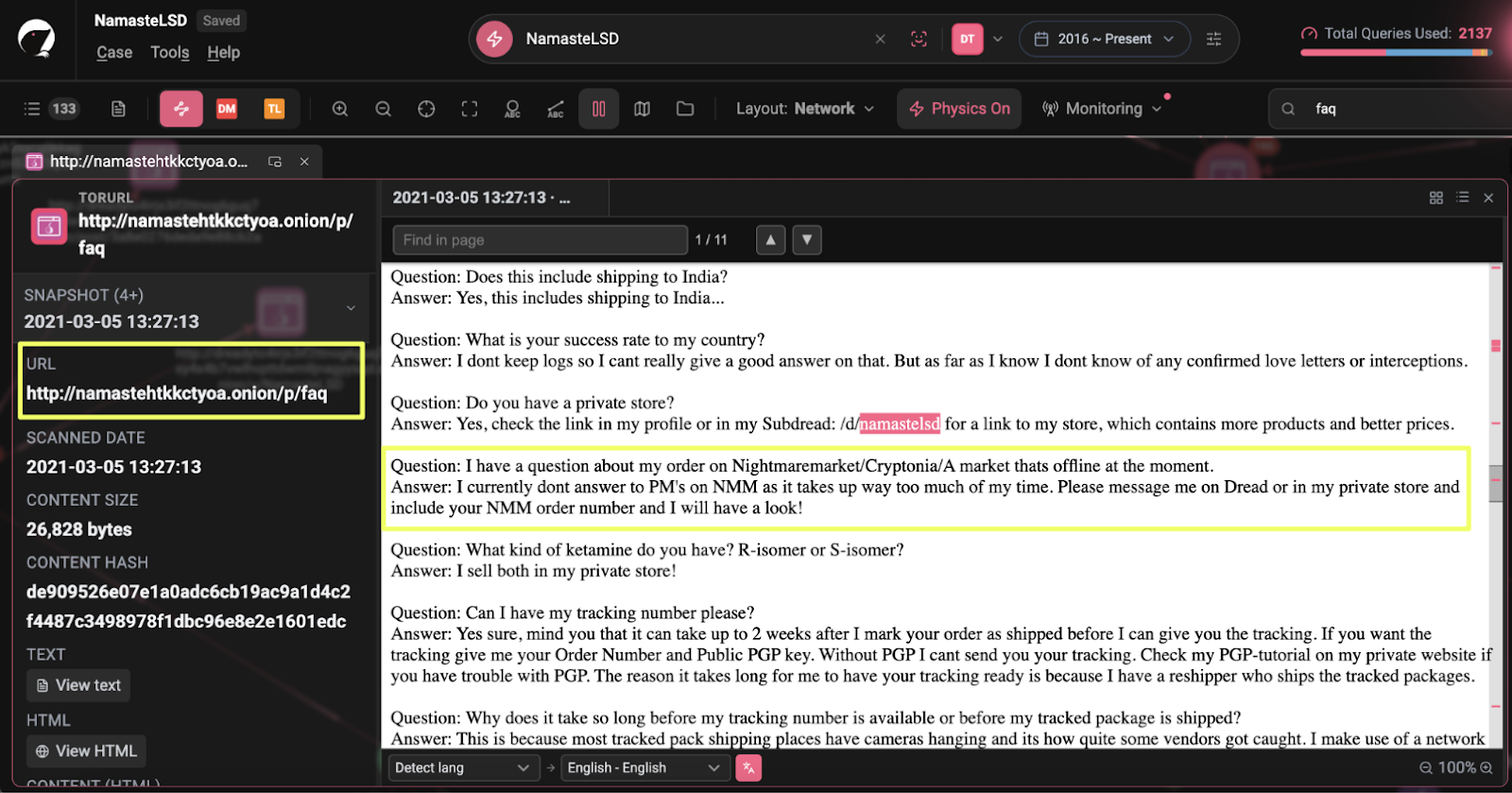
Across these records, NamasteLSD presented a fairly consistent approach: establish a verifiable identity, distribute sales across several platforms and maintain alternative channels for reaching customers. The documentation also created a detailed record of the brand that could be used to identify the original vendor later. That distinction becomes important when examining activity carried out under the NamasteLSD name after the original operation's active period.`
More Than One Person Behind the Name
Searching /u/NamasteLSD in StealthMole's Darkweb Tracker returned the vendor's Dread profile, archived comments and customer discussions spanning several years. The records showed how the account promoted its products, handled questions and interacted with buyers. They also revealed a second account involved in customer-facing activity, alongside a Reddit profile that provided further insight into how the business operated.
The vendor in its own words
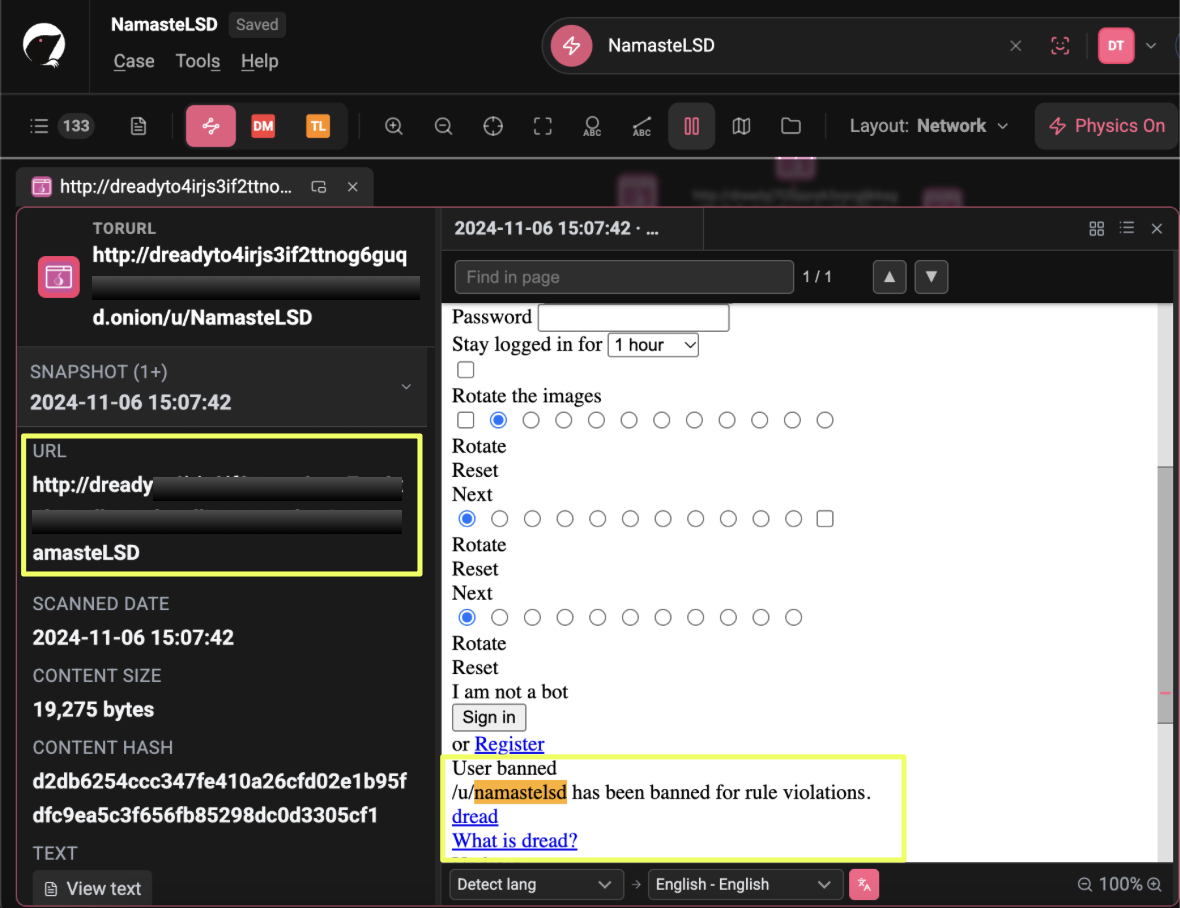
A StealthMole capture from November 2024 shows that the Dread account /u/NamasteLSD had been banned for rule violations. Its earlier activity, preserved in indexed threads, provides a clearer picture of its role in the community.
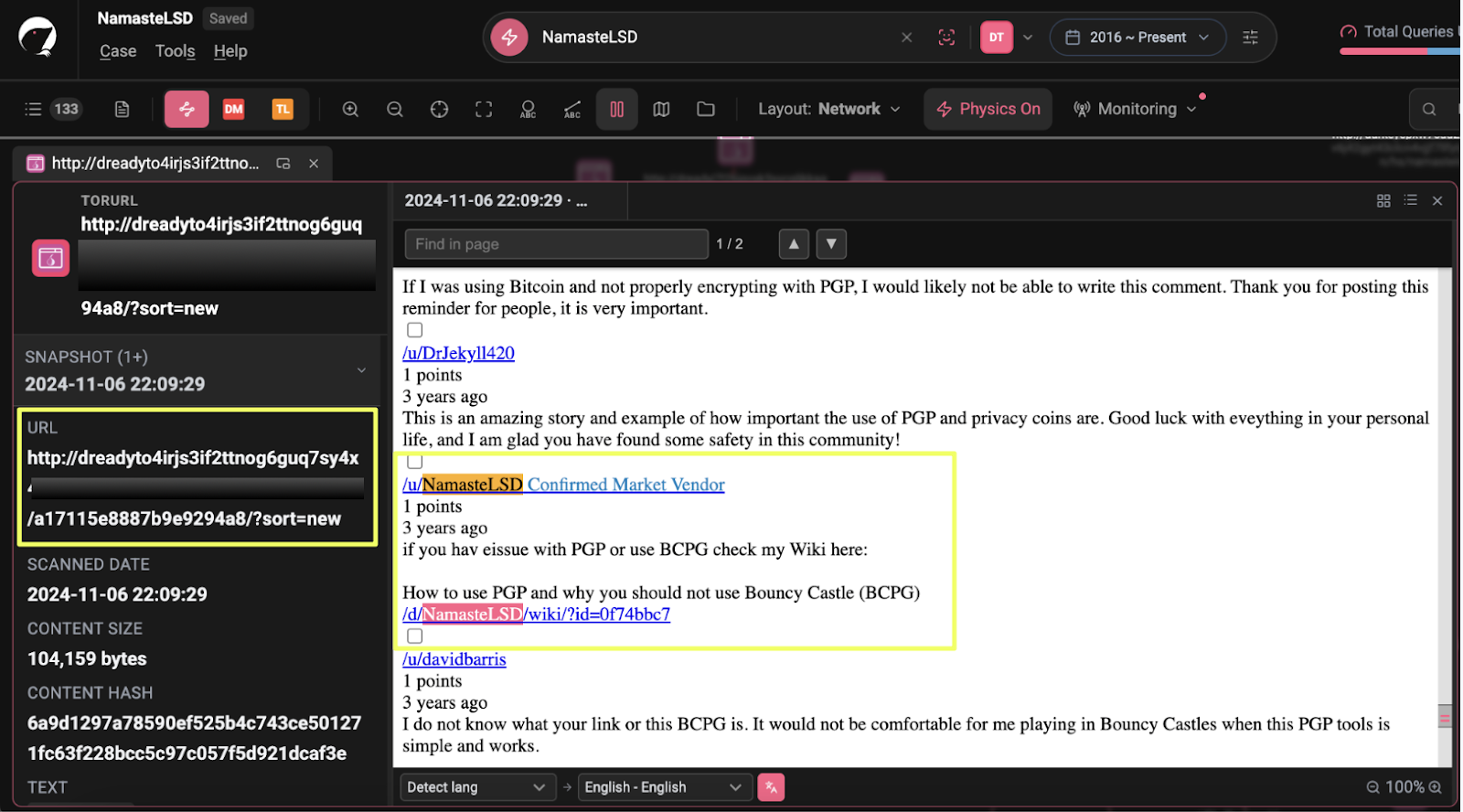
The account held the "Confirmed Market Vendor" flair and directed users to a PGP guide on its subdread wiki, warning against weak PGP implementations. In a separate classifieds thread on /d/DarkNetAustralia, it used the "International Vendor" flair to advertise a giveaway of at least 1,000 LSD tabs to mark the launch of a new store.
Another discussion, concerning Empire Market's closure, showed the account responding to a user's claim that Wickr had been compromised. The exchange also referenced NamasteLSD's Telegram shop as an alternative contact channel.
The account's Dread activity included the following identifiers and references:
- Main account: /u/NamasteLSD
- Subdread: /d/NamasteLSD
- PGP guide: /d/NamasteLSD/wiki/?id=0f74bbc7
- Account flair: Confirmed Market Vendor
- Additional flair: International Vendor
- Giveaway: At least 1,000 LSD tabs, advertised in a /d/DarkNetAustralia classifieds thread
The same discussions revealed another account, /u/NamasteLSD_S. Both accounts commented in threads about Dread's captcha system, and customers addressed them together when seeking help with orders. One user wrote, "/u/NamasteLSD /u/NamasteLSD_S please help?"
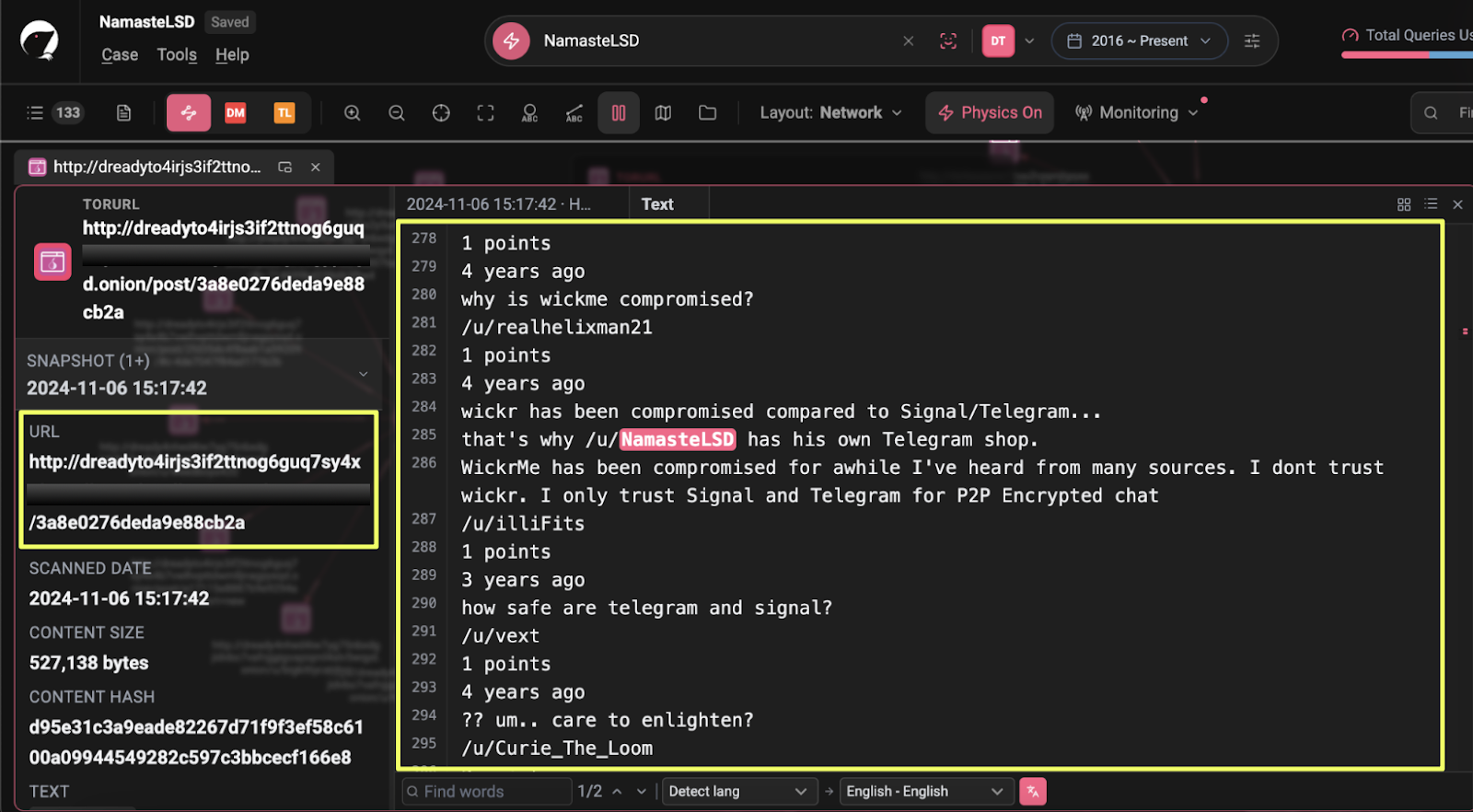
This establishes that both accounts appeared in the vendor's customer-facing activity. The available comments do not identify who controlled the second account or confirm whether it was used by a separate person.
A team, not a lone vendor
A July 2021 interview published by Darknet Inside provides further context. The interviewee described themselves as a NamasteLSD representative responsible for public relations and customer support. They said they had joined the team after ordering from the vendor for a long time, identified Empire as its first market, and stated that products were sourced from laboratories and importers in Europe.
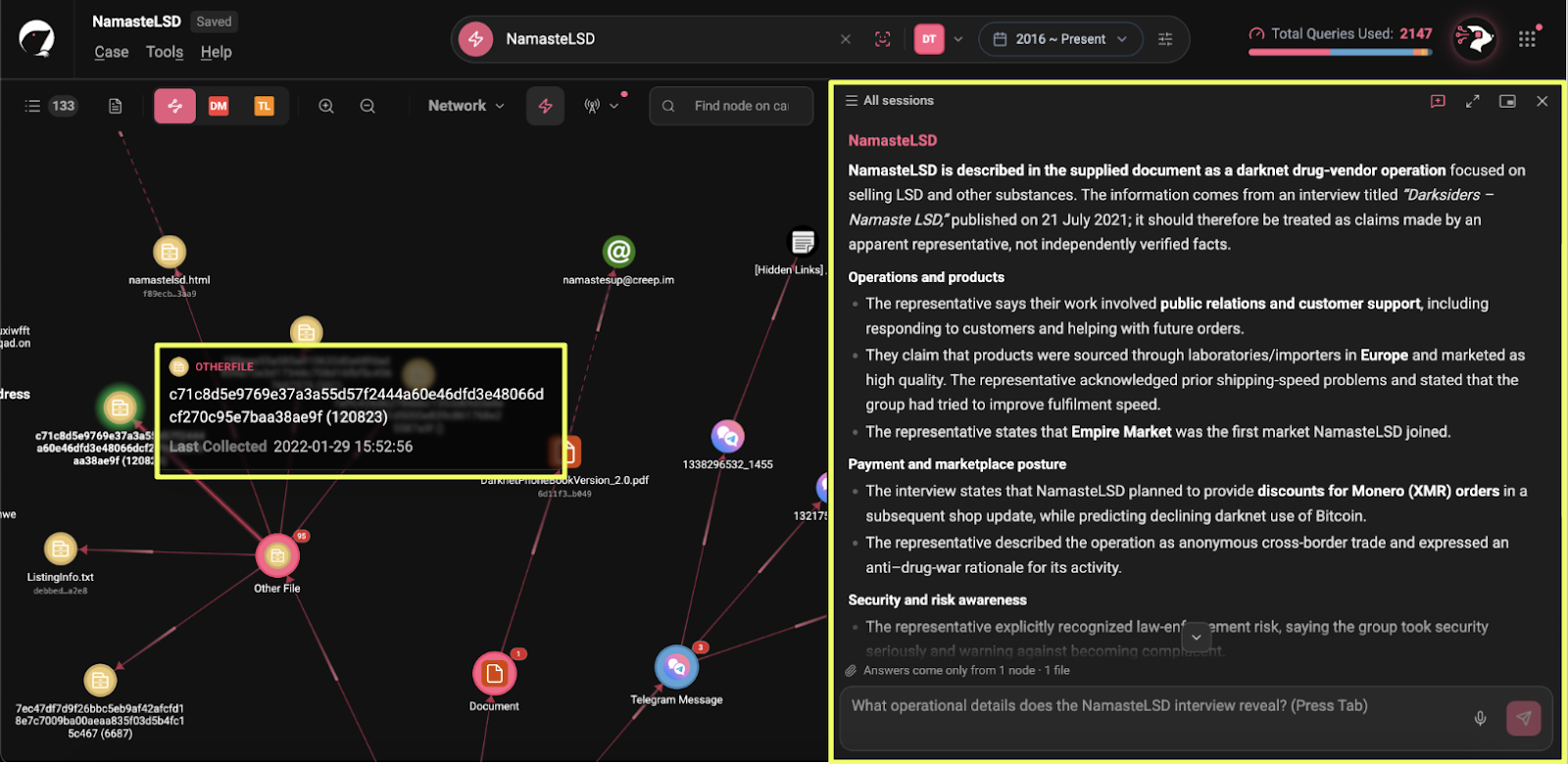
The store's own records support the account of a wider operation. One announcement opened with the words "Both /u/NamasteLSD_S and me", while the FAQ described using other people to transport parcels.

The evidence points to distinct customer-facing and shipping activities, but it does not establish a complete organisational structure. The main account was associated with the brand's PGP identity, and /u/NamasteLSD_S appeared in customer discussions. The interview provides a separate account of someone handling PR and support, although the available records do not conclusively link that interviewee to the second Dread account.
The investigation therefore supports the presence of multiple roles around the NamasteLSD operation, but not the real identities of the people performing them.
The Reddit account the FAQ pointed to
The FAQ listed DSLetsaman as the replacement for the banned Reddit account /u/NamasteLSD. The account's own profile details and comments provide additional evidence connecting it to the vendor.
The suspended account carried the following flairs:
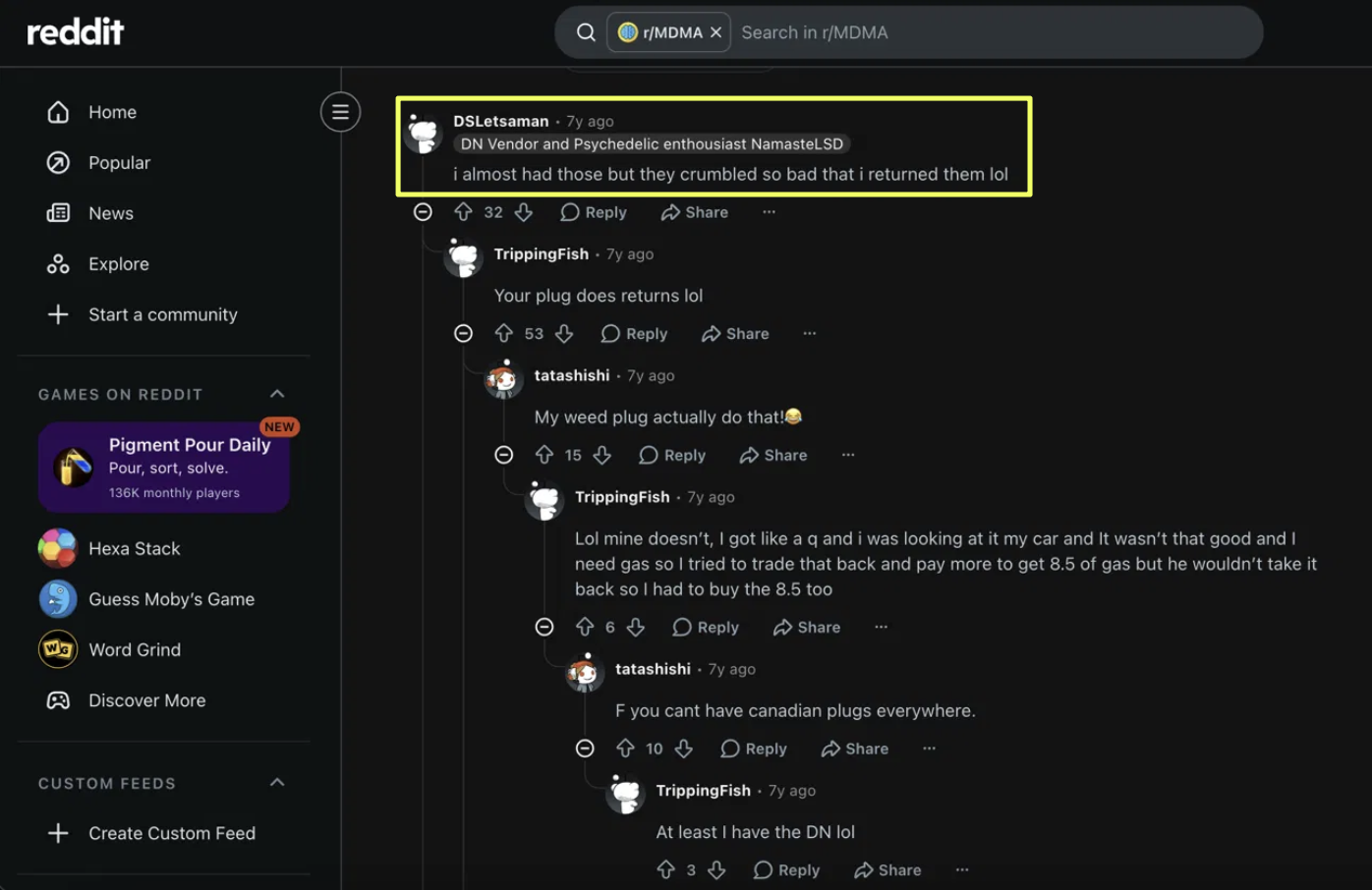
- In r/MDMA: "DN Vendor and Psychedelic enthousiast NamasteLSD"
- In r/2cb: "NamasteLSD - One and Only"
Its comments date to approximately 2019 and include discussions about product quality, returns and product photographs.
In r/2cb, a buyer posted a reagent test indicating a problem with a purchased batch. DSLetsaman acknowledged that a poorly synthesised 100-gram batch of 2C-B had been sold and offered a refund or reshipment. The reply was signed "~ namastelsd".
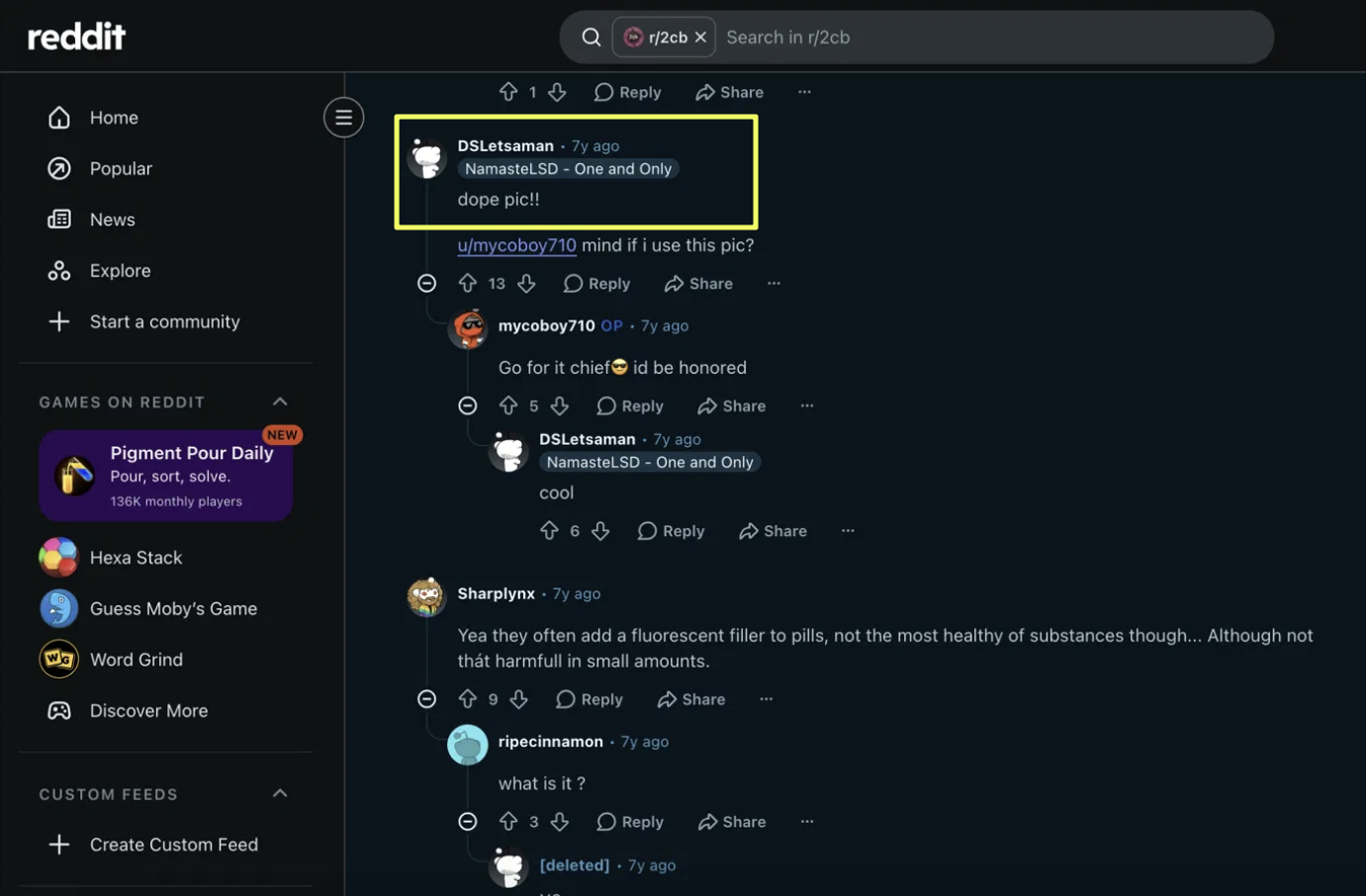
Other comments provided further details about the vendor's dealings with products:
- Subreddit: r/2cb
- Issue discussed: A poorly synthesised 100-gram batch of 2C-B
- Response: Refund or reshipment offered
- Signature: namastelsd
- Separate discussion in r/MDMA: The account said it had returned a batch of pills because they crumbled.
- Separate discussion in r/2cb: The account asked a user for permission to reuse a product photograph.
The admission concerning the 2C-B batch and the comment about returning pills are consistent with a reseller dealing with upstream suppliers. However, these exchanges do not independently identify those suppliers or establish that the vendor never produced any products itself.
The vendor's clearnet presence
NamasteLSD also maintained a presence outside the dark web. An X account created in May 2020 described itself as a "Deepweb drug vendor" and used the same purple logo found on the vendor's subdread banner.
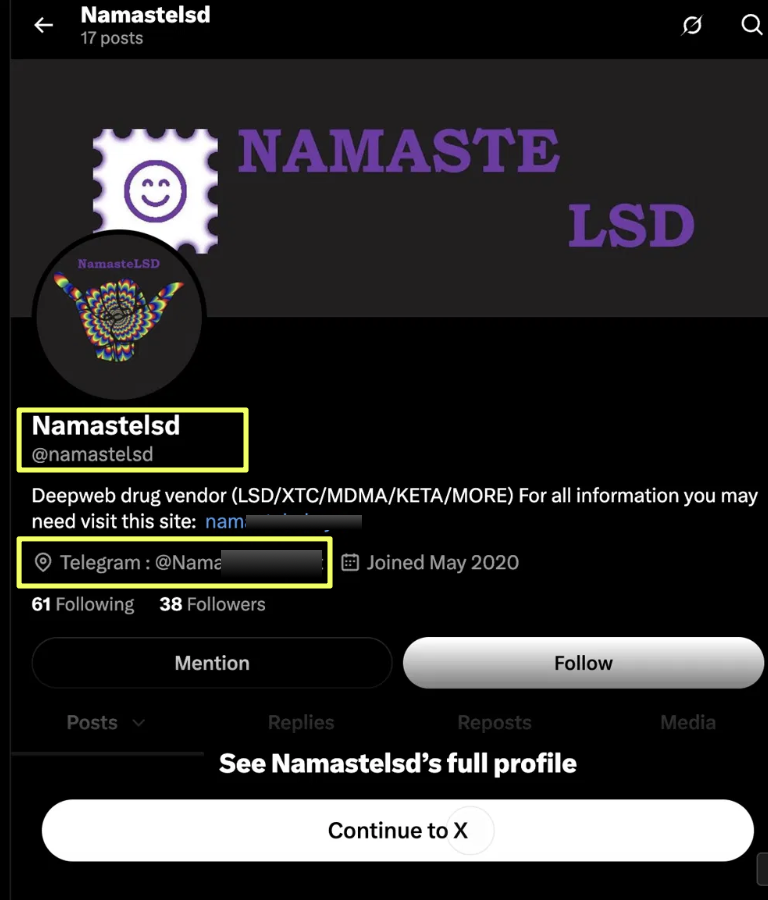
A domain zone file indexed by StealthMole records the registration of the linked website in the same month.
- X account: @namastelsd
- Website: namaste**.****
- Domain registration: 8 May 2020
- Telegram handle listed on X: @NamasteL*****t
- Telegram shop bot listed in the store FAQ: @namastel******t
The matching branding and timing support an association between the X account and namaste***.***. The two Telegram handles, however, do not match. The available records do not establish whether this reflected a change in the vendor's contact channels, the use of separate bots or activity by another account using the same name.
What the customers saw
Customer discussions on Dread and Reddit provide a view of NamasteLSD's reported shipping origins, customer base and reputation. The records contain both successful delivery reports and complaints about orders, product quality and customer support.
Shipping and Destinations
Customers described shipments originating from the Benelux region and France. Dread discussions included comments such as "from France not NL" and "Ket pack landed! FR-USA". A store listing also advertised blotters shipped from France.
The relevant records include:
- Shipping regions mentioned in the FAQ: Benelux
- Additional origin reported by customers: France
- Dread comment: "from france not NL"
- Dread delivery report: "Ket pack landed! FR-USA"
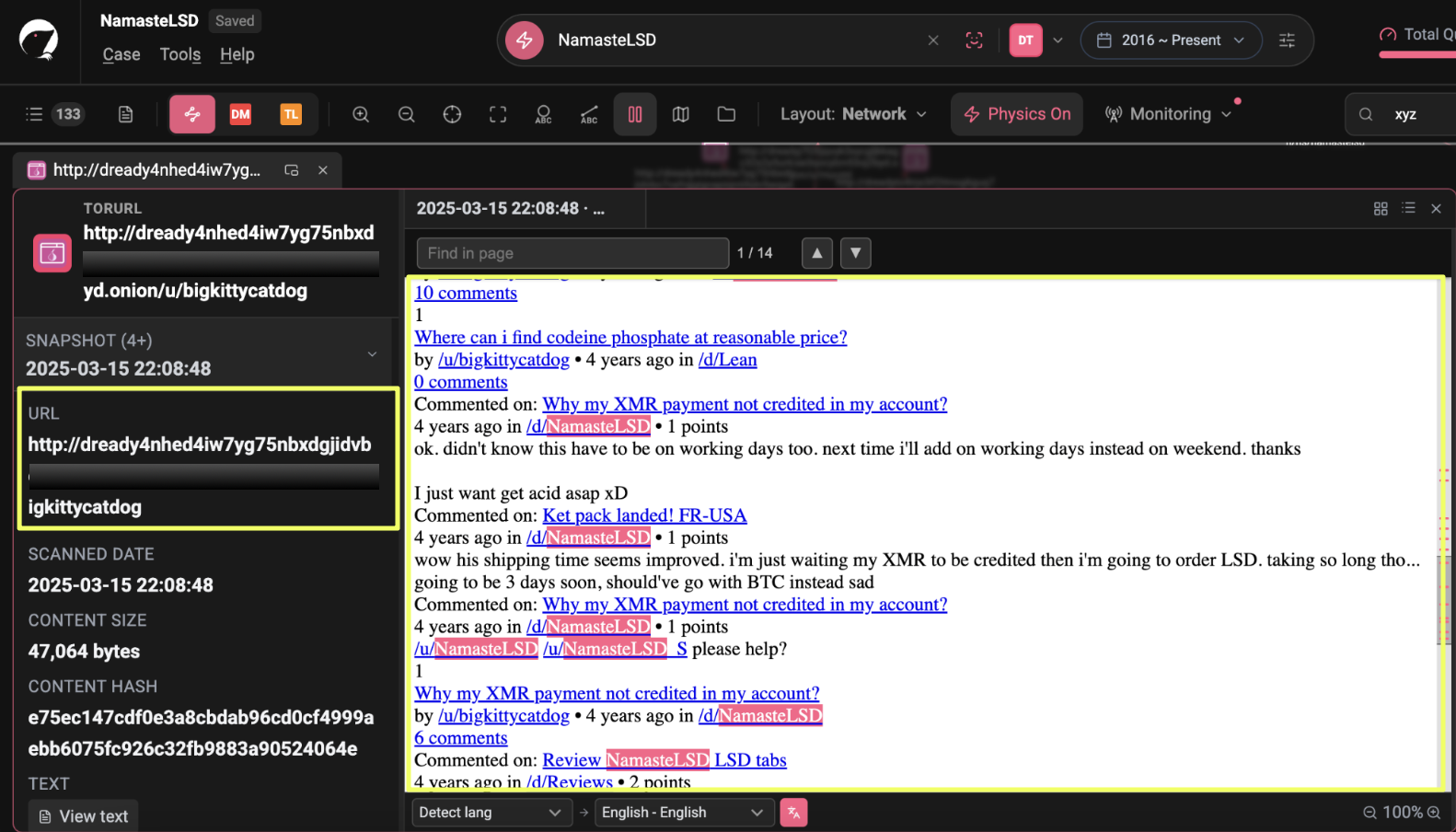
These accounts indicate that customers associated the operation with more than one European dispatch point. They do not establish the origin of every shipment.
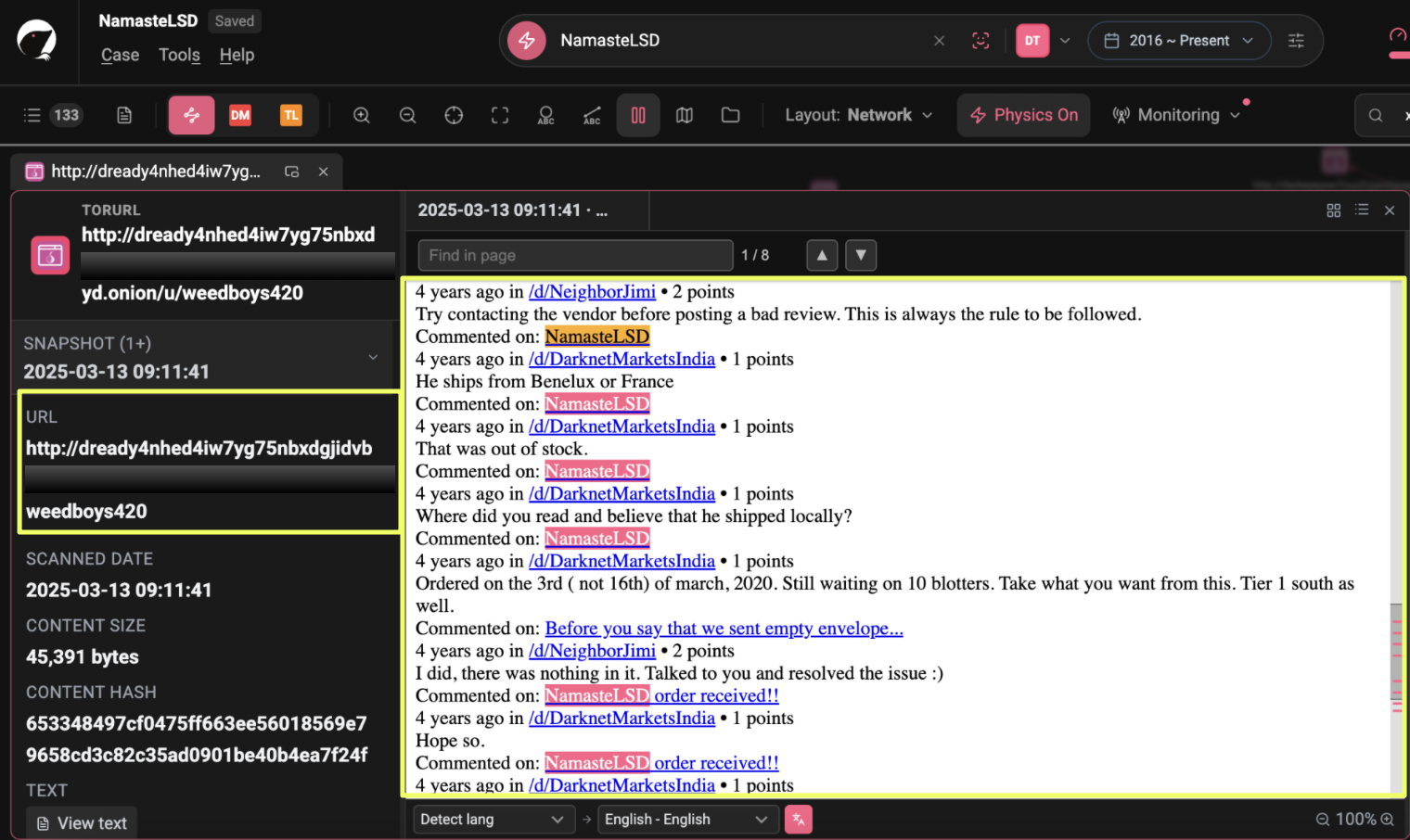
India also featured repeatedly in the customer discussions. Several threads on /d/DarknetMarketsIndia mentioned NamasteLSD and its Telegram shop, including discussions about using Telegram safely on Tails to place orders. One user was still waiting in 2020 for an order placed in March, while a Reddit user in India described waiting three weeks. The FAQ also addressed Indian customers, warning that delivery could be slow while maintaining that shipments were possible.
Customer Feedback
NamasteLSD received favourable reviews alongside persistent complaints. Darknet Inside's 2020 review awarded the store four out of five stars and praised its customer support. A Reddit user also reported that NamasteLSD tabs had tested at approximately 204 micrograms through a drug-checking service. That result remains a user-reported claim and cannot be independently verified from the available records.
Negative feedback covered several areas:
- Shipping delays: Customers reported waiting weeks for orders.
- Customer support: Some users complained that the vendor went silent on Jabber for days.
- Seized orders and alleged scams: A Dread user repeatedly accused the vendor of scamming customers, including in a thread titled "Namaste order seized".
- Product quality: A Reddit buyer reported receiving a product with no apparent potency.
- Broader warnings: An r/darknet post carried the title "NAMASTELSD is a scammer avoid like plague".
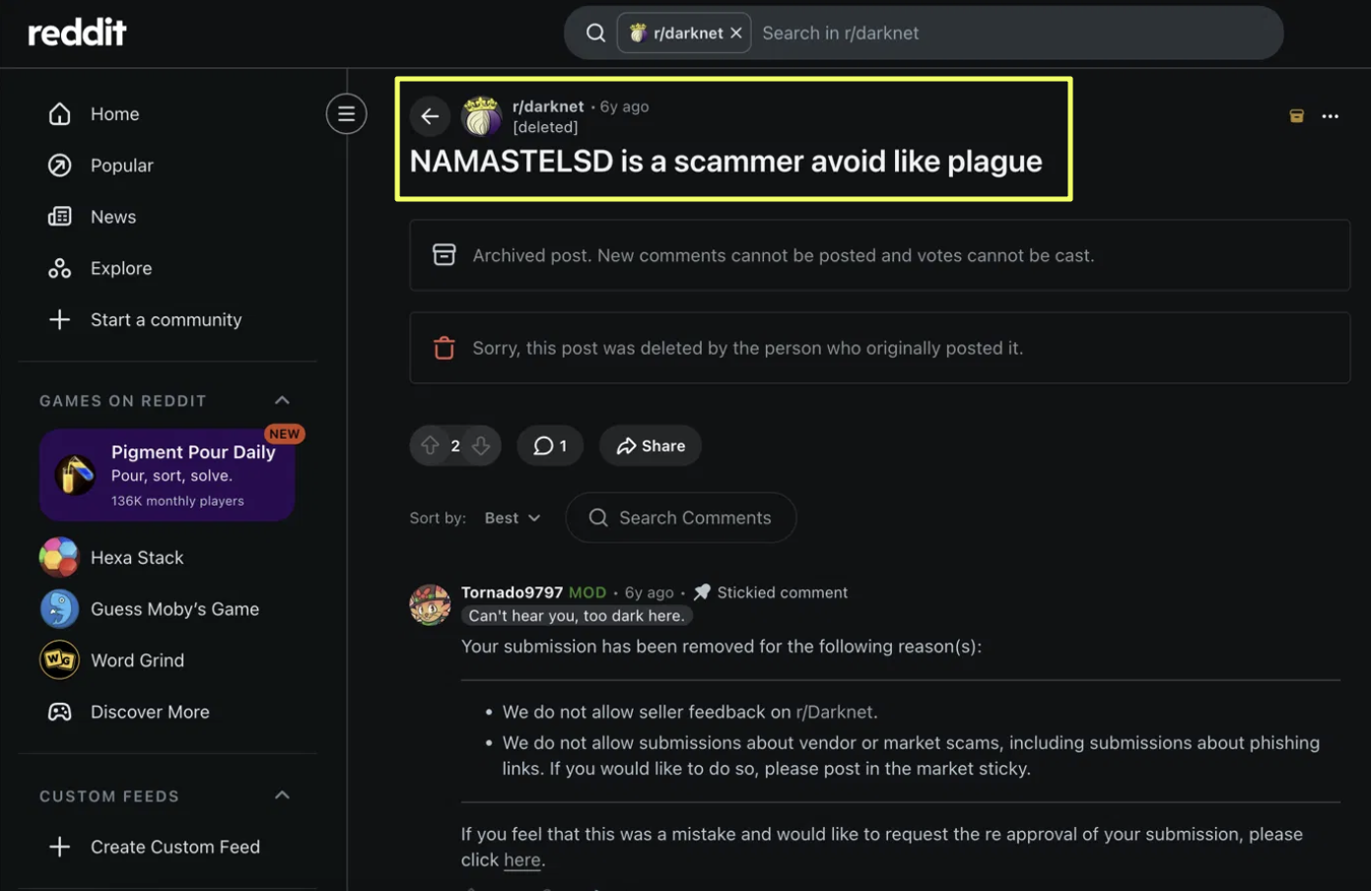
These are individual customer accounts, not independently verified findings, and the complaints do not establish that every disputed transaction involved deliberate fraud. They do, however, show that the vendor's reputation was far from uniform. Even as NamasteLSD maintained multiple sales channels and attracted customers in different markets, its public record included recurring disputes over delivery, support and product quality.
A New Store, Then Silence
StealthMole's captures of namastehtkkctyoa.onion, dating back to November 2020, revealed an announcement that introduced a new private store. The banner read "NEW STORE LIVE NOW" and linked to another onion address. Extracting the links from the captured product pages also revealed a separate domain associated with hiring and reseller pages.
- New store: e5fcylcyb76ltvx7tsm3uxiwfftdjhwealtzx7xb54mzftyg6ffjeqad.onion
- Hiring and reseller pages: llvswsrtheafqe76fzowfppwuclxssanjt4noahtgtbklpt2tt3gjuqd.onion
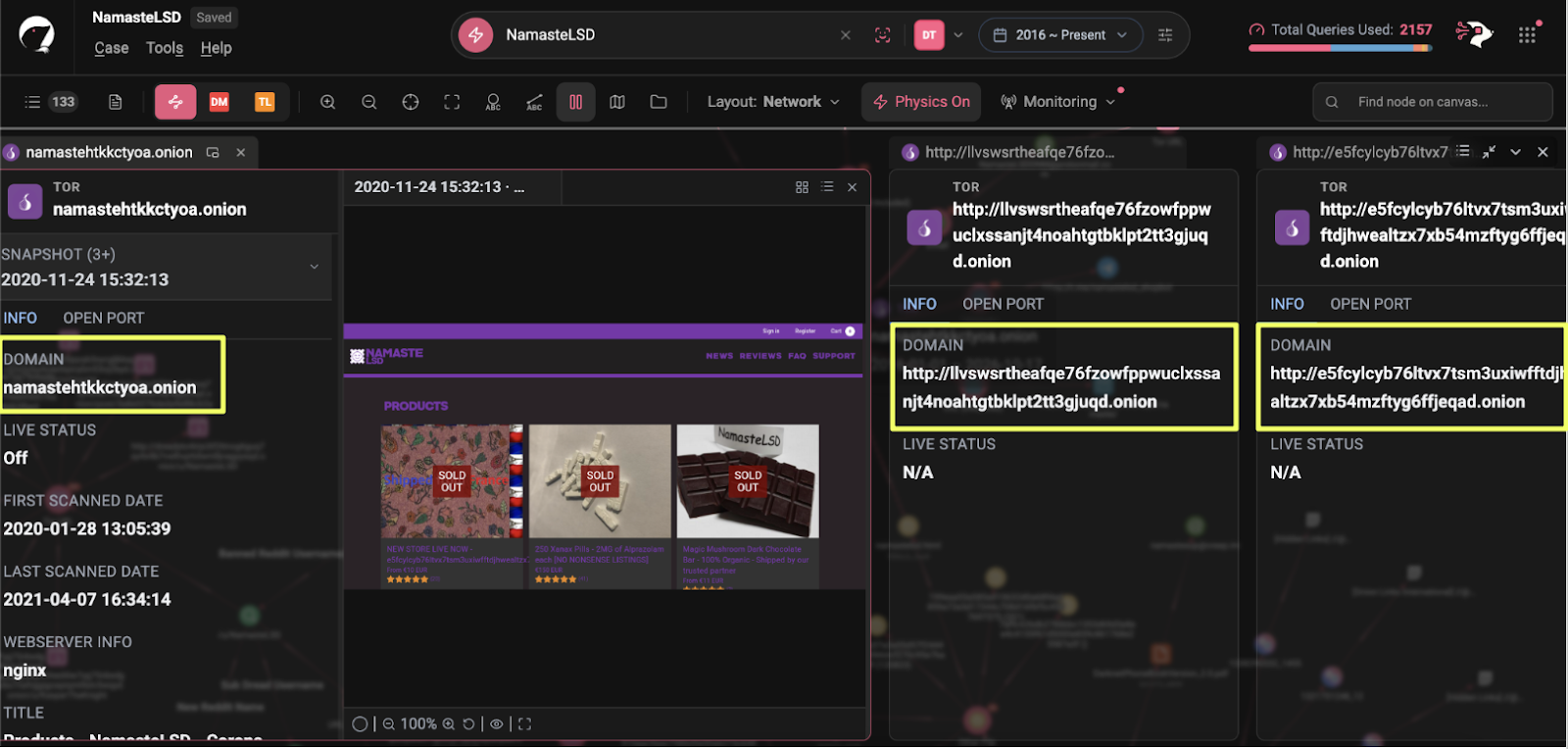
The announcement, written jointly by the people behind /u/NamasteLSD and /u/NamasteLSD_S, described a rebuilt store with automatic Bitcoin and Monero payments, promotional codes, flexible order quantities and improved options for resellers. It attributed previous downtime to DDoS attacks, competitor activity and difficulties contacting Dread's administrator.
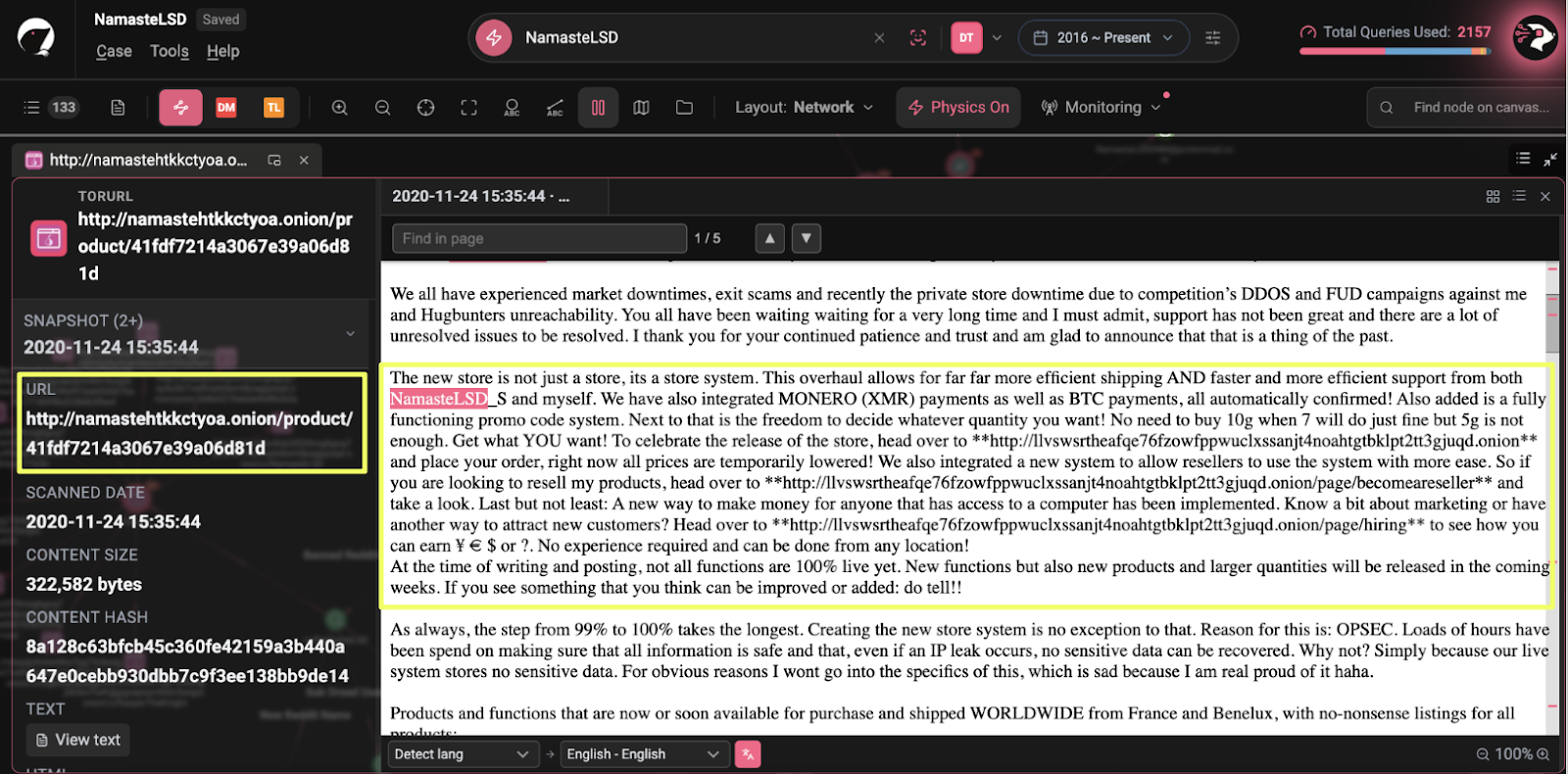
The post also claimed that the new system stored no sensitive information, meaning an IP address leak would not expose customer data. A separate subdread announcement referred to new PGP keys for both account holders ahead of the launch.
The new domain used the prefix e5fcy, a detail that becomes significant when examining the later sites built around the NamasteLSD name.
The quiet months
By 2021, customer discussions were increasingly focused on the vendor's absence. A chat log created in August 2021 includes a buyer expressing concern that NamasteLSD had not been seen online for some time. Other Dread users complained that the support account had been absent from Jabber for days.
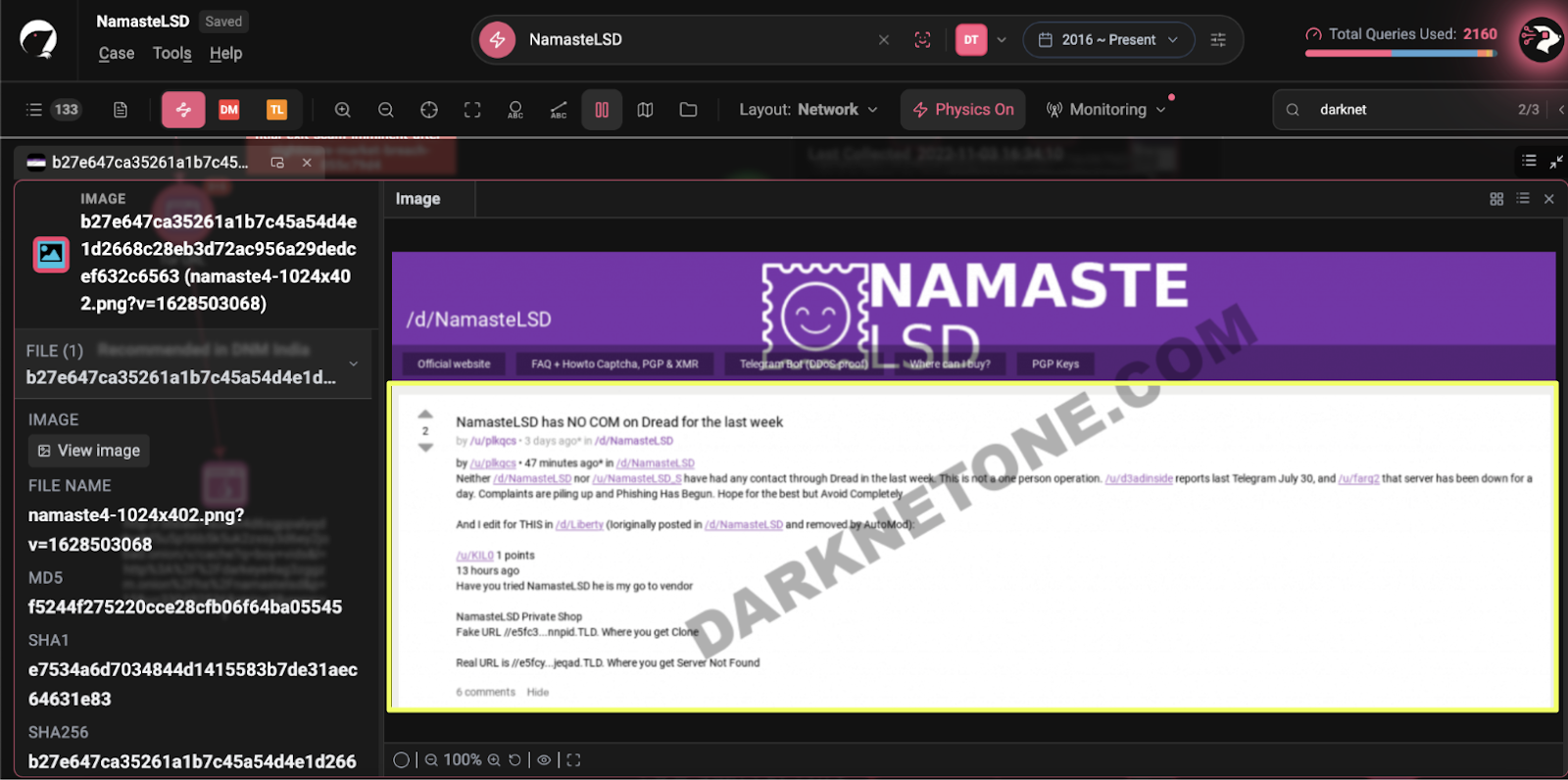
A post preserved in a DarknetOne screenshot was titled "NamasteLSD has NO COM on Dread for the last week". It specifically noted that neither of the two accounts had been in contact.
The relevant accounts were:
- /u/NamasteLSD
- /u/NamasteLSD_S
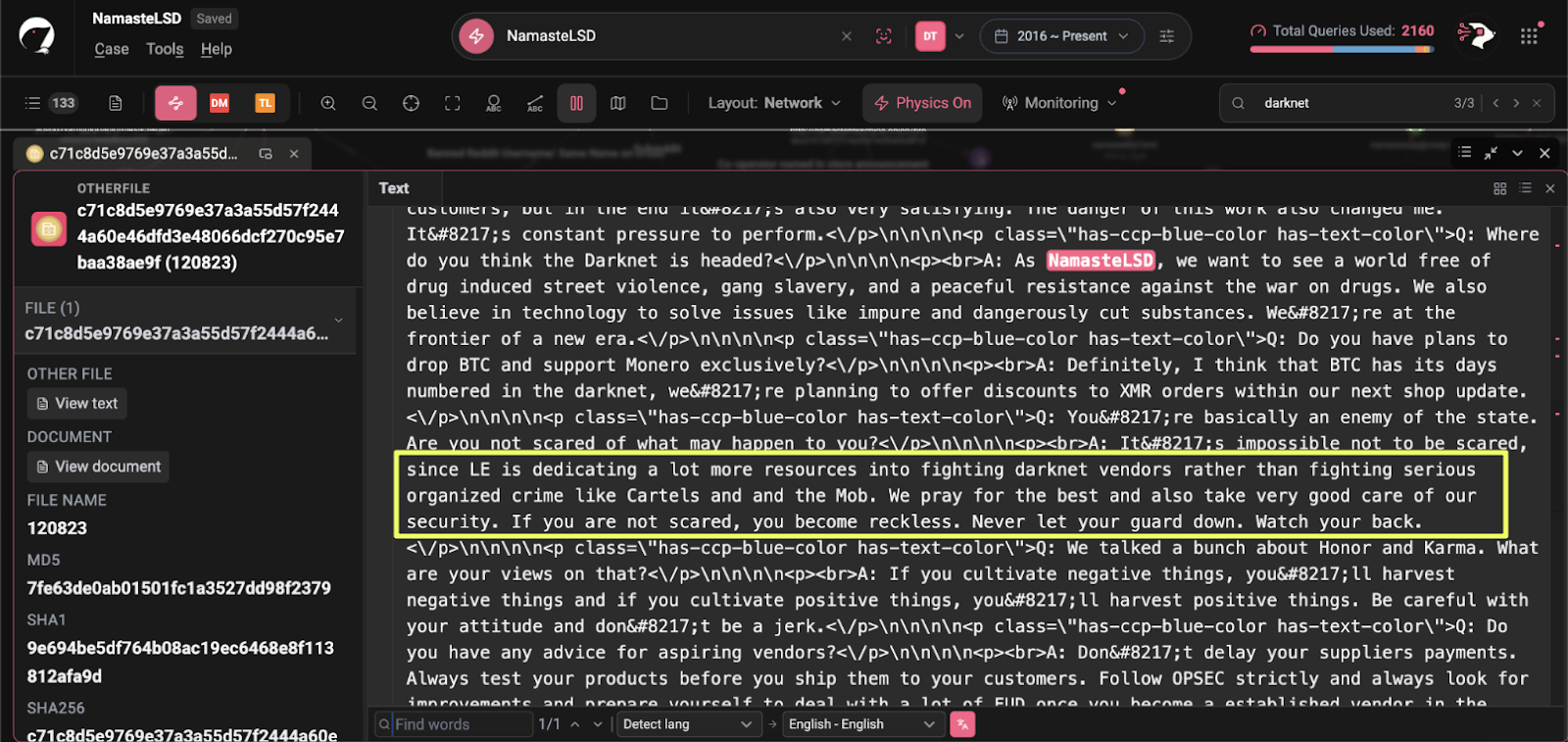
On 21 July 2021, Darknet Inside published an interview with a NamasteLSD representative. Asked about law enforcement, the interviewee said the operation took security seriously and that vendors should never let their guard down. Less than three weeks later, the store's new address was replaced by a seizure notice.
The seizure
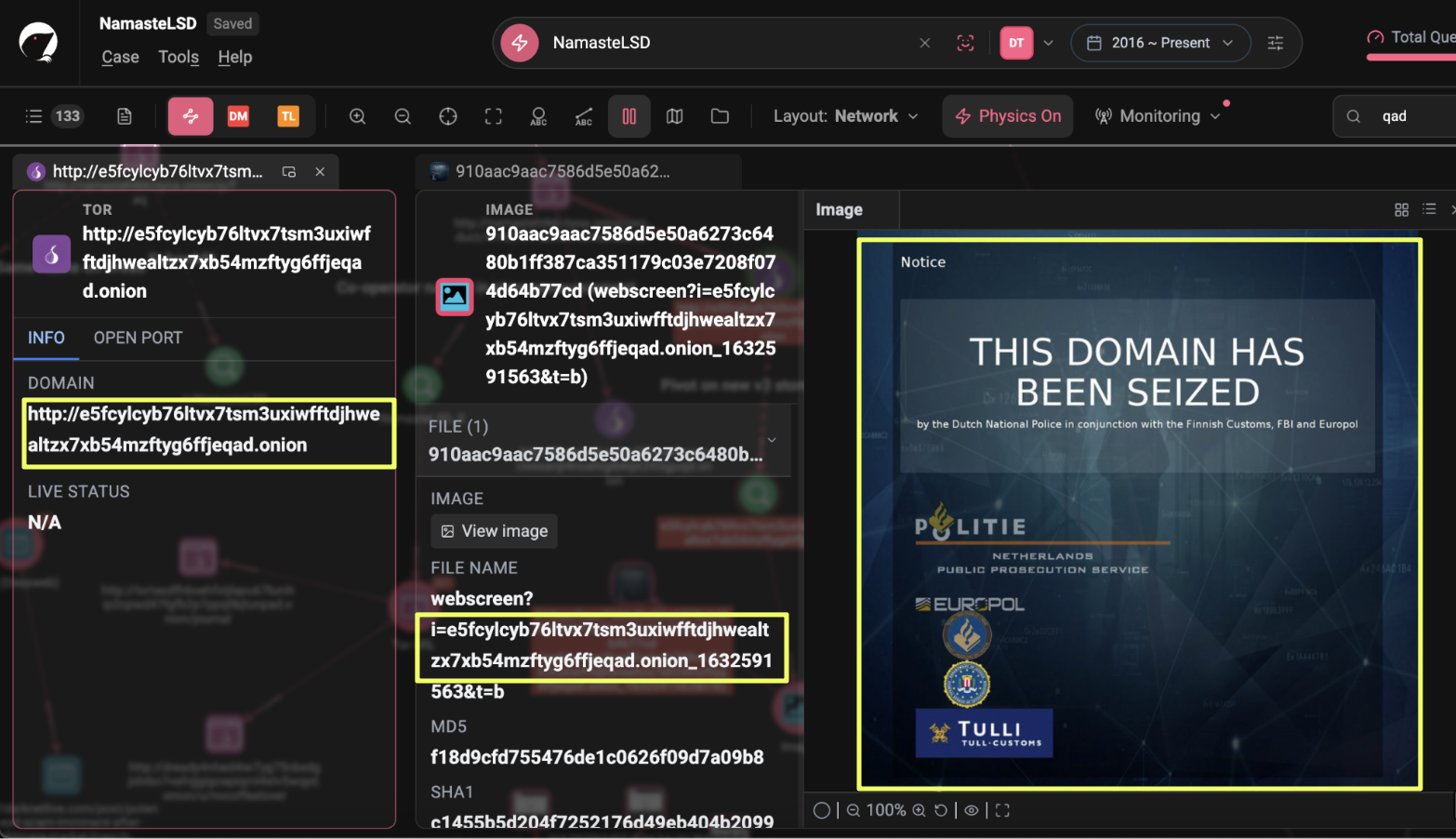
A screenshot of the new store from September 2021 showed a law enforcement notice replacing the storefront. The notice stated that the domain had been seized by the Dutch National Police in conjunction with Finnish Customs, the FBI and Europol. It also displayed the logo of the Netherlands Public Prosecution Service.
The key details were:
- Seized domain: e5fcylcyb76ltvx7tsm3uxiwfftdjhwealtzx7xb54mzftyg6ffjeqad.onion
- Date of seizure: 9 August 2021
- Authority named on the notice: Dutch National Police
- Other agencies named: Finnish Customs, FBI and Europol
A tor journal page also dates the seizure to 9 August 2021 under the title "NamasteLSD's Private Shop Has Been Seized". Darkipedia gives the same date but attributes the operation to Finnish law enforcement and states that the team had been arrested.
The vendor's subsequent disappearance is consistent with the earlier reports of inactivity. The main Dread account was later marked as banned, and a mid-2026 post asked administrators to delete subdreads created by /u/namastelsd_s, describing them as inactive with no moderators available. The records examined here contain no confirmed activity from either account after August 2021.
The Name Outlives the Vendor
The seizure provides a clear endpoint for the original store, but not for the NamasteLSD name. StealthMole's historical records contain multiple onion domains using the same branding in the years that followed. Some reproduced the original storefront, while others altered payment information or presented login pages without evidence of an operating shop.
The central question is whether these domains represent a return by the original vendor or an attempt by others to exploit its established reputation. The available records point towards the latter.
Imitation started before the seizure
A Darkweb Tracker search for DSLetsaman, the Reddit account associated with NamasteLSD, returned a Tor domain first collected by StealthMole in October 2020. Its pages closely reproduced the original store's news and FAQ content, but changes to the payment information exposed a critical difference.
- Lookalike domain: namawnpdio6gltks.onion
- Associated email: nam*************s@ema********r.com
- Bitcoin address: 1KRk*************************VKE
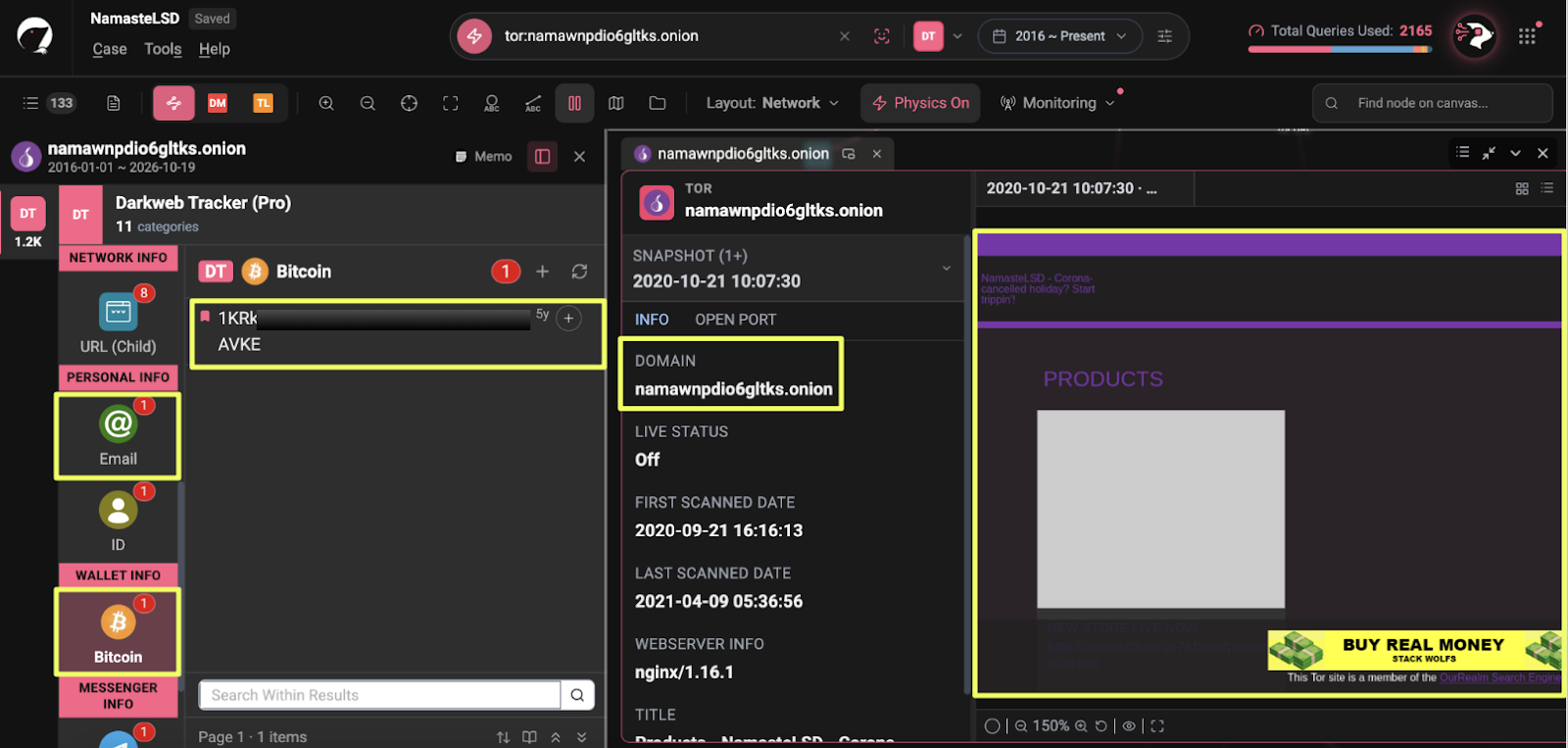
A comparison of the two stores showed that the lookalike had replaced the original Monero payment information with a string containing the Bitcoin address twice. The address had also been inserted into the PGP signature block, breaking it. The Dread link on the copied site pointed to a different domain from the one used by the original store.
These changes are consistent with a phishing proxy designed to reproduce the legitimate storefront while redirecting payments. The Bitcoin address and email should therefore be treated as indicators associated with the lookalike, not as evidence of NamasteLSD's own infrastructure. The domain's nama prefix also resembles the original brand, reinforcing the appearance of a connection.
Riding the vendor's own address
Another clone appeared around the time of the seizure. A Dread warning, preserved in a DarknetOne screenshot told buyers that a site using the address prefix e5fc3 was a clone and distinguished it from the legitimate store beginning e5fcy.
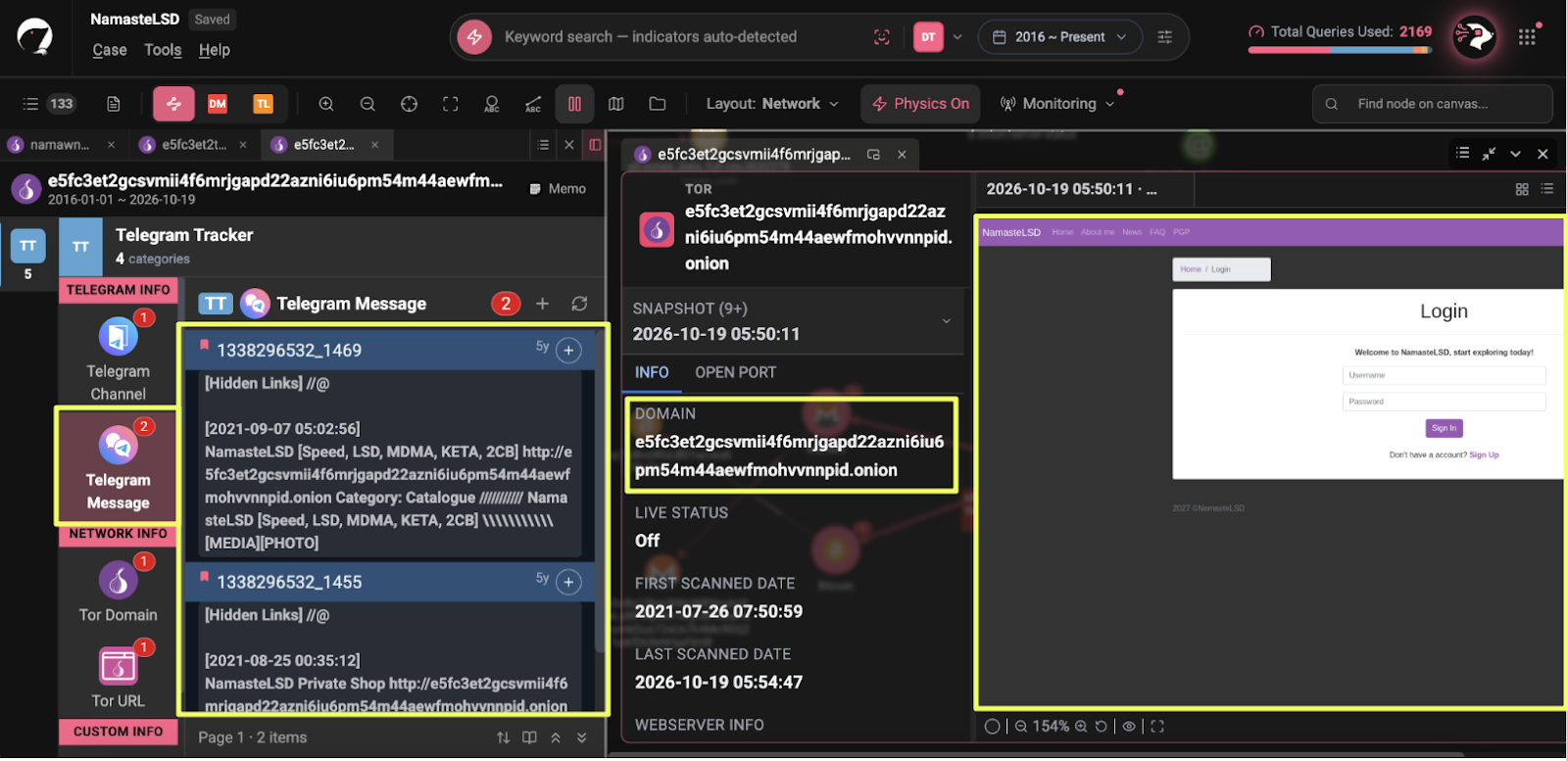
StealthMole's Telegram Tracker recorded the clone being advertised in the Hidden Links channel on 25 August 2021 and again on 7 September 2021, after the original store had been seized.
- Clone: e5fc3et2gcsvmii4f6mrjgapd22azni6iu6pm54m44aewfmohvvnnpid.onion
- Original store: e5fcylcyb76ltvx7tsm3uxiwfftdjhwealtzx7xb54mzftyg6ffjeqad.onion
- First recorded Telegram advertisement: 25 August 2021
- Telegram message ID: 1338296532_1455
The clone's address began with e5fc3et2, closely resembling the original store's e5fcy prefix. Its advertising also reused the NamasteLSD name and product descriptions. The same promotional wording, "NamasteLSD [Speed, LSD, MDMA, KETA, 2CB]", appeared on an Extreme Forum Marketplace profile in October 2021 and in a paste preserved in a leaked paste-site database.
StealthMole's captures from November 2021 to September 2022 showed the clone displaying a purple login page with the message "Welcome to NamasteLSD, don't let Covid limit your exploring!". The available evidence establishes that the site reproduced the vendor's branding, but does not identify who operated it.
The lookalikes that kept coming
StealthMole's records contain three further NamasteLSD-branded domains appearing after the original store's seizure.
- i6t3ocxt4lkwzi7aezlu4yf6ixkbbi6hbu4g73kxtmo3pqv4feuok2ad.onion
- lsd222xovelyemsqaa77w4cx4aqbjbr4rw5uazzfhlflxkjdvwutjnad.onion
- e5fc3et2tfadyw7zo4auu5qyjziob4qcmfwf6743eryaqpw4xvvcy5id.onion
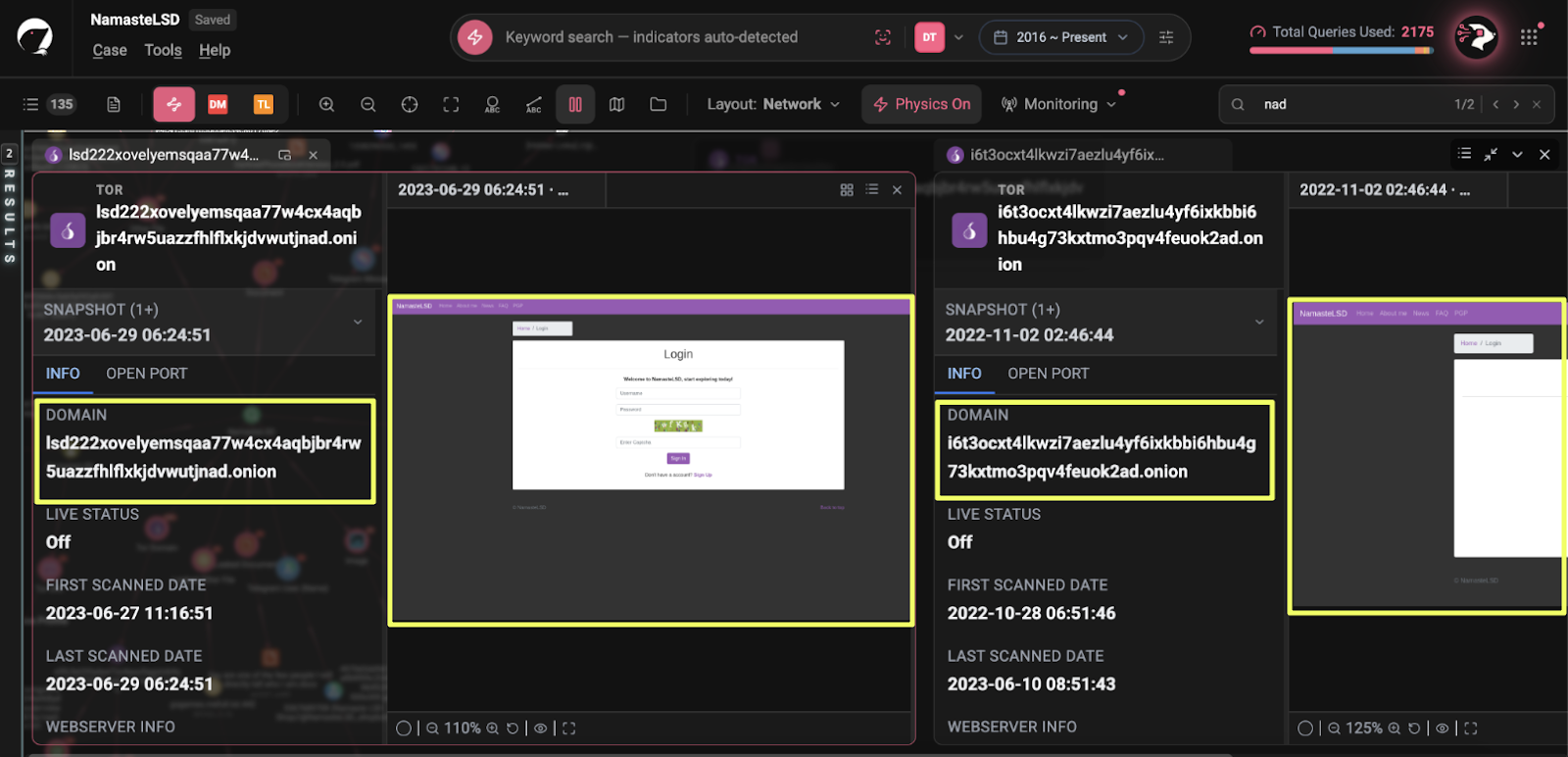
The first domain was captured in April 2023 displaying the same purple login template as the earlier clone, including an identical captcha image. An onion-site list shared on Telegram in September 2023 labelled both as NamasteLSD.
The second domain continued to appear in link directories under the same name. MegaLinks still listed it as NamasteLSD.
- Domain: lsd222xovelyemsqaa77w4cx4aqbjbr4rw5uazzfhlflxkjdvwutjnad.onion
- Latest recorded directory capture: 15 October 2026
- Directory: MegaLinks
The third domain provides the most recent evidence of continued use of the brand.
- Domain: e5fc3et2tfadyw7zo4auu5qyjziob4qcmfwf6743eryaqpw4xvvcy5id.onion
- First recorded scan: 27 July 2026
- Latest recorded scan: 15 October 2026
- Page title: NamasteLSD
- Server banner: Apache/2.4.58 on Ubuntu
- Footer: ©NamasteLSD 2027
- Status at the last scan: Offline
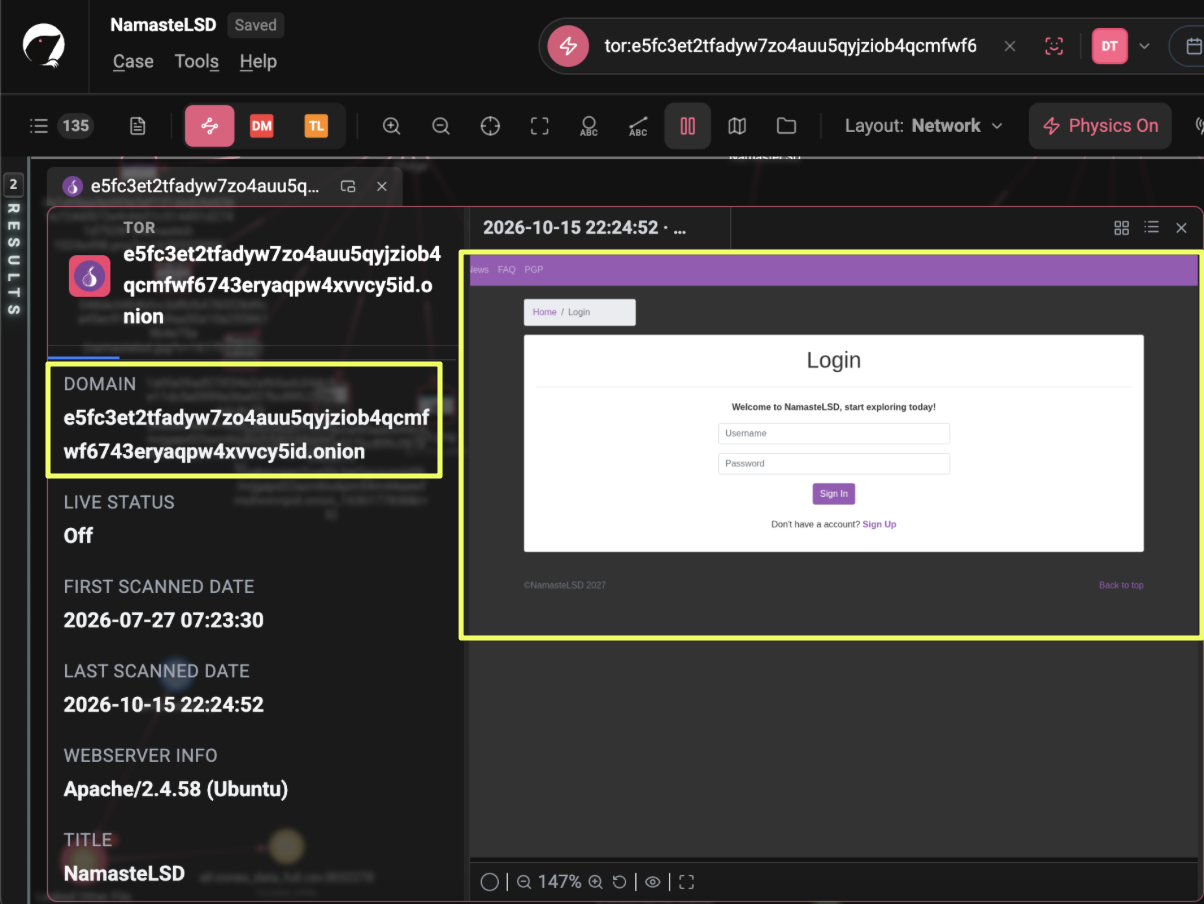
The site displayed the same purple login form found on earlier clones. Its address also shared the exact eight-character prefix e5fc3et2 with the 2021 clone. The repeated prefix and shared template suggest a connection between the two sites, although the evidence cannot establish whether they were operated by the same person or whether a later operator deliberately copied the earlier clone.
The pattern is more consistent with the continued reuse of NamasteLSD's branding than with a verified return by the original vendor. None of the captured sites provides evidence of a functioning storefront beyond the login pages, and the available records contain no content signed with the original vendor's known PGP key.
Conclusion
The seizure of NamasteLSD's private store on 9 August 2021 marks the clearest dividing point in the investigation. Before the takedown, the store, PGP signatures, forum accounts and customer discussions documented a European operation that had expanded across darknet markets, a private onion store and Telegram. The records also showed that several people appeared to be involved in customer support and shipping.
After the seizure, the evidence changes. NamasteLSD-branded sites continued to appear, but the investigation found no verified sign that the original operator had returned. Instead, the later domains reproduced the store's branding and, in some cases, its address structure, while one earlier copy altered payment details in a way consistent with phishing.
The distinction is important when assessing whether NamasteLSD is still active. The original operation cannot be confirmed as active, even though the name continued to circulate in October 2026. The strongest way to verify a claimed connection to the original vendor would be to check it against the established PGP identity. None of the post-seizure material examined in this investigation provided that confirmation.
Editorial Note
Dark web investigations rarely provide a complete picture. Stores disappear, accounts are banned and familiar names can continue circulating long after the people behind them have stopped operating. In this case, archived store pages, forum discussions and indexed files helped establish the original vendor's activity and distinguish it from later copies.
The operators behind those copies remain unidentified, and the available evidence does not resolve every connection. StealthMole's historical records made it possible to trace how the NamasteLSD name persisted, while keeping the original operation separate from activity that could not be reliably attributed to it.
To access the unmasked report or full details, please reach out to us separately.
Contact us: support@stealthmole.com
Labels: Darkweb Marketplace, Featured



.svg)
.svg)
.svg)